How to resolve AdBlock issue?
News
- Details
- Written by: Elizabeth Larson
The council will meet at 6 p.m. Tuesday, April 6.
The meeting will be by teleconference only. The city council chambers will not be open to the public.
The agenda can be found here.
To speak on an agenda item, access the meeting remotely here or join by phone by calling toll-free 669-900-9128 or 346-248-7799. The webinar ID is 973 6820 1787, access code is 477973; the audio pin will be shown after joining the webinar. Those phoning in without using the web link will be in “listen mode” only and will not be able to participate or comment.
Comments can be submitted by email to
Indicate in the email subject line "for public comment" and list the item number of the agenda item that is the topic of the comment. Comments that read to the council will be subject to the three-minute time limitation (approximately 350 words). Written comments that are only to be provided to the council and not read at the meeting will be distributed to the council prior to the meeting.
On Tuesday, the council will present proclamations designating April as Sexual Assault Awareness Month, Child Abuse Prevention Month and Fair Housing Month in the city of
Lakeport.
In council business, Utilities Superintendent Paul Harris will present an overview of the utilities operations.
Finance Director Nick Walker also will present amendments to the fiscal year 2020-21 city budget as recommended by staff for the council’s approval.
On the consent agenda – items considered noncontroversial and usually accepted as a slate on one vote – are ordinances, minutes of the regular council meeting on March 16 and a proposed resolution adopting a records retention schedule, and authorizing destruction of certain City records and rescinding Resolution No. 2746 (2020).
Email Elizabeth Larson at
- Details
- Written by: Lake County News reports
The National Highway Traffic Safety Administration reports 3,142 people were killed in motor vehicle crashes involving distracted drivers in 2019 nationwide.
That same year in California, there were at least 18,698 crashes from distracted driving that resulted in 108 deaths and more than 13,500 injuries.
“Driving safely requires your full attention,” CHP Commissioner Amanda Ray said. “Distractions put you and others on the road at risk. Together, with our traffic safety partners, enforcement, and the cooperation of the motoring public, we can save lives and eliminate this dangerous behavior on California’s roadways.”
Distractions are not limited to cellular phones. Other electronics, children, pets, and eating or drinking while driving can also divert attention and result in a crash.
Breaking distracted driving laws becomes more serious this year. Beginning July 1, a violation for using a handheld cellular phone or texting while driving will result in a fine and also add a point to the driver’s record for each violation occurring within 36 months of a prior conviction for the same offense.
“Distracted driving is a serious issue that is 100 percent preventable,” California Office of Traffic Safety Director Barbara Rooney said. “That text, phone call, or social post is never more important than the task of driving.”
As part of Distracted Driving Awareness Month, the first week of April is California Teen Safe Driving Week.
Throughout the week, CHP and Impact Teen Drivers will place an increased emphasis on informing California’s newest drivers about the dangers and consequences of reckless and distracted driving.
“Parents, your kids have been watching you drive since they were in a forward-facing car seat,” Kelly Browning, Ph.D., executive director of ITD, said. “Your driving habits will become their driving habits – be the driver you want your kids to be.”
- Details
- Written by: ESTHER OERTEL
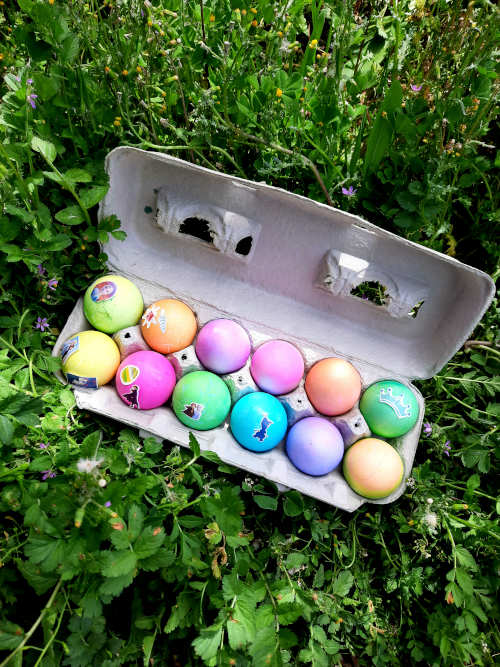
MIDDLETOWN, Calif. – I was born into a family of very creative souls, and at no time during the year was this on more collective display than when we colored eggs for Easter.
We didn’t have much – there were no extravagant Easter presents and no Easter Sunday ham – but we went all out when it came to decorating eggs.
Old newspapers were spread to protect our rustic kitchen table and supplies were laid out - dozens of cups of dye, wax crayons, egg dippers, colored tissue paper and the like – and then we got to work. It was an hours-long process, and the joy derived from that endeavor was epic.
My mother, my four siblings and I developed all kinds of techniques that were honed and perfected through the years, and we were always very proud of the result. At least six dozen artistically dyed eggs were ready for hiding on Easter morning by the time we were done.
This year I was able to decorate eggs with my granddaughter, a happy process. She’s 4 and a half and not quite ready for the complex egg-dying techniques of my childhood, but much joy was borne out of our experience. She was proud to take home a dozen brightly colored eggs to show her mother after our session.
The tradition of decorating eggs is an ancient one, going back at least 60,000 years, as evidenced by engraved ostrich eggs found in Africa.
Decorated eggs, as well as representations of eggs in gold and silver, were placed in the graves of the ancient Sumerians and Egyptians some 5,000 years ago.
In some early cultures, such as pre-dynastic Egypt, Mesopotamia and Crete, eggs symbolized death and rebirth, as well as kingship. It was a common symbol of fertility in others.
For early Christians, eggs represented the empty tomb of Jesus, from which they believed he was resurrected.
As Anne Jordan writes in her textbook, Christianity, “Easter eggs are used as a Christian symbol to represent the empty tomb. The outside of the egg looks dead but inside there is new life, which is going to break out. The Easter egg is a reminder that Jesus will rise from His tomb and bring new life.”
Some sources believe that the custom of the Easter, or Paschal, egg can be traced to the early Christians of Mesopotamia, eventually spreading from there to Eastern Europe and Siberia through the Orthodox Church and later into Europe through Catholic and Protestant churches.
Other scholars maintain that the tradition arose in Western Europe during the Middle Ages, when eggs were forbidden during Lent. They speculate that eggs became part of the Easter celebration when the Lenten fast was broken.
The tradition of dying eggs no doubt stems from ancient Christians who stained eggs red to symbolize the blood of Christ shed on the cross. This tradition of dying eggs red continues today in the Orthodox and Eastern Catholic churches.
A legend exists in Eastern Christianity about Mary Magdalene, a disciple of Christ, who is said to have brought cooked eggs to share with the other women at the tomb of Jesus. They are purported to have miraculously turned bright red when she saw the risen Christ.
In Judaism, a hard-boiled egg representing festival sacrifice is part of the Passover Seder plate, and there is speculation that early Christians may have added to that tradition with the use of red dye to represent the blood of Christ.
Interestingly, Sephardic Jews of Spain prepare a braised egg dish called huevos haminados, in which patterns are created on the eggs by dying them with onion skins, tea leaves or coffee.
Some say that the Passover custom of hunting for the afikomen (a half piece of matzo) may be the precursor to the tradition of an Easter egg hunt.
Whenever and wherever the custom of the Easter egg originated and however it evolved, eggs have been part of Easter celebrations since the earliest times.
Just in case you’ve got a lot of hard-boiled eggs on hand this Easter, today’s recipe, curried egg salad stuffed into pasta shells, will help you use them up. These are meant to be eaten out of hand and are quite portable, so will do well on a picnic or as a passed hors d’oeuvre. Walnuts and parsley add texture and freshness to the mixture. Enjoy!
Pasta shells with curried egg salad
16 or 20 large pasta shells
6 hard-cooked eggs, peeled and chopped
1/3 cup mayonnaise
2 – 3 teaspoons curry powder
1 tablespoon Dijon mustard
¼ cup finely chopped walnuts
¼ cup finely chopped parsley
Salt and pepper to taste, if desired
1 large bowl filled with cold water and 2 tablespoons salad oil
Cook pasta in boiling, salted water until just tender, about 10 minutes. When cooked, remove with a slotted spoon to drain in a colander. Immerse pasta in cold water until completely cooled. Drain well and pat dry with paper towels if necessary.
Combine mayonnaise, curry powder and mustard. Taste and adjust seasonings, if needed. Mix eggs, nuts and parsley with dressing. Stuff egg mixture into shells. Garnish with additional parsley, if desired.
Recipe by Esther Oertel.
Esther Oertel is a writer and passionate home cook from a family of chefs. She grew up in a restaurant, where she began creating recipes from a young age. She’s taught culinary classes in a variety of venues in Lake County and previously wrote “The Veggie Girl” column for Lake County News. Most recently she’s taught culinary classes at Sur La Table in Santa Rosa. She lives in Middletown.
- Details
- Written by: Karen Sullivan, Kim Riley, and Terre Logsdon
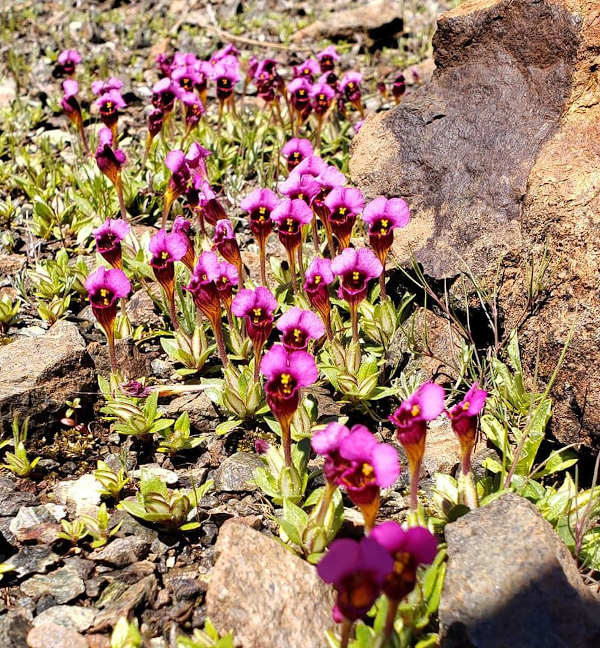
Name: Mimulus douglasii
Family: Mimulus (Monkeyflower)
Common Names: Purple mouse-ears
Colors: Pale pink to deep fuschia and purple
LAKE COUNTY, Calif. – The diminutive flower that packs a colorful punch and is often found on serpentine soils, mimulus douglasii (purple mouse-ears) is a species of monkeyflower known by the common names brownies and purple mouse-ears and is native to Lake County and the mountains and foothills of California and Oregon.
Purple mouse-ears attracts native bees, butterflies, and hummingbirds, and is a lovely addition to border areas of your garden or farm if you have heavy clay soils; it can survive in dry (serpentine) soils as well as near wetlands or irrigation as long as the soils are nutrient-deficient.
While the flower itself has five petals, it is called purple mouse-ears for the 2 prominent upper lobes, much like a field mouse.
It’s preferred habitat is in soils composed primarily of serpentine, the slick-green rock found in many areas of Lake County. Although not as well known as the state flower California poppy (Eschscholzia californica), serpentine is actually the official California state rock.
In next week’s column, we’ll discuss serpentine-laden soils and the unique plant species found on them, but for this week, if you have the chance to explore right now and find small 1- to 2-inch plants with stunning colors and ears, chances are you’re looking at purple mouse-ears! They will typically be in bloom for a few more weeks.
Nurseries where you can purchase seeds: Unknown at this time.
Terre Logsdon is an environmentalist, composter, and advocate for agroecology solutions to farming. An avid fan and protector of California wildflowers, plants, natural resources, and the environment, she seeks collaborative solutions to mitigate the effects of climate change. Kim Riley is retired, an avid hiker at Highland Springs, and has lived in Lake County since 1985. After 15 years of trail recovery and maintenance on the Highland Springs trails, she is now focused on native plants, including a native plant and pollinator garden on her property as well as promoting and preserving the beauty of the Highland Springs Recreation Area. Karen Sullivan has operated two nurseries to propagate and cultivate native plants and wildflowers, has lived in Kelseyville for the past 30 years, rides horses far and wide to see as many flowers as possible, and offers native plants and wildflowers for sale to the public. They are collaborating on a book, Highland Springs Recreation Area: A Field Guide, which will be published in the future. In the meanwhile, please visit https://www.facebook.com/HighlandSpringsNaturalists and https://www.facebook.com/HighlandSpringsRecreationArea.