 How to resolve AdBlock issue?
News
- Details
- Written by: Lake County News reports
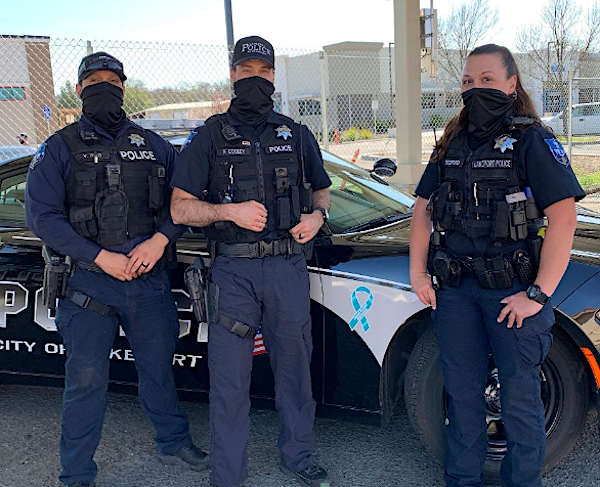
The Lakeport City Council will present a proclamation to Lake Family Resource Center designating April as Sexual Assault Awareness Month.
The Lakeport Public Works Department will light the downtown street lights in teal beginning April 1.
All Lakeport Police cars and officer uniforms will have a teal ribbon displayed throughout the month.
Susie Q’s Donuts, 414 S. Main St., will make donuts with teal-colored frosting, with 100-percent of the sale proceeds donated to the Lake Family Resource Center Sexual Assault Awareness Fund.
The public is encouraged to participate in Denim Day on Wednesday, April 28, and wear jeans to protest against sexual violence.
In support of Denim Day, Lakeport Police officers are authorized to wear jeans for their uniform pants from Friday, April 23, through Friday, April 30.
“We encourage the public to join us in raising awareness and supporting sexual assault survivors throughout the month of April: buy teal-colored donuts, wear an article of teal-colored clothing or wear jeans on April 28,” said Lakeport Police Chief Brad Rasmussen.
- Details
- Written by: ANDREW W. HAIT
Women-owned firms made up only 19.9% of all firms that employed people in the United States in 2018 but their numbers are growing.
There were 6,861 more women-owned firms in 2018 than in 2017, up 0.6% to 1.1 million, according to the Census Bureau’s Annual Business Survey, or ABS.
Women-owned employer firms reported nearly $1.8 trillion in sales, shipments, receipts or revenue and employed over 10.1 million workers with an annual payroll of $388.1 billion in 2018.
The ABS provides data on race, ethnicity, sex and veteran status of owners of businesses with one or more paid employees. This information can be invaluable in helping economic development organizations promote growth of minority and women business ownership in their areas.
As the nation recognizes Women’s History Month, this data highlights some of women’s contributions to our economy.
Women business growth by sector
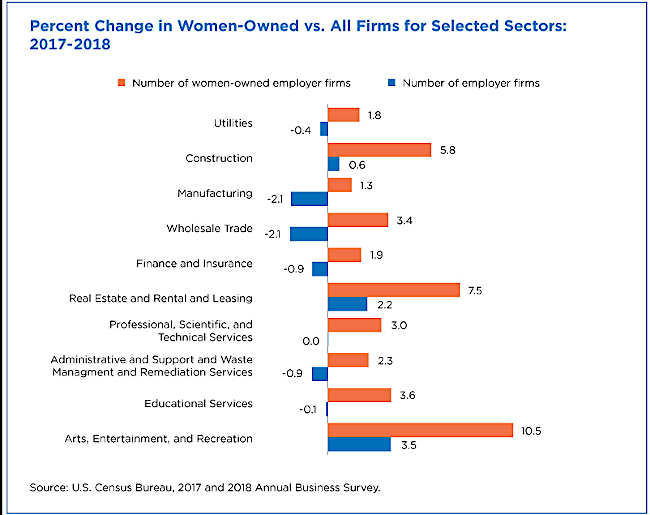
Women-owned firms in the Arts, Entertainment, and Recreation sector rose 10.5%, from 22,219 in 2017 to 24,542 in 2018. The 10 sectors shown in the chart below also saw growth in women-owned businesses.
Characteristics of women business owners
Demographic characteristics of the nation’s women-owned firms are similar to their male-owned firm counterparts.
Most women-owned businesses are run by White women (82.8% of all women-owned firms), non-minority (74.6%), non-Hispanic (92.4%), and non-veteran (98.9%).
Are there more women-owned businesses in some sectors?
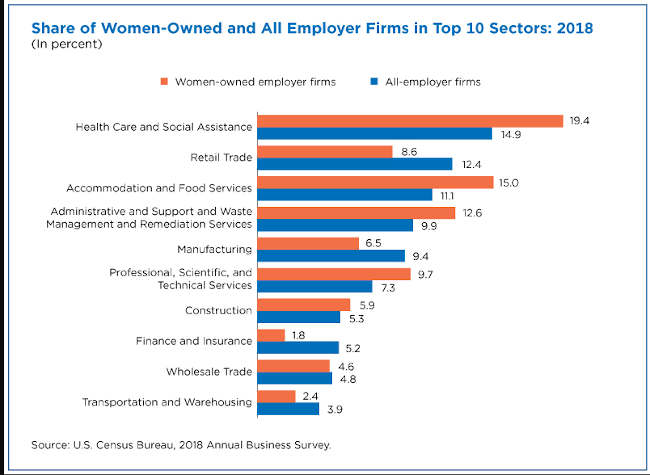
Women-owned firms tend to be more concentrated in certain sectors than all firms overall. According to the ABS, 191,230 or approximately 16.8% of the nation’s total 1.1 million women-owned firms in 2018, were classified in the Professional, Scientific, and Technical Services sector, compared to 14.3% for all firms in the sector.
Employees of women-owned firms were also concentrated in certain sectors. Nearly 2.0 million or approximately 19.4% of the 10.1 million employees of women-owned firms worked in the Health Care and Social Assistance sector in 2018, compared to 14.9% of all firm employees.
Sex parity
Average annual earnings of employees of women-owned firms lag behind the national earnings average of the workers of all firms: $38,238 in average annual payroll per employee compared with $54,114.
Women-owned firms in nine of the 20 sectors the ABS covered had average annual payroll per employee statistically lower than the total for all firms in those sectors.
The lack of sex parity was also visible in average annual sales, shipments or revenue.
In 2018, women-owned firms earned an average of $1.6 million in sales, shipments or revenue; male-owned firms earnings were double that at $3.2 million.
What states have the most women-owned businesses?
With more firms than any other state (742,139), it’s not surprising that the nation’s most populous state, California, also had the most women-owned firms in 2018.
California’s 149,927 women-owned firms employed over 1.3 million workers with $57.4 billion in annual payroll in 2018.
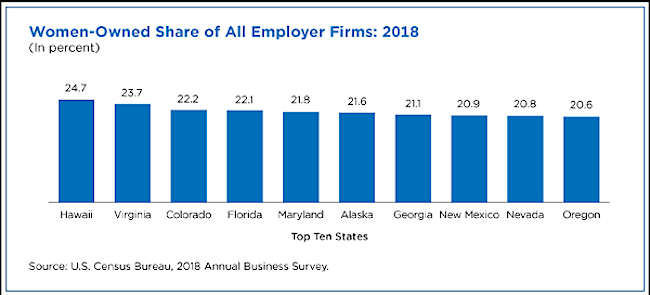
In Hawaii, women-owned firms made up 24.7% of all firms in the state. In Virginia, women-owned firms made up 23.7% of all firms, and in Colorado women-owned firms made up 22.2% of all firms in the state.
In terms of employment, women-owned firms in Montana made up 11.0% of all employees in the state.
Women-owned firms in the District of Columbia reported average annual payroll per employee of $57,031, higher than the national average of $38,238 for all women-owned firms in the United States.
What about the self-employed?
In addition to ABS data on women-owned employer businesses, the new Nonemployer Statistics – Demographics (NES-D) program publishes data on women-owned nonemployer firms, typically referred to as self-employed. The 10.6 million self-employed women-owned firms in 2017 reported sales, shipments, or revenue of $286.1 billion.
The NES-D program supplements ABS data and includes similar breakouts by the race, ethnicity and veteran status of the business owner. It also includes data the business itself, including the industry classification, and breakouts by receipts size and legal form of organization. Combining the ABS and NES-D data gives us the total number of women-owned firms in the United States.
Some key statistics from the 2017 NES-D:
– The nearly 1.6 million Hispanic women-owned firms reported sales of $34.7 billion in 2017.
– The nearly 3.7 million minority women-owned firms reported sales of $83.8 billion in 2017.
– The 142,000 veteran women-owned firms reported sales of $3.1 billion in 2017.
Where do we go from here?
As governments and communities strive to encourage business ownership by people who mirror the race and ethnicity of their residents, there is also a push to have business ownership reflect the sex of the workforce.
The Census Bureau’s ABS and NES-D provide key data that federal agencies, for example, can use to promote business ownership by women.
The Small Business Administration, the Department of Commerce’s Minority Business Development Agency, and the National Women’s Business Council also provide key resources to encourage women-owned businesses, along with dozens of federal, state, local and private sector organizations.
ABS data are only possible thanks to the millions of businesses who respond to Census Bureau surveys and programs.
Note: All comparative statements made in the text of this story have undergone statistical testing and are significant at the 90% confidence level. Comparisons shown in the tables and graphics have not been tested for statistical significance and, therefore, should be interpreted with caution. Differences between estimates may be attributed to sampling or nonsampling error rather than to differences in underlying economic conditions. Use caution drawing conclusions from the estimates and comparisons shown. For more information on the survey methodology, including sampling error and nonsampling error, check out the ABS website. All dollar values are expressed in current dollars, i.e., they are not adjusted for price changes.
Andrew W. Hait is a survey statistician/economist at the Census Bureau.
- Details
- Written by: Elizabeth Larson

The National Oceanic and Atmospheric Administration, or NOAA, is upgrading its Global Forecast System weather model to boost weather forecasting capabilities across the U.S.
The agency said these advancements will improve hurricane genesis forecasting, modeling for snowfall location, heavy rainfall forecasts, and overall model performance.
For the first time, the Global Forecast System, or GFS, will be coupled with a global wave model called WaveWatchIII which will extend current wave forecasts from 10 days out to 16 days and improve the prediction of ocean waves forced by the atmosphere.
Coupling the GFS and wave models will streamline the National Centers for Environmental Prediction production suite by consolidating atmospheric and wave forecast data and distributing them together.
The GFS resolution will increase by doubling the number of vertical levels, from 64 to 127. Improvements to atmospheric physics will enhance snow and precipitation forecasting capabilities in this latest upgrade as well.
“This substantial upgrade to the GFS, along with ongoing upgrades to our supercomputing capacity, demonstrates our commitment to advancing weather forecasting to fulfill our mission of protecting life and property,” said Louis W. Uccellini, Ph.D., director, NOAA’s National Weather Service. “Today’s upgrade also establishes a strong foundation for further planned enhancements that will allow for the assimilation of even more data into the model.”
In addition to GFS upgrades, NOAA is concurrently modernizing the Global Data Assimilation System. This effort will allow the model to ingest more data from geostationary and polar-orbiting satellites, as well as flight-level wind, temperature and moisture observations from aircraft.
“These upgrades are part of the Next Generation Global Prediction System within the Unified Forecast System framework, which is an ongoing effort to leverage the expertise of the broader weather community and expedite the research to operations pathway,” said Vijay Tallapragada, Ph.D., chief of the Modeling and Data Assimilation Branch at NOAA’s Environmental Modeling Center, or EMC. “By coupling the WaveWatchIII and GFS models, we will extend current wave forecasts and integrate wave forecasting into the global model to streamline model products.”
EMC conducted retrospective and real-time testing, covering part of the 2018 hurricane season and the entire period from May 10, 2019 to the present, for a comprehensive evaluation of the model upgrades. This latest version of the model, called GFSv16, showed improved forecast skills in many areas, including hurricane genesis lead times, snowfall forecasting, and the prediction of extreme rainfall events.
The announcement marks the first major upgrade to the Finite-Volume Cubed-Sphere, or FV3, dynamical core-based GFS, which replaced the spectral dynamical core-based GFS in June 2019. The GFS with the FV3 dynamical core brings together the superior physics of the global atmosphere with day-to-day reliability and speed of operational numerical weather prediction.
Learn more about previous GFS upgrades and the history of the FV3 dynamical core at NOAA.
- Details
- Written by: Elizabeth Larson
The council will meet at 6 p.m. Thursday, April 1.
Beginning with Thursday’s meeting, the public may attend city council meetings again in person. However, the council chambers will have limited capacity and attendees must adhere to masking and social distancing mandates.
The meeting will be broadcast live on the city's YouTube channel or the Lake County PEGTV YouTube Channel. Community members also can participate via Zoom.
The agenda can be found here.
Comments and questions can be submitted in writing for City Council consideration by sending them to Administrative Services Director/City Clerk Melissa Swanson at
To give the council adequate time to review your questions and comments, please submit your written comments prior to 4 p.m. on Thursday, April 1.
Each public comment emailed to the city clerk will be read aloud by the mayor or a member of
staff for up to three minutes or will be displayed on a screen. public comment emails and town hall public comment submissions that are received after the beginning of the meeting will not be included in the record.
On Thursday night, the council will present proclamations declaring Public Safety Telecommunicators Week, and declaring April 2021 as Sexual Assault Awareness Month and Child Abuse Prevention Month.
The Hope Center also will present the council with an update.
Under business, councilmembers will consider awarding a $552,662 bid for the Austin Park Bus Stop Renovation & Promenade Improvement Project to Granite Construction, and authorize the city manager to approve up to the budgeted amount for additional unforeseen contract amendments.
The council also will consider a resolution approving responsibilities and guidelines for members of the Measure V Citizen Oversight Committee.
On the meeting's consent agenda – items that are not considered controversial and are usually adopted on a single vote – are warrants; adoption of the 12th Amendment to the FY 2020-21 Budget (Resolution 2020-27) appropriating funding for design services for 2021 Measure V Projects and the Austin Park Bus Stop Renovation & Promenade Improvement Project, Resolution No. 2021-19; authorize city manager to enter into a contract with California Engineering Co. for engineering consultant services; accept the property located at 16332 27th Ave. and authorize the city manager to sign the certificate of acceptance; consideration of adoption of resolution reducing the fee for property owner requested vehicle abatement, Resolution No. 2021-20; continuation of declaration of local emergency Issued on Oct. 9, 2017, and ratified by council action Oct. 12, 2017; continuation of declaration of local emergency issued on March 14, 2020, and ratified by council action on March 19, 2020; Adopt Resolution 2021-21 authorizing the city of Clearlake's annual progress report submittal to Department of Housing and Community Development and the Governor's Office of Planning and Research Application.
After the public portion of the meeting, the council will meet in closed session to discuss labor negotiations and negotiate the sales price and terms for a city-owned apartment building at 14141 Lakeshore Drive.
Email Elizabeth Larson at