 How to resolve AdBlock issue?
News
- Details
- Written by: Elizabeth Larson
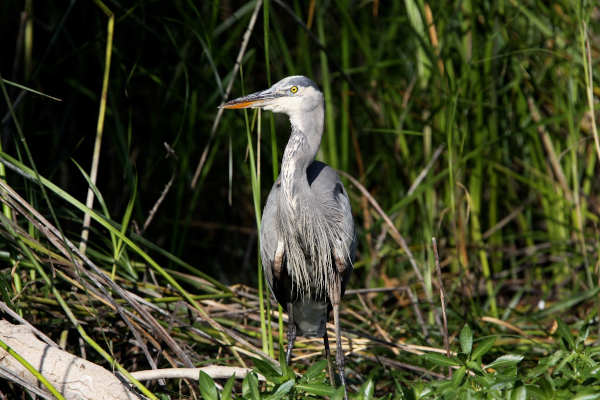
LAKE COUNTY, Calif. – Lake County’s amazing bird life is the inspiration for a proclamation offered by the Board of Supervisors on Tuesday morning.
The supervisors have declared April as “Bird Appreciation Month” in Lake County.
District 5 Supervisor Jessica Pyska brought the request for the proclamation to the board on behalf of the Redbud Audubon Society in order to honor the importance of the bird life in Lake County and on Clear Lake and to focus on efforts that every person in the county can do to make life better for birds.
“April 22, 2021, is Earth Day and a bird appreciation proclamation seemed like a fitting way to honor this event as well,” said Redbud Audubon President Roberta Lyons, who wrote the proclamation.
Pyska read the proclamation, which highlights the more than 300 species of birds that make their home in Lake County, including the second-highest concentration in California of breeding Clark’s and Western Grebes.
The birds also are an important attraction for tourists and a benefit to the local economy, the proclamation said, adding “there is much that individual homeowners, businesses and residents can do to provide safe passage and habitat for both migrating and resident birds.”
Lake County plays a critical role on an international scale for migratory birds that have no boundaries. As such, both the National Audubon Society and Bird Life International have recognized Clear Lake and surrounding areas as a Globally Important Bird Area, the proclamation said.
Pyska, who lives on Cobb Mountain, said that in the weeks after the 2015 Valley fire – in which she and thousands of others lost their homes – they started to have community meetings about how to get the ecology jumpstarted and repair the fire’s damage to the environment.
She said they invited a local ecologist, Larry Ray, to come to an early meeting. “The very first thing that you need to do is invite the birds back,” Pyska recalled Ray as saying.
That included providing food and habitat, because with the birds come the rest of the ecology, Pyska said.
As a result, a community project to build bird houses began, with people building them or bringing them from out of the county. Hundreds were built or given, she said.
Pyska said people also brought food – mostly acorns – to feed the birds.
“It was one of those sparks in our community that brought everybody together,” she said.
At the same time, Pyska said they could see the environment responding to the birds.
“That’s a really special memory for me,” Pyska said, adding that it marked the beginning of the regrowth of the area.
Lyons, who attended the meeting virtually, thanked the board.
“We’re just hoping that it helps to raise awareness of the fabulous bird life that we have here in Lake County,” she said.
She also hoped it would encourage people to do more and to do what they can to make sure our birds are safe and have habitat available to them.
Lyons said people need to think about how what they do impacts the wildlife around us.
She added that she hopes everyone gets out there and watches the fabulous bird life.
As part of Redbud Audubon’s efforts throughout the month, the organization will provide information on how to improve habitat in your own yard, how to insure the safety of birds and also information about the group, which was founded in 1976 and is the oldest conservation organization in Lake County.
The text of the proclamation follows.
WHEREAS, Birds are present everywhere in our environment, including our cities and towns, wetlands, the Clear Lake Shoreline, oak woodlands, and Chaparral and
WHEREAS, The Local Redbud Audubon Society has worked for over 40 years to raise the awareness of the importance of the local bird population here, including presenting the annual Heron Days bird tour event almost every year for the last 20 years and
WHEREAS, April 22, is officially designated as Earth Day and birds are a vital part of the environment in Lake County and worldwide and
WHEREAS, Lake County’s rich natural resources support more than 300 species of birds, including the second-highest concentration in the State of California of breeding Clark’s and Western Grebes on Clear Lake and
WHEREAS, The presence of such a large number of birds here is an important attraction for tourists and a benefit to the local economy; there is much that individual homeowners, businesses and residents can do to provide safe passage and habitat for both migrating and resident birds and
WHEREAS, Lake County plays a critical role on an International scale for migratory birds that have no boundaries and the National Audubon Society and Bird Life International have recognized Clear Lake and surrounding areas as a Globally Important Bird Area (IBA).
NOW, THEREFORE, BE IT RESOLVED that the Lake County Board of Supervisors hereby proclaims April, 2021 as Bird Appreciation Month in Lake County.
Email Elizabeth Larson at
- Details
- Written by: Elizabeth Larson
MATH will meet at 7 p.m. Thursday, April 8, via Zoom. The meeting is open to the public.
To join the Zoom meeting click on this link; the meeting ID is 935 1671 5770. Call in at 888-788-0099.
At 7:08 p.m., the group will consider correspondence and get an update on stop signs in Middletown.
At 7:15 p.m., there will be an opportunity for public input on items not already on the agenda.
At 7:25 p.m., Supervisor Moke Simon will give his monthly update.
The group also will hear from PG&E representative Tracy Craig, who is scheduled at 7:35 p.m. to give an update on the monitoring and enforcement at the sequestration area on Butts Canyon Road.
There also will be a followup report at 7:50 p.m. by Laurel Bard on the March 27 Middletown BroomBusters Event, which will be followed up by a review of the community wildfire protection plans, also led by Bard.
The MATH Board includes Co-Chairs Rosemary Córdova and Monica Rosenthal, Secretary Lisa Kaplan, and Ken Gonzales and Paul Baker.
MATH – established by resolution of the Lake County Board of Supervisors on Dec. 12, 2006 – is a municipal advisory council serving the residents of Anderson Springs, Cobb, Coyote Valley (including Hidden Valley Lake), Long Valley and Middletown.
For more information email
Email Elizabeth Larson at
- Details
- Written by: Lake County News reports
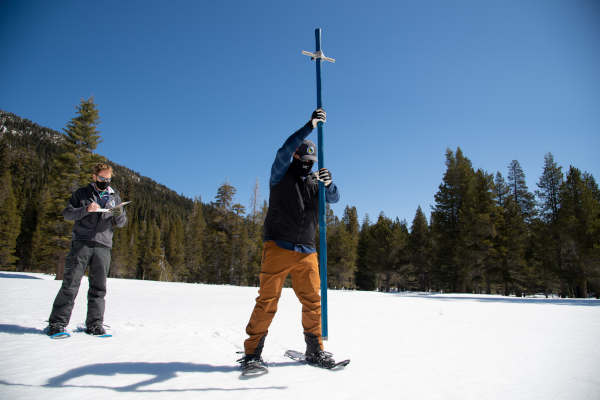
Snowpack measurements across California continue to show below-normal depth, a concern because of the amount of water supply stored in mountain snow.
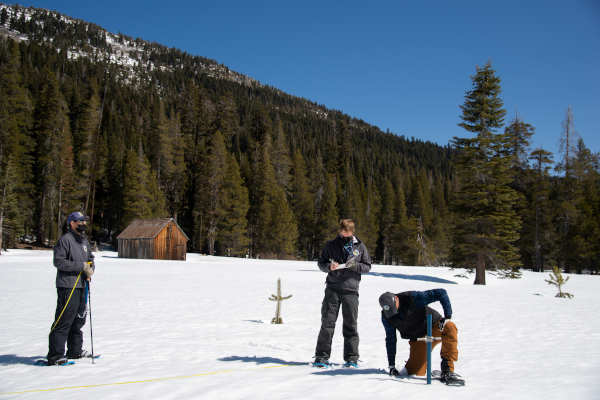
The Department of Water Resources on Thursday conducted the fourth snow survey at the Phillips Station snow course.
The manual survey recorded 49.5 inches of snow depth and a snow water equivalent, or SWE, of 21 inches, which is 83 percent of average for this location. The SWE measures the amount of water contained in the snowpack and is a key component of DWR’s water supply forecast.
Measurements from DWR’s electronic snow survey stations indicate that statewide the snowpack’s SWE is 16.5 inches, or 59 percent of average for the date. April 1 is typically when California’s snowpack is the deepest and has the highest SWE.
“While there is some snow on the ground today at Phillips Station, there is no doubt California is in a critically dry year. State agencies, water suppliers and Californians are more prepared than ever to adapt to dry conditions and meet the challenges that may be ahead,” said DWR Director Karla Nemeth. “With climate change impacting how precipitation falls in California, ongoing water efficiency and long-term efforts like recycling water, capturing stormwater, and planting water-friendly landscapes are essential to securing California’s water future.”
While the Southern Sierra remains well below average for both rain and snow, the picture is somewhat different in the Northern and Central part of the state where California typically receives 75 percent of the State’s annual precipitation.
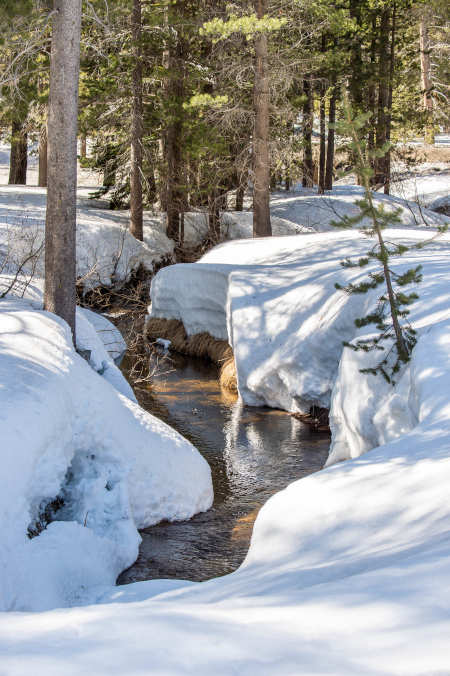
The few storms that impacted California this year have been colder, bringing more snow than rain.
This is a positive sign for the Sierra snowpack which accounts for 30 percent of California’s fresh water supply in an average year.
In the Mendocino National Forest, snowpack levels also are below normal.
DWR’s California Data Exchange Center shows that the 6,200-foot Anthony Peak, located in the Stony Creek river basin on the forest’s Covelo Ranger District, recorded 24 inches of depth and 11 inches of water content, for a density of 46 percent as of March 30. That’s up from the 32 percent density recorded at the site at the end of March 2021.
At Plaskett Meadows, located at 6,000 feet elevation on the Eel River basin, recorded snow depth of 10 inches and 4.5 inches of water content for a density of 45 percent on March 31, compared to 42 percent density in a year-over comparison.
For Water Year 2021, the snowpack in the Northern and Central Sierra peaked at 70 percent of average, however rain is below 50 percent of average, which ties this year for the third driest year on record.
The severity of dry conditions is particularly evident in the Feather River watershed where water levels at Lake Oroville, the State Water Project’s largest reservoir, are currently at 53 percent of average.
Statewide, following a below-average 2020 water year, California’s major reservoirs are at just 50 percent of overall capacity. The amount of water expected to enter California’s reservoirs when the snowpack melts is projected to be just 58 percent of average.
With dry conditions continuing to impact California’s water supply, DWR recently announced an adjustment to the State Water Project allocation for 2021. The department now expects to deliver 5 percent of requested supplies this year, down from the initial allocation of 10 percent announced in December.
Officials said California is better prepared for drought than in the past. Following the 2012-2016 drought, DWR enacted many programs focused on managing the state’s water through a strategic, integrated approach with a strong emphasis on water use efficiency and conservation. The state provides assistance and tools to local water agencies to help them reduce their drought vulnerability.
DWR’s Water Use and Efficiency Branch provides agencies and individuals with assistance for improving water use efficiency and developing and meeting efficient water use requirements.

- Details
- Written by: Robin Marks
While researchers are still striving to understand why some patients experience these “long-haul” symptoms, two UC San Francisco clinicians from complimentary specialties have teamed up to create an integrative medicine skills program that can give such patients better tools to cope with the debilitating symptoms.
“I’ve never tried to develop a program for a condition that we know so little about,” said Juliet Morgan, MD, a neurologist and chief resident in psychiatry at the UCSF Weill Institute for Neurosciences. “We’re trying to stay as close to the evidence as possible to tailor treatment to this specific group.”
Morgan has partnered with palliative care physician Meghan Jobson, MD, PhD, a fellow in the School of Medicine, and the two have been combing studies about integrative approaches to other chronic conditions, as well as recent insights into COVID-19 symptoms, and bringing all the knowledge to bear on their effort.
“We looked at this population, and we said, ‘What does the literature tell us about low-cost and effective interventions that can work for symptoms of chronic conditions?’” said Jobson. Morgan adds, “What we found is significant evidence that mindfulness meditation produces physiological changes in the body that help manage stress, and that support groups reduce feelings of isolation.”
The clinicians added cognitive behavioral therapy to create a low-cost, low-risk program to help patients manage stress and anxiety. They completed the first run of the three-week program in December 2020, with a group of 10 patients.
Only two of the 10 enrolled had required brief hospitalization, one of them in the ICU for 24 hours, while the other eight experienced mild to moderate illness. Participants ranged in age from mid-30s to early 70s. All of them had been sick in March or April and had been incapacitated by symptoms for over eight months.
Grappling with loss of identity
Herman, a post-COVID patient in UCSF’s COVID-19 Neurorecovery Clinic and OPTIMAL Clinic, was accepted into the pilot program. He developed COVID-19 in March 2020 and is still struggling with fatigue, gastrointestinal issues, memory loss and shortness of breath.
“It was really amazing that suddenly I had people to talk to about this, people who were going through the same thing,” he said. “We could work through this illness together instead of being so isolated. It gave me something to look forward to.”
Herman’s experience mirrors that of most people with post-COVID effects, many of whom were young and healthy before they got sick, and now can’t work or conduct normal lives, said Morgan. The circumstances leave many patients grappling with a loss of identity.
“These are people who thought of themselves as quick-minded, in charge of their lives, and able to help others,” she said. “And now they have these debilitating symptoms and they don’t really know what’s happening to them or what they can do about it. It’s a huge change from who they used to be.”
Like many others in the first round of patients, Herman hadn’t previously used any of the integrative techniques – meditation, support group, or cognitive behavioral therapy – that he experienced in the group.
“I’ve always thought those kinds of things weren’t really for me, but I found them really helpful,” he said. “It gives you an idea of what’s possible. You develop a better outlook and realize that it’s not all doom and gloom out there.”
Finding validation
Since the group stopped officially meeting in December, over half of the group members have taken up some sort of mindfulness practice on their own, and that many say the practice has provided relief from symptoms.
Herman, who said his condition is slowly improving, has continued the practices he learned from the group, like writing a list of what he’s grateful for each day and remembering to just stop and take a breath. In addition, he said, it’s been validating just to have people acknowledge that what is happening to him is real.
That recognition may be one of the most important takeaways from the experience. “They feel like they finally have a base of people who believe them,” said Jobson. “We could tell in the first session that they’re just so thirsty for each other’s stories.”
Ideally, the researchers hope what they learn through their work will be a model for how others can apply mindfulness and integrative strategies to help people cope with other chronic conditions such as fibromyalgia and arthritis.
“We believe that COVID-19 can demonstrate the importance of providing these skills that are so fundamental for living in such a busy, intense world,” said Jobson. “Our goal is to find ways to improve the quality of life for people with chronic symptoms. The responses we’ve had so far leave us hopeful.”
The physicians have another group underway, with plans for future groups over the next year. Interested patients should fill out the form on the group’s website to stay informed about future enrollment, https://osher.ucsf.edu/public-classes/integrative-medicine-group-covid-recovery.
Robin Marks writes for the University of California San Francisco.