 How to resolve AdBlock issue?
News
- Details
- Written by: Elizabeth Larson
LAKE COUNTY, Calif. – One person was reported to have died early Sunday morning following a vehicle rollover near Lakeport.
The solo-vehicle wreck was reported shortly after 12 a.m. by someone who said they heard a loud crash, according to the California Highway Patrol.
The CHP said the crash was reported in the 1500 block of Mountview Road, near the intersection with Scotts Valley Road.
Firefighters arriving at the scene at around 12:15 a.m. found an overturned SUV with an unconscious male subject who had been ejected from the vehicle, according to radio reports.
An air ambulance was requested but a few minutes later the medic unit on scene reported that the patient had died, with the CHP’s online report confirming a fatality shortly thereafter.
The sheriff’s department was dispatched to respond to the scene because of the fatality, radio traffic indicated.
Additional details about the wreck were not immediately available early Sunday.
Email Elizabeth Larson at
Email Elizabeth Larson at
- Details
- Written by: Jonathan Runstadler, Tufts University and Kaitlin Sawatzki, Tufts University


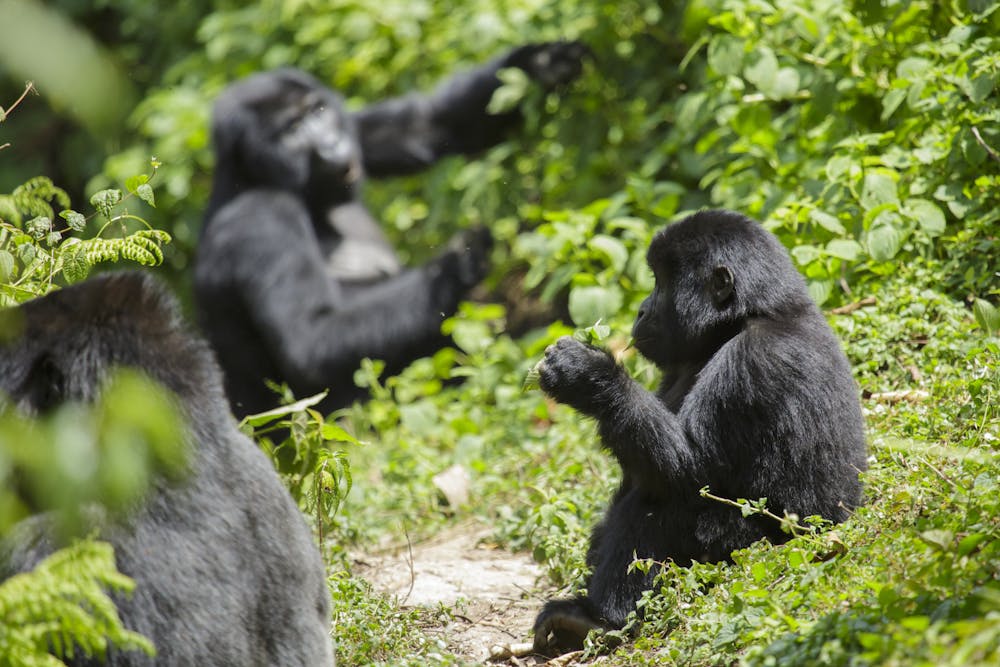
Over the course of the COVID-19 pandemic, researchers have found coronavirus infections in pet cats and dogs and in multiple zoo animals, including big cats and gorillas. These infections have even happened when staff were using personal protective equipment.
More disturbing, in December the United States Department of Agriculture confirmed the first case of a wild animal infected with SARS-CoV-2, the virus that causes COVID-19. Researchers found an infected wild mink in Utah near a mink farm with its own COVID-19 outbreak.
Are humans transmitting this virus to wildlife? If so, what would this mean for wild animals – and people too?

How viruses hop between species
We are two scientists who study viruses in wildlife and are currently running a study investigating the potential for SARS-CoV-2 transmission from humans into domestic and wild animals.
When viruses move from one species into another, scientists call it spillover. Thankfully, spillover doesn’t occur easily.
To infect a new species, a virus must be able to bind to a protein on a cell and enter the cell while dodging an immune system the virus hasn’t encountered before. Then, as a virus works to avoid antibodies and other antiviral attackers, it must replicate at a high enough volume to be transmitted on to the next animal.
This usually means that the more closely related two species are, the more likely they are to share viruses. Chimpanzees, the species most closely related to humans, can catch and get sick from many human viruses. Earlier this month, veterinarians at the San Diego Zoo announced that the zoo’s troop of gorillas was infected with SARS–CoV–2. This indicated it is possible for this virus to jump from humans to our close relatives.
Some viruses tend to stay in a single species or in closely related species, while other viruses seem innately more capable of large species jumps. Influenza, for example, can infect a wide variety of animals, from sparrows to whales. Similarly, coronaviruses are known to regularly jump between species.
The question of how many and which species can be infected by SARS-CoV-2 – and which ones might be able to support continued circulation of the virus – is an important one.
Searching for COVID-19 in wildlife

For human-to-wildlife spillover of SARS-CoV-2 to occur, an animal needs to be exposed to a high-enough viral dose to become infected.
The highest-risk situations are during direct contact with humans, such as a veterinarian’s caring for an injured animal. Contact between a sick person and a pet or farm animal also poses a risk, as the domestic animal could act as an intermediate host, eventually passing the virus to a wild animal.
Another way COVID-19 could spill over from humans into animals is through indirect infection, such as through wastewater. COVID-19 and other pathogens can be detected in waste streams, many of which end up dumped, untreated, into environments where wildlife like marine mammals may be exposed. This is thought to be how elephant seals in California became infected with H1N1 influenza during the swine flu pandemic in 2009.
To study whether spillover of SARS-CoV-2 is happening, our team at Tufts is partnering with veterinarians and licensed wildlife rehabilitators across the U.S. to collect samples from and test animals in their care. Through the project, we have tested nearly 300 wild animals from over 20 species. So far, none – from bats to seals to coyotes – have shown any evidence of COVID-19 by swab or antibody tests.
Other researchers have launched targeted surveillance of wild animals in places where captive animals have been infected. The first confirmed infection in a wild mink was found during surveillance near an infected mink farm. It’s not yet clear how this wild mink got the coronavirus, but the high density of infected minks and potentially infectious particles from them made it a high-risk location.
_11.jpg)
Bad for animals, bad for humans
When a virus infects a new species, it sometimes mutates, adapting to infect, replicate and transmit more efficiently in a new animal. This is called host adaptation. When a virus jumps to a new host and begins adapting, the results can be unpredictable.
In late 2020, when SARS-CoV-2 jumped into farmed mink in Denmark, it acquired mutations that were uncommon in humans. Some of these mutations occurred in the part of the virus that most vaccines are designed to recognize. And it didn’t just happen once – these mutations independently arose in mink farms multiple times. While it’s not yet clear what impact, if any, these mutations may have on human disease or the vaccine, these are signs of host adaptation that could allow novel variants of the virus to persist and reemerge from animal hosts in the future.
Another risk is that SARS-CoV-2 could cause disease in animals. Ecologists are especially concerned about endangered species like the black-footed ferret, which is closely related to minks and thought to be very susceptible to the virus.
Human-to-wildlife spillover has happened before. In the late 20th century, the Ebola virus jumped from humans into great apes and has resulted in devastating consequences for these endangered animals. More recently, a human respiratory virus has been detected in threatened mountain gorilla populations and has caused deaths as well.
But perhaps the biggest risk to humans is that spillover could result in the coronavirus establishing a reservoir in new animals and regions. This could provide opportunities for reintroduction of COVID-19 into humans in the future. This month researchers published a paper showing that this had already happened on a small scale with human–to–mink–to–human transmission on mink farms in Denmark.
While our team has found no evidence of COVID-19 in wild animals in the U.S. at this time, we have seen convincing evidence of regular spillover into dogs and cats and some zoo animals. The discovery of the infected wild mink confirmed our fears. Seeing the first wild animal with natural COVID-19 is alarming, but sadly, not surprising.
Jonathan Runstadler, Professor of Infectious Disease and Global Health, Cummings School of Veterinary Medicine, Tufts University and Kaitlin Sawatzki, Postdoctoral Infectious Disease Researcher, Tufts University
This article is republished from The Conversation under a Creative Commons license. Read the original article.
- Details
- Written by: Elizabeth Larson
Dogs available for adoption this week include mixes of Belgian Malinois, German Shepherd, husky, Labrador Retriever, mastiff, pit bull and Rottweiler.
Dogs that are adopted from Lake County Animal Care and Control are either neutered or spayed, microchipped and, if old enough, given a rabies shot and county license before being released to their new owner. License fees do not apply to residents of the cities of Lakeport or Clearlake.
The following dogs at the Lake County Animal Care and Control shelter have been cleared for adoption (additional dogs on the animal control Web site not listed are still “on hold”).
Call Lake County Animal Care and Control at 707-263-0278 or visit the shelter online at http://www.co.lake.ca.us/Government/Directory/Animal_Care_And_Control.htm for information on visiting or adopting.

Male Rottweiler
This male Rottweiler has a short black and brown coat.
He has been neutered.
He is in kennel No. 10, ID No. 14315.

Male pit bull terrier
This male pit bull terrier has a short blue and white coat.
He is in kennel No. 11, ID No. 14314.

German Shepherd-husky mix
This male German Shepherd-husky mix has a medium-length coat.
He is in kennel No. 16, ID No. 14309.

Female pit bull terrier
This young female pit bull terrier has a short tan coat.
She is in kennel No. 18, ID No. 14306.

Male pit bull terrier-hound
This young male pit bull terrier-hound mix has a medium-length brown coat.
He is in kennel No. 19, ID No. 14276.

Male pit bull terrier
This male pit bull terrier has a short black and white coat.
He is in kennel No. 20, ID No. 14295.

Female pit bull terrier
This female pit bull terrier has a short brown and black coat.
She is in kennel No. 21, ID No. 14310.

Female German Shepherd
This female German Shepherd has a medium-length black and tan coat.
She is in kennel No. 22, ID No. 14316.

Female pit bull terrier
This female pit bull terrier puppy has a short black and white coat.
She is in kennel No. 23, ID No. 14305.

Female pit bull terrier
This senior female pit bull terrier has a short blue and white coat.
She is in kennel No. 24, ID No. 14299.

Pit bull-mastiff mix
This male pit bull-mastiff mix has a short chocolate coat.
He is in kennel No. 26, ID No. 14287.

Male German Shepherd-husky mix
This male German Shepherd-husky mix has a medium-length black and tan coat.
He has been neutered.
He’s in kennel No. 28, ID No. 14307.

Male Belgian Malinois
This young male Belgian Malinois has a medium-length red and black coat.
He is in kennel No. 29, ID No. 14269.

Male pit bull terrier
This male pit bull terrier has a short gray coat.
He has been neutered.
He is in kennel No. 32, ID No. 14271.

Female German Shepherd-husky mix
This young female German Shepherd-husky mix has a short black and tan coat.
She is in kennel No. 34, ID No. 14308.
Email Elizabeth Larson at
- Details
- Written by: Robert Sanders

BERKELEY, Calif. – Apart from black holes, magnetars may be the most extreme stars in the universe.
With a diameter less than the length of Manhattan, they pack more mass than that of our sun, wield the largest magnetic field of any known object — more than 10 trillion times stronger than a refrigerator magnet — and spin on their axes every few seconds.
A type of neutron star — the remnant of a supernova explosion — magnetars are so highly magnetized that even modest disturbances in the magnetic field can cause bursts of X-rays that last sporadically for weeks or months.
These exotic, compact stars are also thought to be the source of some types of short gamma ray bursts (GRBs): bright flashes of highly energetic radiation that have puzzled astronomers since they were first detected in the 1970s. Several of these giant magnetar flares have been detected within the Milky Way Galaxy.
But because they are so intense that they saturate detectors, and observations within the galaxy are obscured by dust, space scientist Kevin Hurley at the University of California, Berkeley, and an international team of astronomers have been looking for these same flares in galaxies outside our own for a clearer view.
That 45-year effort is paying off. A short gamma ray burst detected last April 15 from a galaxy 11.4 million light years away shows a clear signature that Hurley thinks could help astronomers find magnetar bursts more easily and finally gather the data needed to check the many theories that explain magnetars and their gamma ray flares.
“We have got what we believe are four solid detections since 1979 of extragalactic giant magnetar flares, two of them almost identical bursts from different galaxies,” said Hurley, a senior space fellow with UC Berkeley’s Space Sciences Laboratory. “It leads us to believe that there may be kind of a template emerging that is going to help us identify them more quickly in the future. My hope is that the pace will now accelerate because we know a lot better what we are looking for.”
Hurley and three colleagues will report the GRB discovery by various U.S. and European satellites and its implications at a media briefing on Wednesday, Jan. 13, at the annual meeting of the American Astronomical Society and in three papers appearing simultaneously in the journals Nature and Nature Astronomy.
Giant magnetar bursts
GRBs, the most powerful explosions in the cosmos, can be detected across billions of light-years. Most of those lasting less than about two seconds, called short GRBs, occur when a pair of orbiting neutron stars spiral into each other and merge.
Astronomers confirmed this scenario for at least some short GRBs in 2017, when a burst followed the arrival of gravitational waves — ripples in space-time — produced when neutron stars merged 130 million light-years away.
But not all short GRBs fit the neutron star merger profile, Hurley said. Specifically, of the 29 magnetars within our Milky Way Galaxy known to exhibit occasional X-ray activity, two have produced giant flares that are different from the bursts from these mergers.
The most recent of these detections was on Dec. 27, 2004, an event that produced measurable changes in Earth’s upper atmosphere, despite erupting from a magnetar located about 28,000 light years away.
Since the late 1970s, Hurley has operated the InterPlanetary Network (IPN), a 24/7 effort to plow through data from many spacecraft — currently five, capturing some 325 gamma bursts per year — in hopes of finding more giant magnetar flares. That network was key to capturing the April 15, 2020, flare.
Shortly before 4:42 a.m. EDT on that Wednesday, a brief, powerful burst of X-rays and gamma rays swept past Mars, triggering the Russian High Energy Neutron Detector aboard NASA’s Mars Odyssey spacecraft, which has been orbiting the planet since 2001.
About 6.6 minutes later, the burst triggered the Russian Konus instrument aboard NASA’s Wind satellite, which orbits a point between Earth and the sun located about 930,000 miles (1.5 million kilometers) away. After another 4.5 seconds, the radiation passed Earth, triggering instruments on NASA’s Fermi Gamma-ray Space Telescope and the European Space Agency’s INTEGRAL satellite.
Analysis of data from the Burst Alert Telescope (BAT) on NASA’s Neil Gehrels Swift Observatory provided additional insight into the event.
These data showed that the pulse of radiation lasted just 140 milliseconds, the blink of an eye.
Hurley and Dmitry Svinkin of Russia’s Ioffe Institute, a member of the IPN team, used the arrival times measured by the Fermi, Swift, Wind, Mars Odyssey and INTEGRAL missions to pinpoint the location of the April 15 burst, called GRB 200415A, squarely in the central region of NGC 253, a bright spiral galaxy located about 11.4 million light-years away in the constellation Sculptor. This is the most precise sky position yet determined for a magnetar located beyond the Large Magellanic Cloud, a satellite of our galaxy and host in 1979 to the first giant flare ever detected.
“This was the most accurately localized magnetar outside of our galaxy so far, and we’ve really pinned it down now, not just to a galaxy, but a part of a galaxy where we expect star formation is going on, and stars are exploding. That is where the supernovas should be and the magnetars, too,” Hurley said. “The April 15 event is a game changer.”
Flashes from a lighthouse
The giant flares seen within the Milky Way look a bit different from those from nearby galaxies because of distance. Astronomers have documented that giant flares from magnetars in the Milky Way and its satellites evolve in a distinct way, with a rapid rise to peak brightness followed by a more gradual tail of fluctuating emission. These variations result from the magnetar’s rotation, which repeatedly brings the flare location in and out of view from Earth, much like a lighthouse.
Observing this fluctuating tail is conclusive evidence of a giant flare — a smoking gun, Hurley said. For magnetar flares millions of light-years away, however, this emission is too dim to detect with today’s instruments. For this reason, giant flares in our galactic neighborhood may be confused with more distant and powerful merger-type GRBs.
The new observations reveal multiple pulses, with the first one appearing in just 77 microseconds — about 13 times the speed of a camera flash and nearly 100 times faster than the rise of the fastest GRBs produced by mergers.
“The combination of the rise time and decay time, we think, may be showing us a template, because we have seen it before — we saw it back in 2005, with another event, almost the carbon copy. And the energy spectrum of the two were also similar,” Hurley said.
Fermi’s Gamma-ray Burst Monitor also detected rapid variations in energy over the course of the flare that have never been observed before.
“Giant flares within our galaxy are so brilliant that they overwhelm our instruments, leaving them to hang onto their secrets,” said Oliver Roberts, an associate scientist at Universities Space Research Association’s Science and Technology Institute in Huntsville, Alabama, who led the study of Fermi data. “For the first time, GRB 200415A and distant flares like it allow our instruments to capture every feature and explore these powerful eruptions in unparalleled depth.”
Starquakes and magnetic field reconnection
Giant flares are poorly understood, but astronomers think they result from a sudden rearrangement of the magnetar’s magnetic field. One possibility is that the field high above the surface may become too twisted, suddenly releasing energy as it settles into a more stable configuration. A mechanical failure of the magnetar’s crust — a starquake — may trigger the sudden reconfiguration.
“The idea is that you have this superstrong magnetic field coming out of the star, but anchored to the crust, and the magnetic field can twist, exerting pressure on the crust. The crust has an elastic limit, and after you exceed that elastic limit, it cracks. Then, that crack sends out waves into the magnetic field, and those waves disrupt the field, and you can get reconnection and energy release and gamma rays,” Hurley said.
Roberts and his colleagues say that the data show some evidence of seismic vibrations during the eruption. The researchers say this emission arose from a cloud of ejected electrons and positrons moving at about 99% the speed of light.
The short duration of the emission and its changing brightness and energy reflect the magnetar’s rotation, ramping up and down like the headlights of a car making a turn.
Roberts describes it as starting off as an opaque blob — he pictures it resembling a photon torpedo from the “Star Trek” franchise — that expands and diffuses as it travels.
The torpedo also factors into one of the event’s biggest surprises. The highest-energy X-rays recorded by the Gamma-Burst Monitor reached 3 million electron volts (MeV), or about 1 million times the energy of blue light.
The satellite’s main instrument, the Large Area Telescope, or LAT, also detected three gamma rays with energies of 480 MeV, 1.3 billion electron volts, or GeV and 1.7 GeV — the highest-energy light ever detected from a magnetar giant flare. What’s surprising is that all of these gamma rays appeared long after the flare had diminished in other instruments.
Nicola Omodei, a senior research scientist at Stanford University, led the LAT team investigating these gamma rays, which arrived between 19 seconds and 4.7 minutes after the main event. The scientists concluded that this signal most likely also came from the magnetar flare.
A magnetar produces a steady outflow of fast-moving particles. As these particles move through space, they plow into, slow and divert interstellar gas. The gas piles up, becomes heated and compressed, and forms a type of shock wave called a bow shock, like the ripples in front of a moving boat.
In the model proposed by the LAT team, the flare’s initial pulse of gamma rays travels outward at the speed of light, followed by the cloud of ejected matter, which is moving nearly as fast. After several days, they both reach the bow shock. The gamma rays pass through.
Seconds later, the cloud of particles — now expanded into a vast, thin shell — collides with accumulated gas at the bow shock. This interaction creates shock waves that accelerate particles, producing the highest-energy gamma rays after the main burst.
The April 15 flare proves that the 2020 and 2004 events constitute their own class of GRBs, Hurley said.
“A few percent of short GRBs may really be magnetar giant flares,” said Eric Burns, an assistant professor of physics and astronomy at Louisiana State University in Baton Rouge who led a study that identified additional extragalactic magnetar suspects. “In fact, they may be the most common high-energy outbursts we’ve detected so far beyond our galaxy — about five times more frequent than supernovae.”
While bursts near the galaxy M81 in 2005 and the Andromeda galaxy (M31) in 2007 had already been suggested to be giant flares, his team identified a newly reported flare in M83, also seen in 2007. Add to these the giant flare from 1979 and those observed in our Milky Way in 1998 and 2004.
“It’s a small sample, but we now have a better idea of their true energies, and how far we can detect them,” said Burns, whose study will appear later this year in The Astrophysical Journal Letters.
Robert Sanders writes for the UC Berkeley News Center.