 How to resolve AdBlock issue?
News
- Details
- Written by: Elizabeth Larson
The meeting will begin at 9 a.m. Tuesday, Nov. 17.
The supervisors will meet in the board chambers on the first floor of the Lake County Courthouse, 255 N. Forbes St., Lakeport, for a hybrid meeting format which also will include the opportunity for community members to continue to participate virtually.
The meeting can be watched live on Channel 8, online at https://countyoflake.legistar.com/Calendar.aspx and on the county’s Facebook page. Accompanying board documents, the agenda and archived board meeting videos also are available at that link.
To participate in real-time, join the Zoom meeting by clicking this link at 9 a.m. The meeting ID is 939 8046 7939, password 667935.
To submit a written comment on any agenda item please visit https://countyoflake.legistar.com/Calendar.aspx and click on the eComment feature linked to the meeting date. If a comment is submitted after the meeting begins, it may not be read during the meeting but will become a part of the record.
In an untimed item, the board will continue a discussion regarding staff’s proposal to consider extending Friday office closures to the public through March 31, 2021, in light of COVID-19 and expected effects of the 2020-21 flu season.
The Friday closures began in August 2018 on a six-month basis in response to county job vacancy rates and have since been extended for other reasons, most recently COVID-19.
At the Nov. 3 meeting, Supervisor Rob Brown said there is nothing more permanent than a temporary program. “This is playing out that way.”
Supervisors expressed their desire to see the closures end and Friday office hours to resume by April. Supervisor Bruno Sabatier suggested that the closures should begin to be rolled back in January, when departments could assign one staffer each to basic customer service duties.
The board on Tuesday is expected to finalize its direction to staff on the matter.
In other business on Tuesday, at 9:05 a.m. the board will get an update from Public Health Officer Dr. Gary Pace.
At 10:45 a.m., the board will consider an ordinance allowing microenterprise home kitchen operations with a pilot program.
A memo to the board from Supervisor Sabatier and Supervisor EJ Crandell explained, “AB626 allows for a home kitchen to be utilized for a limited number of meals per week, and a limited amount of income to individuals wishing to start a home based food facility. In order to allow this to occur in Lake County, we must opt in and allow the permitting of such facilities.”
The memo noted that on July 21 the board approved moving forward with producing an ordinance opting in for AB626 and offering a Microenterprise Home Kitchen Operations permit to the public.
Since county staffers have raised issues about the impact on workload, Crandell and Sabatier are proposing a pilot program allowing for a maximum of two applications per month for a maximum of 10 total applications during the pilot program period.
“The applications will also be separated at 2 per district to ensure that the program will be accessible around the county and not concentrated in one area,” the memo said.
The permit process will require approval by the landlord if the home is not owned by the tenant and also will require a zoning permit or minor use permit depending on whether or not food is being delivered, according to the memo.
“A minor use permit would be necessary to ensure that parking and traffic issues would be mitigated prior to approving a permit,” Crandell and Sabatier wrote.
The full agenda follows.
CONSENT AGENDA
5.1: Approve the early release of one member of the Lucerne Area Town Hall.
5.2: Ratify second side letter agreement with county of Lake Deputy Sheriff’s Association regarding amendment to the 2019 MOU.
5.3: Approve amendment to the County of Lake COVID-19 Public Health Emergency Return to Work – Worksite Protection Protocol.
5.4: (a) Waive the formal bidding process, pursuant to Lake County Code Section 38.2, as it is not in the public interest due to the unique nature of goods or services; and (b) approve the agreement between the county of Lake and Redwood Community Services Inc. Tule House for substance abuse block grant eligible substance use disorder perinatal residential services for Fiscal Year 2020-21, for an amount not to exceed $50,000 and authorize the board chair to sign the agreement.
5.5: (a) Waive the formal bidding process, pursuant to Lake County Code Section 38.2, as it is not in the public interest due to the unique nature of goods or services; and (b) approve the agreement between the county of Lake and Redwood Community Services Inc. Tule House for drug Medi-Cal eligible substance use disorder perinatal residential services for Fiscal Year 2020-21, for an amount not to exceed $150,000.00 and authorize the board chair to sign the Agreement.
5.6: (a) Waive the formal bidding process, pursuant to Lake County Code Section 38.2, as it is not in the public interest due to the unique nature of goods or services; and (b) approve the agreement between the county of Lake and Willow Glen Care Center for adult residential support services and specialty mental health services for Fiscal Year 2020-21 for a contract maximum of $100,000 and authorize the board chair to sign the agreement.
5.7: (a) Waive the formal bidding process pursuant to Lake County Code Section 38.2, as it is not in the public interest due to the unique nature of goods or services; and (b) approve agreement between the county of Lake and Social Service Data Solutions Inc. DBA Decipher HMIS and Impact Homelessness Project for the coordination of activities involved in the compliance with the Lake County Continuum of Care Homeless Management Integration Software for Fiscal Year 2020-21 for a contract maximum of $54,300 and authorize the board chair to sign the agreement.
5.8: Adopt resolution approving the standard agreement between county of Lake and the Department of Housing and Community Development in the amount of $560,227 and authorize the board chair to sign the agreement.
5.9: Approve Addendum No. 3 to the commercial lease agreement between the county of Lake and Bruno’s Property Management to allow for the additional lease of attached property at the 6302 13th Ave., Lucerne, California and authorize the board chair to sign.
5.10: Adopt resolution to amend the budget for FY 2020-2021 by appropriating unanticipated revenue for Public Health services and authorize the Health Services director to sign necessary documents to secure these funds.
5.11: Adopt resolution amending Resolution 2020-134 establishing position allocations for Fiscal Year 2020-21, Budget Unit No.4011, Public Health.
5.12: Approve the continuation of a local health emergency and order prohibiting the endangerment of the community through the unsafe removal, transportation, and disposal of fire debris for the Mendocino Complex fire.
5.13: Approve the continuation of a local health emergency related to the 2019 Coronavirus (COVID-19) as proclaimed by the Lake County Public Health officer.
5.14: A) Authorize the Public Services director / assistant purchasing agent to issue a purchase order not to exceed $65,000 to Leete Generators for a portable diesel generator, including installation; and B) approve Budget Transfer in Budget Unit 4011, Health Services Department, Public Health Division to Object Code 62-74, to purchase and install a backup generator in the amount of $65,000.
5.15: Approve the continuation of resolution ratifying the declaration of local health emergency and order prohibiting the endangerment of the community through the unsafe removal, transport, and disposal of fire debris for the LNU Complex wildfire.
5.16: Approve the continuation of a local emergency due to the Mendocino Complex fire incident (River and Ranch fires).
5.17: Approve the continuation of a local emergency due to the Pawnee fire incident.
5.18: Approve the Continuation of a local emergency due to COVID-19.
5.19: Approve the continuation of a local emergency in Lake County in response to the LNU Lightning Complex wildfire event.
5.20: Sitting as the Board of Directors, Lake County Watershed Protection District, consideration and approval of joint funding agreement with the U.S. Geological Survey, U.S. Dept. of the Interior for annual maintenance of the Kelsey Creek flow gauge station in the amount of $14,430 and authorize the chair to sign.
5.21: Sitting as the Board of Directors for the Lake County Watershed Protection District, (a) waive the formal bidding process, pursuant to Lake County Code Section 38.2 (2) & (3), as it is not in the public interest due to the unique nature of the goods or services and its determined that competitive bidding would produce no economic benefit to the county; (B) approve the agreement between the county of Lake and EOA Inc. environmental consulting firm in the amount of $104,000 to provide assistance to meet NPDES storm water permit and TMDL compliance and to authorize the chair of the board of directors to sign the agreement.
5.22: Sitting as the Board of Directors for the Lake County Watershed Protection District, approve the reimbursement agreements between the district and (a) the city of Lakeport and the (b) city of Clearlake to provide reimbursement for TMDL and storm water program services and to authorize the chair of the board of directors to sign the agreements.
5.23: Approve amendment one to agreement between the county of Lake and Quincy Engineering Inc. for engineering services for Hill Road MP 7.75 Landslide Repair Project in Lake County.
5.24: Approve amendment two to the agreement between the county of Lake and Quincy Engineering Inc. for engineering services for replacement of Cooper Creek Bridge at Witter Springs Road (14C-0119) in Lake County.
5.25: Approve additional leave of absence that extends beyond Department Leave and County Administrative Officer approved leave for Shirah Ruiz from Nov. 12, 2020, through Jan. 4, 2021, and authorize the Board of Supervisors chair.
TIMED ITEMS
6.1, 9:01 a.m.: Public input.
6.2, 9:05 a.m.: Consideration of update on COVID-19.
6.3, 10 a.m.: Public hearing, discussion/consideration to name an existing unnamed road located off Jerusalem Grand in Middletown Area, Psi Keep Ranch Road.
6.4, 10:30 a.m.: Discussion of Proposition 64 Draft Cannabis Equity Assessment and Funding For Equity Program.
6.5, 10:45 a.m.: Consideration of ordinance allowing microenterprise home kitchen operations with a pilot program.
6.6, 11:15 a.m.: Continuance of hearing on account and proposed assessment for the property 12942 Second St., Clearlake Oaks.
UNTIMED ITEMS
7.2: (a) Discussion and possible direction to staff regarding Friday closures; (b) consideration of a resolution extending Friday closures through March 31, 2021, in light of COVID-19 and expected effects of the 2020-21 flu season.
7.3: Consideration of proposed 2021 Board of Supervisors regular meeting calendar.
7.4: Consideration of amendment two to the agreement between the county of Lake and the Kelseyville Motel for COVID-19 emergency isolation housing and authorize the chair to sign.
CLOSED SESSION
8.1: Public employee appointment pursuant to Gov. Code Section 54957(b) (1): Appointment of Special Districts administrator.
8.2: Public employee evaluations: County Administrative Officer Carol Huchingson, Public Health Officer Dr. Gary Pace.
8.3: Conference with legal counsel: Existing litigation pursuant to Government Code section 54956.9 (d)(1): City of Clearlake v. County of Lake, et al.
8.4: Conference with legal counsel: Significant exposure to litigation pursuant to Government Code section 54956.9(d)(2)(e)(3), claim of Lillie.
8.5: Conference with legal counsel: Existing litigation pursuant to Government Code section 54956.9 (d)(1): Sabalone v. County of Lake.
Email Elizabeth Larson at
- Details
- Written by: Elizabeth Larson
The council will meet at 6 p.m. Tuesday, Nov. 17.
The meeting will be by teleconference only. The city council chambers will not be open to the public.
The agenda can be found here.
To speak on an agenda item, access the meeting remotely here or join by phone by calling toll-free 669-900-9128 or 346-248-7799. The webinar ID is 973 6820 1787, access code is 477973; the audio pin will be shown after joining the webinar. Those phoning in without using the web link will be in “listen mode” only and will not be able to participate or comment.
Comments can be submitted by email to
Indicate in the email subject line "for public comment" and list the item number of the agenda item that is the topic of the comment. Comments that read to the council will be subject to the three minute time limitation (approximately 350 words). Written comments that are only to be provided to the council and not read at the meeting will be distributed to the council prior to the meeting.
In a public hearing during the Tuesday meeting, the council will consider approving a resolution that would change the name of Westside Park Road to Charlie Jolin Way.
The proposal, which was brought to the council over the summer by the Westside Community Park Committee, received initial approval from the council before it went to the Lakeport Planning Commission. The commission followed up by approving the proposal in October.
Jolin died in June at age 96. He is credited with being the prime mover in the creation and promotion of the park.
Also on Tuesday, Public Health Officer Dr. Gary Pace will give the council an update on COVID-19 in Lake County.
In other business, the council will receive a presentation on the Redwood Empire Municipal Insurance Fund and the merger with Public Agency Risk Sharing Authority of California to create the California Intergovernmental Risk Authority, or CIRA, and direct staff to work with CIRA on steps necessary to complete the merger and place joint powers agreements and bylaws as a consent item on a future agenda.
On the consent agenda – items considered noncontroversial and usually accepted as a slate on one vote – are ordinances; minutes of the council’s regular Nov. 3 meeting; and the Oct. 29 warrant register.
Email Elizabeth Larson at
- Details
- Written by: Luna Lu, Purdue University and Vishal Saravade, Purdue University

Every day, Americans travel on roads, bridges and highways without considering the safety or reliability of these structures. Yet much of the transportation infrastructure in the U.S. is outdated, deteriorating and badly in need of repair.
Of the 614,387 bridges in the U.S., for example, 39% are older than their designed lifetimes, while nearly 10% are structurally deficient, meaning they could begin to break down faster or, worse, be vulnerable to catastrophic failure.
The cost to repair and improve nationwide transportation infrastructure ranges from nearly US$190 billion to almost $1 trillion. Repairing U.S. infrastructure costs individual households, on average, about $3,400 every year. Traffic congestion alone is estimated to cost the average driver $1,400 in fuel and time spent commuting, a nationwide tally of more than $160 billion per year.
I am a professor in the Lyles School of Civil Engineering and the director of the Center for Intelligent Infrastructures at Purdue University. My co-author, Vishal Saravade, is part of my team at the Sustainable Materials and Renewable Technology (SMART) Lab. The SMART Lab researches and develops new technologies to make American infrastructure “intelligent,” safer and more cost-effective. These new systems self-monitor the condition of roads and bridges quickly and accurately and can, sometimes, even repair themselves.
Smart, self-healing concrete
Infrastructure – bridges, highways, pavement – deteriorates over time with continuous use. The life of structures could be extended, however, if damages were monitored in real time and fixed early on. In the northern U.S., for example, freeze-thaw cycles in winter cause water to seep into the pavement where it freezes, expands and enlarges cracks, which can cause significant damage. If left unrepaired, this damage may propagate and break down pavements and bridges.
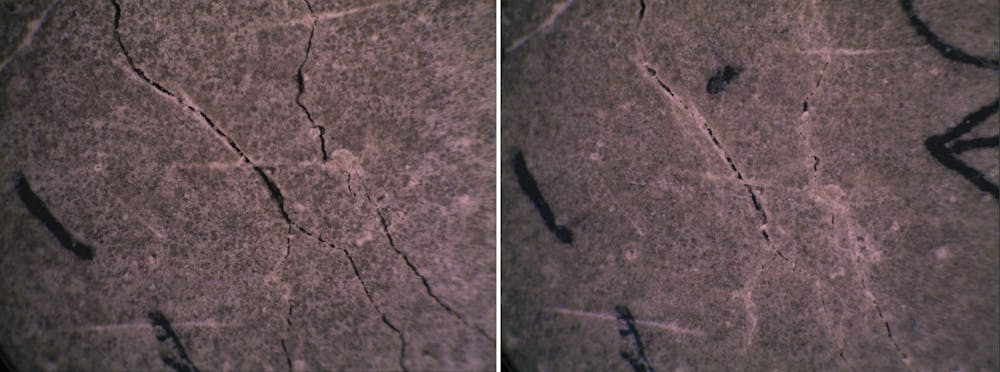
Such damage can be identified and repaired autonomously. At an early stage of a crack, for example, self-healing pavement would activate super absorbent polymers to absorb water and produce concrete-like material that fills in the crack. Cracks as small as a few microns could be healed to prevent significant damage by preventing or delaying the later stages of the freeze-thaw cycle.
Roadway technology
Many researchers in the world are working on improving construction infrastructure. Technologies recently being explored include solar and energy-harvesting roads, charging lanes for electric vehicles, smart streetlights and reducing carbon-related emissions from construction materials.
At the Purdue SMART Lab, our team is also testing novel sensors that monitor transportation infrastructure by embedding them in several Indiana interstate highways. We plan to expand to other state highway systems in the next few years with a goal to better accommodate increased traffic and provide accurate estimates of road conditions during construction and its life.
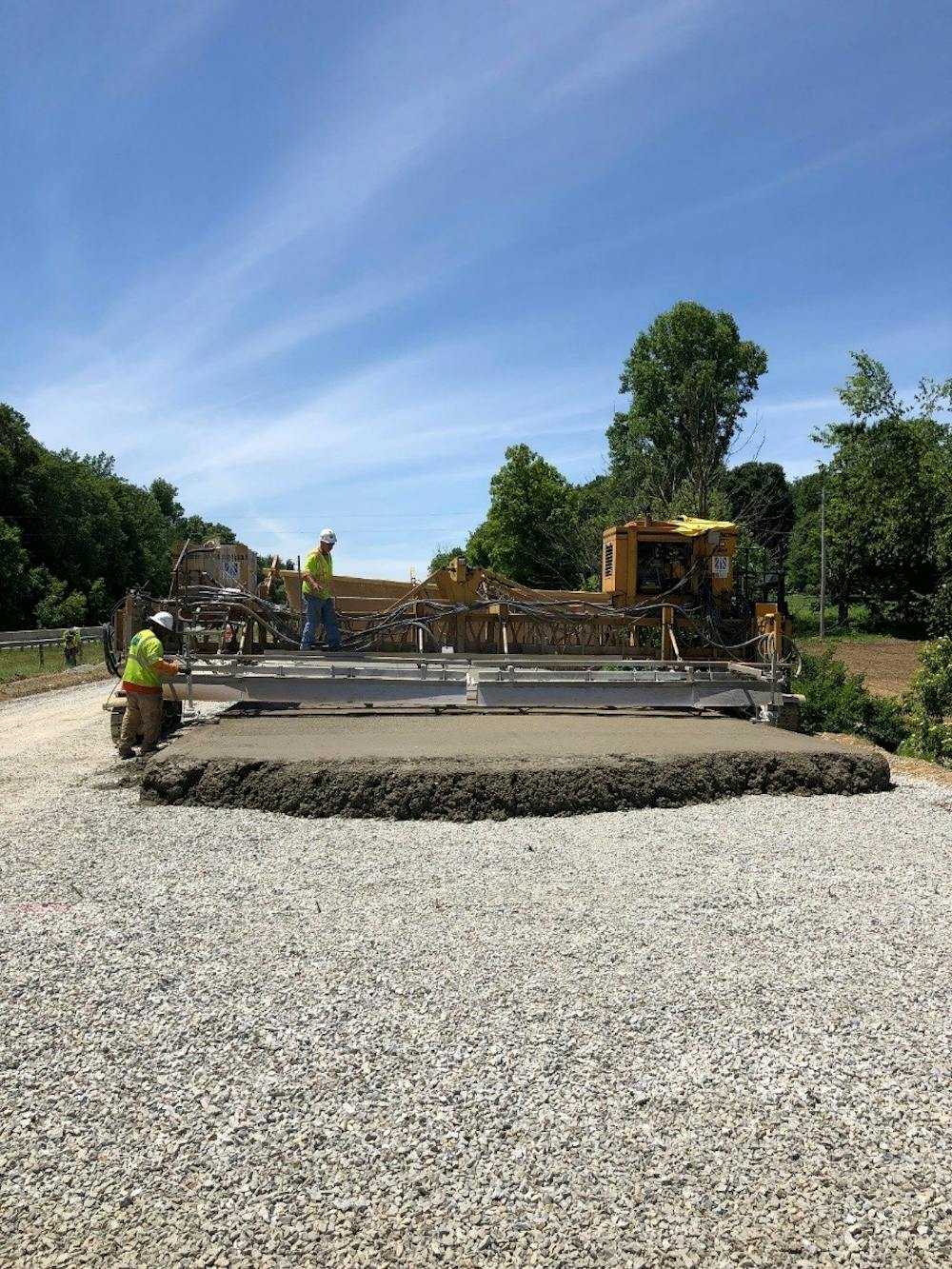
Sensors embedded in concrete pavement acquire information about the infrastructure’s health condition in real time and communicate the data to computers. Electrical signals are applied through the sensors. Concrete’s vibrations are converted into electrical signals that are read and analyzed by lab-built customized software. This enables transportation engineers to make effective and data-driven decisions from opening roads to traffic and to proactively identifying issues that cause damage or deterioration.
After concrete is poured for highway pavement, for example, it takes hours to cure and become strong enough to open for traffic. The timing of when to open a highway depends on when the concrete mix is cured. If a roadway opens too early and the concrete is undercured, it can reduce the life expectancy of the pavement and increase maintenance costs. Waiting too long to open a road can result in traffic delays, congestion and increased safety risks for construction workers and commuters. Curing concrete for massive highway projects requires close attention by engineers in conjunction with the weather specific to that region.
Smart sensors embedded in concrete enable engineers to monitor the infrastructure and make data-driven decisions about when a road can open while retaining maximum life expectancy. Sensors can also help monitor the quality of concrete and whether it is robust enough to withstand traffic flow and corrosion after a roadway is opened. Smart, efficient infrastructure can significantly reduce structural failures, both catastrophic and through normal wear, as well as lead to reduced costs and provide new ways for structural engineers to assess real-time information about the pavement.
[Get our best science, health and technology stories. Sign up for The Conversation’s science newsletter.]
Saving time and money
Congress recognizes the need to invest in American transportation systems. A $494 billion legislation package, the INVEST In America Act, was recently introduced to address America’s deteriorating highways and bridges while diminishing carbon pollution.
Smart sensors and intelligent infrastructure system can enable significant savings of time and money with improved construction safety. Sensors can provide engineers with real-time data of the quality of our infrastructure to make the best decisions for building and maintaining roads, bridges and pavements while improving safety for drivers and construction workers. The addition of self-repairing properties can help build sustainable and long-lasting infrastructure to reduce maintenance and costs.
Luna Lu, ACPA Scholar & Professor Of Civil Engineering, Purdue University and Vishal Saravade, Post-doctoral Scientist, Purdue University
This article is republished from The Conversation under a Creative Commons license. Read the original article.
- Details
- Written by: Esther Oertel

LAKE COUNTY, Calif. – When the chill of autumn visits Lake County, my thoughts turn to the local olive harvest.
You may have seen orchards of gnarled olive trees with their characteristic grey-green leaves as you’ve driven around the county. At this time of year, the trees give up their treasure: a tiny fruit amazingly packed full of flavor and health benefits.
A number of local growers produce their own olive oil, and it’s delicious!
It’s quite possible that olives are the most symbolic fruits the world has ever known. They were not only beloved but considered sacred in many ancient Mediterranean cultures spanning the millennia.
Olive trees, leaves, and fruit have been a symbol of a variety of positive attributes through the ages, including peace, wisdom, glory, fertility, power, purity and abundance.
The olive is one of the plants most cited in literature, found in such places as Homer’s Odyssey, the words of the Roman poet Horace, Greek mythology, the Bible (where it’s mentioned more than 30 times), and the Koran, where there are seven references, including as a “precious fruit.”
Olive trees are known for their longevity, and there are dozens of them in southern Europe and the Middle East that are reputed to be between 2,000 and 4,000 years old. In some cases, scientific studies have confirmed this.
Interestingly, these trees still bear fruit.
Olives in our hemisphere are harvested in the fall and winter, typically beginning in November. Depending on their intended use, they may be harvested prior to ripening as green olives, fully ripe as black olives, or somewhere in between.
There are dozens of olive varieties – more than a hundred – and they vary wildly in terms of size. Color in their ripened state can vary from shades of brown to purple to black.
Olives are among the healthiest foods on the planet and are packed full of nutrients and health-supporting elements such as antioxidants, iron, vitamin E, dietary fiber, copper, and monosaturated fats.
The olive is native to the eastern Mediterranean coastal region, including southeastern Europe, northern Africa, and western Asia. They’re now grown in a variety of places in the world that have a similar climate.
This is true of California, where much of our climate is like that of the Mediterranean region, making it possible for our state to produce nearly 75 percent of the olive oil in the United States.
Lake County shares this olive-friendly climate, and I’m grateful that local olive growers and vintners produce their own oil.
Some years ago, I had the privilege of witnessing the crushing of an olive harvest at what was then the Kelseyville Olive Mill. (Chacewater Winery and Olive Mill now occupies the property.)
Bins full to the top with local olives were brought to the mill to be metamorphosized into rich, golden-green, extra virgin olive oil. The ones that were being processed that day were from the now-closed Ceago del Lago property in Nice.
I was struck by the sheer beauty of those little fruits, arrayed like colorful jewels in their containers as they awaited processing through the sorting mechanisms to ready them for the press.
And then, finally, the reward: lush, succulent, glimmering drops of Lake County olive oil dribbled from the press, ready for bottling.
But why use olive oil?
First and foremost, there are positive health benefits.
Studies have shown that monounsaturated fats such as olive oil are linked with a reduction in the risk of coronary heart disease. Olive oil has been shown to be effective in lowering cholesterol and blood sugar levels, as well as having a positive effect on high blood pressure. It contains vitamin E and carotenoids, powerful antioxidants that protect our cells from damage.
Secondly, it tastes good!
A simple piece of bread is transformed when dipped into it, greens benefit from its drizzle, and its flavor delights our taste buds in pesto and Caprese salad. It’s quite versatile in the kitchen when used as a substitute for other fats.
And why should one seek out and buy local olive oil?
Aside from supporting our county’s industry and lowering the carbon footprint of the foods we eat, there are other benefits.
For one, the oil is fresher. Because local growers make smaller batches, it’s sure to be fresher than oil transported across miles of ocean or state highways.
Another reason is the taste. Local olive oils are lovingly handcrafted with this in mind. In some cases, such as at local farmers’ markets or winery tasting rooms, it’s possible to taste before you purchase.
Like wine, not all olive oils go with all dishes, and you may be partial to one oil’s taste over another. Flavors vary depending on the type of olive pressed, and some are stronger than others.
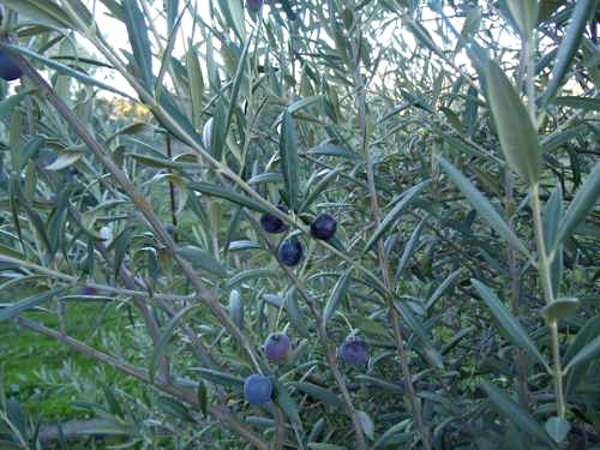
There are seemingly endless varieties of olives; some are as tiny as a fingernail, others are as large as a plum, and varying types are grown in Lake County.
The blend of olive varieties, as well as the ratio of ripe to green olives, contributes to each oil’s unique taste. It can be said that the complexity of producing a fine olive oil is akin to producing a fine wine, minus the aging process.
As with wine, there’s a special language to describe the properties of olive oil. Peppery, fruity, and grassy are just a few of the descriptive adjectives thrown around at a tasting.
A third reason to purchase local oils is that you can be assured of the quality.
While the European Union has stringent guidelines for what’s sold on that continent (and the California Olive Oil Council has a voluntary certification process for extra virgin olive oil), there is no such safeguard for olive oil marketed in the U. S. Hence, almost anything can be called “extra virgin” and sold here.
Unfortunately, there have been numerous documented cases where imported oils have been falsely labeled as extra virgin olive oil.
In contrast, local growers produce ONLY oil that comes from virgin oil production and can truly be called “extra virgin.”
Lake County olive oil producers include Chacewater Winery and Olive Mill of Kelseyville, home to one of the only olive presses in the area. In addition to pressing their own certified organic olives, they process olives for other local growers. Their oils, some of which have earned medals, are available via their website or at their tasting room.
Loasa Farms, also in Kelseyville, is the olive oil-producing arm of Dorn Vineyards. Their oil can be purchased at the Lake County Farmers Finest market, which is held year-round on Saturdays at the fairgrounds in Lakeport.
Rosa d’Oro Vineyards, makers of Italian varietal wines, produces a Tuscan blend olive oil available on their website or at their tasting room located at their Kelseyville vineyard. The folks at Rosa d’Oro Vineyards were instrumental in creating the Kelseyville Olive Festival, now a yearly tradition.
Olivopolis, an olive ranch in Jerusalem Valley north of Middletown, has a Tuscan blend oil available at a couple of venues in Lake County: the Laujor Estate Winery near Kelseyville and Hardester’s Markets in Middletown or Hidden Valley Lake. Their Tuscan blend and a new single varietal oil may also be purchased on their website.
Villa Barone Olive Orchard, also in Jerusalem Valley and with their own olive press, has produced a lot of Lake County olive oil; however, according to their website, they will soon stop selling due to retirement plans. For now, it can be purchased at Hardester’s Markets in Middletown and Hidden Valley Lake, as well as through Lake County Organics Plus, a local organic food delivery service.
They will continue to fill orders through their website while supplies last, and once management of their orchard has been worked out post-retirement, oils from their trees may be available again in the future.
I was happy to learn that another Lake County olive oil may be on the horizon. Stonehouse Cellars of Clearlake Oaks plans to bottle oil from their 2020 olive harvest, their first. Depending on availability, it should be sold at the Lake County Farmers Finest market in Lakeport.
For longest shelf life, olive oil should be in dark bottles as clear glass allows light to deteriorate the oil. Be sure not to use oil that has a rancid smell. Store your olive oil in a cool, dark place.
Once opened, I store mine in the refrigerator to guarantee freshness, though this is not necessary if you go through your opened bottle in a reasonable amount of time. If stored in the fridge, it will solidify, so I place the bottle in a bowl of warm water for a few minutes to liquefy the oil for use.
Today’s recipe is for a simple mixed olive tapenade, which is especially delightful when made with a flavorful local oil. Served as an appetizer or as an addition to a light meal, tapenade is typically paired with little bread toasts known as crostini in Italian or crouton in French. Directions for making these little toasts are also below. Enjoy!
Tapenade
1 cup high-quality black and green olives, any combination (have fun choosing them at an olive bar!)
1 tablespoon capers
2 cloves garlic
2 tablespoon extra-virgin olive oil
1 teaspoon lemon juice
Freshly ground black pepper, to taste
Coarsely chop all ingredients in a food processor fitted with a steel blade. (Be careful not to over-process, as tapenade should not be smooth.) If stored in a tightly covered container, tapenade should keep for up to a month in the fridge. Add some extra virgin olive oil to moisten it when needed before serving. Serve on crackers or little toasts (recipe below). If desired, spread toasts first with cream cheese or goat cheese before topping with tapenade.
To make the little toasts, slice a baguette and brush each piece with olive oil. Toast the slices on a baking sheet in a 400-degree oven for several minutes until the outside is brown and toasty and the inside is soft. (You can test this by pressing lightly with your finger.) For an added treat, rub a fresh garlic clove lightly over the pieces.
Recipes by Esther Oertel.
Esther Oertel is a writer and passionate home cook from a family of chefs. She grew up in a restaurant, where she began creating recipes from a young age. She’s taught culinary classes in a variety of venues in Lake County and previously wrote “The Veggie Girl” column for Lake County News. Most recently she’s taught culinary classes at Sur La Table in Santa Rosa. She lives in Middletown.