 How to resolve AdBlock issue?
News
- Details
- Written by: Lake County News reports
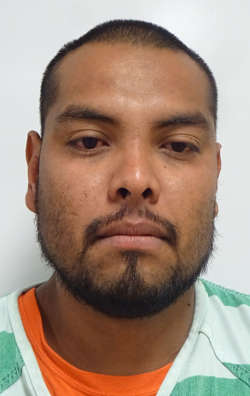
LAKE COUNTY, Calif. – A Clearlake man has been sentenced to state prison for setting a June fire that occurred east of Clearlake Oaks.
On Monday, Judge J. David Markham sentenced Jose Feliciano Medina Jimenez, 27, to four years in state prison for felony violations of arson of forest land and resisting executive officers by means of threat or violence, said Chief Deputy District Attorney Richard Hinchcliff.
At the same time, Hinchcliff said Judge Markham ordered Jimenez to register as an arson offender for the rest of his life.
Sheriff’s deputies responded to the area of Mule Skinner Road and Highway 20 east of Clearlake Oaks on June 20 in response to a vegetation fire, as Lake County News has reported.
Sheriff’s Deputy Matthew McCabe arrived and contacted Jimenez standing in the middle of Highway 20 waving his arms, according to investigative reports by the Lake County Sheriff’s Office and Cal Fire.
When McCabe attempted to speak to Jimenez, Jimenez removed a large knife from his pocket. Jimenez ignored numerous commands to drop the knife and walked toward McCabe twice with the knife in his hand, the investigative reports said.
After about 10 minutes McCabe was able to get Jimenez to get rid of the knife and was able to handcuff Jimenez. When McCabe tried to place him in his patrol vehicle Jimenez began violently thrashing around, based on the reports.
Jimenez was placed in the vehicle with the assistance of other deputies arriving on the scene. One officer suffered a laceration to his knee, authorities reported.
While in the patrol vehicle, authorities said Jimenez attempted to kick the door open. When deputies opened the door Jimenez jumped out of the vehicle toward the deputies and violently resisted the deputies. The deputies were able to restrain Jimenez with a leg restraint and end his resistance and combativeness.
The reports said a Bic lighter was located in Jimenez’s pocket and he was determined to be under the influence of methamphetamine.
Deputy Antonio Castellanos and Cal Fire arson investigator Gary Uboldi interviewed Jimenez. The reports said Jimenez admitted starting the fire, claiming he became paranoid from the methamphetamine and believed people were spying on him and were going to hurt him.
Jimenez admitted to starting the fire in an effort to get the people to leave. He also admitted to starting the fire in an area with plywood and tires near a tree where it was dry and would be conducive to starting a fire, officials said.
Jimenez also admitted that at the time all of this occurred he had been working cultivating and tending marijuana plants on the property. The sheriff’s reports said deputies eradicated 352 marijuana plants from the property.
Cal Fire investigators Gary Uboldi and Brandon Bertolino conducted the origin and cause investigation for the fire, which fire officials said burned six acres and was quickly suppressed by Cal Fire using multiple engines and aircraft.
Cal Fire prevented the fire from possibly burning hundreds or thousands of acres and numerous structures due to the dry conditions and rural, brushy and steep terrain in the area, Hinchcliff said.
Hinchcliff said Jimenez’s prior criminal history included a conviction in 2017 for driving under the influence causing injury and two federal convictions in 2014 and 2018 for illegal entry into the United States.
Hinchcliff, who handles most of the fire-related prosecutions for Lake County including this case, charged Jimenez with arson, resisting officers and marijuana cultivation. Thomas Feimer was appointed as a public defender to represent Jimenez.
On Aug. 4, pursuant to a plea agreement negotiated with the District Attorney’s Office, Jimenez pleaded no contest to felony arson of forest land and felony resisting officers, with an agreed-upon potential sentence of up to four years state prison, Hinchcliff said.
At the Tuesday sentencing, in addition to sentencing Jimenez to four years in prison and ordering him to register as an arson offender, Hinchcliff said Judge Markham also ordered him to pay $1,200 in restitution.
Hinchcliff said restitution also was reserved for Cal Fire.
- Details
- Written by: Elizabeth Larson
The complex, which has been burning for two weeks following a round of lightning storms, remained at 375,209 acres on Monday, with containment up to 66 percent, Cal Fire said.
The fires on the complex include the 317,609-acre Hennessey, burning in Colusa, Lake, Napa, Solano and Yolo counties, which is 64-percent contained; the Walbridge fire west of Healdsburg, at 54,940 acres and 70-percent contained; and the Meyers fire north of Jenner, which remains at 2,360 acres and 99-percent containment, according to Cal Fire’s Monday evening report.
Assigned resources have begun to be reduced slightly. On Monday, Cal Fire said there were 2,730 personnel, 277 engines, 59 water tenders, 19 helicopters, 46 hand crews and 59 dozers.
Cal Fire reported that the number of structures threatened by the complex is down to 3,375 – about a tenth of what it was at its height – with structures destroyed remaining at 1,209 and those damaged at 193.
Much of the structure damage has been in Napa, Solano and Sonoma counties. To date, nine structures – eight of them homes – have been reported destroyed in Lake County.
Evacuation orders and warnings for parts of southern Lake County remained in place on Monday night, Cal Fire reported.
Those included evacuation orders for part of Jerusalem Valley and east of Hidden Valley Lake, east of Middletown and the Lower Lake area west of the Lake County line, while evacuation warnings are still in effect for Middletown and Lower Lake.
Email Elizabeth Larson at
- Details
- Written by: Lake County News reports
The soldiers are due to arrive early this week from the 14th Brigade Engineer Battalion, 2nd Stryker Brigade Combat Team, 2nd Infantry Division, I Corps, from Joint Base Lewis-McChord, Washington.
The soldiers will be deployed on the August Complex on the Mendocino National Forest after conducting additional ground training and fireline certification.
The August Complex started on August 17, 2020, from 37 different lightning fires. Many of those fires have been contained or have merged to form larger fires. As of Monday night, the Complex was 236,288 acres and 20-percent contained.
“This support will provide additional capacity to ensure firefighting resources are available to respond to ongoing and emerging wildfires in California,” said Randy Moore, regional forester for the Pacific Southwest Region. “I thank the U.S. military for their continued support with these soldiers, as well as C-130 aircraft, equipped with Modular Airborne Fire Fighting Systems units. Their assistance with wildfire suppression efforts for California’s wildfires is greatly appreciated.”
This is the first active-duty military mobilization for wildfire support in California since the Mendocino Complex Fire in 2018.
U.S. Army North, U.S. Northern Command’s Joint Force Land Component Command (JFLCC) will oversee the operations, providing personnel and command and staff support.
“For more than four decades, the Department of Defense has maintained an interagency agreement with the U.S. Department of Agriculture and U.S. Department of the Interior to provide firefighting support to wildland fire management agencies when requested,” said Lt. Gen. Laura J. Richardson, U.S. Army North (Fifth Army) and JFLCC commander. “During that time, federal military ground forces have mobilized 37 times to support wildland firefighting response efforts, and it is an honor to oversee such a mobilization again in support of our partners and America.”
There are 38 large wildfires currently burning in California, with more than 1.5 million acres burned so far this year.
August Complex incident information is posted on InciWeb.
- Details
- Written by: Lake County News reports
These protections apply to tenants who declare an inability to pay all or part of the rent due to a COVID-related reason.
“COVID-19 has impacted everyone in California – but some bear much more of the burden than others, especially tenants struggling to stitch together the monthly rent, and they deserve protection from eviction,” said Gov. Newsom. “This new law protects tenants from eviction for non-payment of rent and helps keep homeowners out of foreclosure as a result of economic hardship caused by this terrible pandemic.”
Newsom added, “California is stepping up to protect those most at-risk because of COVID-related nonpayment, but it’s just a bridge to a more permanent solution once the federal government finally recognizes its role in stabilizing the housing market. We need a real, federal commitment of significant new funding to assist struggling tenants and homeowners in California and across the nation.”
On Friday, the governor, Senate President pro Tempore Toni G. Atkins and Assembly Speaker Anthony Rendon announced an agreement on the legislation, AB 3088, co-authored by Assemblymembers David Chiu (D-San Francisco) and Monique Limón (D-Santa Barbara) and Senators Steven Bradford (D-Gardena) and Anna Caballero (D-Salinas).
Under the legislation, no tenant can be evicted before Feb. 1, 2021, as a result of rent owed due to a COVID-19 related hardship accrued between March 4 and Aug. 31, 2020, if the tenant provides a declaration of hardship according to the legislation's timelines.
For a COVID-19-related hardship that accrues between Sept. 1, 2020, and Jan. 31, 2021, tenants must also pay at least 25 percent of the rent due to avoid eviction.
Tenants are still responsible for paying unpaid amounts to landlords, but those unpaid amounts cannot be the basis for an eviction. Landlords may begin to recover this debt on March 1, 2021, and small claims court jurisdiction is temporarily expanded to allow landlords to recover these amounts. Landlords who do not follow the court evictions process will face increased penalties under the Act.
The legislation also extends anti-foreclosure protections in the Homeowner Bill of Rights to small landlords; provides new accountability and transparency provisions to protect small landlord borrowers who request CARES-compliant forbearance; and provides the borrower who is harmed by a material violation with a cause of action.
Additional legal and financial protections for tenants include:
– Extending the notice period for nonpayment of rent from 3 to 15 days to provide the tenant additional time to respond to landlord’s notice to pay rent or quit.
– Requiring landlords to provide hardship declaration forms in a different language if rental agreement was negotiated in a different language.
– Providing tenants a backstop if they have a good reason for failing to return the hardship declaration within 15 days.
– Requiring landlords to provide tenants a notice detailing their rights under the Act.
– Limiting public disclosure of eviction cases involving nonpayment of rent between March 4, 2020, and Jan. 31, 2021.
– Protecting tenants against being evicted for “just cause” if the landlord is shown to be really evicting the tenant for COVID-19-related nonpayment of rent.
Existing local ordinances can generally remain in place until they expire and future local action cannot undermine this Act’s framework.
Nothing in the legislation affects a local jurisdiction’s ability to adopt an ordinance that requires just cause, provided it does not affect rental payments before Jan. 31, 2021.