How to resolve AdBlock issue?
Refresh this page
How to resolve AdBlock issue?
Refresh this page
Lake County News,California
  • Home
    • Registration Form
  • News
    • Community
      • Obituaries
      • Letters
      • Commentary
    • Education
    • Veterans
    • Police Logs
    • Business
    • Recreation
    • Health
    • Religion
    • Legals
    • Arts & Life
    • Regional
  • Calendar
  • Contact us
    • FAQs
    • Phones, E-Mail
    • Subscribe
  • Advertise Here
  • Login

City of Lakeport to host water plant open house on May 7

LAKEPORT, Calif. — The city of Lakeport invites the public to a water plant open house on Wednesday, May 7, from 3 to 7 p.m. at 590 Konocti Ave.

This family-friendly event offers the opportunity to tour the city’s state-of-the-art water treatment facility and gain insight into the process of treating Clear Lake water to meet strict drinking water standards.

Attendees will see firsthand how raw lake water is cleaned, tested, and delivered safely to homes and businesses throughout Lakeport.

The open house will include:

• Guided tours of the treatment plant;
• Snacks and light refreshments;
• Balloons and eco-friendly giveaways for children;
• Educational materials on water conservation and public works operations.

“This is a great chance for our community to see the work that goes into providing safe drinking water every day,” said Utilities Director Paul Harris. “We’re proud to show off our facility and help people understand the vital infrastructure behind every drop.”

All ages are welcome. No RSVP is required.

For more information, contact Paul Harris at 707-263-3578 or visit www.cityoflakeport.com.
Details
Written by: LAKE COUNTY NEWS REPORTS
Published: 21 April 2025

401(k) plans and stock market volatility: What you need to know


It’s been a wild ride. iStock/Getty Images Plus

With stock market charts resembling the contours of a roller-coaster ride in recent days, many Americans could be forgiven for eyeing their 401(k)s with a little concern.

Retirement savings are crucial to the financial well-being of millions of especially older people in the U.S., so the concern is understandable.

But just how worried should people be by market fluctuations? And just how big a hit do 401(k)s take when markets fall? The Conversation turned to Western Governors University’s Ronald Premuroso, an expert in this area, for answers.

What is a 401(k)?

Simply put, a 401(k) is an employer-sponsored retirement savings plan in which employees contribute a portion of their compensation on a tax-deferred basis.

The employee is eligible at any age to contribute to a 401(k) plan and has the option to pay into these plans throughout their employment. Many employers match some or all of an employee’s contributions, making the plan even more attractive.

What about withdrawals?

Under Internal Revenue Service rules, someone with a 401(k) is required to start making monetary withdrawals from their plan when they reach age 73. Some people start withdrawing at an earlier age.

Someone with a 401(k) can withdraw funds from the plan early, and at any time. But the money amounts withdrawn will typically be deemed taxable income. In addition, those age 59 and a half and under will likely face a 10% penalty on the withdrawal, unless the employer’s plan allows for hardship distributions, early withdrawals or loans from your plan account.

The IRS has specific rules for these early withdrawals; if you find yourself in this situation, you should get help from a tax professional.

All withdrawals starting at age 73, which tax professionals call “RMDs,” are then taxable in retirement – presumably at a lower tax rate than the employee was subject to while employed and working. So these withdrawals starting at age 73 can be a very tax-efficient way of financial planning, including personal income tax planning, for later in life, especially in one’s retirement years.

Again, it’s important to get help from a tax professional to make sure you meet the IRS’ RMD dollar withdrawal requirements once you start withdrawing.

In calendar-year 2025, the most that an employee can contribute to a tax-deferred 401(k) plan annually is US$23,500, including the employer’s match. “Super catch-up contributions are allowed for employees over the age of 50 to their employer’s 401(k) plan each year indexed to inflation. In 2025, super catch-up contributions allow individuals age 50 and older to contribute an additional $7,500 beyond the standard limit, bringing their total annual contribution to $31,000. For those turning age 60, 61, 62 or 63 in 2025, the SECURE Act 2.0 allows a higher catch-up contribution limit of $11,250, resulting in a total allowable contribution of $34,750 in 2025.

When and why did 401(k)s become popular?

Before 1978, retirement savings options were limited.

In 1935, Congress created the Social Security Retirement Plan. This was followed by the Employee Retirement Income Security Act of 1974, which created individual retirement accounts, or IRAs, as a way for employees to save tax-deferred money for their retirement.

401(k) plans became popular with the passage of the Revenue Act of 1978 by Congress.

Congress saw 401(k) plans at that time as an alternative way to supplement Social Security benefits that all eligible Americans are entitled to receive upon retirement. In 1981, the IRS issued new rules and regulations allowing employees to fund their 401(k)s through payroll deductions. This significantly increased the number of employees contributing to their employers’ 401(k) plans.

As of September 2024, Americans held $8.9 trillion in 401(k) plans, according to the Investment Company Institute. A study published by the Pension Rights Center toward the end of 2023 using data provided by the Bureau of Labor Statistics concluded that 56% of all workers – including private sector and state and local government workers – participate in a workplace retirement plan. That equates to 145 million full- and part-time workers.

How are 401(k) plans affected by market rises and falls?

Contributions to a 401(k) are typically invested in a variety of financial instruments, including in the stock market.

Most 401(k) plans offer investment options with varying levels of risk, allowing employees to choose based on their personal comfort levels and financial goals.

Employers typically outsource the management of these 401(k) plans to third parties. Some of the largest companies managing 401(k) funds on behalf of employers and employees include Fidelity Investments, T. Rowe Price and Charles Schwab, to name just a few.

Because many of these investments are tied to the stock market, 401(k) balances can rise or fall with market fluctuations.

An elderly lady sits at a table with papers in front of her.
401(k) plans are a financial lifeline for many American retirees. Halfpoint Images/Getty Images

Should I be worried about the stock market tanking my 401(k)?

It depends – on when you started making contributions, when you plan to retire and when you expect to start making withdrawals.

Employees with 401(k) accounts should only be worried about falling stocks if they need the money right now – either for retirement living expenses or for other emergency reasons. If you don’t need to take money out soon, there’s usually no reason to panic. History has shown that markets can rebound quickly; short-term drops often don’t signal long-term trends.

Over time, the stock market has experienced many periods of falling stock prices: the bursting of the internet bubble of 2000; the period after the events of 9/11; and the U.S. and global banking crisis of 2007-2010, to name but three.

But overall, over time, stock market returns have averaged 9% from 1994 to 2024, and this includes the periods of falling stock prices mentioned above.

So even if you are a baby boomer heading for retirement and your 401(k) has taken a hit in recent weeks, don’t panic. Bear in mind the truism that stock markets can always go down as well as up.

History suggests that in the long run, depending upon your plans and timing for retirement, working together with a trusted financial adviser strategically with regard to your 401(k) retirement savings is a good approach, especially during periods like we have seen in recent weeks in the stock market.

This article is for informational purposes and does not constitute financial advice. Consult with a qualified financial adviser before making financial decisions.The Conversation

Dr. Ronald Premuroso, Accounting Instructor, Western Governors University School of Business

This article is republished from The Conversation under a Creative Commons license. Read the original article.
Details
Written by: Dr. Ronald Premuroso, Western Governors University School of Business
Published: 21 April 2025

Tuleyome Tales: California buckeye – elegance in every season

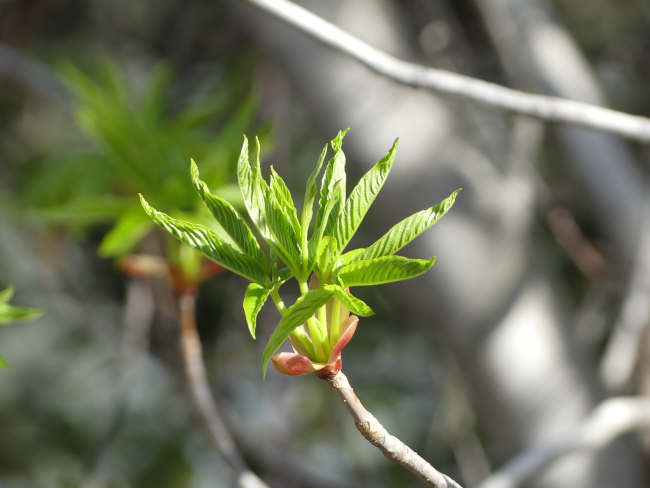
California Buckeye leaves emerging. Photo by Roxanne Moger.


NORTHERN CALIFORNIA — My favorite way of enjoying nature is to watch small changes unfold over the seasons, to visit the same tree for example, throughout the year and see the passing of time written in the branches.

Our native California buckeyes (Aesculus californica) are a feast for the eyes in every season and one of my favorites to visit in this way.

California buckeyes have a graceful appearance with elegant silver-gray bark and branches that meander gently as they lengthen.

Growing in both shrub and tree forms, between 15 and 40 feet, they typically have multi-trunked structures, and rounded crowns that grow as wide as they do tall, giving them a pleasing symmetry.

Aesculus californica are endemic to California and southern Oregon, meaning that they are not found growing naturally anywhere else.

Paleobotanists (scientists who study the evolutionary history of plants) consider them a paleoendemic species, indicating they were once much more widespread, their range restricted over time to a smaller more specialized geographic area.

Today California buckeyes grow along the central coast ranges, in the foothills of the Sierra Nevada and Cascade ranges and in woodlands throughout the Central Valley. They can be found on dry slopes, in canyons, and along stream edges providing natural erosion control, and have been known to live up to 300 years.

These gorgeous trees are a beautiful example of the resilience of California native plants to the challenges of our Mediterranean climate, with hot dry summers and mild wet winters. These adaptations are part of what make this tree so dynamic and compelling to observe.

In mid to late winter Aesculus californica is one of the first trees of the year to put out new foliage, their soft chartreuse buds bursting with new growth as early as February. This early start helps them to take advantage of the winter rains while avoiding the heat of late summer.

By March and April their branches will be flush with shiny dark green, palmately-compound leaves up to 7 inches around. Each leaf has 5 to 7 oblong-lanceolate leaflets, with finely serrated edges radiating from a single point, like fingers on a hand.

The leaves alone are beautiful, but California buckeyes really begin showing off in May and June with their stunning floral displays. In full bloom, the tree looks like a giant bouquet. The flowers form in panicles, conelike clusters between 6 to 12 inches in length, made up of many pink and cream blooms, with four delicate petals, and long stamens carrying bright orange pollen.

Abundant blooms provide nectar to hummingbirds, butterflies, moths, and many species of native bees which in return provide the service of pollination. Most commonly one or two buckeyes will develop per flower cluster, each resembling a small green pear.

California buckeye trees have developed several clever ways to protect themselves and ensure reproductive success. One of those strategies is that all parts of the tree are poisonous to humans and other mammals.

Toxicity increases the chances of their seeds being left to sprout rather than being eaten in large numbers and ensures that their leaves will not be overgrazed. Tender early leaf growth has lower levels of toxicity and is sometimes grazed upon by deer and California ground squirrels are the only mammal adapted to the toxicity of raw buckeye seeds.

These protective toxins are also present in the nectar and pollen of the tree. Native bees have coevolved with the trees in our region and are able to tolerate the toxins, whereas European honeybees, brought to North America by European settlers in the early 1620s, are not adapted to these toxins and can be harmed if they consume the nectar in large quantities.

Beekeepers have found ways of mitigating the risks to European honeybees by planting other plants with similar bloom times nearby, allowing for a wider range of nectar sources thereby reducing the risk of overconsumption by a hive, or by moving hives during the buckeye flowering period.

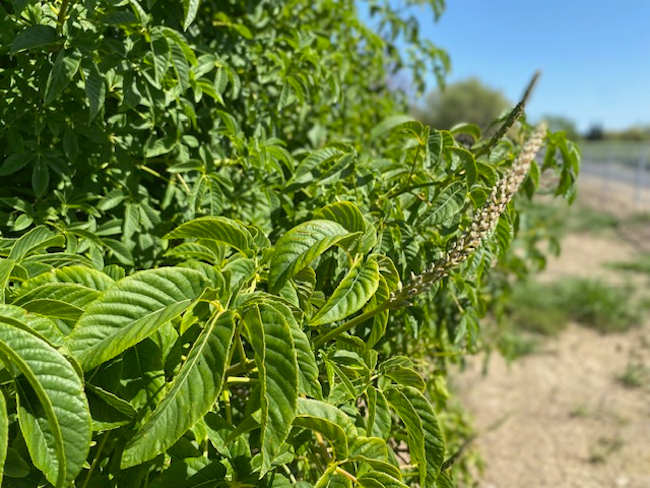
California Buckeye leaves and unopened flowers. Photo by Kristie Ehrhardt.


While European honeybees are the most recognizable bee to most of us, California is home to over 1600 species of native bees, many of whom depend on California buckeye blooms for nectar. California native bees range in size from the Perdita minima (currently known to be the smallest bee in the world!) measuring just under two millimeters, to our largest species, the Valley Carpenter Bee or Xylocopa varipuncta that grow up to an inch in length.

Visiting a California buckeye in bloom is a fantastic opportunity for curious naturalists and hikers to get to know some of our native pollinators.

California buckeyes are a culturally significant plant for many indigenous Californians. Various parts of the buckeye tree were used for medicine, and fire drilling. Buckeye seeds were used for fishing, by mashing the seeds and pouring them into water, which dazed or killed fish, making them easier to catch.

Many indigenous Californian peoples including Costanoan, Salinan, Kitanemuk, Serrano, Wappo, Sierra Miwok, Coast Miwok, Chumash, Kawaiisu, and Northern Maidu used buckeye seeds for food in times of scarcity, while the Pomo used them even when other food sources were plentiful.

Raw buckeyes are poisonous, but after an extensive process of grinding, boiling and leaching the toxic tannins, a meal could be formed for use in cooking, similar to the process of leaching toxins from acorns.

Most deciduous trees hold onto their leaves until October or November, but California buckeyes are summer deciduous, dropping their leaves in July and August when temperatures are high and water is scarce. Going dormant in midsummer, the tree conserves water, and is more resistant to drought, another clever adaptation to our intense summers.

Leaves gone, the pear-shaped buckeyes are left hanging like ornaments on the branches. As summer turns to fall, the husks dry, split open, and the glossy brown-orange buckeye is revealed giving a sense of the tree’s namesake, the eye of a deer.

In October and November buckeye seeds begin falling to the ground, leaving the branches ever more graceful in their simplicity. The tree will remain dormant until February comes and starts the process anew and last year’s fallen buckeyes will begin sending down their tap roots shortly after the first rain.

The best way to plant a buckeye is to grow one from a freshly fallen seed, as they dry out quickly. Plant them directly in the ground rather than in a pot which can inhibit the tap root and stunt the tree long term. Once established they are drought tolerant, easy to maintain and provide dynamic nature watching and beauty throughout the year.

Diana Drips is a Certified California Naturalist. Tuleyome is a 501 (c)(3) nonprofit conservation organization based in Woodland, California. For more information go to www.tuleyome.org. 
Details
Written by: Diana Drips
Published: 20 April 2025

Helping Paws: Dogs for Easter

LAKE COUNTY, Calif. — Lake County Animal Care and Control has dogs waiting for their new homes at Easter.

The dogs available for adoption this week include mixes of Australian shepherd, border collie, bull mastiff, Catahoula leopard dog, cattle dog, Chihuahua, French bulldog, German shepherd, husky, Labrador Retriever, pit bull terrier, poodle, Rottweiler and Siberian husky.

Dogs that are adopted from Lake County Animal Care and Control are either neutered or spayed, microchipped and, if old enough, given a rabies shot and county license before being released to their new owner. License fees do not apply to residents of the cities of Lakeport or Clearlake.

Those dogs and the others shown on this page at the Lake County Animal Care and Control shelter have been cleared for adoption.

Call Lake County Animal Care and Control at 707-263-0278 or visit the shelter online for information on visiting or adopting.

The shelter is located at 4949 Helbush in Lakeport.

Email Elizabeth Larson at This email address is being protected from spambots. You need JavaScript enabled to view it.. Follow her on Twitter, @ERLarson, and on Bluesky, @erlarson.bsky.social. Find Lake County News on the following platforms: Facebook, @LakeCoNews; X, @LakeCoNews; Threads, @lakeconews, and on Bluesky, @lakeconews.bsky.social.


Oliver's preview photo
Oliver

Mila's preview photo
Mila

Charles's preview photo
Charles

Toby's preview photo
Toby

Timmy's preview photo
Timmy

Mister's preview photo
Mister

O'Reiley's preview photo
O'Reiley

Billy's preview photo
Billy

Chuck's preview photo
Chuck

Lady's preview photo
Lady

Hershey's preview photo
Hershey

Pinto's preview photo
Pinto

Argo's preview photo
Argo

Sadie's preview photo
Sadie

 
Finn's preview photo
Finn

Rome's preview photo
Rome

Karl's preview photo
Karl

Kiley's preview photo
Kiley

Marjorie's preview photo
Marjorie

Lisa's preview photo
Lisa

Maggie's preview photo
Maggie

Talley's preview photo
Talley

Kennel#26(Booty)'s preview photo
Kennel#26(Booty)

Bristol 's preview photo
Bristol

Zena's preview photo
Zena

Kennel#17's preview photo
Kennel#17


Kennel#6's preview photo
Kennel#6

Kennel#8's preview photo
Kennel#8

Kennel#2's preview photo
Kennel#2
Details
Written by: Elizabeth Larson
Published: 20 April 2025
  • 300
  • 301
  • 302
  • 303
  • 304
  • 305
  • 306
  • 307
  • 308
  • 309

Public Safety

  • Lakeport Police Department celebrates long-awaited new headquarters

  • Lakeport Police Department investigates flag vandalism cases

  • Lakeport Police Department thanks Kathy Fowler Chevrolet for donation

Community

  • Hidden Valley Lake Garden Club installs new officers

  • 'America's Top Teens' searching for talent

  • 'The Goodness of Sea Vegetables' featured topic of March 5 co-op talk

Community & Business

  • Annual 'Adelante Jovenes' event introduces students, parents to college opportunities

  • Gas prices are dropping just in time for the holiday travel season

  • Lake County Association of Realtors installs new board and presents awards

  • Local businesses support travel show

  • Preschool families harvest pumpkins

  • Preschool students earn their wings

How to resolve AdBlock issue?
Refresh this page