How to resolve AdBlock issue?
Refresh this page
How to resolve AdBlock issue?
Refresh this page
Lake County News,California
  • Home
    • Registration Form
  • News
    • Community
      • Obituaries
      • Letters
      • Commentary
    • Education
    • Veterans
    • Police Logs
    • Business
    • Recreation
    • Health
    • Religion
    • Legals
    • Arts & Life
    • Regional
  • Calendar
  • Contact us
    • FAQs
    • Phones, E-Mail
    • Subscribe
  • Advertise Here
  • Login

California exceeds 4 million MyShake app downloads; Californians urged to be prepared

During Earthquake Preparedness Month, Gov. Gavin Newsom on Friday announced a major milestone: the MyShake app — which alerts Californians before an earthquake begins — has surpassed 4 million downloads, the equivalent of more than 10% of the state.

This achievement is a significant step in expanding access to California’s life-saving earthquake technology and building resilience across the state.

California’s nation-leading Earthquake Early Warning system notifies residents in advance of shaking by using ground motion sensors across California.

More than 60% of the 1,046 sensors have been installed since the program launched in 2019, making the system more accurate and able to deliver alerts faster.

Last week, the MyShake app distributed 693,044 alerts for the 5.2 magnitude earthquake near Julian in San Diego County, a subset of the total 7.5 million alerts sent out for that event. Some MyShake users received as much as 35 seconds notice before shaking occurred.

“MyShake provides Californians with life-saving seconds before earthquakes strike. This milestone is a proud moment for California, and a reminder that preparedness is a continuous effort. We urge everyone to spread the word to friends, family, neighbors, and co-workers to download this critical tool,” said Gov. Newsom.

The California Earthquake Early Warning System combines the MyShake smartphone application with traditional alert and warning delivery methods such as Wireless Emergency Alerts, or WEA.

Now, with the integration of early warning technology within the most popular smartphone devices, the system can deliver alerts to most Californians.

Since its inception, MyShake has delivered more than 5 million alerts for nearly 170 earthquakes.

The MyShake app is free, easy to use, and available in six languages (English, Spanish, Chinese (Traditional), Tagalog, Korean, and Vietnamese). It can be downloaded on iOS, Android, and Chromebooks. The app contains earthquake and tsunami preparedness information not found in other alerting platforms and includes the secure Homebase feature which allows users to set a default location where they can receive earthquake early warning alerts even if location services are temporarily down or turned off.

Californians are also encouraged to pair earthquake early warning with the Cal OES Earthquake Readiness Guide. This recently released comprehensive guide offers clear, easy-to-follow earthquake safety tips, explains essential preparedness steps, and how Californians can take protective actions before, during, and after an earthquake. Download the guide here today to ensure you and your loved ones are prepared.

To learn more about earthquake preparedness and download the MyShake earthquake early warning application, visit: www.earthquake.ca.gov.
Details
Written by: LAKE COUNTY NEWS REPORTS
Published: 26 April 2025

Space News: Dark energy may have once been ‘springier’ than it is today − DESI cosmologists explain what their collaboration’s new measurement says about the universe’s history


The Mayall 4-meter Telescope at the Kitt Peak National Observatory houses the DESI instrument. KPNO/NOIRLab/NSF/AURA/P. Marenfeld

Gravity pulls us to earth, a lesson you learn viscerally the first time you fall. Isaac Newton described gravity as a universal attractive force, one that holds the Moon in orbit around the Earth, the planets in orbit around the Sun, and the Sun in orbit around the center of our galaxy.

In the 1990s, astronomers made the astonishing discovery that the expansion of the universe has sped up over the past 5 billion years, which implies that gravity can push as well as pull.

Einstein’s theory of general relativity explains gravity as a consequence of curved space-time, where it allows for both attraction and repulsion. However, producing gravitational repulsion requires a new form of energy with exotic physical properties, often referred to as “dark energy.”

New results from a large survey of the universe, announced in March 2025, are challenging the conventional picture of dark energy.

Dark energy and cosmic expansion

The simplest explanation for cosmic acceleration assumes a form of energy that fills apparently empty space and stays constant over time, instead of diluting as the universe expands.

In fact, quantum mechanics predicts that “empty” space is filled with particles that flare briefly into and out of existence. At first glance, it seems like this effect could explain a constant dark energy, but no simple estimates of the effect’s magnitude line up with actual observations. Nonetheless, constant dark energy is a simple assumption that has proven successful in explaining many cosmological measurements.

Today’s standard cosmological model incorporates this kind of constant dark energy. It also incorporates atoms and dark matter, which exert the attractive gravity that resists dark energy’s repulsion.

New dark energy measurements

The new measurements from the Dark Energy Spectroscopic Instrument, or DESI, collaboration, which we are affiliated with, pose the sharpest challenge yet to this standard model.

Relative to the constant dark energy predictions, the new DESI measurements suggest that the universe was expanding slightly faster a few billion years ago – by 1% to 3% – before relaxing to the expansion rate predicted today. One explanation for this temporary speed up is that the “springiness” of dark energy – a combination of energy and pressure that determines its repulsive effect – was higher in the past. The springiness then declined as the universe expanded further.

Astronomers can measure the history of the universe from our vantage point in the present because light travels at a finite speed. So, we see distant objects as they were in the past. Cosmic expansion stretches the wavelength of light – a phenomenon known as redshift. A precise measurement of an object’s light can reveal the size of the universe at the time the light was emitted.

The new DESI results are based on measuring the redshifts of more than 14 million galaxies, creating a three-dimensional map that spans 12 billion years of cosmic history. To determine the distances light traveled across this map, DESI measured a subtle feature imprinted on the clustering of these galaxies by acoustic waves that traveled through the early universe.

An exciting result

DESI’s evidence for evolving dark energy comes from combining its own distance and redshift measurements with other measurements of the average density of matter in the universe. The higher the density of matter, the more strongly it can pull against dark energy’s expansive push. The matter density measurements come from the European-led Planck space mission, which mapped structure in the cosmic microwave background.

The combination of DESI and Planck data favors evolving dark energy, instead of constant dark energy, with a statistical significance of 3.1 standard deviations. This result has only a 1 in 500 chance of occurring randomly.

Despite the long odds, physicists consider such a finding to be solid but not overwhelming evidence, in part because even the most careful experimenters may underestimate uncertainties in their measurements.

To strengthen the statistical case, DESI scientists added measurements of cosmic distances made by the Dark Energy Survey collaboration, which applied a different measurement technique based on the brightness of light from supernova explosions.

The combination of DESI, Planck and Dark Energy Survey supernovae favors the evolving dark energy model by odds of 40,000 to 1. However, other supernova surveys give results that agree more with constant dark energy, so most cosmologists aren’t yet ready to abandon the standard cosmological model.

Even if DESI’s findings hold up, they still can’t say what dark energy is. But they can provide much stronger clues than cosmologists had before.

The DESI-based model implies that dark energy changed its properties surprisingly quickly. Dark energy began to lose its repulsive strength at about the same time it became the dominant form of energy in the cosmos.

Extrapolating to the past, this model also implies that dark energy once had an extraordinary springiness, at a level that no simple theory of a dark energy field can explain. As future data sharpens these measurements, the findings could point us in a weird new direction – perhaps even challenging Einstein’s theory of gravity itself.

A figure showing that as the universe gets older, the amount of evolving dark energy increases, then decreases slightly.
In the model that fits the DESI data, the density of dark energy goes up and then declines, shown as a blue curve, instead of staying constant as assumed in the standard cosmological model, indicated by the horizontal dotted line. In either case, the density of atoms and dark matter dilutes as the universe expands, shown as a red curve, and today it is only about half that of dark energy. The repulsive effect of dark energy began to exceed the attractive effect of matter when the universe was about 8 billion years old, marked as ‘acceleration begins.’ David Weinberg

An ambitious experiment

DESI is an extremely ambitious undertaking and an example of “big science” at its best. The instrument itself is mounted on the 4-meter Mayall Telescope at the Kitt Peak National Observatory. It uses 5,000 optical fibers mounted on tiny robotic positioners that guide the light from individual galaxies to scientific instruments that dissect that light and record the data for measuring redshifts.

Every 15 minutes, the telescope shifts to a new area of the sky, and the robots move the fibers to point to 5,000 new galaxy locations. After five years of design and construction, DESI has operated continuously since 2021.

A panel with lots of tiny sensors arranged in alternating lines.
A close-up of the DESI focal plane showing a few of the 5,000 fiber positioners. The white spots inside the bluish circles are the optical fibers that guide the light collected from distant galaxies to the spectrographs about 40 meters away. Dr. Claire Poppett, DESI Collaboration

Led by the Department of Energy’s Lawrence Berkeley National Laboratory, DESI is a collaboration of over 900 scientists at 70 institutions around the world. At our university alone, more than 20 faculty, students, postdocs and research staff have worked on DESI over the past decade.

This work includes contributions to building and installing spectrographs, which measure the properties of light, as well as writing software to record data, leading instrument operations, observing and troubleshooting at the telescope, designing galaxy and quasar surveys, creating catalogs for statistical analysis, testing measurement techniques with computer simulations, interpreting results and writing papers – all in tight communication with our collaborators.

If the evidence for evolving dark energy holds up — and despite our instinctive caution, we think it has a good chance of doing so — it will join a list of remarkable 21st-century discoveries achieved with large U.S. national investments.

These discoveries include the first detection of gravitational waves by the National Science Foundation-funded Laser Interferometer Gravitational-Wave Observatory, LIGO, and the spectacular measurements of galaxies and exoplanet atmospheres by NASA’s James Webb Space Telescope.

These achievements show what the support of science by U.S. taxpayers and dedicated, creative researchers across the globe can accomplish.The Conversation

David Weinberg, Professor of Astronomy, The Ohio State University; Ashley Ross, Research Assistant Professor of Physics, The Ohio State University; Klaus Honscheid, Professor of Physics, The Ohio State University, and Paul Martini, Professor of Astronomy and Physics, The Ohio State University

This article is republished from The Conversation under a Creative Commons license. Read the original article.
Details
Written by: David Weinberg, The Ohio State University; Ashley Ross, The Ohio State University; Klaus Honscheid, The Ohio State University, and Paul Martini, The Ohio State University
Published: 26 April 2025

Kelseyville High School Senior Ryan Taylor elected to state FFA leadership

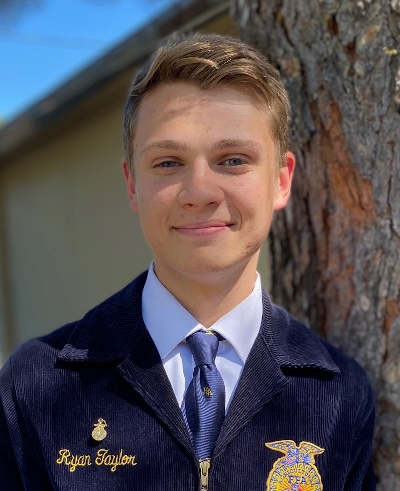
Kelseyville High School senior Ryan Taylor, who has been elected as the California State Future Farmers of America’s secretary for the 2025-26 year. Photo courtesy of the Kelseyville Unified School District.

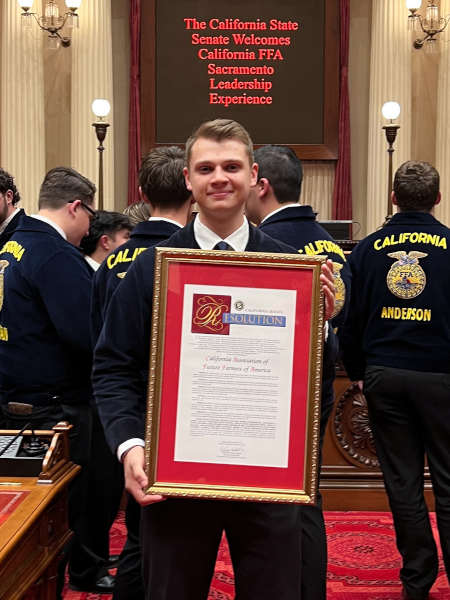
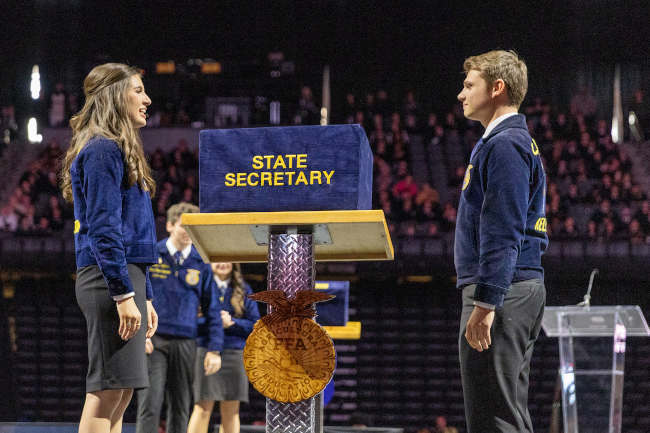
KELSEYVILLE, Calif. — Earlier this month at the 2025 California State Future Farmers of America, or FFA, Leadership Conference, Kelseyville High School senior Ryan Taylor was elected to the state’s executive leadership team as secretary for the 2025-26 year.

To fulfill this role, Taylor will defer his acceptance to Stanford University for a year while he works with his fellow officers to lead the more than 104,000 FFA members statewide.

Taylor was one of 64 applicants who went through paper screening. Prior to the conference, the State FFA Nominating Committee, consisting of two FFA delegates from each of the six regions, went through the applications and video submissions narrowing the 64 to 38.

Taylor then went through seven rounds of interviews with four sequential cuts over the course of about 48 hours, and was eventually named to the slate of 12 officer candidates, two candidates per position.

Each group of two had to answer two one-minute questions on stage in front of the voting delegates. Taylor said he was honored to have been chosen.

FFA’s mission is to make a positive difference in the lives of students by developing their potential for premier leadership, personal growth and career success through agricultural education.

Taylor will be part of the student leadership team that hosts conferences, mentors and trains other FFA leaders, and generally makes sure FFA continues to be a “well-oiled machine,” he explained.

“State office is a one-year commitment outside of high school. So the day after graduation, I will move out to the state officer house in Galt, where I’ll live with my five teammates for the extent of one year. We’ll work with Hugh Mooney, who is our assistant state FFA adviser,” Taylor continued.

Taylor was first introduced to FFA when he enrolled in an agricultural biology class his freshman year taught by Donelle McCallister, who is also one of four FFA Advisors. By the end of the year, Taylor’s passion for FFA had blossomed.

During the next few years, he attended FFA conferences and earned awards at speaking competitions and as a member of his welding team. He was elected to leadership roles, first for his chapter then for his region. He says each time he achieved a goal, McCallister and other advisors, including teachers Michael Zeni, Heather Koschik, and Maille McCallister, would encourage him to challenge himself at the next level.

“They've pointed out the next steps, given me the opportunities, and they've gotten me to where I am today–both because they've shown me how to do it, what I can do, and then also just giving me encouragement along the way to keep on keeping on,” Taylor said.

Kelseyville High School senior Ryan Taylor was elected the California State Future Farmers of America’s secretary for the 2025-26 year in April. Photo courtesy of the Kelseyville Unified School District.

And by keeping on, he says he learned a lot.

“The biggest lessons were around personal growth and self-sufficiency. FFA encourages people to be the best versions of themselves that they can possibly be. For me that meant doing well in school, making sure I could at least try with every opportunity. Even if failure or rejection was there, it's just redirection to something that I'm going to end up being better at, or it's an opportunity to become better at the thing that I failed at,” he said.

He also believes FFA keeps some students engaged in school who otherwise would not be.

“FFA encompasses so many things that a classroom doesn't. It's a lot more vocational. It has more job aspects to it. It's more hands-on, and it requires a lot more critical thinking than standard education does,” he said.

He encouraged incoming Kelseyville High freshmen to get involved early.

“Everybody's scared as a freshman, and nobody wants to have that initiative to take that first step to see what is out there,” Taylor said. “A lot of them want to stay in their classrooms where they're comfortable with the teachers, where they can be with their friends, pass their classes, and move on with their life. And then usually sophomore, junior, senior years, they're no longer the littlest fish in the ocean, so they can start branching out a little bit more. But getting involved as a freshman gives you a whole extra year to explore what high school has to offer you. So I think that getting involved is definitely the best thing that freshmen can do.”

Kelseyville High School senior Ryan Taylor at the State Capitol. Photo courtesy of the Kelseyville Unified School District.
Details
Written by: LAKE COUNTY NEWS REPORTS
Published: 25 April 2025

Poll: California residents demand governor and lawmakers control skyrocketing utility bills

California utility consumers are demanding lawmakers rein in skyrocketing rates and hold for-profit investor owned utilities accountable, according to new polling data from David Binder Research released by The Utility Reform Network and California Environmental Voters.

California voters overwhelmingly expressed strong concern about excessive skyrocketing utility bills.

By a strong majority, California residents ask that lawmakers rein in rate increases and protect consumers:

• 82% of California voters are concerned about the cost of their monthly electric bill.
• 79% of California voters agree the government should do more to limit price increases.
• 93% of California voters agree utilities should not charge customers for wasteful spending, including lobbying, PR, and marketing campaigns.
• 91% of California voters support ending excessive utility profits to cut consumer costs.
• 80% of Gen Z Voters agree fossil fuel companies should pay for rising electricity bills.

“It is clear from the polling data that California residents expect their elected representatives to take action now, and pass legislation that will limit utility overspending, trim record-breaking corporate profits, support public financing to reduce long-term costs, and provide short-term ratepayer relief,” said Mark Toney, executive director of The Utility Reform Network.

The polling data follows multiple, egregious rate hikes from California’s major for-profit utilities, who touted excessive profits while customers struggled to make ends meet.

PG&E, who had six rate hikes in 2024, enjoyed a 10% increase in profits from 2023 to 2024, similar to SoCalEdison who enjoyed a 9.8% profit increase from the year prior.

Advocates point to wasteful spending and misuse of ratepayer funds as a key source of high utility bills — issues advocates hope will be remedied by new legislation.

“California families are being further spun into an affordability crisis while for-profit utilities continue to hike up rates to increase shareholder profits. Consumers have footed the cost of utility overspending and misuse of ratepayer funds for too long. As the climate crisis worsens and extreme weather becomes more frequent, equitable access to affordable power is especially important. Now, California voters are demanding lawmakers deliver on their promises to prioritize electricity affordability by reining in utility profits and protecting consumers,” said Mary Creasman, chief executive officer of California Environmental Voters.

The Utility Reform Network, or TURN, and EnviroVoters are supporting the Campaign for Affordable Power bill package:

• AB 1167 (Berman, Addis) Prohibits utility misspending of ratepayer dollars.
• AB 1020 (Schiavo): Prevents double-charging and boosts accountability.
• SB 636 (Menjivar): Provides hardship deferments to vulnerable customers.
• SB 330 (Padilla): Promotes alternative financing for transmission to reduce costs.
• SB 24 (McNerney): Prohibits for-profit Investor owned utilities from undermining local establishment of municipal utility districts.

It’s not too late for lawmakers to honor their commitments on affordability, and make proper strides to protect consumers. The polling data sends a clear message to lawmakers and legislative leaders: California voters need affordable power and utility accountability.

Detailed polling results and analysis can be found at https://www.turn.org/campaign-for-affordable-power-cap.
Details
Written by: LAKE COUNTY NEWS REPORTS
Published: 25 April 2025
  • 295
  • 296
  • 297
  • 298
  • 299
  • 300
  • 301
  • 302
  • 303
  • 304

Public Safety

  • Lakeport Police Department celebrates long-awaited new headquarters

  • Lakeport Police Department investigates flag vandalism cases

  • Lakeport Police Department thanks Kathy Fowler Chevrolet for donation

Community

  • Hidden Valley Lake Garden Club installs new officers

  • 'America's Top Teens' searching for talent

  • 'The Goodness of Sea Vegetables' featured topic of March 5 co-op talk

Community & Business

  • Annual 'Adelante Jovenes' event introduces students, parents to college opportunities

  • Gas prices are dropping just in time for the holiday travel season

  • Lake County Association of Realtors installs new board and presents awards

  • Local businesses support travel show

  • Preschool families harvest pumpkins

  • Preschool students earn their wings

How to resolve AdBlock issue?
Refresh this page