How to resolve AdBlock issue?
Refresh this page
Lake County News,California
  • Home
    • Registration Form
  • News
    • Education
    • Veterans
    • Community
      • Obituaries
      • Letters
      • Commentary
    • Police Logs
    • Business
    • Recreation
    • Health
    • Religion
    • Legals
    • Arts & Life
    • Regional
  • Calendar
  • Contact us
    • FAQs
    • Phones, E-Mail
    • Subscribe
  • Advertise Here
  • Login
How to resolve AdBlock issue?
Refresh this page

News

Helping Paws: Terriers and puppies

LAKE COUNTY, Calif. — Lake County Animal Care and Control has many dogs of all sizes and many breeds ready for adoption this week.

The dogs available for adoption this week include mixes of Chihuahua, German shepherd, husky, Labrador Retriever, pit bull terrier, Pomeranian, terrier and shepherd.

Dogs that are adopted from Lake County Animal Care and Control are either neutered or spayed, microchipped and, if old enough, given a rabies shot and county license before being released to their new owner. License fees do not apply to residents of the cities of Lakeport or Clearlake.

Those animals shown on this page at the Lake County Animal Care and Control shelter have been cleared for adoption.

Call Lake County Animal Care and Control at 707-263-0278 or visit the shelter online for information on visiting or adopting.

The shelter is located at 4949 Helbush in Lakeport.

Email Elizabeth Larson at This email address is being protected from spambots. You need JavaScript enabled to view it.. Follow her on Twitter, @ERLarson, and on Bluesky, @erlarson.bsky.social. Find Lake County News on the following platforms: Facebook, @LakeCoNews; X, @LakeCoNews; Threads, @lakeconews, and on Bluesky, @lakeconews.bsky.social. 

Saphire's preview photo
Saphire

Scrappy's preview photo
Scrappy

Kennel #13a's preview photo
Kennel #13a

Kennel #16a's preview photo
Kennel #16a

Kennel #13e(Purple)'s preview photo
Kennel #13e(Purple)

Kennel#15a(Purple)'s preview photo
Kennel#15a(Purple)

Kennel#15b(Red)'s preview photo
Kennel#15b(Red)

Kennel#15c(Yellow)'s preview photo
Kennel#15c(Yellow)

Kennel#15e(Blue)'s preview photo
Kennel#15e(Blue)

Kennel #16b's preview photo
Kennel #16b

Jax's preview photo
Jax

Kona's preview photo
Kona

Henry's preview photo
Henry

Spring's preview photo
Spring

Penny's preview photo
Penny

Alley's preview photo
Alley

Bear's preview photo
Bear

Brook's preview photo
Brook

Buster's preview photo
Buster

Barlow's preview photo
Barlow

Rio's preview photo
Rio

Kennel#24Green's preview photo
Kennel#24Green

Kennel#23Red's preview photo
Kennel#23Red

Kennel#24Yellow's preview photo
Kennel#24Yellow

Kennel#23Blue's preview photo
Kennel#23Blue

Kennel#22's preview photo
Kennel#22

Luigi's preview photo
Luigi

Kennel#22White 's preview photo
Kennel#22White

Kennel#23White 's preview photo
Kennel#23White

Kennel#10's preview photo
Kennel#10

Kennel#27's preview photo
Kennel#27

Snoopy's preview photo
Snoopy

Spunky 's preview photo
Spunky


Kennel #11a's preview photo
Kennel #11a

Kennel #11b's preview photo
Kennel #11b

Kennel#34's preview photo
Kennel#34
 
Kennel#25's preview photo
Kennel#25

Kennel#21(Marshal)'s preview photo
Kennel#21(Marshal)

Space News: What’s up for July 2025

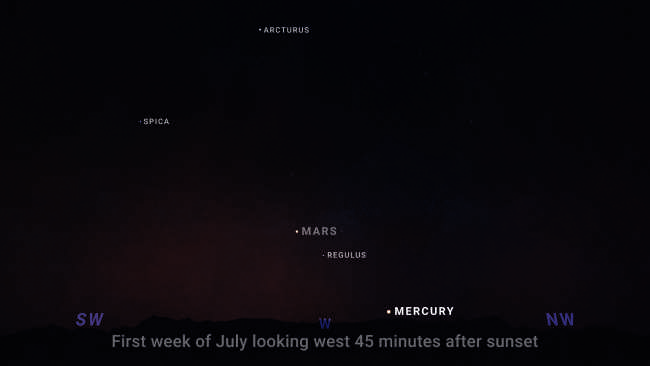
Sky chart showing Mercury and Mars in the western sky following sunset in early July. NASA/JPL-Caltech.

What’s up for July? Mars shines in the evening sky, 60 years after its first close-up, Venus brightens your mornings, and the eagle soars overhead.

First up, Mercury is visible for a brief time following sunset for the first week of July. Look for it very low in the west 30 to 45 minutes after sundown. It sets within the hour after that, so be on the ball if you want to catch it!

Mars is visible for the first hour or two after it gets dark. You'll find it sinking lower in the sky each day and looking a bit dimmer over the course of the month, as our two planets' orbits carry them farther apart. The crescent Moon appears right next to Mars on the 28th.

July is the 60th anniversary of the first successful flyby of Mars, by NASA’s Mariner 4 spacecraft in 1965. Mariner 4 sent back the first photos of another planet from deep space, along with the discovery that the Red Planet has only a very thin, cold atmosphere.

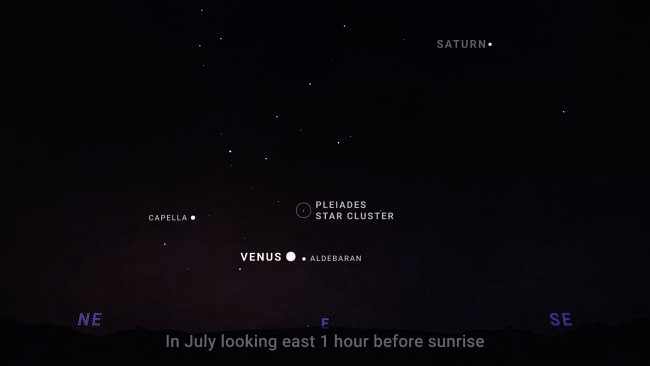
Sky chart showing Venus in the morning sky in July. NASA/JPL-Caltech.


Next, Saturn is rising late in the evening, and by dawn it's high overhead to the south.

Looking to the morning sky, Venus shines brightly all month. You'll find it in the east during the couple of hours before sunrise, with the Pleiades and bright stars Aldebaran and Capella. And as the month goes on, Jupiter makes its morning sky debut, rising in the hour before sunrise and appearing a little higher each day.

By the end of the month, early risers will have the two brightest planets there greeting them each morning. They're headed for a super-close meetup in mid-August, and the pair will be a fixture of the a.m. sky through late this year. Look for them together with the crescent moon on the 21st and 22nd.

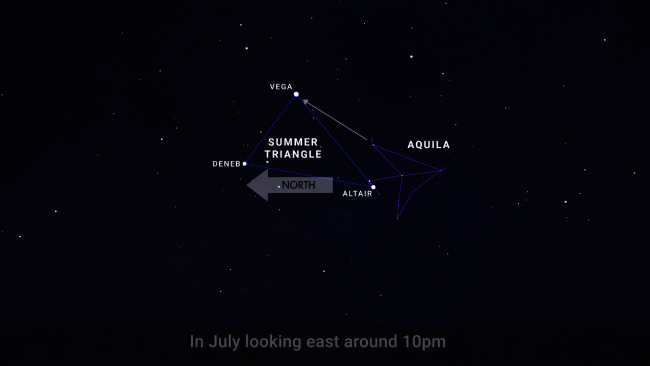
Sky chart showing the shape and orientation of the constellation Aquila in the July evening sky. Aquila's brightest star, Altair, is part of the Summer Triangle star pattern. NASA/JPL-Caltech.


Aquila, the eagle

From July and into August, is a great time to observe the constellation Aquila, the eagle.

This time of year, it soars high into the sky in the first half of the night. Aquila represents the mythical eagle that was a powerful servant and messenger of the Greek god Zeus. The eagle carried his lightning bolts and was a symbol of his power as king of the gods.

To find Aquila in the sky, start by locating its brightest star, Altair. It’s one the three bright stars in the Summer Triangle, which is super easy to pick out during summer months in the Northern Hemisphere. Altair is the second brightest of the three, and sits at the southernmost corner of the triangle.

The other stars in Aquila aren’t as bright as Altair, which can make observing the constellation challenging if you live in an area with a lot of light pollution. It’s easier, though, if you know how the eagle is oriented in the sky. Imagine it’s flying toward the north with its wings spread wide, its right wing pointed toward Vega. If you can find Altair, and Aquila's next brightest star, you can usually trace out the rest of the spread-eagle shape from there. ​​The second half of July is the best time of the month to observe Aquila, as the Moon doesn't rise until later then, making it easier to pick out the constellation's fainter stars.

Observing the constellation Aquila makes for a worthy challenge in the July night sky. And once you're familiar with its shape, it's hard not to see the mythical eagle soaring overhead among the summertime stars.

Preston Dyches works for NASA's Jet Propulsion Laboratory.


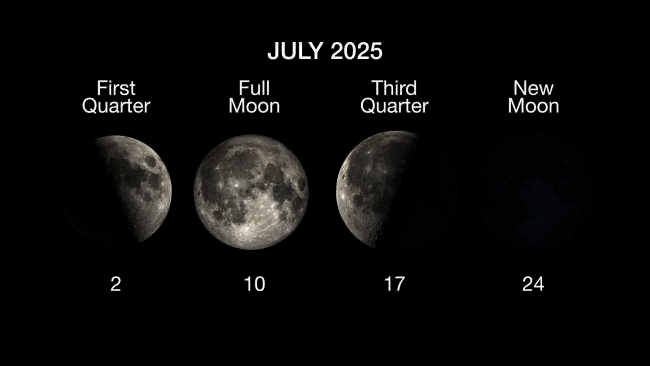
The phases of the Moon for July 2025. NASA/JPL-Caltech.

Lakeport celebrates July 4; more Independence Day weekend celebrations planned Saturday

Enjoying the fireworks show in Lakeport, California, on the evening of Friday, July 4, 2025. Photo by Lingzi Chen/Lake County News.


LAKEPORT, Calif. — Thousands of people packed into the city of Lakeport for its annual July 4 celebration on Friday.

The day was marked by a variety of activities and vendors.

The event culminated in the nighttime fireworks display over Clear Lake.

If you missed the celebration in Lakeport, don’t worry, there’s more to come on Saturday.

Clearlake’s daylong celebration will begin with the parade on Saturday morning, continuing through the day and ending with the fireworks display.

On Saturday evening there will be fireworks in Lakeport at Konocti Vista Casino and at the Lakeport Speedway following racing action. 

More details on the Saturday evenings are below.

A sailboat passes Library Park in Lakeport, California, on the evening of Friday, July 4, 2025. Photo by Lingzi Chen/Lake County News.

SATURDAY, JULY 5

CLEARLAKE

Redbud Parade and Festival

The Lakeshore Lion’s Club of Clearlake is sponsoring its 67th annual Redbud Parade and Festival. 

The parade will start at Redbud Park at 11 a.m. on Saturday, July 5, and will proceed down Lakeshore Drive to Austin Park. 

The theme of this year’s parade is “Cruising the 50s.” 

The event will feature local marchers, marching bands, decorated floats, vintage cars, parade and show horses, fire and police vehicles, and much more. 

The city of Clearlake will host a free concert showcasing Dylan Schneider at 7 p.m.

The Lakeshore Lion’s Club will sponsor the firework display at dark.

LAKEPORT

Konocti Vista community fireworks show and party

Konocti Vista Casino will hold its free community fireworks show.

The evening will begin with a party at 6 p.m. featuring vendors, food, a DJ and bar, with the Fun Zone Arcade open indoors.

Fireworks start at dusk, approximately 9:30 p.m. They can be viewed from the marina and parking lot.

Konocti Vista is located at 2755 Mission Rancheria Road.

Lakeport Speedway fireworks display

Lakeport Speedway will host its annual fireworks display following an evening of racing on Saturday, July 5.

Grandstands open at 5 p.m. with racing at 7 p.m. and fireworks to follow.

Visit https://www.lakeportspeedwaytickets.com/ for more information and to buy tickets.


Along with the ideals it expresses, the Declaration of Independence mourns for something people lost in 1776 − and now, too

The committee assigned to draft the Declaration of Independence, from left: Thomas Jefferson, Roger Sherman, Benjamin Franklin, Robert R. Livingston and John Adams. Currier & Ives image, photo by MPI/Getty Images

Right around the Fourth of July, Americans pay renewed attention to the country’s crucial founding document, the Declaration of Independence. Whether Republican or Democrat or independent, some will say – with reverence – that adherence to the values expressed in the declaration is what makes them American.

President Barack Obama, in his second inaugural address, gave voice to this very conviction.

“What binds this nation together,” he stated, “is not the colors of our skin or the tenets of our faith or the origins of our names.” What truly makes Americans American, he resolved, “is our allegiance to an idea, articulated in a declaration made more than two centuries ago.”

The declaration still stands today as a manifesto. There are its lofty, “self-evident” principles, of course: that “all men are created equal” and that they are “endowed by their Creator with certain unalienable Rights” such as “Life, Liberty and the pursuit of Happiness.”

But I’m a historian of the early republic, and I wish to remind you that the declaration doesn’t just go all pie in the sky. And it’s more than an academic paper waxing on and on about the fashionable philosophical doctrines of the 18th century – freedom and equality – or the coolest philosopher ever, John Locke.

The declaration provides a realistic depiction of a wounded society, one shivering with fears and teetering on the brink of disaster.

A poster reminding Americans of the history of the Declaration of Independence, printed in 1942.
The declaration has been central to American identity; here, a 1942 poster, printed during World War II, reminds Americans of its history. Smith Collection/Gado/Getty Images

Repeated injuries and usurpations

On June 11, 1776, the Continental Congress asked five of its members to prepare a text that would notify the British king and his Parliament of America’s firm intention to get a divorce.

The drafting committee comprised Benjamin Franklin of Pennsylvania, John Adams of Massachusetts, Roger Sherman of Connecticut, Robert R. Livingston of New York, and a man who had a stellar reputation as a gifted writer, Thomas Jefferson of Virginia.

Jefferson didn’t waste time. He locked himself up in a rented room near the State House in Philadelphia, and within a couple of days he was ready to submit a draft to his four teammates for revision.

The committee was smitten by the clarity and effectiveness of the document. Other than suggesting a few corrections, Jefferson’s colleagues were elated by the text.

The Continental Congress promptly received the document, discussed it, made a handful of alterations, and in the late morning of July 4, 1776, adopted it.

Late that night, Philadelphia printer John Dunlap was given the historic task of issuing the first copies of the final Declaration of Independence.

In retrospect, all of this may sound like a tale of fearless heroes eager to break the chains of oppression and single-handedly affirm their boundless love of freedom.

However, when Thomas Jefferson took the pen in his hand, he didn’t think of himself as a hero. Rather, looking ahead at the immediate future and the drama that would inexorably unfold, he felt overwhelmed. A war, pitting brethren against brethren, the Colonists against their mother country, had already started.

The situation was tense and painful, because 18th-century Americans didn’t quite see themselves as Americans. They trusted they were active members of a powerful, expanding British Empire.

What had begun as yet another crisis over Parliament’s right to tax its overseas possessions had quickly transformed into a turning point over whether the Colonies should become independent.

As a consequence, readers of the declaration cannot escape the impression that this document carries a sense of reluctance, betrayal, fear and even sadness.

We Colonists thought we were free, the logic of the declaration goes, but now we are waking up to the dismal realization that the king and the Parliament treat us like their personal slaves.

Jefferson’s words appear to longingly express how wonderful it would be for “one people” not to be put in the condition to “dissolve the political bands which have connected them with another.” How desirable it would have been if a way to renew “the ties of our common kindred” could be found.

Unfortunately, what Jefferson calls “repeated injuries and usurpations” have created enemies out of a common ancestry, thus stifling the “voice of justice and of consanguinity.”

How not to grieve at these “injuries”? The king is guilty for “abolishing our most valuable Laws”; he has “excited domestic insurrections amongst us”; he has sent “Officers to harass our people”; he has obstructed “the Laws for Naturalization of Foreigners”; and he has “made Judges dependent on his Will alone.”

Americans didn’t seek a revolution, the declaration concludes, but Colonists must accept “the necessity” of a separation: “Such has been the patient sufferance of these Colonies; and such is now the necessity which constrains them to alter their former Systems of Government.”

A man in colonial dress writing at a desk strewn with books and papers, by candlelight.
Painter N.C.Wyeth’s depiction of Thomas Jefferson writing the text of the Declaration of Independence. Bettman/Getty Images

‘Forget our former love for them’

Americans today may believe that the Declaration of Independence belongs to them – which it does. The declaration is an American document.

But to an even larger extent, it belongs to Thomas Jefferson. It’s a Jeffersonian document.

One of the most consequential American philosophers, the author of the declaration poured into the text his theories of society and of human nature.

For him, human beings should not live as isolated atoms in constant competition against each other. Jefferson was a communitarian, which means that he believed that the very happiness voiced in the declaration could occur only when individuals regard themselves as functional parts of a larger whole made of other human beings.

The declaration was built upon the tenet that, as Jefferson would explain many years later, “Nature hath implanted in our breasts a love of others, a sense of duty to them, a moral instinct in short, which prompts us irresistibly to feel and to succour their distresses.”

As a moral philosopher, Jefferson wasn’t perfect, obviously – and his views on race and slavery prove that. But the declaration puts forth the argument that the British king and the Parliament are also to blame for having transformed a united people, a people who used to love each other, into a mass of foreigners suspicious of each other.

In Jefferson’s account, this king has carried out the supreme betrayal – like tyrannical powers often do. He has stabbed the Americans as well as the British. He has split them into antagonistic parties. And we Americans, as Jefferson wrote in a telling passage of the declaration that didn’t survive revisions, “must endeavor to forget our former love for them.”

The American nation was born of the traumatic experience of an amputation. It’s a residual half of a former whole that one way or another managed to learn to become a whole again.

But after 250 years, America appears once more a people who seem to have lost what binds them together. Those “political bands which have connected them with another” are being tested; “the ties of … common kindred” are frayed.

Such words describe a time, centuries ago, of great uncertainty, fear and sadness. It seems America has arrived yet again at such a time.The Conversation

Maurizio Valsania, Professor of American History, Università di Torino

This article is republished from The Conversation under a Creative Commons license. Read the original article.

Clearlake Animal Control: ‘Sully’ and the dogs

“Sully.” Photo courtesy of Clearlake Animal Control.


CLEARLAKE, Calif. — Clearlake Animal Control has a group of friendly dogs that would make great additions to new families.

The shelter has 48 adoptable dogs listed on its website.

This week’s dogs include “Sully,” a gentle 3 year old pitbull mix who shelter staff describe as a “sweetheart” whose timid nature “quickly melts into love once he gets to know you.”

Shelter staff said Sully thrives in a secure yard, ensuring he stays safe as he explores the world around him. “While he prefers no cats or small animals in his space, Sully is a good boy at heart, just waiting for the right family to shower with affection. Get ready for cuddles and loyalty from this loving fella!”

The shelter is located at 6820 Old Highway 53. It’s open from 9 a.m. to 6 p.m. Tuesday through Saturday. 

For more information, call the shelter at 707-762-6227, email This email address is being protected from spambots. You need JavaScript enabled to view it., visit Clearlake Animal Control on Facebook or on the city’s website.

This week’s adoptable dogs are featured below.

Email Elizabeth Larson at This email address is being protected from spambots. You need JavaScript enabled to view it.. Follow her on Twitter, @ERLarson, and on Bluesky, @erlarson.bsky.social. Find Lake County News on the following platforms: Facebook, @LakeCoNews; X, @LakeCoNews; Threads, @lakeconews, and on Bluesky, @lakeconews.bsky.social. 

Space News: Astronomers have discovered another puzzling interstellar object − this third one is big, bright and fast

The Haleakala Observatory, left, houses one telescope for the ATLAS system. That system first spotted the object 3I/ATLAS, which isn’t visible in this image. AP Photo/Lindsey Wasson

Astronomers manning an asteroid warning system caught a glimpse of a large, bright object zipping through the solar system late on July 1, 2025. The object’s potentially interstellar origins excited scientists across the globe, and the next morning, the European Space Agency confirmed that this object, first named A11pl3Z and then designated 3I/ATLAS, is the third ever found from outside our solar system.

Current measurements estimate that 3I/ATLAS is about 12 miles (20 kilometers) wide, and while its path won’t take it close to Earth, it could hold clues about the nature of a previous interstellar object and about planet formation in solar systems beyond ours.

On July 2 at 3 p.m. EDT, Mary Magnuson, an associate science editor at The Conversation U.S., spoke to Darryl Z. Seligman, an astrophysicist at Michigan State University who has been studying 3I/ATLAS since its discovery.

What makes 3I/ATLAS different from its predecessors?

We have discovered two interstellar objects so far, ’Oumuamua and Comet 2I/Borisov. ’Oumuamua had no dust tail and a significant nongravitational acceleration, which led to a wide variety of hypotheses regarding its origin. 2I/Borisov was very clearly a comet, though it has a somewhat unique composition compared to comets in our solar system.

All of our preparation for the next interstellar object was preparing for something that looked like a ’Oumuamua, or something that looked like Borisov. And this thing doesn’t look like either of them, which is crazy and exciting.

This object is shockingly bright, and it’s very far away from the Earth. It is significantly bigger than both of the interstellar objects we’ve seen – it is orders of magnitude larger than ’Oumuamua.

For some context, ’Oumuamua was discovered when it was very close to the Earth, but this new object is so large and bright that our telescopes can see it, even though it is still much farther away. This means observatories and telescopes will be able to observe it for much longer than we could for the two previous objects.

It’s huge and it’s much farther away, but it is also much faster.

When I went to bed last night, I saw an alert about this object, but nobody knew what was going on yet. I have a few collaborators who figure out the orbits of things in the solar system, and I expected to wake up to them saying something like “yeah, this isn’t actually interstellar.” Because a lot of times you think you may have found something interesting, but as more data comes in, it becomes less interesting.

Then, when I woke up at 1 a.m., my colleagues who are experts on orbits were saying things like “no, this is definitely interstellar. This is for real.”

How can astronomers tell if something is an interstellar object?

The eccentricity of the object’s orbit is how you know that it’s interstellar. The eccentricity refers to how noncircular an orbit is. So an eccentricity of zero is a pure circle, and as the eccentricity increases, it becomes what’s known as an ellipse – a stretched out circle.

An animation showing a line with a dot labeled ''Oumuamua' that intersects the oval-shaped ellipses showing the orbits of Earth, Mars and other planets.
A hyperbolic orbit isn’t a closed loop, as this rendering of ‘Oumuamua’s trajectory shows. All the planets have oval-shaped elliptical orbits, which close in a loop. The interstellar object instead passes through but doesn’t come back around. Tomruen/Wikimedia Commons, CC BY-SA

And then once you get past an eccentricity of one, you go from an ellipse to a hyperbolic orbit, and that is unbound. So while an elliptical orbit is stretched out, it still orbits and comes back around. An object with a hyperbolic orbit comes through and it leaves, but it never comes back. That type of orbit tells you that it didn’t come from this solar system.

When researchers are collecting data, they’re getting points of light on the sky, and they don’t know how far away they are. It’s not like they see them and can just tell, “oh, that’s eccentric.” What they’re seeing is how far away the object is compared with other stars in the background, what its position is and how fast it’s moving. And then from that data, they try to fit the orbit.

This object is moving fast for how far away it is, and that’s what’s telling us that it could be hyperbolic. If something is moving fast enough, it’ll escape from the solar system. So a hyperbolic, unbound object inherently has to be moving faster.

This is a real-time process. My collaborators have preexisting software, which will, every night, get new observations of all the small bodies and objects in the solar system. It will figure out and update what the orbits are in real time. We’re getting data points, and with more data we can refine which orbit fits the points best.

What can scientists learn from an interstellar object?

Objects like this are pristine, primordial remnants from the planet formation process in other planetary systems. The small bodies in our solar system have taught us quite a lot about how the planets in the solar system formed and evolved. This could be a new window into understanding planet formation throughout the galaxy.

As we’re looking through the incoming data, we’re trying to figure out whether it’s a comet. In the next couple of weeks, there will likely be way more information available to say if it has a cometary tail like Borisov, or if it has an acceleration that’s not due to a gravitational pull, like ’Oumuamua.

If it is a comet, researchers really want to figure out whether it’s icy. If it contains ices, that tells you a ton about it. The chemistry of these small bodies is the most important aspect when it comes to understanding planet formation, because the chemical composition tells you about the conditions the object’s solar system was in when the object formed.

For example, if the object has a lot of ices in it, you would know that wherever it came from, it didn’t spend much time near a star, because those ices would have melted. If it has a lot of ice in it, that could tell you that it formed really far away from a star and then got ejected by something massive, such as a planet the size of Jupiter or Neptune.

Fundamentally, this object could tell astronomers more about a population of objects that we don’t fully understand, or about the conditions in another solar system.

We’ve had a couple of hours to get some preliminary observations. I suspect that practically every telescope is going to be looking at this object for the next couple of nights, so we’ll get much more information about it very soon.The Conversation

Darryl Z. Seligman, Assistant Professor, Michigan State University

This article is republished from The Conversation under a Creative Commons license. Read the original article.

  • 198
  • 199
  • 200
  • 201
  • 202
  • 203
  • 204
  • 205
  • 206
  • 207

Community

  • Sheriff’s Activities League and Clearlake Bassmasters offer youth fishing clinic

  • City Nature Challenge takes place April 24 to 27

Public Safety

  • Lakeport Police logs: Wednesday, Feb. 11

  • Lakeport Police logs: Tuesday, Feb. 10

Education

  • Ramos measure requiring school officer training in use of anti-opioid drug moves forward

  • Lake County Chapter of CWA announces annual scholarships 

Health

  • California ranks 24th in America’s Health Rankings Annual Report from United Health Foundation

  • Healthy blood donors especially vital during active flu season

Business

  • Employment law summit takes place March 9

  • Two Lake County Mediacom employees earn company’s top service awards

Obituaries

  • Terry Knight

  • Ellen Thomas

Opinion & Letters

  • Who should pay for AI’s power? Not California ratepayers

  • Crandell: Supporting nephew for reelection in supervisorial race

Veterans

  • State honors fallen chief warrant officer killed in conflict in Iran

  • CalVet and CSU Long Beach team up to improve data collection related to veteran suicides

Recreation

  • April Audubon program will show how volunteers can help monitor local osprey nests

  • First guided nature walk of spring at Anderson Marsh State Historic Park April 11

  • Second Saturday guided nature walks continue at Anderson Marsh State Historic Park

  • Wet weather trail closure in effect on Upper Lake Ranger District

Religion

  • Kelseyville Presbyterian Church plans Easter service

  • Easter ‘Sonrise’ Service returns to Xabatin Community Park

Arts & Life

  • ‘CIA’ delves into the shadowy world of an espionage thriller

  • ‘War Machine’ shifts the battlefield into uncharted territory

Government & Politics

  • Lake County Democratic Central Committee endorses Falkenberg

  • Crandell launches reelection campaign plans March 15 event

Legals

  • April 23 hearing on Lake Coco Farms Major Use Permit

  • NOTICE OF 30-DAY PUBLIC COMMENT PERIOD & NOTICE OF PUBLIC HEARING

How to resolve AdBlock issue?
Refresh this page