How to resolve AdBlock issue?
Refresh this page
Lake County News,California
  • Home
    • Registration Form
  • News
    • Education
    • Veterans
    • Community
      • Obituaries
      • Letters
      • Commentary
    • Police Logs
    • Business
    • Recreation
    • Health
    • Religion
    • Legals
    • Arts & Life
    • Regional
  • Calendar
  • Contact us
    • FAQs
    • Phones, E-Mail
    • Subscribe
  • Advertise Here
  • Login
How to resolve AdBlock issue?
Refresh this page

News

Energy Star, on the Trump administration’s target list, has a long history of helping consumers’ wallets and the planet


The blue Energy Star label is widely recognized across the U.S. Alex Tai/SOPA Images/LightRocket via Getty Images

Since the early 1990s, the small blue Energy Star label has appeared on millions of household appliances, electronics and even buildings across the United States. But as the Trump administration considers terminating some or all of the program, it is worth a look at what exactly this government-backed label means, and why it has become one of the most recognizable environmental certifications in the country.

Energy Star was launched by the U.S. Environmental Protection Agency in 1992 and later expanded in partnership with the Department of Energy with a simple goal: making it easier for consumers and businesses to choose energy-efficient products, helping them reduce energy use and save money, without sacrificing quality or performance.

As a scholar of energy conservation, I have studied the Energy Star program’s development and public impact, including how it has shaped consumer behavior and environmental outcomes.

According to the EPA, it has saved consumers an average of US$15 billion a year on energy costs since its inception, a massive return on a program that costs taxpayers an estimated $32 million a year.

How Energy Star works

When you see an Energy Star label on a product, it means that product has met strict energy efficiency standards set by the EPA in collaboration with the U.S. Department of Energy, which tests how much energy appliances use. The federal agencies also consult with product manufacturers, utilities and others to figure out how best to improve products and determine how cost-effective changes might be.

Products that earn the Energy Star certification typically use significantly less energy than standard models, often between 10% and 50% less. The energy – and financial – savings can add up quickly, especially when homes or buildings have multiple Energy Star appliances and systems.

Energy Star itself does not manufacture or sell products. Instead, it acts as a trusted third-party certifier, providing consumers and businesses with reliable information and clear labeling. It also offers information to help people estimate energy savings and compare long-term costs, making it easier to identify high-performing, cost-effective options. Manufacturers participating in Energy Star seek to improve their environmental reputation and increase their market share, giving them a strong incentive to meet the program’s efficiency criteria.

Today, the label appears on refrigerators, dishwashers, laptops, commercial buildings and even newly built homes. The government says people in more than 90% of American households recognize the label.

A cardboard box bears an Energy Star label.
Energy Star-certified appliances include upright freezers, clothes washers and many other types of home equipment, which use between 10% and 50% less energy than uncertified items. AP Photo/Joshua A. Bickel

People don’t always choose efficient products

Energy Star seeks to tackle a wide range of problems that can result in people deciding not to buy energy-efficient products.

One problem is that efficient models often come with higher up-front costs. While efficient models save money over time, that higher purchase price can discourage buyers. Energy Star helps counter this problem by clearly showing how much money can be saved on energy costs over the lifetime of the product – as compared with noncertified products – and by offering rebates that reduce the initial expense.

Another problem involves what economists call “split incentives.” A landlord might not want to pay a higher price up front for energy-efficient appliances if the tenants are the ones who will save money on the utility bills. And renters may not want to spend a lot of money on appliances or equipment in a place they do not own. Energy Star tries to bridge this divide by promoting whole-building certifications, which encourage landlords to invest in their buildings’ energy efficiency with the goal of making their properties more attractive to tenants.

The countless varieties of refrigerators, dishwashers, air conditioners and other items on the market can also create confusion. Consumers who just look at manufacturers’ promotional material may find it very hard to determine which appliances truly deliver better energy efficiency. The Energy Star label makes this comparison easier: If the label is there, it is among the most efficient choices available.

And consumers are often skeptical of manufacturers’ claims – especially when it comes to new technologies or environmental promises. Energy Star’s status as a program backed by the government, rather than a private company, gives it a level of independence and credibility that many other labels lack. People know the certification is based on science, not sales tactics.

Lastly, Energy Star helps overcome the problem that many people are not aware of how much energy their appliances consume, or how those choices contribute to climate change. By connecting everyday products to larger environmental outcomes, Energy Star helps consumers understand the effects of their decisions, without needing to become energy experts.

The program delivers real results

Since its inception, more than 800,000 appliance models have earned Energy Star certification based on the criteria for their type of product.

The same principles that make the label valuable for consumer appliances – independent certification, clear metrics and a focus on results – have proved equally effective in real estate. Nearly 45,000 commercial buildings and industrial plants have earned certification. And there have been more than 2.5 million Energy Star-certified homes and apartments built in the U.S.

In 2023 alone, over 190,000 new homes and apartments were certified, representing more than 12% of all new residential construction nationwide.

Energy Star-certified homes are designed to be at least 10% more energy efficient than those built to standard building codes, with more insulation and windows and lights that are energy-efficient, as well as appliances. These enhancements can translate to better quality, comfort and long-term cost savings for homeowners.

Commercial buildings, which account for about 18% of total U.S. energy use, have also benefited substantially. Research I was involved in found that certified commercial buildings use an average of 19% less energy than their noncertified counterparts.

A cat curled up sleeping next to a laptop computer.
Computers can sleep, too – not just cats. Both types conserve energy. Markus Scholz/picture alliance via Getty Images

Why government leadership matters

Energy Star’s status as a government-led label contributes to its credibility as a more neutral and science-based source of information than commercial labels.

Energy Star’s government connections also bring scale: By requiring federal purchases to have Energy Star certifications, the federal government can influence manufacturers. For example, a federal executive order in 1993 required government agencies to purchase only computers that had been Energy Star-certified, which required them to have energy-saving sleep functions.

In response, manufacturers began including the feature so they could sell their products to the government. Consumers soon came to expect the sleep feature on all computers.

A quiet success story in energy and climate

Energy Star does not grab headlines. It does not rely on regulation or mandates. Yet it has quietly become one of the most effective tools the U.S. has for improving energy efficiency across homes, offices and public buildings.

That said, the program is not without its limitations. Some critics have pointed out that not all certified products consistently perform at the highest efficiency levels. Other critics note that the benefits of Energy Star are more accessible to wealthier consumers who can afford up-front investments, even with available rebates. And the EPA itself has, at times, struggled to manage the certification process and update standards in line with the latest technological advances.

At a time when energy costs and climate concerns are rising, Energy Star stands out as a rare example of a practical, nonpartisan program that delivers real benefits. It helps individuals, businesses and communities save money, lower emissions and take part in a more sustainable future – one smart decision at a time.The Conversation

Magali A. Delmas, Professor of Management, Institute of the Environment and Sustainability, Anderson School of Management, University of California, Los Angeles

This article is republished from The Conversation under a Creative Commons license. Read the original article.

Off-road trail revival: Volunteers put in the work on Mendocino National Forest

mnftrailwork1

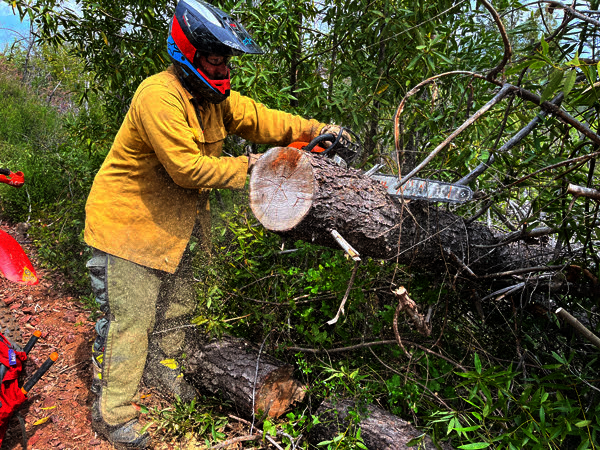
Forest Service staff joined volunteers to cut fallen logs out of off-highway trails as part of a trail revival work event at Upper Lake Ranger District, Mendocino National Forest, May 3, 2025. USDA Forest Service photos by Derrick Ray.


MENDOCINO NATIONAL FOREST, Calif. — Each year thousands of visitors travel to the Mendocino National Forest, looking to escape the grind and craving adventure.

With its rugged off-road trails, scenic vistas and proximity to Sacramento and the Bay Area, the national forest has become a world-class destination in the off-road and overlanding communities.

But in 2018, a devastating wildfire destroyed much of the trail system in the southern half of the forest. And subsequent years of severe winter storms and bark beetle infestation have also taken a toll on these trails and roads.

So on May 3, 64 volunteers mobilized for a trail revival project organized by the Mendocino 4x4 Club, Post Wildfire OHV Recovery Alliance, and onX Offroad.

“We are super pumped!” said Forest Service OHV Recreation Tech Derrick Ray in a welcome to volunteers as they gathered gear and supplies for a day on the trails.

It’s been a monumental effort by staff, partners and local volunteers to keep this premiere trail system open and safe for riders.

After the fires, volunteer groups reached out to support the USDA Forest Service and used official partnership agreements to ramp up their capacity.

This year, several volunteers received chainsaw training and certification to safely operate saws on Forest Service trails, a huge step forward for safety and public access.

It takes hard work and dedication to maintain a trail system that rises from creeks to mountain ridgetops through chaparral, oak woodland, and conifer forests. Add to that the constant job of clearing brush from trails and removing downed trees that fall during frequent high winds.

“After the Ranch Fire in 2018 burned through basically every trail on the district, the only way we are going to succeed with our OHV program is with volunteers,” said Deputy District Ranger Terry Nickerson.

After a solid day’s effort, volunteers cleared 21 miles of trails and put in a collective 170 hours of work. And that’s just one day’s worth of trail clearing. Through much of the fall and spring riding seasons, riders will continue to volunteer and help clear trails.

mnftrailwork2

A volunteer prunes overgrown shrubs off of trail for better visibility and safer riding conditions as part of a trail revival work event at Upper Lake Ranger District, Mendocino National Forest, May 3, 2025. USDA Forest Service photos by Derrick Ray.


Trails for all levels

Along the North Coast Mountains, there are plenty of destinations for riders to explore, whether on a dirt bike, motorcycle, side by side, dual sport or Jeep. Look for beginner level green trails to challenging blue trails, to the most challenging black diamond trails.

But don’t get too distracted by the views and historic fire lookouts. When you’re out riding, be aware of your surroundings and anticipate other riders or downed trees around the corner. Anyone visiting the forest should check the website alerts for potential closures and stop by a ranger station to get the latest on trail conditions.

“These trails are a world class OHV destination,” said Nickerson. “We ask everyone to practice responsible riding and to leave the facilities better than you found them, so they can be enjoyed by the next person.”

Anyone interested in volunteering to help with trail maintenance can reach out to the forest and district offices to learn about upcoming opportunities.


mnftrailwork3

Volunteers at a trail revival work event at Upper Lake Ranger District, Mendocino National Forest, May 3, 2025. USDA Forest Service photos by Derrick Ray.


‘No Kings’ protest draws big crowd in Lakeport

061425lakeportprotest

Demonstrators gather in Old Courthouse Museum Square park in downtown Lakeport, California, as part of the “No Kings Nationwide Day of Defiance” on Saturday, June 14, 2025. Photo by Elizabeth Larson/Lake County News.


LAKEPORT, Calif. — A group of peaceful but persistent protesters gathered in downtown Lakeport on Saturday to demonstrate against attacks on democracy.

The Saturday demonstration, parts of the “No Kings Nationwide Day of Defiance,” took place from noon to 2 p.m. It was centered at the Old Courthouse Museum Square park.

People of all ages — from small children up to people in their 90s — filled the park and also lined the sidewalk on the opposite side of the street, with participants also extending further down Main Street. They came with an array of signs with messages criticizing the Trump administration and its policies.

This is the fourth major demonstration that’s been held in downtown Lakeport since the start of the year.

A previous event, a “Hands Off” protest held April 5 at the same location as part of a previous nationwide effort, was estimated to have had about 650 participants, double the size of the demonstration that had come before it.

This time, reports from the scene and attendees estimated that the number of participants was close to 1,200 people. At that size, the demonstration is among the largest recorded in Lake County in recent decades.

The newly formed nonpartisan Indivisible Lake County supported the event, organized by the Lake County Democratic Club.

Early on Saturday afternoon, a group of Trump supporters in vehicles sporting pro-Trump and State of Jefferson flags, drove through downtown Kelseyville before traveling to Lakeport, passing the downtown demonstration.

Lakeport’s protest event was among an estimated 2,000 across all 50 states, coinciding with a military parade in Washington, DC as part of the 250th anniversary of the U.S. Army.

Firm attendance numbers at the demonstrations have so far not been given, but estimates have ranged from five million to 11 million participants.

Email Elizabeth Larson at This email address is being protected from spambots. You need JavaScript enabled to view it.. Follow her on Twitter, @ERLarson, and on Bluesky, @erlarson.bsky.social. Find Lake County News on the following platforms: Facebook, @LakeCoNews; X, @LakeCoNews; Threads, @lakeconews, and on Bluesky, @lakeconews.bsky.social.

Firefighters perform Saturday night water rescue near Lakeport

LAKE COUNTY, Calif. — Firefighters rescued a man from Clear Lake near Lakeport on Saturday night.

Lakeport Fire Protection District was dispatched to the 2700 block of Lakeshore Boulevard near Crystal Lake Way just after 9:30 p.m. Saturday, according to radio traffic.

Dispatch reported receiving multiple calls about a man in the water screaming for help.

Scanner traffic indicated firefighters on jet skis launched from the Fifth Street boat ramp and responded to the area. The subject in trouble may have been associated with a kayak.

At about 9:45 p.m., the Lakeport Fire chief reported over the air that they had the subject secured on a rope up against a shore wall. Less than five minutes later, the individual had been pulled from the water.

Fire officials said over the air that the subject was transported to Sutter Lakeside Hospital for care just before 10 p.m.

Email Elizabeth Larson at This email address is being protected from spambots. You need JavaScript enabled to view it.. Follow her on Twitter, @ERLarson, and on Bluesky, @erlarson.bsky.social. Find Lake County News on the following platforms: Facebook, @LakeCoNews; X, @LakeCoNews; Threads, @lakeconews, and on Bluesky, @lakeconews.bsky.social.

Helping Paws: More brand new pets in waiting

LAKE COUNTY, Calif. — A week after more than half of its shelter occupants were sent to new homes, Lake County Animal Care and Control has a new group of animals waiting to be adopted.

The dogs available for adoption this week run the gamut from puppies to adults, small terriers to larger breeds.

Dogs that are adopted from Lake County Animal Care and Control are either neutered or spayed, microchipped and, if old enough, given a rabies shot and county license before being released to their new owner. License fees do not apply to residents of the cities of Lakeport or Clearlake.

Those dogs and the others shown on this page at the Lake County Animal Care and Control shelter have been cleared for adoption.

Call Lake County Animal Care and Control at 707-263-0278 or visit the shelter online for information on visiting or adopting.

The shelter is located at 4949 Helbush in Lakeport.

Email Elizabeth Larson at This email address is being protected from spambots. You need JavaScript enabled to view it.. Follow her on Twitter, @ERLarson, and on Bluesky, @erlarson.bsky.social. Find Lake County News on the following platforms: Facebook, @LakeCoNews; X, @LakeCoNews; Threads, @lakeconews, and on Bluesky, @lakeconews.bsky.social.


Lisa's preview photo

Lisa

Tucker's preview photo

Tucker

Bandit 's preview photo

Bandit

Desiree's preview photo

Desiree

Elvis's preview photo

Elvis

Topaz's preview photo

Topaz

Amber's preview photo

Amber

Killian's preview photo

Killian

Sky 's preview photo

Sky

Shep's preview photo

Shep

Prince's preview photo

Prince

Chama's preview photo

Chama

Saphire's preview photo

Saphire

Scrappy's preview photo

Scrappy

Clovis's preview photo

Clovis

Sicily's preview photo

Sicily

Kennel#11a's preview photo

Kennel#11a

Kennel#11b's preview photo

Kennel#11b

Kennel#11c's preview photo

Kennel#11c

Kennel#11d's preview photo

Kennel#11d

Kennel #16a's preview photo

Kennel #16a

Kennel #16d's preview photo

Kennel #16d

Kennel #16e(Red)'s preview photo

Kennel #16e(Red)

Kennel #16f(Purple)'s preview photo

Kennel #16f(Purple)

Toby's preview photo

Toby

Kennel#19's preview photo

Kennel#19

Kennel#5's preview photo

Kennel#5

Kennel#7's preview photo

Kennel#7

Space News: Where is the center of the universe?


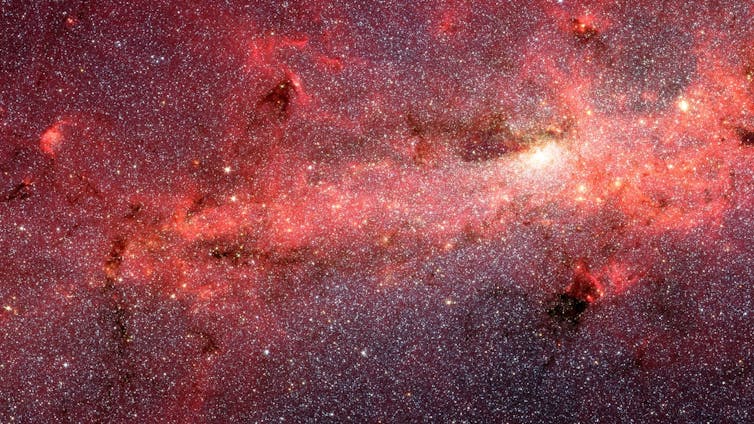
In space, there are four dimensions: length, width, height and time. scaliger/iStock/NASA via Getty Images Plus

About a century ago, scientists were struggling to reconcile what seemed a contradiction in Albert Einstein’s theory of general relativity.

Published in 1915, and already widely accepted worldwide by physicists and mathematicians, the theory assumed the universe was static – unchanging, unmoving and immutable. In short, Einstein believed the size and shape of the universe today was, more or less, the same size and shape it had always been.

But when astronomers looked into the night sky at faraway galaxies with powerful telescopes, they saw hints the universe was anything but that. These new observations suggested the opposite – that it was, instead, expanding.

Scientists soon realized Einstein’s theory didn’t actually say the universe had to be static; the theory could support an expanding universe as well. Indeed, by using the same mathematical tools provided by Einstein’s theory, scientists created new models that showed the universe was, in fact, dynamic and evolving.

I’ve spent decades trying to understand general relativity, including in my current job as a physics professor teaching courses on the subject. I know wrapping your head around the idea of an ever-expanding universe can feel daunting – and part of the challenge is overriding your natural intuition about how things work. For instance, it’s hard to imagine something as big as the universe not having a center at all, but physics says that’s the reality.

The universe gets bigger every day.

The space between galaxies

First, let’s define what’s meant by “expansion.” On Earth, “expanding” means something is getting bigger. And in regard to the universe, that’s true, sort of. Expansion might also mean “everything is getting farther from us,” which is also true with regard to the universe. Point a telescope at distant galaxies and they all do appear to be moving away from us.

What’s more, the farther away they are, the faster they appear to be moving. Those galaxies also seem to be moving away from each other. So it’s more accurate to say that everything in the universe is getting farther away from everything else, all at once.

This idea is subtle but critical. It’s easy to think about the creation of the universe like exploding fireworks: Start with a big bang, and then all the galaxies in the universe fly out in all directions from some central point.

But that analogy isn’t correct. Not only does it falsely imply that the expansion of the universe started from a single spot, which it didn’t, but it also suggests that the galaxies are the things that are moving, which isn’t entirely accurate.

It’s not so much the galaxies that are moving away from each other – it’s the space between galaxies, the fabric of the universe itself, that’s ever-expanding as time goes on. In other words, it’s not really the galaxies themselves that are moving through the universe; it’s more that the universe itself is carrying them farther away as it expands.

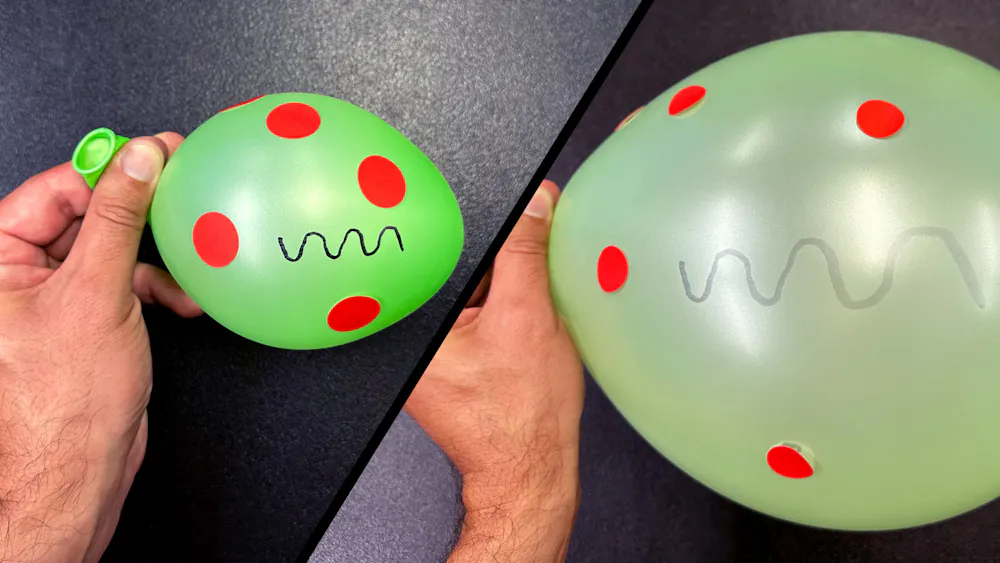
A common analogy is to imagine sticking some dots on the surface of a balloon. As you blow air into the balloon, it expands. Because the dots are stuck on the surface of the balloon, they get farther apart. Though they may appear to move, the dots actually stay exactly where you put them, and the distance between them gets bigger simply by virtue of the balloon’s expansion.

split screen of a green balloon with red dots and a squiggle on the surface, lightly inflated and then much more blown up
It’s the space between the dots that’s growing. NASA/JPL-Caltech, CC BY

Now think of the dots as galaxies and the balloon as the fabric of the universe, and you begin to get the picture.

Unfortunately, while this analogy is a good start, it doesn’t get the details quite right either.

The 4th dimension

Important to any analogy is an understanding of its limitations. Some flaws are obvious: A balloon is small enough to fit in your hand – not so the universe. Another flaw is more subtle. The balloon has two parts: its latex surface and its air-filled interior.

These two parts of the balloon are described differently in the language of mathematics. The balloon’s surface is two-dimensional. If you were walking around on it, you could move forward, backward, left, or right, but you couldn’t move up or down without leaving the surface.

Now it might sound like we’re naming four directions here – forward, backward, left and right – but those are just movements along two basic paths: side to side and front to back. That’s what makes the surface two-dimensional – length and width.

The inside of the balloon, on the other hand, is three-dimensional, so you’d be able to move freely in any direction, including up or down – length, width and height.

This is where the confusion lies. The thing we think of as the “center” of the balloon is a point somewhere in its interior, in the air-filled space beneath the surface.

But in this analogy, the universe is more like the latex surface of the balloon. The balloon’s air-filled interior has no counterpart in our universe, so we can’t use that part of the analogy – only the surface matters.

A blown-up purple balloon on a blue background.
Trying to figure out how the universe works? Start by contemplating a balloon. Kristopher_K/iStock via Getty Images Plus

So asking, “Where’s the center of the universe?” is somewhat like asking, “Where’s the center of the balloon’s surface?” There simply isn’t one. You could travel along the surface of the balloon in any direction, for as long as you like, and you’d never once reach a place you could call its center because you’d never actually leave the surface.

In the same way, you could travel in any direction in the universe and would never find its center because, much like the surface of the balloon, it simply doesn’t have one.

Part of the reason this can be so challenging to comprehend is because of the way the universe is described in the language of mathematics. The surface of the balloon has two dimensions, and the balloon’s interior has three, but the universe exists in four dimensions. Because it’s not just about how things move in space, but how they move in time.

Our brains are wired to think about space and time separately. But in the universe, they’re interwoven into a single fabric, called “space-time.” That unification changes the way the universe works relative to what our intuition expects.

And this explanation doesn’t even begin to answer the question of how something can be expanding indefinitely – scientists are still trying to puzzle out what powers this expansion.

So in asking about the center of the universe, we’re confronting the limits of our intuition. The answer we find – everything, expanding everywhere, all at once – is a glimpse of just how strange and beautiful our universe is.The Conversation

Rob Coyne, Teaching Professor of Physics, University of Rhode Island

This article is republished from The Conversation under a Creative Commons license. Read the original article.

  • 212
  • 213
  • 214
  • 215
  • 216
  • 217
  • 218
  • 219
  • 220
  • 221

Community

  • Sheriff’s Activities League and Clearlake Bassmasters offer youth fishing clinic

  • City Nature Challenge takes place April 24 to 27

Public Safety

  • Lakeport Police logs: Wednesday, Feb. 11
  • Lakeport Police logs: Tuesday, Feb. 10

Education

  • Ramos measure requiring school officer training in use of anti-opioid drug moves forward

  • Lake County Chapter of CWA announces annual scholarships 

Health

  • California ranks 24th in America’s Health Rankings Annual Report from United Health Foundation

  • Healthy blood donors especially vital during active flu season

Business

  • Employment law summit takes place March 9

  • Two Lake County Mediacom employees earn company’s top service awards

Obituaries

  • Terry Knight

  • Ellen Thomas

Opinion & Letters

  • Who should pay for AI’s power? Not California ratepayers

  • Crandell: Supporting nephew for reelection in supervisorial race

Veterans

  • State honors fallen chief warrant officer killed in conflict in Iran

  • CalVet and CSU Long Beach team up to improve data collection related to veteran suicides

Recreation

  • April Audubon program will show how volunteers can help monitor local osprey nests

  • First guided nature walk of spring at Anderson Marsh State Historic Park April 11

  • Second Saturday guided nature walks continue at Anderson Marsh State Historic Park

  • Wet weather trail closure in effect on Upper Lake Ranger District

Religion

  • Kelseyville Presbyterian Church plans Easter service

  • Easter ‘Sonrise’ Service returns to Xabatin Community Park

Arts & Life

  • ‘CIA’ delves into the shadowy world of an espionage thriller

  • ‘War Machine’ shifts the battlefield into uncharted territory

Government & Politics

  • Lake County Democratic Central Committee endorses Falkenberg

  • Crandell launches reelection campaign plans March 15 event

Legals

  • April 23 hearing on Lake Coco Farms Major Use Permit

  • NOTICE OF 30-DAY PUBLIC COMMENT PERIOD & NOTICE OF PUBLIC HEARING

How to resolve AdBlock issue?
Refresh this page