How to resolve AdBlock issue?
Refresh this page
Lake County News,California
  • Home
    • Registration Form
  • News
    • Education
    • Veterans
    • Community
      • Obituaries
      • Letters
      • Commentary
    • Police Logs
    • Business
    • Recreation
    • Health
    • Religion
    • Legals
    • Arts & Life
    • Regional
  • Calendar
  • Contact us
    • FAQs
    • Phones, E-Mail
    • Subscribe
  • Advertise Here
  • Login
How to resolve AdBlock issue?
Refresh this page

News

Lake County Vector Control to combat spring mosquitoes with drone treatment


A drone similar to this one will be used by Lake County Vector Control for treatments in March 2025.


LAKEPORT, Calif. — To prevent a surge of biting mosquitoes this spring, the Lake County Vector Control District said it will conduct a targeted aerial treatment of marshlands near Clear Lake.

Starting Monday, March 10, weather permitting, a black and white drone, about 6 to 8 feet wide, will fly low over areas between Clear Lake State Park and Lakeport, including parts of S-Bar-S Ranch, Scotts Valley, Lyons Creek, Bridge Arbor and Upper Lake.

Residents in these areas may see or hear the drone during daylight hours.

Why is this happening?

The district's winter monitoring found a large number of mosquito larvae in these wetlands.

These larvae, a type called Aedes increpitus, hatch from eggs laid in the mud and are known for their aggressive biting in the spring.

What is being used?

The district will use VectoPrime FG, a safe and effective biological larvicide. It contains a natural soil bacterium (Bti) and (S)-methoprene, which target mosquito larvae without harming fish, plants, animals, or other insects. The product is applied as granules, minimizing drift.

Is it safe?

The Environmental Protection Agency has approved VectoPrime FG. It breaks down quickly in nature, leaving no lasting residue. The District prioritizes using the safest products available.

Where can I find more information?

For the treatment date and any changes, visit the District's website: www.lcvcd.org.

To request the VectoPrime FG product label or Safety Data Sheet, or SDS, visit the website or call 707-263-4770.

For more information on West Nile virus, visit: http://westnile.ca.gov/. 

For mosquito repellent information, visit: http://www.cdc.gov/westnile/faq/repellent.html. 

This drone treatment follows a larger aerial treatment with a crop duster plane on Feb. 25, designed to target wider areas. Both methods help reduce the need for adult mosquito control later.

Members of Congress press Trump Administration on firings of election security workers, pause of critical election security efforts

U.S. Senator Alex Padilla (D-Calif.), ranking member of the Senate Committee on Rules and Administration, and U.S. Representative Joe Morelle (N.Y.-25), ranking member of the Committee on House Administration, continued pressing senior officials at the Cybersecurity and Infrastructure Security Agency, or CISA, for answers on the status of their election-related work.

This comes after not receiving a response to their letter last month on the firings of CISA employees who previously worked on election security, including misinformation and disinformation issues.

“As ranking members of the House and Senate Committees with jurisdiction over federal elections, we have a right to understand the changes occurring at CISA given its critical election security mission,” wrote the lawmakers. “Failure to respond to these questions is deeply disturbing given so many high-ranking administration officials’ refusals to accept the outcome of legitimate elections and involvement in spreading election-related mis- and disinformation.”

Since their original letter, more CISA employees have been put on administrative leave, and CISA has paused election security efforts as they rush through an internal assessment behind closed doors without consulting Congress or state and local election officials.

Meanwhile, employees of President Trump and Elon Musk’s Department of Government Efficiency, or DOGE, including a 19-year-old staffer tied to interactions with cybercriminals, have infiltrated CISA’s systems.

“Election infrastructure is critical infrastructure. Changes at CISA could have dramatic impacts on future elections — the cornerstone of our democracy,” continued the lawmakers. “Without a reasonable, transparent process that consults with Congress and Chief Election Officials on a bipartisan basis, we are alarmed that political leadership at DHS and DOGE is directing CISA to undercut the security of our elections, making us more vulnerable to malign foreign actors and risking the safety of election officials.”

The lawmakers also condemned the permanent termination without notice of federal funds for the Election Infrastructure Information Sharing and Analysis Center, or EI-ISAC, which is an essential resource for threat monitoring and coordination between state officials on election security matters.

Additionally, the lawmakers highlighted a Feb. 21, 2025, letter from the bipartisan National Association of Secretaries of State to Department of Homeland Security Secretary Kristi Noem, and pushed CISA to consult with election officials while conducting their assessment.

Padilla and Morelle said the secretaries’ letter underscores the need for CISA’s services to ensure the successful administration of elections.

Last week, Padilla and Morelle expressed serious concerns about the dangerous implications for elections following President Trump’s executive order purporting to bring independent regulatory agencies under total control of the White House.

Padilla previously denounced the illegal firing of FEC Chair Weintraub and led 10 Democratic Senators to demand President Trump rescind this decision.

The full text of the letter is published below.

Dear Ms. Bean and Ms. Harrington:

We are concerned by the lack of timely written response to our February 13, 2025, letter on the status of the election-related work and the treatment of employees at the Cybersecurity and Infrastructure Security Agency (CISA). Since the sending of that letter, several additional, disturbing reports have come to light, including (1) more CISA employees have been put on administrative leave, (2) election security efforts have been paused during a secretive review that is being rushed through without consultation with Congress or state and local election officials, and (3) employees of the U.S. Department of Government Efficiency (DOGE), including at least one who is a known cybersecurity risk, are reworking CISA without any transparency.

We expect a thorough and substantive response to both letters, and a briefing on the results of the assessment following its anticipated conclusion on March 6, 2025, with a discussion of any anticipated changes to the agency prior to any being finalized. While we recognize that CISA and DOGE is declining to communicate with Congress on individual personnel decisions, Congress has a right to understand the overall personnel numbers and structural changes occurring at CISA. We reiterate our request for information on the numbers of CISA employees whose work, in whole or in part, covered election-related matters that have either been placed on administrative leave or fired. Our committees have received information that the number of election security officials put on leave is greater than initially reported and public reports indicate that 130 CISA employees have been fired already.

We understand that CISA launched a review of its election security work soon after receiving our February 13 letter. While we understand the assessment of the agency’s work remains ongoing—with a reported March 6 deadline—we urge your continued commitment to maintaining elections as a key component of CISA’s core mission. Additionally, we call your attention to the February 21, 2025, letter from the bipartisan National Association of Secretaries of State and urge you to consult with key Congressional committees and Chief Election Officials before the conclusion of the assessment. In their letter, the Secretaries noted the importance of CISA’s services, including cybersecurity services, physical security assessments, planning resources, and briefings on the foreign threats facing our election systems at the state and local level. While we encourage CISA to ensure these services remain intact, decisions to upend these programs after a three-week review without seriously considering the input of Members of Congress or the individuals running elections in the states would be irresponsible and shortsighted.

We are also gravely concerned about the permanent termination of federal funds for the Election Infrastructure Information Sharing and Analysis Center (EI-ISAC). The EI-ISAC played a critical role in threat monitoring and coordination between state officials, and the lack of notice prior to the termination of federal funding has left states unable to accept the services of the Center for Internet Security. We recommend restoring federal funding for the EI-ISAC as soon as possible. If CISA or DOGE refuse to do so, they owe Congress a substantive explanation for this decision and details of how CISA will be providing these services to states in the absence of the EI-ISAC.

Furthermore, we are shocked by public reporting that an inexperienced DOGE staffer with a history of engagement with hacking groups, and who was fired for leaking sensitive information from a previous job, is now working at CISA. We demand an immediate answer as to how many DOGE employees are currently housed at CISA, as well as the level of access they have been given to sensitive information. Senior Advisor to the President Elon Musk has publicly committed the Administration and DOGE to the highest levels of transparency, and we expect a full accounting for DOGE’s activities at an agency with a mission as sensitive as CISA’s.

As Ranking Members of the House and Senate Committees with jurisdiction over federal elections, we have a right to understand the changes occurring at CISA given its critical election security mission. Failure to respond to these questions is deeply disturbing given so many high-ranking administration officials’ refusals to accept the outcome of legitimate elections and involvement in spreading election-related mis- and disinformation. Election infrastructure is critical infrastructure. Changes at CISA could have dramatic impacts on future elections – the cornerstone of our democracy. Without a reasonable, transparent process that consults with Congress and Chief Election Officials on a bipartisan basis, we are alarmed that political leadership at DHS and DOGE is directing CISA to undercut the security of our elections, making us more vulnerable to malign foreign actors and risking the safety of election officials.

Thank you for your attention to this matter and we look forward to your prompt response, no later than Monday, March 17.

COVID-19 is the latest epidemic to show biomedical breakthroughs aren’t enough to eliminate a disease


COVID-19 has become a part of modern life that many people don’t pay much attention to. Spencer Platt via Getty Images News

The COVID-19 pandemic transformed over the past five years from a catastrophic threat that has killed over 7 million people to what most people regard today as a tolerable annoyance that doesn’t require precaution. Nonetheless, COVID-19 continues to kill over 2,000 people per month globally and cause severe illness in the infirm or elderly.

The evolution of the COVID-19 pandemic – from devastation, to optimism for eradication, to persistent, uneven spread of disease – may seem unprecedented. As an infectious disease doctor and medical historian, however, I see similarities to other epidemics, including syphilis, AIDS and tuberculosis.

Vaccines, medications and other biomedical breakthroughs are necessary to eliminate epidemic diseases. But as I explore in my book, “Persisting Pandemics,” social, economic and political factors are equally important. On its own, medical science is not enough.

Syphilis, AIDS and TB have stuck around

Syphilis is a sexually transmitted disease first identified in 1495. It causes skin rashes and may progress to causing paralysis, blindness or both. For centuries, syphilis weakened nations by disabling parents, workers and soldiers in the prime of their lives. Innovative drugs – first Salvarsan (1909), then penicillin (1943) – offered a path toward eradication when used together with widespread testing.
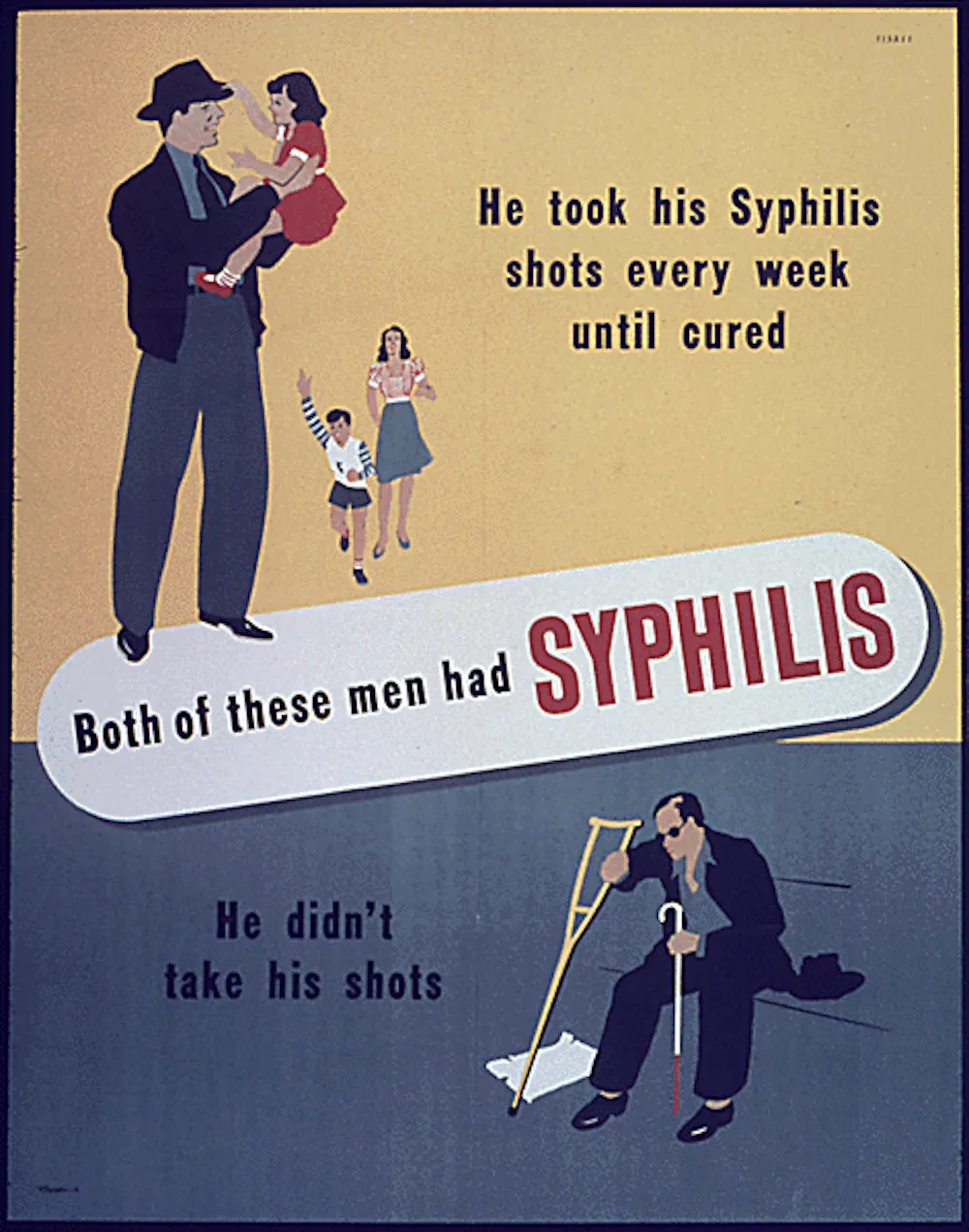
Poster reads 'Both of these men had SYPHILIS' and pictures a healthy one with a family who got his shots, and a man alone with crutch and blindness who didn't
A 1940s poster focuses on the medical cure for the disease. National Archives, CC BY

Public health programs conducted from the 1930s through the 2000s, however, failed – not because of the efficacy of the treatments but because of socioeconomic conditions.

One challenge has been persistent stigma around getting tested for the disease and tracing sexual partners. Poverty is another; it can force women into commercial sex activities and prevent people from learning how to protect themselves from sexually transmitted infections. Population migration due to commerce or war can cause high-risk behaviors such as sexual promiscuity. Women in some cultures lack authority to negotiate for condom use. And governments have not consistently prioritized the sustained funding needed to support efforts to eliminate the disease.

Despite societal indifference toward syphilis, in the 2020s over 8 million new cases occur globally each year, particularly among racial minorities and low-income populations.

The history of HIV/AIDS is shorter than that of syphilis, but the trajectory has similarities. Doctors first described HIV/AIDS in 1981, when it was a nearly uniformly fatal sexually transmitted disease. Novel antiretroviral drugs introduced in 1996 offered medical scientists the hope of disease elimination through public health campaigns, centered on widespread testing and treatment, implemented in 2013.

But these programs, for reasons like with syphilis, are not meeting their treatment targets across all countries, especially among low-income populations and racial minorities. Sustaining funding for health care infrastructure and the multidrug regimens for 39 million people living with HIV poses an added challenge. Today, despite a cavalier public attitude toward the disease, AIDS causes over 630,000 deaths globally. That number will likely increase substantially given the Trump administration’s decision to cut funding for United States Agency for International Development programs.

Tuberculosis is a third disease that also depleted workforces and weakened nations, particularly in postindustrial revolution 19th-century cities. The disease spread widely because poverty placed people in poorly ventilated working conditions and crowded tenement dwellings. The development of new combination antimicrobial drug regimens offered an avenue for disease eradication in the 1960s.

Nonetheless, the inability to sustain funding to complete complex treatment courses, problems isolating people who could not afford suitable homes, and poor adherence due to homelessness, incarceration or migration during war or trade have compromised public health campaigns. Despite societal nonchalance, tuberculosis today kills up to 1.6 million globally yearly.

two EMTs in PPE rush a patient on a stretcher away from ambulance
Memories of the early, emergency phase of the COVID-19 pandemic have faded. Stan Grossfeld/The Boston Globe via Getty Images

The COVID-19 case study

The trajectories of these epidemics show how campaigns based solely on biomedical approaches that target pathogens are not enough to eliminate disease.

COVID-19 provides the latest example. In the U.S., the pandemic and its lockdowns disproportionately affected low-income people and racial minorities, especially those employed in front-line jobs that did not allow remote work from home. These groups were more likely to reside in crowded residences with poor ventilation or no space for isolation.

Despite the rapid development of a breakthrough mRNA vaccine that offered hope for what President Joe Biden euphorically termed “independence from the virus,” the promise never fully materialized.

Too few people received shots, in large part due to socioeconomic factors.

Wealthy countries purchased vaccines that lower-income countries could not afford. Allocation difficulties kept vaccines from remote regions of the world.

Vaccine hesitancy due to mistrust in science, along with sentiment that vaccine mandates violated individual freedoms, also prevented people from getting the shot. Similar attitudes reduced rates of mask-wearing and isolation.

Consequently, surges that could have been avoided took more lives.

Drugs and vaccines can’t do it alone

Modern medical science is unmatched in treating pathogens and disease symptoms. But to stop disease, it’s also critical to address the social, economic and political conditions that enable its spread.

Public health officials have started to implement a variety of structural solutions:

  • Stigma reduction programs to reduce the shame of having a disease and increase the number of people tested.
  • Cash transfers to provide sex workers with capital to invest in less risky, alternative businesses.
  • Peer education to empower sex workers with the authority to negotiate for condoms and safer sex practices.
  • Health infrastructure expansion to enable access to testing and treatment facilities.
  • Housing reforms to guarantee adequate air filtration and appropriate isolation facilities.
  • Resistance to anti-science appointees to government positions to prevent the implementation of regressive public health measures.
  • Sustained funding for public health efforts across political administrations that may have different priorities.
several men wearing coveralls watch another man who's holding up a poster
A peer educator talks about HIV/AIDS with his colleagues at a maintenance shop in Kenya. Wendy Stone/Corbis Historical via Getty Images

Early 20th-century public health officials had hoped that efficient scientific solutions alone could take the place of 19th-century, pre-germ-theory environmental sanitation efforts. COVID-19, syphilis, HIV/AIDS and tuberculosis show that while biomedical breakthroughs are necessary to eliminate epidemic diseases, sustained focus and resources aimed at helping the most socially and economically vulnerable are essential.The Conversation

Powel H. Kazanjian, Professor of Infectious Diseases and of History, University of Michigan

This article is republished from The Conversation under a Creative Commons license. Read the original article.


Authorities investigate death of man injured in January assault

LAKE COUNTY, Calif. — A man who was stabbed in downtown Kelseyville in late January has died, and while officials said the cause remains under investigation his death does not appear connected to the assault.

The stabbing victim was identified by family and authorities as Alfonso Hernandez Guzman.

Hernandez Guzman was stabbed at Pioneer Park in Kelseyville on the evening of Jan. 24 following a verbal argument and flown to an out-of-county hospital for treatment, as Lake County News has reported.

Authorities arrested Anthony Lee Black, 40, of Kelseyville for the assault that same night.

Black has been charged with attempted homicide, battery with serious bodily injury, assault with a deadly weapon and obstructing or resisting a public officer.

Following a preliminary hearing on Feb. 13, Black was ordered to stand trial on the charges, according to court records.

On Feb. 24, Hernandez Guzman was back at Pioneer Park — where he had been stabbed — when authorities said he died. His family told Lake County News that he was found with no obvious signs of assault.

Lake County Sheriff’s Office spokesperson Lauren Berlinn said deputies and the coroner sergeant responded at approximately 1:30 p.m. that day to Hernandez Guzman’s death.

“We can confirm that he did not pass away from injuries related to the stabbing,” said Berlinn.

Berlinn said there hasn’t been a cause of death determination as of yet.

Chief Deputy District Attorney Rich Watson said that following his preliminary hearing, Black was arraigned again in the case on Feb. 25.

He’s now set for trial on the charges on April 16, Watson said.

Watson also confirmed that Hernandez Guzman’s cause of death remains under investigation with the sheriff’s office.

Black remains in custody with bail set at $250,000, according to Lake County Jail records.

Email Elizabeth Larson at This email address is being protected from spambots. You need JavaScript enabled to view it.. Follow her on Twitter, @ERLarson, and on Bluesky, @erlarson.bsky.social. Find Lake County News on the following platforms: Facebook, @LakeCoNews; X, @LakeCoNews; Threads, @lakeconews, and on Bluesky, @lakeconews.bsky.social.

Body washes ashore near Clearlake

LAKE COUNTY, Calif. — Authorities are investigating the discovery of a body found in Clear Lake.

The body was reported to have come ashore at the Bella Laguna beach area off Golf Avenue in Clearlake on Tuesday afternoon.

Clearlake Police Chief Tim Hobbs confirmed to Lake County News that a deceased individual was recovered from the lake on Tuesday in that area.

Because the body was in the lake, which is the county jurisdiction, the Lake County Sheriff's Office is conducting the death investigation, Hobbs said.

Sheriff’s spokesperson Lauren Berlinn confirmed on Wednesday that the agency responded to the scene and conducted a coroner's investigation.

“At this time, the decedent has not been positively identified,” Berlinn said.

Email Elizabeth Larson at This email address is being protected from spambots. You need JavaScript enabled to view it.. Follow her on Twitter, @ERLarson, and on Bluesky, @erlarson.bsky.social. Find Lake County News on the following platforms: Facebook, @LakeCoNews; X, @LakeCoNews; Threads, @lakeconews, and on Bluesky, @lakeconews.bsky.social.

Big Valley Rancheria holds ribbon cutting for new tribal apartments

LAKEPORT, Calif. — Fifteen tribal families now have long-term, sustainable housing thanks to a new project completed by Big Valley Rancheria’s Tribal Housing Department.

The project, located at 902 S. Forbes St. in Lakeport, was celebrated with a ribbon cutting ceremony on Feb. 25.

It was completed through the First Home Housing Program via the California Department of Housing and Community Development.

Native Americans have some of the highest rates of homelessness in the nation, according to the American Community Survey.

The decennial Census suggests that Native American’s rates are second only to Black Americans.

“As Native Americans and as citizens of the great state of California, we know all too well the enormous need and demand for housing,” said Big Valley Tribal Chairman Flaman McCloud Jr. “This is just the first step of many to come. Housing is a barrier for so many of our tribal members who want to lift themselves up, but without a safe and warm roof over their heads, employment, education, health and wellness will continue to be a struggle.”

Vice-Chairman Nick Jack thanked the tribe's employees and housing board. “As Native people, we’ve always known that it takes a village … housing and good paying jobs is what Big Valley wants to bring to Lake County, and we hope that the state and our neighbors will continue to work with and support our vision for our communities.”

“We’re challenging our tribal citizens, elders, employees and federal and state partners to join us in continuing to improve the lives of our tribal members and fellow Lake County community members, so that our young people will continue and carry-on our vision and this journey,” said Veronica Rael-Aparicio, executive assistant and Tribal Transportation Program coordinator.
  • 282
  • 283
  • 284
  • 285
  • 286
  • 287
  • 288
  • 289
  • 290
  • 291

Community

  • Sheriff’s Activities League and Clearlake Bassmasters offer youth fishing clinic

  • City Nature Challenge takes place April 24 to 27

Public Safety

  • Lakeport Police logs: Wednesday, Feb. 11

  • Lakeport Police logs: Tuesday, Feb. 10

Education

  • Ramos measure requiring school officer training in use of anti-opioid drug moves forward

  • Lake County Chapter of CWA announces annual scholarships 

Health

  • California ranks 24th in America’s Health Rankings Annual Report from United Health Foundation

  • Healthy blood donors especially vital during active flu season

Business

  • Employment law summit takes place March 9

  • Two Lake County Mediacom employees earn company’s top service awards

Obituaries

  • Terry Knight

  • Ellen Thomas

Opinion & Letters

  • Who should pay for AI’s power? Not California ratepayers

  • Crandell: Supporting nephew for reelection in supervisorial race

Veterans

  • State honors fallen chief warrant officer killed in conflict in Iran

  • CalVet and CSU Long Beach team up to improve data collection related to veteran suicides

Recreation

  • April Audubon program will show how volunteers can help monitor local osprey nests

  • First guided nature walk of spring at Anderson Marsh State Historic Park April 11

  • Second Saturday guided nature walks continue at Anderson Marsh State Historic Park

  • Wet weather trail closure in effect on Upper Lake Ranger District

Religion

  • Kelseyville Presbyterian Church plans Easter service

  • Easter ‘Sonrise’ Service returns to Xabatin Community Park

Arts & Life

  • ‘CIA’ delves into the shadowy world of an espionage thriller

  • ‘War Machine’ shifts the battlefield into uncharted territory

Government & Politics

  • Lake County Democratic Central Committee endorses Falkenberg

  • Crandell launches reelection campaign plans March 15 event

Legals

  • April 23 hearing on Lake Coco Farms Major Use Permit

  • NOTICE OF 30-DAY PUBLIC COMMENT PERIOD & NOTICE OF PUBLIC HEARING

How to resolve AdBlock issue?
Refresh this page