How to resolve AdBlock issue?
Refresh this page
Lake County News,California
  • Home
    • Registration Form
  • News
    • Education
    • Veterans
    • Community
      • Obituaries
      • Letters
      • Commentary
    • Police Logs
    • Business
    • Recreation
    • Health
    • Religion
    • Legals
    • Arts & Life
    • Regional
  • Calendar
  • Contact us
    • FAQs
    • Phones, E-Mail
    • Subscribe
  • Advertise Here
  • Login
How to resolve AdBlock issue?
Refresh this page

News

Tuleyome Tales: After a fire, ecological succession

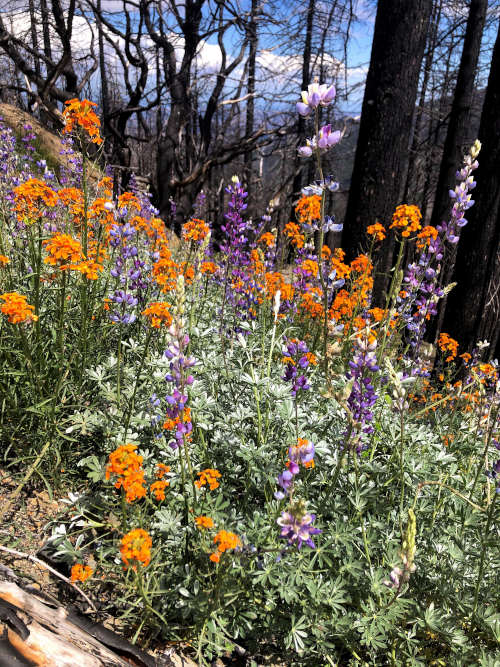
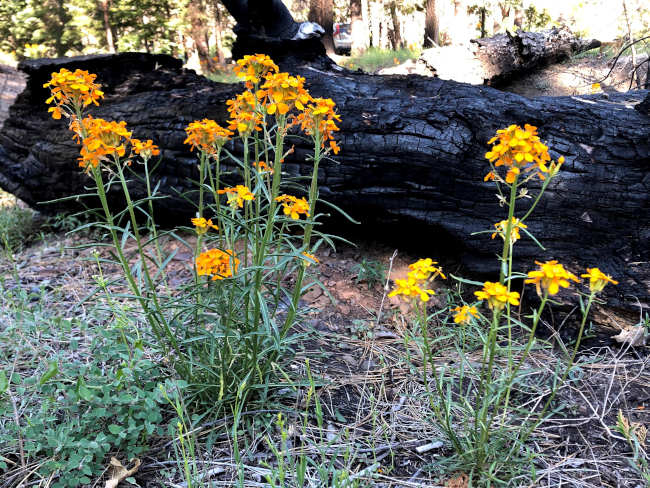
Wallflowers blooming following fire. Photo by Nate Lillge.

NORTHERN CALIFORNIA — Recovering after a fire has become a very frequent part of life in California.

Though fire is an intrinsic part of the California landscape, the fires in recent years feel different. Climate scientists agree that these fires, in frequency as well as severity, are indeed intensifying, an effect of human-caused climate change.

As of this writing, over 23,000 acres in and around our sister landscape, the Santa Monica Mountain National Recreation Area in Southern California, have been burned in the Palisades fire. Watching updates about the blaze in the southern part of our state had many of us remembering times when fires were closer to home, here in the Berryessa Snow Mountain region.

According to Solano County records, the 2020 LNU Lightning Complex fires burned 363,220 acres across Colusa, Lake, Napa, Solano, Sonoma and Yolo counties. Over the course of the fire, which lasted from Aug. 17 to Oct. 2, there were 1,491 structures destroyed, another 232 were damaged and tragically the fire took 6 human lives. It was the seventh largest wildfire in recorded California history.

Our beloved natural landscape and wildlife in the Berryessa Snow Mountain region was severely impacted. It is easy to recall the burnt hills, the charred trees, as well as the smokey skies that lasted all summer in 2020. Almost five years later, I find myself continuing to look to nature for wisdom about recovery after such significant losses.

Ecological succession is the term used by scientists to describe the process by which a biological community evolves over time. Primary succession is the process of ecological growth starting from completely barren or newly exposed land, after a volcanic eruption, for instance, when there is rock but no soil for plants to grow in.

“Pioneer species” in ecological terms are the first species to become established in a habitat. Seeds and spores brought in on the wind, in water, or dropped by a passing bird, bring the first species of plants to inhabit the landscape, creating a simple biological community. Over time, the plant matter decomposes and becomes soil, making way for larger plants and a more complex ecosystem.

Secondary succession occurs after a fire or other disturbance when the landscape is significantly altered, but the building blocks of soil are already present. In secondary succession, pioneer plant species like ferns and mosses are often the first to return. Ferns grow from rhizomes, horizontal root systems under the soil, which can withstand a moderate fire, allowing for ferns to appear as quickly as 3 weeks post-fire. Mosses can also begin to grow just 2 months after a fire. In the first spring post-fire we see grasses and wildflowers taking advantage of the sunlight once shaded out by the overstory. Nature wastes no time.

California native plants have evolved to live alongside fire, and they do so in several different ways. Some native plants like toyon (Heteromeles arbutifolia) rely upon resprouting new growth from the crown of an established plant after a fire, their root ball having stored nutrients to prepare for a time like this.

Many manzanita species (Arctostaphylos manzanita) rely upon germination of seeds to replenish their populations and use “fire cues” such as heat and smoke for seed germination.

Some plants have adapted to regenerate both by seed and resprouting at the crown such as California Yerba Santa (Eriodictyon californicum). Species of plants referred to as fire-followers, as the name implies, are signaled to germinate by the chemicals in charred wood and smoke after a fire.

Some endemic fire followers only grow in the one to two years after a fire, from seeds left behind after a previous fire, these newly sprouted plants will also produce masses of seeds to be stored in the soil until the next fire.

An example of a fire follower in our region is the wildflower Whispering bells (Emmenanthe penduliflora). Fascinatingly, studies have shown that many fire-following plants are more nutritionally dense when growing in ash-enriched soil from a recent fire, providing more nutrients to the herbivores who graze on them.

Wildflower bloom following fire. Photo Nate Lillge.


Along with plant life, insects and small mammals are also an integral part of succession after a fire. Many insect species are attracted to the scent of smoke and ash which signals ample food in the form of charred plant material. Birds are then drawn by the increase in insects in the area.

Small mammals such as rodents and rabbits are key to recovery in an area impacted by fire thanks to their ability to repopulate quickly, and their adaptability to shifts in the landscape. This boom in small mammals then brings larger mammals and birds of prey.

In the five to 10 years following a fire, we will start to see shrubs returning to the landscape, while trees can take decades to create the beginnings of an overstory. While it can take hundreds of years for a landscape to move from pioneer mosses and wildflowers to an ecosystem with mature trees, there is a lot of life happening in the years in between. Some ecosystems display more biodiversity in the years after a fire, than in the years leading up to one.

Perhaps the concept of ecological succession can help us cope with the impacts of present and future fires. In ecological succession, each plant and animal in the community does a little something to recover, and slowly there is renewal and opportunity.

As individuals we can’t change everything, but we can each do a little something and together that can make all the difference.

Driving or hiking through the fire-impacted areas now, almost five years later, you see the remains of charred trees that once shaded the understory, snags now providing habitat for woodpeckers and other cavity nesting birds. There are fields of miniature lupines, Yerba Santa, common woolly sunflower and broad leaf phacelia.

Wildflowers and grasses enjoying the lack of competition for sunlight provide a delicious buffet for wildlife to enjoy. Among disturbed edges, you find the soft low creeping of turkey mullein (Croton setiger), and the familiar brilliance of California fuschia (Epilobium canum).

Our state’s most famous fire-follower, the iconic California poppy (Eschscholzia californica) shimmers all over the hills. If you are lucky you might hear the persistent courting melodies of a northern mockingbird (Mimus polyglottos) or the distant “Chi-ca-go!” of a California Quail (Callipepla californica). Life has continued to push on.

Diana Drips is a Certified California Naturalist. Tuleyome is a 501 (c)(3) nonprofit conservation organization based in Woodland, CA. For more information go to www.tuleyome.org. 

Helping Paws: Many adoptable dogs and puppies

LAKE COUNTY, Calif. — Lake County Animal Care and Control has numerous puppies along with adult dogs waiting to go to new homes.

The dogs available for adoption this week include mixes of Australian shepherd, border collie, cattle dog, German shepherd, husky, Labrador Retriever, pit bull terrier, Rhodesian ridgeback, Rottweiler and terrier.

Dogs that are adopted from Lake County Animal Care and Control are either neutered or spayed, microchipped and, if old enough, given a rabies shot and county license before being released to their new owner. License fees do not apply to residents of the cities of Lakeport or Clearlake.

Those dogs and the others shown on this page at the Lake County Animal Care and Control shelter have been cleared for adoption.

Call Lake County Animal Care and Control at 707-263-0278 or visit the shelter online for information on visiting or adopting.

The shelter is located at 4949 Helbush in Lakeport.

Email Elizabeth Larson at This email address is being protected from spambots. You need JavaScript enabled to view it.. Follow her on Twitter, @ERLarson, and on Bluesky, @erlarson.bsky.social. Find Lake County News on the following platforms: Facebook, @LakeCoNews; X, @LakeCoNews; Threads, @lakeconews, and on Bluesky, @lakeconews.bsky.social.


Foster#9966's preview photo
Foster#9966

#90(Fern)'s preview photo
#90(Fern)

#90(Cedar)'s preview photo
#90(Cedar)

#90(Willow)'s preview photo
#90(Willow)

#90(Maple)'s preview photo
#90(Maple)

#114(Jenny)'s preview photo
#114(Jenny)
#32(Vivian)'s preview photo
#32(Vivian)
#138(Cisco)'s preview photo
#138(Cisco)

Diesel's preview photo
Diesel

Calvin's preview photo
Calvin
Grizzly's preview photo
Grizzly
Bailey's preview photo
Bailey
Arlo's preview photo
Arlo

Starla's preview photo
Starla

Foster#10068's preview photo
Foster#10068

Victor's preview photo
Victor

Mocha's preview photo
Mocha
Ruby's preview photo
Ruby
#1(Luna)'s preview photo
#1(Luna)

#8(Koa)'s preview photo
#8(Koa)

#8(Kai)'s preview photo
#8(Kai)

Jet's preview photo
Jet

Sam's preview photo
Sam

Louie's preview photo
Louie

Ace's preview photo
Ace

Bear-Bear's preview photo
Bear-Bear

Chai's preview photo
Chai

Hazel's preview photo
Hazel
 
Hamilton's preview photo
Hamilton

Hulk's preview photo
Hulk

Scout's preview photo
Scout

Buddy's preview photo
Buddy

A#68(Noah)'s preview photo
A#68(Noah)

C#135(Holly)'s preview photo
C#135(Holly)

Brynn's preview photo
Brynn

Lynn's preview photo
Lynn


Kennel #15's preview photo
Kennel #15
 

How much does scientific progress cost? Without government dollars for research infrastructure, breakthroughs become improbable


America may not maintain its position as a global leader in biomedical research without federal support. Sean Gladwell/Moment via Getty Images

On Feb. 7, 2025, the U.S. National Institutes of Health issued a policy that could weaken the position of the United States as a global leader in scientific innovation by slashing funds to the infrastructure that allows universities and other institutions to conduct research in the first place.

Universities across the nation carry out research on behalf of the federal government. Central to this partnership is federal grant funding, which is awarded through a rigorous review process. These grants are the lifeblood of biomedical research in the U.S.

When you think of the costs of scientific research, you might picture the people who conduct the research, and the materials and lab equipment they use. But these don’t encompass all the essential components of research. Every scientific and medical breakthrough also depends on laboratory facilities; heating, air conditioning, ventilation and electricity; and personnel to ensure research is conducted securely and in accordance with federal regulations.

These critical indirect costs of research are both substantial and unavoidable, not least because it can be very expensive to build, maintain and equip space to conduct research at the frontiers of knowledge. The NIH stated that it spent more than US$35 billion on grants in the 2023 fiscal year, which went to more than 300,000 researchers at more than 2,500 universities, medical schools and other kinds of research institutions across the nation. Approximately $9 billion of this funding was allocated to indirect costs.

NIH grants have supported the direct costs of my own scientific research on developing treatments for conditions ranging from cancer to eye diseases. I would be unable to carry out my research without the support of the indirect costs the NIH plans to cut.

What are indirect costs?

Indirect costs, also known as facilities and administration costs, or overhead, are funds provided to institutions to cover expenses that are not directly tied to specific research projects but are essential for their execution. Unlike direct costs, which cover salaries, supplies and experiments, indirect costs support the overall research environment, ensuring that scientists have the necessary resources to conduct their work effectively.

Indirect costs include maintaining optimal laboratory spaces, specialized facilities providing services like imaging and gene analysis, high-speed computing, research security, patient and personnel safety, hazardous waste disposal, utilities, equipment maintenance, administrative support, regulatory compliance, information technology services, and maintenance staff to clean and supply labs and facilities.

Academic institutions conduct research on behalf of the federal government.

Research institutions that receive federal grants must comply with the rules and regulations established by the U.S. Office of Management and Budget. These guidelines dictate the indirect cost rates of each institution.

Institutions submit proposals to federal agencies that outline the costs associated with maintaining research infrastructure. The cost allocation division of the Department of Health and Human Services reviews these proposals to ensure compliance with federal policies.

Indirect rates can range from 15% to 70%, with the specific level depending on the research and infrastructure needs of an institution.

Typically, institutions undergo an exacting process to renegotiate their indirect rates every four years, factoring in components such as general, departmental and program administration, building and equipment depreciation, interest, operations and maintenance, and library expenses. Universities need to carefully justify these cost components to ensure the sustainability of research infrastructure and compliance with federal requirements.

Notably, indirect costs from grants do not cover the full cost of carrying out research at universities. In 2023, colleges and universities contributed approximately $27 billion of their own funding, such as money from their endowments, to support research. This included $6.8 billion in indirect costs that the federal government did not reimburse.

Slashing vital research funding

In its February announcement, the National Institutes of Health declared that it would no longer determine indirect costs rates based on the needs of each institution. Instead, it would issue a standard indirect cost rate of 15% across all grants. The rationale given by the agency for the cap is to “ensure that as many funds as possible go towards direct scientific research costs rather than administrative overhead.”

It notably comes after the Trump administration and Elon Musk have sought to slash federal spending, with Musk criticizing indirect cost rates as “a ripoff.”

A standard 15% rate would significantly affect an institution’s ability to maintain its research infrastructure. For example, if a university had a 50% indirect cost rate in 2024, it would receive $150,000 for a $100,000 grant, with $50,000 allocated to indirect costs. With the new NIH cap, this would drop to $115,000, with only $15,000 for indirect costs.

The scale of this cut in research support becomes apparent at the state level, with harms to both red and blue states. For example, Texas institutions would face a reduction of over $310 million, and institutions in Iowa a reduction of nearly $37 million. California would lose more than $800 million, and Washington over $178 million.

Person wearing nitrile gloves pipetting a liquid into a vial over a lab area
Research has both indirect and direct costs – and both are essential. David Ryder/Stringer via Getty Images News

The NIH compared the new 15% cap to the indirect cost rates that foundations typically set for institutions of higher education. It pointed to the 10% rate granted by the Bill & Melinda Gates Foundation and Smith Richardson Foundation, the 12% rate of the Gordon and Betty Moore Foundation and Robert Wood Johnson Foundation, and the 15% rate of the Carnegie Corporation of New York, Chan Zuckerberg Initiative, John Templeton Foundation, Packard Foundation, and Rockefeller Foundation.

However, many researchers and funders have criticized this claim as misleading. A spokesperson for the Gates Foundation has previously stated that the listed rate does not reflect how the organization allocates its funds. Universities have pointed out that they often accept foundation grants with low or zero overhead rates because these grants constitute a relatively small portion of their funding and are often spent on early-stage faculty whose careers need additional support.

In addition, it is only because NIH grants cover a significant portion of their overhead costs that research institutions are able to accept foundation grants with such low indirect rates.

Biomedical researchers respond

Scientists and researchers responded to the NIH announcement with deep concern about the negative effects these funding cuts would have on biomedical research in the United States.

The Council on Governmental Relations, which monitors federal policy for major universities and medical research centers, stated that “America’s competitors will relish this self-inflicted wound,” urging the NIH to “rescind this dangerous policy before its harms are felt by Americans.”

The president and CEO of the Association of American Medical Colleges stated that the NIH policy would “diminish the nation’s research capacity, slowing scientific progress and depriving patients, families, and communities across the country of new treatments, diagnostics and preventative interventions.”

Research institutions, scientific societies, advocacy groups and lawmakers from both major political parties have pushed back against the 15% cap on indirect costs, urging NIH leadership to reconsider its policy.

Soon after the attorneys general of 22 states filed lawsuits challenging the policy, a federal judge issued a temporary pause in those states until lifted by the court.

Scientists expect the long-term effects of these funding cuts to significantly damage U.S. biomedical research. As the debate over federal support to academic research institutions unfolds, how institutions adapt and whether the NIH reconsiders its approach will determine the future of scientific research in the United States.The Conversation

Aliasger K. Salem, Bighley Chair and Professor of Pharmaceutical Sciences, University of Iowa

This article is republished from The Conversation under a Creative Commons license. Read the original article.

Biomedical research in the U.S. is world-class in part because of a long-standing partnership between universities and the federal government.

Space News: NASA’s PUNCH mission to revolutionize our view of solar wind


Earth is immersed in material streaming from the Sun. This stream, called the solar wind, is washing over our planet, causing breathtaking auroras, impacting satellites and astronauts in space, and even affecting ground-based infrastructure.

NASA’s Polarimeter to Unify the Corona and Heliosphere, or PUNCH, mission will be the first to image the Sun’s corona, or outer atmosphere, and solar wind together to better understand the Sun, solar wind, and Earth as a single connected system.

Launching no earlier than Feb. 28, aboard a SpaceX Falcon 9 rocket from Vandenberg Space Force Base in California, PUNCH will provide scientists with new information about how potentially disruptive solar events form and evolve. This could lead to more accurate predictions about the arrival of space weather events at Earth and impact on humanity’s robotic explorers in space.

“What we hope PUNCH will bring to humanity is the ability to really see, for the first time, where we live inside the solar wind itself,” said Craig DeForest, principal investigator for PUNCH at Southwest Research Institute’s Solar System Science and Exploration Division in Boulder, Colorado.

Seeing solar wind in 3D

The PUNCH mission’s four suitcase-sized satellites have overlapping fields of view that combine to cover a larger swath of sky than any previous mission focused on the corona and solar wind.

The satellites will spread out in low Earth orbit to construct a global view of the solar corona and its transition to the solar wind. They will also track solar storms like coronal mass ejections, or CMEs. Their Sun-synchronous orbit will enable them to see the Sun 24/7, with their view only occasionally blocked by Earth.

Typical camera images are two dimensional, compressing the 3D subject into a flat plane and losing information. But PUNCH takes advantage of a property of light called polarization to reconstruct its images in 3D.

As the Sun’s light bounces off material in the corona and solar wind, it becomes polarized — meaning the light waves oscillate in a particular way that can be filtered, much like how polarized sunglasses filter out glare off of water or metal. Each PUNCH spacecraft is equipped with a polarimeter that uses three distinct polarizing filters to capture information about the direction that material is moving that would be lost in typical images.

“This new perspective will allow scientists to discern the exact trajectory and speed of coronal mass ejections as they move through the inner solar system,” said DeForest. “This improves on current instruments in two ways: with three-dimensional imaging that lets us locate and track CMEs which are coming directly toward us; and with a broad field of view, which lets us track those CMEs all the way from the Sun to Earth.”

All four spacecraft are synchronized to serve as a single “virtual instrument” that spans the whole PUNCH constellation.

The PUNCH satellites include one Narrow Field Imager and three Wide Field Imagers. The Narrow Field Imager, is a coronagraph, which blocks out the bright light from the Sun to better see details in the Sun’s corona, recreating what viewers on Earth see during a total solar eclipse when the Moon blocks the face of the Sun — a narrower view that sees the solar wind closer to the Sun.

The Wide Field Imagers are heliospheric imagers that view the very faint, outermost portion of the solar corona and the solar wind itself — giving a wide view of the solar wind as it spreads out into the solar system.  

“I’m most excited to see the ‘inbetweeny’ activity in the solar wind,” said Nicholeen Viall, PUNCH mission scientist at NASA’s Goddard Space Flight Center in Greenbelt, Maryland. “This means not just the biggest structures, like CMEs, or the smallest interactions, but all the different types of solar wind structures that fill that in between area.”

When these solar wind structures from the Sun reach Earth’s magnetic field, they can drive dynamics that affect Earth's radiation belts. To launch spacecraft through these belts, including ones that will carry astronauts to the Moon and beyond, scientists need to understand the solar wind structure and changes in this region.

Building off other missions

“The PUNCH mission is built on the shoulders of giants,” said Madhulika Guhathakurta, PUNCH program scientist at NASA Headquarters in Washington. “For decades, heliophysics missions have provided us with glimpses of the Sun’s corona and the solar wind, each offering critical yet partial views of our dynamic star’s influence on the solar system.”

When scientists combine data from PUNCH and NASA’s Parker Solar Probe, which flies through the Sun’s corona, they will see both the big picture and the up-close details. Working together, Parker Solar Probe and PUNCH span a field of view from a little more than half a mile (1 kilometer) to over 160 million miles (about 260 million kilometers).

Additionally, the PUNCH team will combine their data with diverse observations from other missions, like NASA’s CODEX (Coronal Diagnostic Experiment) technology demonstration, which views the corona even closer to the surface of the Sun from its vantage point on the International Space Station.

PUNCH’s data also complements observations from NASA’s EZIE (Electrojet Zeeman Imaging Explorer) — targeted for launch in March 2025 — which investigates the magnetic field perturbations associated with Earth’s high-altitude auroras that PUNCH will also spot in its wide-field view.

As the solar wind that PUNCH will observe travels away from the Sun and Earth, it will then be studied by the Interstellar Mapping and Acceleration Probe, or IMAP, mission, which is targeting a launch in 2025.

“The PUNCH mission will bridge these perspectives, providing an unprecedented continuous view that connects the birthplace of the solar wind in the corona to its evolution across interplanetary space,” said Guhathakurta.

The PUNCH mission is scheduled to conduct science for at least two years, following a 90-day commissioning period after launch. The mission is launching as a rideshare with the agency’s next astrophysics observatory, SPHEREx (Spectro-Photometer for the History of the Universe, Epoch of Reionization and Ices Explorer).

“PUNCH is the latest heliophysics addition to the NASA fleet that delivers groundbreaking science every second of every day,” said Joe Westlake, heliophysics division director at NASA Headquarters in Washington. “Launching this mission as a rideshare bolsters its value to the nation by optimizing every pound of launch capacity to maximize the scientific return for the cost of a single launch.”

The PUNCH mission is led by Southwest Research Institute’s offices in San Antonio, Texas, and Boulder, Colorado. The mission is managed by the Explorers Program Office at NASA Goddard for NASA’s Science Mission Directorate in Washington.

Abbey Interrante writes for NASA’s Goddard Space Flight Center in Greenbelt, Maryland.

Vehicle rollover on Highway 20 leads to death of horses; fundraisers organized to help family

LAKE COUNTY, Calif. — A stretch of Highway 20 proved deadly for three prized horses early this week when the trailer they were riding in went down an embankment.

The crash took place on the evening of Sunday, Feb. 16, according to the California Highway Patrol’s Clear Lake Area office.

The CHP said the crash occurred on Highway 20 near Watertrough Road, east of Clearlake Oaks.

A Redwood Valley family was returning from a high school rodeo in Corning when they were involved in the wreck.

CHP Sgt. Josh Dye said they were driving an RV towing a horse trailer and for reasons still under investigation lost control.

“When the RV overturned and slid to the edge of the embankment, the horse trailer became detached and went down the embankment,” Dye said.

Dye said it is a very steep embankment and quite a ways down from the highway.

He said two horses were killed and a third was severely injured and was dispatched by the driver and owner of the horses.

Along with the CHP, Dye said Northshore Fire responded to the scene.

The people in the vehicle were unhurt, Dye said.

A GoFundMe has been organized by Kirstin McCready to assist the family who lost the horses, identified as Shasta Jameson-Green and Nick Gradek and their children Emerald, Willow and Juniper.

The horses who died were named Poco, 45 and Doug.

“These animals were more than just horses—they were family, deeply loved by their owners and their children, with countless irreplaceable memories shared,” the GoFundMe page explains.

“These horses meant everything to this family. The love, time, and financial investment they dedicated to their children's dreams were taken from them in an instant,” the online fundraiser explained.

As of early Saturday morning, the GoFundMe page had raised $31,490, with a goal of $45,000.

Other fundraisers are also being held for the family, including the “Give Back Barrel Race” that Lake County District 1 Supervisor Helen Owen is hosting at her ranch in Middletown on March 2.

Dye confirmed that the wreck occurred in the same area of Highway 20 where there have been two previous wrecks involving livestock.

One of them, a year ago this month, involved a big rig full of 36 cattle traveling from Orland to Arcata that rolled onto its side.

In October 2023, a double-decker livestock trailer with 79 head of cattle on board and traveling from Fortuna to Tennessee flipped over after taking the turns in that stretch of highway too fast, according to the CHP.

Email Elizabeth Larson at This email address is being protected from spambots. You need JavaScript enabled to view it.. Follow her on Twitter, @ERLarson, and on Bluesky, @erlarson.bsky.social. Find Lake County News on the following platforms: Facebook, @LakeCoNews; X, @LakeCoNews; Threads, @lakeconews, and on Bluesky, @lakeconews.bsky.social.

Authorities ID man killed in January crash

LAKE COUNTY, Calif. — Authorities have identified the man killed last month in a crash near Clearlake Oaks, with the investigation into the crash continuing.

Salvador Reyes Fregoso, 39, Clearlake, was identified as the crash victim, said Lauren Berlinn of the Lake County Sheriff’s Office.

Berlinn said Reyes Fregoso was reported missing on Jan. 28 after he didn’t return home.

The day after Reyes Fregoso was reported missing, California Highway Patrol officers were dispatched to assist the sheriff’s office with a fatality traffic collision.

Reyes Fregoso’s body was found by CHP officers and deputies in his vehicle, which was down a steep embankment on High Valley Road near Valley Oak Drive in the Clearlake Oaks area.

The CHP is leading the investigation into the crash.

“As of our investigation it appears this was an alcohol related solo vehicle crash,” Sgt. Joel Skeen told Lake County News.

Skeen said he wouldn’t have more information available to share until the crash investigation is completed.

Email Elizabeth Larson at This email address is being protected from spambots. You need JavaScript enabled to view it.. Follow her on Twitter, @ERLarson, and on Bluesky, @erlarson.bsky.social. Find Lake County News on the following platforms: Facebook, @LakeCoNews; X, @LakeCoNews; Threads, @lakeconews, and on Bluesky, @lakeconews.bsky.social.
  • 290
  • 291
  • 292
  • 293
  • 294
  • 295
  • 296
  • 297
  • 298
  • 299

Community

  • Sheriff’s Activities League and Clearlake Bassmasters offer youth fishing clinic

  • City Nature Challenge takes place April 24 to 27

Public Safety

  • Lakeport Police logs: Wednesday, Feb. 11

  • Lakeport Police logs: Tuesday, Feb. 10

Education

  • Ramos measure requiring school officer training in use of anti-opioid drug moves forward

  • Lake County Chapter of CWA announces annual scholarships 

Health

  • California ranks 24th in America’s Health Rankings Annual Report from United Health Foundation

  • Healthy blood donors especially vital during active flu season

Business

  • Employment law summit takes place March 9

  • Two Lake County Mediacom employees earn company’s top service awards

Obituaries

  • Terry Knight

  • Ellen Thomas

Opinion & Letters

  • Who should pay for AI’s power? Not California ratepayers

  • Crandell: Supporting nephew for reelection in supervisorial race

Veterans

  • State honors fallen chief warrant officer killed in conflict in Iran

  • CalVet and CSU Long Beach team up to improve data collection related to veteran suicides

Recreation

  • April Audubon program will show how volunteers can help monitor local osprey nests

  • First guided nature walk of spring at Anderson Marsh State Historic Park April 11

  • Second Saturday guided nature walks continue at Anderson Marsh State Historic Park

  • Wet weather trail closure in effect on Upper Lake Ranger District

Religion

  • Kelseyville Presbyterian Church plans Easter service

  • Easter ‘Sonrise’ Service returns to Xabatin Community Park

Arts & Life

  • ‘CIA’ delves into the shadowy world of an espionage thriller

  • ‘War Machine’ shifts the battlefield into uncharted territory

Government & Politics

  • Lake County Democratic Central Committee endorses Falkenberg

  • Crandell launches reelection campaign plans March 15 event

Legals

  • April 23 hearing on Lake Coco Farms Major Use Permit

  • NOTICE OF 30-DAY PUBLIC COMMENT PERIOD & NOTICE OF PUBLIC HEARING

How to resolve AdBlock issue?
Refresh this page