 How to resolve AdBlock issue?
CHP receives Native-Tribal Traffic Education Program grant to strengthen community partnerships
The California Highway Patrol has received the Native-Tribal Traffic Education Program, or TTEP, grant, a transformative initiative to build stronger relationships and improve outreach with Native American communities throughout California.This $425,000 federal grant will support a series of programs focused on safety, education and cultural understanding.
The TTEP grant provides resources to create specialized training, community outreach and educational events that increase awareness of tribal sovereignty and respect cultural traditions.
The program also aims to address the unique challenges Native American communities face.
“This grant is a significant milestone for our department and the communities we serve across California,” said CHP Commissioner Sean Duryee. “It allows us to enhance safety and foster cultural understanding through essential resources and educational programs.”
Grant funds will be used to conduct workshops and training sessions for CHP personnel, emphasizing culturally informed law enforcement practices and the historical context of Native American relations.
The program will also support the development of educational materials that provide safety information and resources tailored to Native American communities.
This initiative aligns with the CHP’s commitment to improving community relations and enhancing public safety through education and outreach.
By working closely with tribal leaders and members, the CHP seeks to address specific concerns and provide meaningful support to Native American communities throughout the state.
Funding for this program was provided by a grant from the California Office of Traffic Safety through the National Highway Traffic Safety Administration.
National Weather Service issues fire weather watch for southern Lake County
LAKE COUNTY, Calif. — The National Weather Service has issued a fire weather watch for southern Lake County late this week due to windy, warm and low-humidity conditions in the forecast.The watch will be in effect from 11 a.m. Thursday, Oct. 17, through 8 p.m. Saturday, Oct. 19. It was issued for fire weather zone 264, which covers much of the lower two-thirds of the county’s geography.
A fire weather watch means that critical fire weather conditions are forecast to occur, the National Weather Service reported.
Forecasters said the watch is due to the potential for gusty northerly winds of between 15 to 25 miles per hour, with gusts up to 45 miles per hour expected over the ridges and higher elevations.
At the same time, humidity is expected to drop as low as 15% during the day and 40% at night.
Such conditions can cause any fires that occur to develop rapidly, the agency said.
While a fire weather watch will be in effect, the overall forecast calls for cooler conditions, with daytime temperatures from Thursday through Saturday ranging into the low 80s, with nighttime lows dropping into the high 30s during that time.
Email Elizabeth Larson at
Gov. Newsom signs legislation to prevent gas price spikes and save Californians money
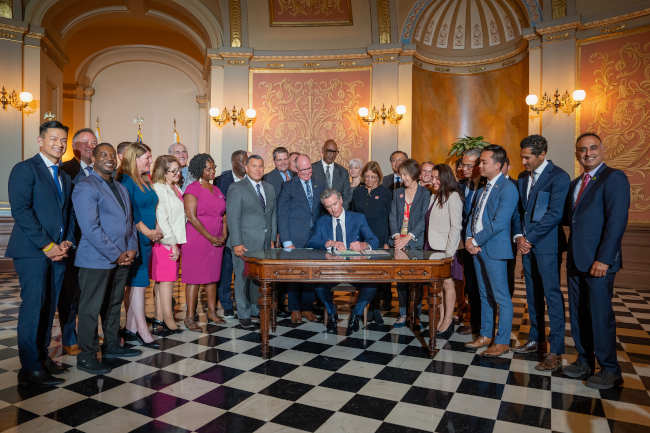
On Monday, surrounded by legislators and community leaders in the rotunda of the California State Capitol, Gov. Gavin Newsom signed legislation to help prevent gas price spikes and save consumers money at the pump.
The legislation — ABX2-1 authored by Assemblymembers Gregg Hart and Cecilia Aguiar-Curry and Senator Nancy Skinner — allows the state to require oil refiners to maintain a minimum inventory of fuel to avoid supply shortages that create higher gasoline prices for consumers and higher profits for the industry. It also authorizes the California Energy Commission to require refiners to plan for resupply during refiner maintenance outages. A signing message can be found here.
“Price spikes have cost Californians billions of dollars over the years, and we’re not waiting around for the industry to do the right thing — we’re taking action to prevent these price spikes and save consumers money at the pump. Now, the state has the tools to make sure they backfill supplies and plan ahead for maintenance so there aren’t shortages that drive up prices. I’m grateful to our partners in the Senate and Assembly for acting quickly to push this forward and help deliver relief for Californians,” said Newsom.
“With this new law, big oil companies are now responsible for stabilizing prices at the pump. It’s a critical accomplishment, but our work is not done. I will continue to fight to lower the cost of living, because housing, groceries and everyday necessities must be more affordable for all Californians,” said Assembly Speaker Robert Rivas (D-Salinas).
“Today, we’re coming together to provide needed relief at the pump and help keep hard-earned dollars in the pockets of Californians. I’m grateful to Governor Newsom, Speaker Rivas, and members of the Senate and Assembly for taking swift action on this critical issue. That said, our work isn’t stopping. We’re going to continue to grind away to help lower the cost of living for folks in every corner of the Golden State. It’s a necessity,” said Senate President pro Tempore Mike McGuire (D-North Coast).
Why it’s needed
Price spikes at the pump are profit spikes for oil companies, and they’re overwhelmingly caused by refiners not backfilling supplies when they go down for maintenance. If this proposal had been in effect last year, Californians could have saved hundreds of millions — if not billions — of dollars at the pump according to analysis from the Division of Petroleum Market Oversight, or DPMO.
Experts have come out in support of this measure, including Stanford economists who praised the proposal for being “an economically sound policy that addresses an important problem in a well-targeted way” and the “additional supply would free up refinery capacity to serve Nevada and Arizona, also reducing prices in these markets.”
Supporters of the bill include mayors, local leaders, consumer organizations, environmental advocates, labor, business leaders and consumer groups. Last month, the Governor and supporters met and discussed how gasoline price spikes affect millions of Californians’ everyday lives, and shared why this plan will help California families.
How we got here
The governor convened a special session to focus on saving Californians money at the pump. The proposal authorizes the California Energy Commission, or CEC, to require petroleum refiners to maintain a minimum inventory of refined fuel throughout the distribution chain to avoid supply shortages that create higher prices at the pump for consumers. It also authorizes the CEC to require refiners to plan for resupply during scheduled refiner maintenance. The text of the proclamation calling for a special session is available here.
Following gasoline price spikes in 2022, Governor Newsom called for a special session and worked in partnership with the Legislature to sign into law a package of reforms holding Big Oil accountable.
California’s new watchdog found that higher gasoline prices were caused by a suspicious market transaction, refinery maintenance without properly preparing for it, and more.
In January of this year, the watchdog sent Gov. Newsom and the legislature a letter outlining specific proposals to reform California’s gasoline spot market, which included a minimum inventory requirement to prevent price spikes due to lack of stable supply.
The state’s gasoline price watchdog also found that, in 2023, gasoline prices spiked largely due to refineries going offline without adequately planning to backfill supplies, which caused refining margins to spike as spot and retail prices jumped — indicating that refinery margins made up the largest proportion of the price spikes between July and September 2023.
Convening experts, community leaders and consumer advocates
The governor on Monday also announced his appointments to the Independent Consumer Fuels Advisory Committee:
Martha Dina Arguello, of Los Angeles, has been appointed to the Independent Consumer Fuels Advisory Committee. Arguello has been Executive Director at Physicians for Social Responsibility – Los Angeles since 2007. She was Director of Health and Environmental Programs at Physicians for Social Responsibility – Los Angeles from 1999 to 2007. Arguello is Co-Founder and Co-Chair of Standing Together Against Neighborhood Drilling and Californians for a Health and Green Economy. She is a member of the California Air Resources Board AB 32 Environmental Justice Advisory Committee and the Steering Committee of Californians for Pesticide Reform. This position does not require Senate confirmation and the compensation is $100 per diem. Arguello is a Democrat.
Michael Jorgenson, of Mill Valley, has been appointed to the Independent Consumer Fuels Advisory Committee. Jorgenson has served as Supervisory Deputy Attorney General at the California Department of Justice, Office of the Attorney General since 2018. He was Deputy County Counsel IV at the Marin County Counsel’s Office from 2017 to 2018. Jorgenson served in several roles at the California Department of Justice, Office of the Attorney General from 2003 to 2017, including Deputy Attorney General in the Public Rights Division, Supervising Deputy Attorney General in the Civil Division and Deputy Attorney General in the Civil Division. He was an Associate at Berman Tabacco from 2001 to 2003 and at Kelly Gill Sherburne & Herrera from 1999 to 2001. He earned a Juris Doctor degree from the University of San Francisco School of Law and a Bachelor of Arts degree in Economics and History from University of Michigan. This position does not require Senate confirmation and the compensation is $100 per diem. Jorgenson is a Democrat.
Neale Mahoney, of Stanford, has been appointed to the Independent Consumer Fuels Advisory Committee. Mahoney has been a Professor of Economics at Stanford University since 2020. He was a Special Policy Advisor for Economic Policy at The White House from 2022 to 2023. Mahoney was a Professor of Economics at the University of Chicago from 2013 to 2020. He earned a Doctor of Philosophy degree in Economics from Stanford University and a Bachelor of Science degree in Applied Mathematics and Economics from Brown University. This position does not require Senate confirmation and the compensation is $100 per diem. Mahoney is a Democrat.
Deborah “Debbie” Meeks, of Walnut Creek, has been appointed to the Independent Consumer Fuels Advisory Committee. Meeks has been Manager of United States West Coast Policy and Business Coordinator at Shell USA since 2021. She was a Manager of Alliances and Portfolios at Shell US Retail from 2017 to 2021. Meeks was Americas and Mexico Regional Manager, Principal Account Executive, and Senior Account Manager at Shell Catalysts and Technologies from 1995 to 2017. She earned a Bachelor of Science degree in Chemical Engineering from California State University, Long Beach. This position does not require Senate confirmation and the compensation is $100 per diem. Meeks is a Democrat.
Norman Rogers, of Santa Ana, has been appointed to the Independent Consumer Fuels Advisory Committee. Rogers has been Second Vice-President at United Steelworkers Local 675 since 2021, and a Plant Operator in Oil Movements at Marathon Petroleum Corporation since 2018. He was a Plant Operator for Oil Movements at Tesoro Refinery from 2013 to 2018. Rogers was a member of the Fire Brigade at the Carson Refinery from 2001 to 2021. He was Plant Operator for Oil Movements at BP from 2001 to 2013, and at Arco Refinery from 1999 to 2001. This position does not require Senate confirmation and the compensation is $100 per diem. Rogers is registered without party preference.
Astrid Zuniga, of Modesto, has been appointed to the Independent Consumer Fuels Advisory Committee. Zuniga has been President at United Domestic Workers/AFSCME 3930 since 2024 and was Vice President from 2016 to 2024. She has been Executive Secretary/Treasurer at the Stanislaus and Tuolumne Central Labor Council since 2013, and an In-Home Support Services Caregiver since 1998. Zuniga is a member of the California Democratic Party Executive Board and the Women’s Advisory Committee for AFSCME International. This position does not require Senate confirmation and the compensation is $100 per diem. Zuniga is a Democrat.
State continues proactive testing for human cases of bird flu; reports 6 confirmed and 5 possible cases
As California continues to proactively test symptomatic individuals for bird flu, the California Department of Public Health, or CDPH, reports that new possible positive human bird flu cases have been identified in the Central Valley since last Friday.To date, the state has identified six confirmed and five possible human cases. The individuals had direct contact with infected dairy cattle at nine different farms.
The five possible human cases are pending confirmatory testing by the Centers for Disease Control and Prevention, or CDC.
Due to shipping delays late last week, and Monday’s federal holiday, the possible (or presumptive positive) specimens are expected to arrive at the CDC early this week.
Given the amount of exposure to infected cows, evidence continues to suggest only animal-to-human spread of the virus in California.
Additionally, based on CDC’s genomic sequencing of three California bird flu cases, there is no evidence to suggest an increased ability for the virus to infect or spread between people and no known reduced susceptibility to antiviral medications.
All individuals with confirmed or possible cases of bird flu have experienced mild symptoms, including eye redness or discharge (conjunctivitis), and have been treated according to CDC guidance. None of the individuals have been hospitalized.
While the risk to the general public remains low, additional human cases of bird flu are expected to be identified and confirmed in California among individuals who have regular contact with infected dairy cattle. CDPH continues to work closely with local health jurisdictions to identify, track, test, confirm, and treat possible and confirmed human cases of bird flu.
More information on CDPH’s response can be found at CDPH’s Bird Flu website.
Additional information on bird flu
Risk remains low: The risk to the general public remains low, but people who interact with infected animals, like dairy or poultry farm workers, are at higher risk of getting bird flu. CDPH recommends that personal protective equipment, or PPE, such as eye protection (face shields or safety goggles), respirators (N95 masks), and gloves be worn by anyone working with animals or materials that are infected or potentially infected with the bird flu virus. Wearing PPE helps prevent infection. Please see CDPH’s Worker Protection from Bird Flu for full PPE guidance.
Pasteurized milk and dairy products continue to be safe to consume, as pasteurization is fully effective at inactivating the bird flu virus. As an added precaution, and according to longstanding state and federal requirements, milk from sick cows is not permitted in the public milk supply.
What CDPH is doing: CDPH said it has helped coordinate and support outreach to dairy producers and farm workers on preventive measures that have helped keep human cases low in other states with bird flu outbreaks. CDPH continues to support local health departments in distributing PPE from state and federal stockpiles directly to affected dairy farms, farmworker organizations, poultry farm workers, those who handle raw dairy products, and slaughterhouse workers. To protect California farm workers from bird flu, during the last four months CDPH has distributed more than 400,000 respirators, 1.4 million gloves, 170,000 goggles and face shields, and 168,000 bouffant caps.
In addition, CDPH said it is working closely with local public health laboratories and local health departments to provide health checks for exposed individuals and ensure testing and treatment are available when needed. As one of the 14 states with infected dairy herds, California also received 5,000 additional doses of seasonal flu vaccine for farm workers from the CDC. CDPH is working to distribute the doses to local health departments with the highest number of dairy farms.
CDPH said it has been tracking bird flu and making preparations for a possible human infection since the state’s first detection in poultry in 2022. CDPH partners closely with the California Department of Food & Agriculture (CDFA) on a broad approach to protect human and animal health. CDPH and the CDC use both human and wastewater surveillance tools to detect and monitor for bird flu, and work closely with local health departments to prepare, prevent, and lessen its impact on human health.
What Californians can do: People exposed to infected animals should monitor for the following symptoms for 10 days after their last exposure: eye redness (conjunctivitis), cough, sore throat, runny or stuffy nose, diarrhea, vomiting, muscle or body aches, headaches, fatigue, trouble breathing and fever. If they start to feel sick, they should immediately isolate, notify their local public health department, and work with public health and health care providers to get timely testing and treatment.
CDPH recommends that all Californians — especially workers at risk for exposure to bird flu — receive a seasonal flu vaccine. Although the seasonal flu vaccine will not protect against bird flu, it can decrease the risk of being infected with both viruses at the same time and reduce the chance of severe illness from seasonal flu.
For the latest information on the national bird flu response, see CDC’s Bird Flu Response Update.




