How to resolve AdBlock issue?
Refresh this page
Lake County News,California
  • Home
    • Registration Form
  • News
    • Education
    • Veterans
    • Community
      • Obituaries
      • Letters
      • Commentary
    • Police Logs
    • Business
    • Recreation
    • Health
    • Religion
    • Legals
    • Arts & Life
    • Regional
  • Calendar
  • Contact us
    • FAQs
    • Phones, E-Mail
    • Subscribe
  • Advertise Here
  • Login
How to resolve AdBlock issue?
Refresh this page

News

California Racial and Identity Profiling Advisory Board releases report on 2023 police stop data

The California Racial and Identity Profiling Advisory Board this week announced the release of its annual report on police stops across California.

The report analyzes 4.7 million vehicle and pedestrian stops conducted in 2023 by 539 law enforcement agencies in California under the Racial and Identity Profiling Act, or RIPA.

Overall, the report shows disparities consistent with those observed in prior years’ data with respect to perceived race, age and disability status.

The report finds, for example, that the disparity between the proportion of stops and the proportion of residential population was greatest for individuals perceived to be Black, who were stopped 126% more frequently than expected, followed by individuals perceived to be Latino, who were stopped 44% more frequently than expected.

In addition to providing an in-depth look into policing in 2023, the report contains a wide array of best practice recommendations related to policing, with a particular focus this year on the policing of youth and its impacts.

"Like those before it, the 2025 RIPA report provides actionable information to address bias in policing. This year’s report is particularly important with its focus on young Californians. The racial disparities of policing stops, searches and use of force of youth is alarming,” said Andrea Guerrero, co-chair of the RIPA Board and Executive Director of Alliance San Diego. “Young Californians who are driving, biking, and walking and perceived to be Black or Brown are regularly stopped, asked to consent to a search, handcuffed, sat on the curb, put in a police car, and questioned for information that is recorded on a field interview card before being released. This is California’s version of stop and frisk that causes immeasurable harm to the community and erodes trust in law enforcement from a young age. In this report, the board makes a number of recommendations that we encourage policy makers, law enforcement agencies and community advocates to consider to eliminate bias in policing and enhance public safety."

“The annual collection of RIPA stop data is one part of our broader effort to increase public safety for all Californians. Through the analysis of stop data and recommendations for thoughtful reforms, we’re continuing to strengthen trust between local law enforcement and the communities they serve,” said Attorney General Rob Bonta. “This year’s report takes a close look at the policing of youth and the lasting impact interactions with police can have at a young age. I’m grateful to the RIPA Board and staff at the California Department of Justice for continuing to shine a light on disparities in police stops at every age and provide recommendations for targeted data-driven reforms.”

The information collected under RIPA includes data on peace officers’ perceptions of the demographics of stopped individuals, such as race or ethnicity, gender identity, sexual orientation, age and disability.

The board uses several well-established methodologies to analyze the data and determine whether disparities can be found across demographic groups and whether bias exists.

Some of the key findings from the Board’s report related to youth include:

• Actions taken: Overall, Native American, Black, Latino, and Multiracial individuals had more actions taken per average stop than other racial and ethnic groups. For youth ages 1-17, officers reported the highest average of actions taken during a stop for Black youth. And for those perceived to be 18-24, officers reported the highest average number of actions taken for Black and Latino youth. Youth perceived to be 12-14 were more likely to be searched, handcuffed, and detained during a stop than any other age group, while youth perceived to be 15-17 were the most likely to be ordered to exit a vehicle during a stop.

Search rates: Native American and Black individuals were searched at higher rates than those who are White, and officers were less likely to discover contraband or evidence during searches of those individuals than they were during searches of individuals perceived to be White. Officers reported the highest rates of searches in stops involving Black, Native American, Multiracial, and Latino youth across all age categories for youth ages 12–24.

Use of force: For youth ages 12–24, officers were more likely to use force in stops of youth perceived to be Black and Native American compared to other racial and ethnic groups. Black and Native American youth also had the highest rates of handcuffing and the highest rates of a firearm pointed at them during a stop. Youth with a perceived disability were more likely to be handcuffed as part of a stop than youth without a perceived disability.

Results of stop: Officers were also more likely to report no action taken for stops of individuals perceived as Native American and Black. Individuals perceived as transgender were arrested at approximately double the rate of those perceived as cisgender or gender nonconforming.

The board’s report also contains a wide array of policy recommendations related to policing, with a particular focus on the impact of police interactions with youth, civilian complaint processes, accountability, officer decertification, and training, on racial and identity profiling.

Through this data analysis and these recommendations, the board said it reaffirms its commitment to improving public safety and achieving the legal mandate to eliminate the racial and identity profiling of all Californians.

For more on RIPA, members of the public are encouraged to visit OpenJustice, a data-driven initiative that works to increase access to data and support the development of public policy.

A copy of the report is available here. More information about the Board is available here.

Learn more about the 2025 RIPA Report: On Tuesday, Jan. 21, at 11 a.m., the California Department of Justice’s Office of Community Awareness, Response, and Engagement, or CARE, will host a community briefing to discuss the RIPA Board’s report. Register for this free webinar at the link here.

Sheriff’s office releases new details in deputy-involved shooting

LAKE COUNTY, Calif. — The Lake County Sheriff’s Office has released some additional information about a deputy-involved shooting that occurred late last week.

The shooting left one person with injuries, as Lake County News has reported. No update has been offered about the individual’s status.

The incident occurred on Friday, Dec. 27, in the 3600 block of Highway 20 in Nice.

In a Tuesday update, the sheriff’s office said that its deputies responded at 2:45 a.m. that day to a business for an alarm call.

As they were concluding the call at about 3 a.m., Deputy Adrian Alexander was approached by a subject wielding multiple knives, the sheriff’s office said.

“The subject was erratic and displayed aggressive actions. Deputy Alexander made multiple attempts to diffuse and de-escalate the situation; however, the subject refused to comply and moved to attack the deputy. Deputy Alexander was forced to discharge his service weapon, striking the subject,” the sheriff’s office said.

The report said deputies immediately began taking life-saving measures while medics responded.

“Medics arrived on scene and transported the subject to a local hospital, where they received treatment before being transferred to an out-of-county hospital,” the sheriff’s office said.

The sheriff’s office said the footage from the responding deputies' body worn cameras will be released within 45 days, in accordance with the requirements of SB 1421, a bill approved in 2018 setting guidelines for the release of records “relating to specified incidents, complaints, and investigations involving peace officers and custodial officers to be made available for public inspection pursuant to the California Public Records Act.”

As a result of the incident, the Lake County Critical Incident Protocol was activated, and a parallel investigation is being conducted by the Lake County District Attorney’s Office, which is the lead investigating agency, officials said.

Since the shooting, the sheriff’s office said Alexander has been placed on administrative leave, which is common in such circumstances based on previous incidents.

The sheriff’s office said the latest information it has provided “is based on a preliminary and ongoing investigation, which continues to evolve as investigators interview witnesses, review physical and electronic records, and analyze forensic evidence. The Department’s understanding of the facts and circumstances may change as additional evidence is collected and analyzed.”

Email Elizabeth Larson at This email address is being protected from spambots. You need JavaScript enabled to view it.. Follow her on Twitter, @ERLarson, and on Bluesky, @erlarson.bsky.social. Find Lake County News on the following platforms: Facebook, @LakeCoNews; X, @LakeCoNews; Threads, @lakeconews, and on Bluesky, @lakeconews.bsky.social.

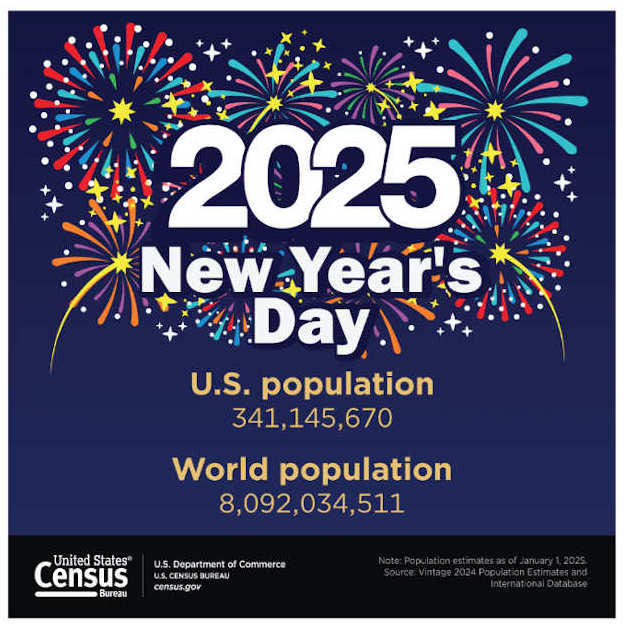
U.S. population projected to reach 341,145,670 Jan. 1


As 2024 came to a close, the U.S. Census Bureau projected the U.S. population would be 341,145,670 on New Year’s Day, an annual increase of 2,640,171 or 0.78%.

By comparison, just before the nation’s independence nearly 250 years ago, the 13 colonies had about 2.5 million residents.

The projected world population on Jan. 1, 2025, is 8,092,034,511, up 71,178,087 (0.89%) from New Year’s Day 2024.

During January 2025, 4.2 births and 2.0 deaths are expected worldwide every second.

Population estimates from U.S. and world population clocks

The Census Bureau’s Population Clock displays simulated real-time growth of the U.S. and world populations.

The U.S. Population Clock shows the population by age (0 to 100+) and sex, as well as the highest-density states, counties and cities.

In January 2025, the United States is expected to experience one birth every 9.0 seconds and one death every 9.4 seconds. Net international migration is expected to add one person to the U.S. population every 23.2 seconds.

The combination of births, deaths and net international migration increases the U.S. population by one person every 21.2 seconds.

The World Population Clock shows the most populous countries and the top U.S. export and import partners.

How does the Census Bureau population clock work?

At the end of each year, the Census Bureau uses a revised series of population estimates to update the short-term projections for the population clock.

Once the updated monthly projections are completed, daily population clock values are derived by interpolation.

Within each calendar month, the daily numerical population change is assumed to be constant, subject to negligible differences caused by rounding.

World population projections

The Census Bureau’s International Database, or IDB, created in the 1960s now produces population projections for 227 countries and equivalent areas, plus 16,919 subnational areas.

Population size (by single year of age and sex) and components of change (fertility, mortality and migration) are available for each calendar year through 2100.

The IDB was last updated in November and is set to be updated again next November. The United States is expected to remain the world’s third most populous country in 2025.

As of July 2024, the top 10 most populous countries were India (1,409,128,296); China (1,407,929,929); the United States (336,673,595); Indonesia (281,562,465); Pakistan (252,363,571); Nigeria (236,747,130); Brazil (220,051,512); Bangladesh (168,697,184); Russia (140,820,810); and Mexico (130,739,927).

Diana M. Rodriguez is a senior communications specialist in the Census Bureau’s Communications Directorate.

New laws taking effect in 2025 meant to strengthen consumer protections

As the new year begins, California will see a new set of laws take effect that were signed by the governor and which are meant to improve the health, safety, and well-being of all Californians.

“California's new laws tackle today's biggest emerging challenges head-on. Through partnership with the Legislature, we’re strengthening public safety, building more housing, and providing more resources for our communities. These practical reforms protect what matters most while creating more opportunities for all Californians,” said Gov. Gavin Newsom.

New laws in 2025: Protecting consumers

California is enacting new laws to protect consumers from unfair financial practices and provide greater control over their money.

• Eliminating extra fees for declined transactions: Under AB 2017 by Assemblymember, now senator, Timothy Grayson (D-Concord) state-chartered banks and credit unions can no longer charge you a fee for declined transactions. This means if a purchase is declined because someone’s account balance is too low, they won't face additional penalties that make financial challenges even harder.

• Protecting credit scores from medical debt: SB 1061 by Sen. Monique Limón (D-Santa Barbara) makes sure Californians’ credit scores aren’t harmed by medical debt. This law stops credit agencies from including medical debt on an individual’s credit report and prevents lenders from considering it in credit decisions, ensuring no one’s credit suffers simply because they needed health care.

• Click to cancel – no more subscription traps: AB 2863 by Assemblymember Pilar Schiavo (D-Santa Clarita Valley) will strengthen consumer rights around subscription services and free trials. Starting July 1, 2025, companies must get clear consent before charging customers after a free trial ends, send annual reminders about recurring charges, and make cancellation just as simple as signing up. Customers will receive advance notice of any price changes, allowing time to decide whether to continue the subscription.

• Stronger protections for renters: Starting in 2025, new laws strengthen tenant protections in California. Landlords must document unit conditions with photos for security deposits (AB 2801 by Assemblymember Friedman), give tenants the option to report on-time rent payments to boost credit (AB 2747 by Assemblymember Haney), and are banned from charging unnecessary fees or higher security deposits for military tenants (SB 611 by Sen. Menjivar).

• Fairer deals for restaurants and consumers: SB 1490 by Sen. María Elena Durazo (D-Los Angeles) ensures food delivery platforms can’t misrepresent fees or keep a restaurant on their app without permission. It also requires a straightforward way for a restaurant to be removed from the platform if they choose. This means local businesses have more control, and there will be more honest pricing and disclosures when ordering food or beverages online.

Newsom’s office said these laws protect Californians from unfair financial practices – whether it's unexpected fees, medical debt affecting credit scores, or subscription charges they never meant to approve. They put more control back in consumers’ hands for managing personal finances.

Transform the daily grind to make life more interesting – a philosopher shares 3 strategies to help you attain the good life


Approaching your regular day with a new mindset can send you in an interesting direction. d3sign/Moment via Getty Images

Imagine it’s Monday morning, too cold and too dark, but once that alarm goes off, you know you’ve got to rally. The kids have to get to school. You’ve got to get to work. And, of course, your ever-growing to-do list hangs over your head like a dark cloud, somehow both too threatening to ignore and too threatening to start its tasks.

On days like this, you may be grateful simply to make it through. But then it begins, all over again.

While you can’t escape the grind, you can transform it. The latest psychological research on the good life points the way: By shifting your mindset, you can make your day-to-day more interesting and create psychological richness within your life. Psychological richness describes a robust form of cognitive engagement. It’s distinct from happiness and meaning, but just as important to the good life.

In collaboration with Shigehiro Oishi and his research lab, I’ve investigated whether the field of positive psychology has largely overlooked an important dimension of the good life. As the philosopher on our team, I had two directives. First, I helped to define the concept of psychological richness and understand what distinguishes it from happiness and meaning. Second, I set out to explore why psychological richness is valuable.

Our initial studies found that people value experiences that stimulate their minds, challenge them and generate a range of emotions. Many would choose a life full of these experiences, which we describe as psychologically rich, over a happy life or a meaningful life.

This insight points to the important role psychological richness can play within the good life, but it stops short of explaining why it’s good and why people ought to make space for psychological richness within their lives. These are value-laden questions that can’t be answered through empirical research. Their answers are found instead through philosophical analysis.

My philosophical analysis suggests that psychological richness is good for you because it’s interesting. My book, “The Art of the Interesting: What We Miss in Our Pursuit of the Good Life and How to Cultivate It,” shows how to add psychological richness to your life by making it more interesting.

One of the easiest ways to do this is by embracing a mindset characterized by curiosity, creativity and what I call “mindfulness 2.0.” When you bring these three perspectives to your day-to-day, you transform the grind into endless opportunities to experience the world as interesting. You develop the capacity to enhance your own life.

Mindfulness 2.0: Noticing without judging

What I call “mindfulness 2.0” means bringing nonevaluative awareness to the world around you – paying attention without judging.

Familiar from mindfulness practices, it’s a form of noticing that brings forth details you typically overlook: the texture of a houseplant’s leaves, the faces of the strangers you pass on the sidewalk, the differing heights of the cans on a store shelf. By bringing these details into your awareness, you stimulate your mind, allowing you to engage mentally with your surroundings in an active manner. Noticing things through mindfulness 2.0 is the first step toward having an interesting experience.

A good place to practice mindfulness 2.0 is during your morning commute. Because it’s routine, you probably don’t feel the need to engage much with the details of what you are doing. Instead you’ll find other ways to pass the time, such as listening to the news or your favorite podcast. These activities distract you from the otherwise boring commute by disengaging you from it.

a murmuration of birds looks like smoke from a factory smokestack
Noticing an intriguing pattern as birds gather overhead can engage your mind as you move through the world. Menahem Kahana/AFP via Getty Images

But you can also get through the commute by engaging with it to make it less boring. Here’s where the power of mindfulness 2.0 kicks in. Through actively noticing things around you – be it the people clustered at the bus stop, or the traffic patterns created by a stoplight, or a flock of birds swooping overhead – you engage your mind and set yourself up to experience the interesting.

Curiosity: Exploring through questions

Curiosity isn’t just for kids. No matter how much you know, there’s always something to be curious about – especially if you’ve learned to notice the details through mindfulness 2.0.

Say you’ve noticed, during your commute, the group of people gathered around the bus stop. Now let your curiosity take off: Was that bus stop always there? How long has that exceptionally weird real estate advertisement been stuck on the seatback? So many people lined up this cold morning. You might wonder if you’d feel a little more connected if you were with them. But then you notice that no one is talking. Do they ride the same bus together, every day, without acknowledging each other?

Through asking questions, you ask your mind to consider something it hadn’t before. You create new thoughts, and if you let your mind keep going, you’ll have an interesting experience, all the while making that same commute. Even better, you’ll have created that interesting experience on your own. You’ve harnessed an ability to enhance your life, an ability that’s completely within your control.

Creativity: Trying something new

While people often think of creativity as a talent, native only to artists or inventors, everyone has the ability to be creative. Creativity is a skill that involves forming new connections with your mind. You’re creative whenever you do something new or different. Whether it is painting a brilliant landscape or wearing a new color combination, developing a new dish or simply tweaking a recipe, it all falls under the umbrella of creativity.

person watering little potted plants
Exploring what your green thumb can coax to flourish is one creative path. Luis Alvarez/DigitalVision via Getty Images

When you are creative, in big or small ways, you generate novelty within your life, and this puts you on the path toward experiencing psychological richness. Novelty all but forces the mind to think and feel in new ways, stimulating that robust form of cognitive engagement that brings the interesting.

Even just a little bit of creativity will bring novelty to your day-to-day routine. Wear something you don’t normally wear. Add a little flair to your handwriting or choose a different colored pen to write with. Change the patterns on your screen saver. Notice the impact these little tweaks have on your day. Little by little, they’ll add up to make your day just a little more interesting.

Everyone’s experience of what’s interesting is unique. There’s no one interesting experience for all of us, because the interesting depends entirely on how our minds engage, react and respond. Through developing mindfulness 2.0, and bringing curiosity and creativity to your experiences, you train your mind to engage, react and respond in ways that will transform any experience into an interesting one.

This is the power a mindset can bring. It’s a capacity to enhance our lives that anyone can develop.The Conversation

Lorraine Besser, Professor of Philosophy, Middlebury

This article is republished from The Conversation under a Creative Commons license. Read the original article.

Lake County Behavioral Health Services launches new CARE Court process

LAKE COUNTY, Calif. — The new Community Assistance, Recovery, and Empowerment, or CARE, Court program, created by state legislation two years ago, is beginning in Lake County.

Lake County Behavioral Health Services announced Monday that it is launching the county’s CARE Court, which aims to divert individuals that are struggling with specific schizophrenia and other psychotic spectrum disorders away from the criminal justice system and into a civil court process that will provide either voluntary or court ordered treatment, stabilization and other support services for individuals in need.

The CARE Court program is designed to assist individuals aged 18 and older who meet specific health and safety criteria by offering court-ordered treatment, services, and housing plans to those who may otherwise struggle with homelessness or become involved with the justice system due to specific untreated psychotic disorders.

A care team from Lake County Behavioral Health Services will work together with individuals to coordinate treatment, housing support, and other services to ensure that individuals with severe mental health conditions receive the care and support they need.

Behavioral Health said the CARE Court initiative is a critical step in addressing the needs of the county’s most vulnerable residents, including those who may not otherwise seek voluntary treatment.

The CARE Court collaborative effort between Lake County Behavioral Health Services and the Lake County Superior Court System will create new pathways for success for Lake County residents that are facing unique and severe mental health challenges, Behavioral Health said.

Petitions for CARE Court can be filed by family members, roommates, health care providers, clinicians, first responders, county behavioral health staff and others as specified in the law.

Gov. Gavin Newsom signed the legislation enacting CARE Court in September 2022.

The bill that created CARE Court, SB 1338, was authored by Sen. Thomas Umberg (D-Santa Ana) and Sen. Susan Talamantes Eggman (D-Stockton).

CARE Court has been phased in across California’s 58 counties in two cohorts.

The first cohort, which began on Oct. 1, 2023, included Glenn, Orange, Riverside, San Diego, Stanislaus, Tuolumne and San Francisco counties. California Health and Humans Services reported that Los Angeles County is in the second cohort but has implemented its program early.

Lake and the other 49 counties in the second cohort were required to implement their programs by Dec. 1, Health and Humans Services said.

For more information regarding the CARE Act, please visit the California Health and Humans Services CARE Act information page at https://www.chhs.ca.gov/care-act/.
  • 328
  • 329
  • 330
  • 331
  • 332
  • 333
  • 334
  • 335
  • 336
  • 337

Community

  • Sheriff’s Activities League and Clearlake Bassmasters offer youth fishing clinic

  • City Nature Challenge takes place April 24 to 27

Public Safety

  • Lakeport Police logs: Wednesday, Feb. 11

  • Lakeport Police logs: Tuesday, Feb. 10

Education

  • Ramos measure requiring school officer training in use of anti-opioid drug moves forward

  • Lake County Chapter of CWA announces annual scholarships 

Health

  • California ranks 24th in America’s Health Rankings Annual Report from United Health Foundation

  • Healthy blood donors especially vital during active flu season

Business

  • Employment law summit takes place March 9

  • Two Lake County Mediacom employees earn company’s top service awards

Obituaries

  • Terry Knight

  • Ellen Thomas

Opinion & Letters

  • Who should pay for AI’s power? Not California ratepayers

  • Crandell: Supporting nephew for reelection in supervisorial race

Veterans

  • State honors fallen chief warrant officer killed in conflict in Iran

  • CalVet and CSU Long Beach team up to improve data collection related to veteran suicides

Recreation

  • April Audubon program will show how volunteers can help monitor local osprey nests

  • First guided nature walk of spring at Anderson Marsh State Historic Park April 11

  • Second Saturday guided nature walks continue at Anderson Marsh State Historic Park

  • Wet weather trail closure in effect on Upper Lake Ranger District

Religion

  • Kelseyville Presbyterian Church plans Easter service

  • Easter ‘Sonrise’ Service returns to Xabatin Community Park

Arts & Life

  • ‘CIA’ delves into the shadowy world of an espionage thriller

  • ‘War Machine’ shifts the battlefield into uncharted territory

Government & Politics

  • Lake County Democratic Central Committee endorses Falkenberg

  • Crandell launches reelection campaign plans March 15 event

Legals

  • April 23 hearing on Lake Coco Farms Major Use Permit

  • NOTICE OF 30-DAY PUBLIC COMMENT PERIOD & NOTICE OF PUBLIC HEARING

How to resolve AdBlock issue?
Refresh this page