How to resolve AdBlock issue?
Study: Poisons on public lands put wildlife at risk
Rat poison used on illegal marijuana farms may be sickening and killing the fisher, a rare forest carnivore that makes its home in some of the most remote areas of California, according to a team of researchers led by University of California, Davis, veterinary scientists.
Researchers discovered commercial rodenticide in dead fishers in Humboldt County near Redwood National Park and in the southern Sierra Nevada in and around Yosemite National Park.
The study, published Friday, July 13, in the journal PLoS ONE, says illegal marijuana farms are a likely source. Some marijuana growers apply the poisons to deter a wide range of animals from encroaching on their crops.
Fishers in California, Oregon and Washington have been declared a candidate species for listing under the federal Endangered Species Act.
Fishers, a member of the weasel family, likely become exposed to the rat poison when eating animals that have ingested it. The fishers also may consume rodenticides directly, drawn by the bacon, cheese and peanut butter “flavorizers” that manufacturers add to the poisons.
Other species, including martens, spotted owls, and Sierra Nevada red foxes, may be at risk from the poison, as well.
In addition to UC Davis, the study involved researchers from the nonprofit Integral Ecology Research Center, UC Berkeley, United States Forest Service, Wildlife Conservation Society, Hoopa Tribal Forestry, and California Department of Fish and Game.
“Our findings were very surprising since non-target poisoning from these chemicals is typically seen in wildlife in urban or agricultural settings,” said lead author Mourad Gabriel, a UC Davis Veterinary Genetics Laboratory researcher and president of the Integral Ecology Research Center. “In California, fishers inhabit mature forests within the national forest, national parks, private industrial and tribal community lands – nowhere near urban or agricultural areas.”
Researchers analyzed 58 fisher carcasses and discovered that 79 percent of them had been exposed to anticoagulant rodenticides. Brodifacoum, a second-generation rodenticide, was found in 96 percent of the exposed fishers.
Second-generation rodenticides are more toxic because they can be lethal after a single ingestion. It can take up to seven days before clinical signs appear, so the poisoned animal can be a significant risk to predators for several days before it dies.
“I am really shocked by the number of fishers that have been exposed to significant levels of multiple second-generation anticoagulant rodenticides,” said pathologist Leslie Woods of the UC Davis California Animal Health and Food Safety Laboratory System, which conducted the necropsies.
Anticoagulant rodenticides inhibit the ability of fishers and other mammals to recycle vitamin K. This creates a series of clotting and coagulation problems, which may lead to uncontrollable bleeding.
Exposure to the poison was high throughout the fisher populations studied, complicating efforts to pinpoint direct sources.
The fishers, many of which had been radio-tracked throughout their lives, did not wander into urban or agricultural environments. However, their habitat did overlap with illegal marijuana farms.
The researchers describe a recent example in which more than 2,000 marijuana plants were removed by law enforcement officials less than 7.5 miles from one of the study areas. Large amounts of rodenticide were observed around the marijuana plants and along plastic irrigation lines.
The fisher deaths occurred between mid-April to mid-May, the optimal time for planting young marijuana plants outdoors – and the time when seedlings are especially vulnerable to pests. This is also when fishers are breeding and raising their young.
Gabriel said fishers may be an “umbrella” species for other forest carnivores. In ecology, an umbrella species is one that, if protected, results in protection of other species, as well.
“If fishers are at risk, these other species are most likely at risk because they share the same prey and the same habitat,” said Gabriel. “Our next steps are to examine whether toxicants used at illegal marijuana grow sites on public lands are also indirectly impacting fisher populations and other forest carnivores through prey depletion.”
Space News: Fifth moon discovered around Pluto
A team of astronomers using NASA’s Hubble Space Telescope have discovered another moon orbiting the dwarf planet Pluto.
They say the new moon, Pluto's fifth, is likely irregular in shape and six to 15 miles across. Provisionally designated S/2012 (134340) 1, it was detected in nine separate sets of images taken by Hubble’s Wide Field Camera 3 on June 26, 27, 29, and July 7 and 9. The moon circles Pluto in a 58,000 mile-diameter orbit.
“The moons form a series of neatly nested orbits, a bit like Russian dolls,” said team leader Mark Showalter of the SETI Institute in Mountain View, Calif.
The Pluto team is intrigued that such a small planet can have such a complex collection of satellites.
The new discovery provides additional clues for unraveling how the Pluto system formed and evolved.
The favored theory is that all the moons are relics of a collision between Pluto and another large Kuiper Belt object billions of years ago. The Kuiper Belt is a broad zone of icy Pluto-like bodies orbiting beyond Neptune. Pluto itself is considered to be a Kuiper Belt object.
The new detection will help scientists navigate NASA’s New Horizons spacecraft through the Pluto system in 2015, when it makes an historic and long-awaited high-speed flyby of the distant world.
The team is using Hubble to scour the Pluto system to uncover potential hazards to New Horizons. Moving past the dwarf planet at a speed of 30,000 miles per hour, the spacecraft could be destroyed in a collision with even a BB-shot-size piece of orbital debris.
“The discovery of so many small moons indirectly tells us that there must be lots of small particles lurking unseen in the Pluto system,” says Harold Weaver of the Johns Hopkins University Applied Physics Laboratory in Laurel, Md.
“The inventory of the Pluto system we're taking now with Hubble will help the New Horizons team design a safer trajectory for the spacecraft,” adds Alan Stern of the Southwest Research Institute in Boulder, Colo., the mission’s principal investigator.
Pluto’s largest moon, Charon, was discovered in 1978 in observations made at the United States Naval Observatory in Washington, D.C. Hubble observations in 2006 uncovered two additional small moons, Nix and Hydra. In 2011 another moon, P4, was found in Hubble data.
In the years following the New Horizons Pluto flyby, astronomers plan to use Hubble’s planned successor, NASA’s James Webb Space Telescope, for follow-up observations.
The Webb telescope's infrared vision will be able to measure the surface chemistry of Pluto, its moons, and many other bodies that lie in the distant Kuiper Belt along with Pluto.
For more information about New Horizons and its mission to Pluto visit http://pluto.jhuapl.edu/ .
Dr. Tony Phillips works for the National Aeronautics and Space Administration.

Mill Fire tops 25,000 acres; hundreds of homes remain threatened
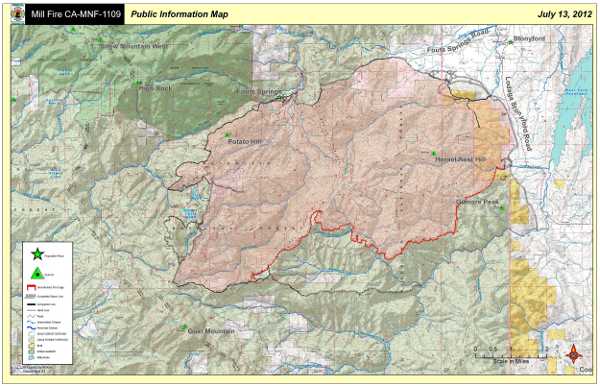
NORTHERN CALIFORNIA – A fire burning in a remote area of the Mendocino National Forest continued to grow on Friday as firefighters used burnout operations to fight the blaze.
On Friday night, Mendocino National Forest officials reported that the Mill Fire, burning 10 miles west of Stonyford near Upper Letts Lake, had reached 25,534 acres and was 50-percent contained. Full containment is estimated to take place Friday, July 20.
Five outbuildings have been destroyed already, and the Friday report stated that more than 400 homes are still threatened in the areas of Fouts Springs, Board Camp Spring, Stonyford and Century Ranch.
No cause has yet been reported. “All we know is that it’s under investigation,” Amy Reid, a U.S. Forest Service staffer and public information officer on the incident, told Lake County News.
Over the course of Friday, officials had reported acreage increases totaling more than 6,500 acres.
“A lot of that new acreage has to do with the burning operations that are under way,” said Reid.
She estimated that the fire could still see significant growth due to plans for continued burning operations.
“They’ll burn as long as conditions are favorable,” Reid said.
Reid said the fire’s south flank has been the most active, and burned steadily until about 4 a.m. Friday when a nighttime inversion layer set in, bringing a layer of stable air, higher humidity and cooler temperatures.
“Generally fire behavior will settle down when you get that inversion,” Reid explained.
The fire has proved to be challenging, she said, with a number of factors coming into play.
Reid said the Mill Fire is burning in extremely rugged terrain, with firefighters having to work on steep hillsides.
It’s also slope driven, and given to quick uphill runs. While firefighters are working on building deep trenches on the fire line, Reid said the fire can roll down below them and come up quickly at them.
“That’s a really dangerous situation,” she said, with a lot of potential for injury to firefighters.
The incident team reported that flame lengths on some of those uphill runs in brush have been 20 to 40 feet high.
“Additionally, we’ve been having unseasonably dry conditions for this time of year,” said Reid, which makes it conducive for really extreme fire behavior.
The area where the fire is burning also has wind factors that come into play, influenced by the marine layer and heating of the air from the Sacramento Valley, she said.
Reid said fire restrictions began on Friday in the Mendocino National Forest. More details can be found at http://bit.ly/Lkujwe .
In addition, archery season is beginning on Saturday, which Reid said is a concern for fire officials.
“This particular area of the district is very popular for hunters,” she said.
However, the area is closed because of the fire, so she said hunters must find other areas to go for now.
While the smoke from the fire had filled Lake County’s air basin earlier in the week, air quality has improved, with the Lake County Air Quality Management District forecasting good conditions over the weekend.
Email Elizabeth Larson at
Adoption Minute: Orange tabby kittens
LAKEPORT, Calif. – Four little orange tabby kittens are awaiting adoption at Lake County Animal Care and Control.
The kittens all are male, and about 12 weeks old.
Some have short coats, one has a medium-length coat, and they each weigh about two pounds.
All are friendly and playful.
To fill out an adoption application online visit http://www.co.lake.ca.us/Government/Directory/Animal_Care_And_Control/Adopt/Dog___Cat_Adoption_Application.htm .
Lake County Animal Care and Control is located at 4949 Helbush in Lakeport, next to the Hill Road Correctional Facility.
Office hours are Monday through Friday, 8 a.m. to 5 p.m., and 1 p.m. to 3 p.m., Saturday. The shelter is open from 10:30 a.m. to 4:30 p.m. Monday through Friday and on Saturday from 1 p.m. to 3 p.m.
Visit the shelter online at http://www.co.lake.ca.us/Government/Directory/Animal_Care_And_Control.htm .
For more information call Lake County Animal Care and Control at 707-263-0278.
Email Elizabeth Larson at