 How to resolve AdBlock issue?
Mill Fire acreage, containment continue to grow
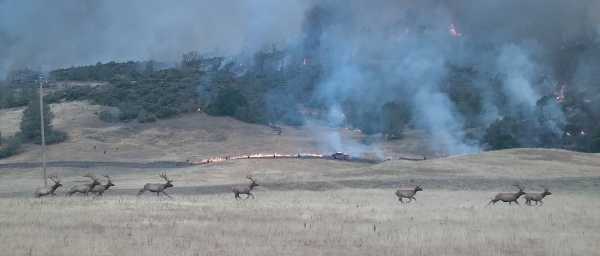
NORTHERN CALIFORNIA – The Mill Fire increased by about 4,500 acres by Friday morning, with firefighters continuing firing operations and meeting continuing challenges due to tough terrain.
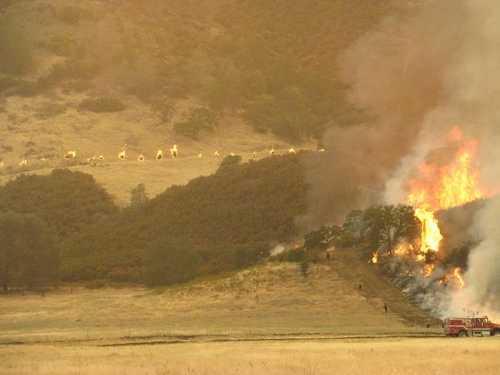
The fire has been burning north and east of Upper Letts Lake in the Colusa County side of the Mendocino National Forest since Saturday, July 7.
Mendocino National Forest officials said the fire was at 23,414 acres and 45 percent containment, with more than 1,600 personnel assigned to the incident.
The southern flank of the fire burned actively in steep rugged terrain overnight until early Friday morning, officials reported. Fire activity along that flank of the fire is expected to increase as an invasion lifts during the day Friday.
Firefighters are continuing to use burnout operations to try to remove fuel from the fire’s path, according to the report.
Forest officials are anticipating an increase in ridgetop winds as a result of a low-pressure trough that’s approaching the Pacific Northwest, brining slight cooling and increased humidity with it.
The resources on scene Friday included 29 Type 1 crews, 13 Type 2 crews, eight helicopters, 100 engines, 19 dozers and 12 water tenders.
An estimated $6.1 million has gone into fighting the fire thus far, according to forest officials.
Forest officials are still anticipating that the Mill Fire will be fully contained by next Friday, July 20.
The forest reported that archery season for deer hunting opens Saturday, July 14.
A closure order remains in effect for the fire area, which will affect hunters who traditionally visit the recreation area outside Stonyford, on the south central portion of the Grindstone Ranger District, where the fire has impacted 90 miles, or two-thirds, of the trail system.
The Snow Mountain Wilderness Area is still open and accessible from northern trailheads, including West Crockett, the forest said.
Email Elizabeth Larson at
Cal Water applies to CPUC for 77 percent rate increase over three years
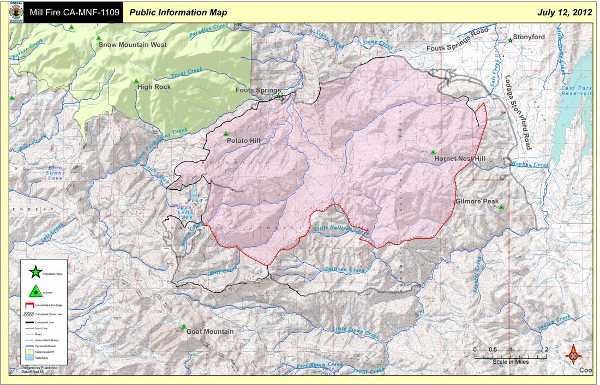
LUCERNE, Calif. – Lucerne residents could be looking at more water rate increases beginning in 2014.
On July 5, California Water Service Co. requested approval to increase rates in 2014, beginning an 18-month water rate review process mandated by the independent state agency responsible for setting the utility’s rates, the California Public Utilities Commission.
To lessen the impact on customers, Cal Water is requesting that the necessary increase be phased in over three years, said Cal Water Redwood Valley District Manager Gay Guidotti.
Guidotti said that, typically, the majority of the increase becomes effective in the first year, and smaller inflation-type increases in the second and third years.
If the CPUC agrees with Cal Water’s request, the typical residential customer would see their monthly bill increase by 77.1 percent between 2014 to 2016.
That breaks down to $18.51, or 62 cents per day, for a 29.4-percent increase in 2014; $25.93, or 86 cents per day, for a 31.9-percent increase in 2015; and $16.94, or 56 cents per day, or 15.8 percent in 2016.
Based on those numbers, residential customers would pay at least $226.30 more over the course of 2014, $313.90 more in 2015 and $204.40 in 2016. Water rates would increase by $2.04 a day over those three years.
Supervisor Denise Rushing is concerned by the proposal.
“You would think that by now Cal Water would have learned that it is they who are perpetuating an economic down spiral in the town of Lucerne with some of the highest water rates in the state,” she said. “They should be working with the PUC and legislators to develop alternatives to the standard rate-making procedures for disadvantaged communities. These alternatives might include a market-reality-based cap.”
She added, “In this desperate economy, as people are losing their homes, to propose these kinds of rate increases is wrong. It further perpetuates the difficulty for those that remain on their system. Will the last home and business left standing pay the full cost of the plant?”
Rushing said it’s time for Cal Water to recognize that standard cost-plus ratemaking does not work in this circumstance. She said she was pleading with the company to help turn the Lucerne economy around.
“In our county owned systems, we have seen rising costs of treatment as well and are only increasing rates for the most essential investments and are finding ways to save money,” she said. “Seventy-seven percent is outrageous, especially on top of the increases to date and the high rates already in place.”
Cal Water reported that it is asking to increase the Rate Support Fund benefit for Lucerne customers, which is a subsidy funded by other Cal Water districts to benefit customers in smaller, higher-cost districts.
During the 18-month review process, expense forecasts can be refined and capital projects can be deferred, resulting in a lower increase than initially requested.
In the last three-year rate review process in 2009, Cal Water initially requested an increase of 54.9 percent; a final increase of 41.8 percent became effective in 2011.
In 2005, the company sought a 247-percent increase, receiving approval from the CPUC for a 121-percent rate increase in 2006, as Lake County News has reported.
Company: Water costs rising
Cal Water said a rate increase is needed to cover higher expenses associated with operating and maintaining the water system, including those incurred to meet strict water quality standards and environmental regulations, make safety improvements and inspections, improve preventative maintenance, and make infrastructure improvements.
In addition, water sales revenue, which helps pay fixed operating costs, has declined over the last three years, requiring the rate for each unit of water to increase to cover the same costs, the company said.
“Unfortunately, water costs are rising, not just here, but throughout the country. Many of them – such as costs for materials, water production and water treatment – are increasing faster than the rate of inflation,” said Gay Guidotti.
“Also, water use is going down, and water utilities have a lot of fixed costs that stay the same regardless of how much water customers use,” Guidotti said. “That results in higher per-unit water costs. The good news is, some variable costs decrease when customers use less water, and those cost decreases are factored in. And conservation can save customers money in the long-term by enabling us to avoid having to invest in new sources of supply to meet higher demand.”
Guidotti said that if water usage had not decreased, the typical residential customer would see an even greater increase in his or her total water bill.
The reduction in overall water usage increases the per-unit cost of water, but the combination of variable cost savings and the customer using fewer units of water results in a total bill that will be lower than it would have been without water conservation efforts, she said.
Cal Water is proposing a number of water system infrastructure upgrades to increase reliability and fire protection and ensure good water quality, including: new water mains, storage tank maintenance, and enhancements to comply with water quality regulations.
The California Public Utilities Commission will thoroughly audit Cal Water’s expenses, plans and operations during the 18-month review process.
It is responsible for setting rates that reflect the actual, dollar-for-dollar costs of providing water service and allow Cal Water to earn a return only on the funds it invests in water system infrastructure, similar to the interest that would be paid on a loan if the funds were borrowed from a bank.
Customers are invited to submit comments in writing or at public participation hearings, if held by the commission.
“We are very sensitive to the need to operate as efficiently as possible,” Guidotti said. “We watch every penny closely because we know that our operations affect customer rates.”
Cal Water serves about 3,600 people through 1,900 service connections in Lucerne and parts of Duncans Mills, Guerneville, Dillon Beach, Noel Heights and Santa Rosa. The company has provided water service in the area since 2000.
Mill Fire reaches 18,985 acres; burnout operations help firefighting effort
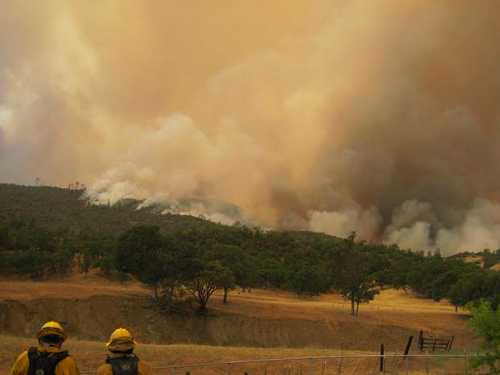
NORTHERN CALIFORNIA – More smoke rose into a column over the horizon on Thursday as firefighters used burnout operations to thin fuel in the path of the state’s largest wildland fire.
The Mill Fire reached 18,985 acres on Thursday, with 40 percent of the blaze contained, according to the U.S. Forest Service.
Full containment is anticipated next Friday, July 20.
The firefighting effort has cost a reported $5 million so far.
The fire has been burning in brush and timber for nearly a week in the Colusa County side of the Mendocino National Forest, north and east of Upper Letts Lake. The cause remains under investigation.
Firefighters made progress securing fire lines along the east and west flanks of the fire, and the north flank continued to hold well, according to an incident team report.
Forest officials reported that the burnout operations began Thursday afternoon along the southern and eastern flanks of the fire, and were set to continue into the night. Crews used aerial and hand ignition techniques to burn out fuels and strengthen containment lines.
Where slope and wind direction aligned, the fire continued to back down the slope and run uphill, the incident team reported.
The resources and personnel assigned to the incident remain substantial.
Approximately 1,582 firefighting personnel were on scene Thursday, along with 29 Type 1 crews, 13 Type 2 crews, eight helicopters, 100 engines, 19 dozers and 12 water tenders.
A closure order remains in effect for the Mendocino National Forest for all roads and trails in the recreation area outside Stonyford on the south central portion of the Grindstone Ranger District.
Officials said the fire has impacted 90 miles – or two-thirds – of the Grindstone Ranger District’s off-highway vehicle trail system.
On Thursday, the Bureau of Reclamation announced that East Park Reservoir in Colusa County was closed to recreational activities due to safety concerns including air quality and emergency vehicles operating in the area.
Local Forest Service officials and the incident management team are in close communication with local air quality management districts, and also are working with agricultural business operations in nearby areas. In addition, the Forest Service and the California Air Resources Board have set up smoke monitors.
The fire has resulted in air quality alerts in Lake and Mendocino counties, with clearer conditions and slightly cooler temperatures expected Friday.
Email Elizabeth Larson at
Air quality on Friday expected to be in ‘good’ category
LAKE COUNTY, Calif. – After air quality warnings were issued earlier in the week due to wildland fire smoke pouring into the air basin, local air quality officials reported that conditions on Friday are expected to be better.
Lake County Air Quality Management District said conditions are improving and good air quality is forecast once again for Lake County on Friday.
However, the district urged community members to exercise caution, as conditions can change rapidly.
District officials attributed the smoke and haze that degraded air quality this week to the Mill Fire in the Colusa County portion of the Mendocino National Forest.
The fire, burning since Sunday, had scorched nearly 19,000 acres by Thursday night, according to U.S. Forest Service officials.
Neighboring Mendocino County also is under air quality health alerts due to the fire.
Lake County Air Quality Management District reported that the fire resulted in ozone and particulate levels exceeding allowed state and federal health-based standards in the past two days on Wednesday and Thursday. The standards are designed to protect sensitive groups of the population from small respirable particulate, ultrafine inhalable particulate and ozone.
Smoky conditions such as those seen in Lake County this week can cause irritation of the eyes, nose and air passages, which can be hazardous in young children, the elderly, individuals with heart conditions or chronic lung disease such as asthma, bronchitis and other respiratory conditions.
Weather patterns – including sustained westerly transport winds – and the growing control of the Mill Fire resulted in improved healthful air beginning Thursday afternoon, according to the district.
However, residual haze and particulate from the wildfires can be expected to intermittently impact areas of Lake County until fire is out, the district reported.
Smoke impacts in Lake County are still possible, at times smoke can be transported to sea within a circulation cell, and then return back over Northern California in a wide band of smoke filled air, or the wind can shift due to changing weather patterns transporting smoke directly into the basin, according to the district.




