How to resolve AdBlock issue?
Refresh this page
Lake County News,California
  • Home
    • Registration Form
  • News
    • Education
    • Veterans
    • Community
      • Obituaries
      • Letters
      • Commentary
    • Police Logs
    • Business
    • Recreation
    • Health
    • Religion
    • Legals
    • Arts & Life
    • Regional
  • Calendar
  • Contact us
    • FAQs
    • Phones, E-Mail
    • Subscribe
  • Advertise Here
  • Login
How to resolve AdBlock issue?

Refresh this page

News

U.S. Winter Outlook predicts warmer and drier South, wetter north

A slowly-developing La Nina is favored to influence conditions for the upcoming winter across most of the country, according to NOAA’s U.S. Winter Outlook released by the Climate Prediction Center, a division of NOAA’s National Weather Service.

This outlook is for December 2024 through February 2025 and contains information on likely conditions throughout the country for temperature, precipitation and drought.

This winter, NOAA predicts wetter-than-average conditions for the entire northern tier of the continental U.S., particularly in the Pacific Northwest and the Great Lakes region, along with northern and western Alaska.

Meanwhile, drier-than-average conditions are expected from the Four Corners region of the Southwest to the Southeast, Gulf Coast and lower mid-Atlantic states.

“In September, we announced a $100 million investment into NOAA’s high-performance computer system to advance research on weather, climate and ocean predictions because understanding our climate system is essential for making longer-term predictions like the Winter Seasonal Outlook, which provides vital information for many of our partners and the public,” said Michael Morgan, Ph.D., NOAA’s assistant secretary of commerce for observation and prediction. “We continue to innovate in this space, developing new ways to share winter forecast information with the public.”

“This winter, an emerging La Nina is anticipated to influence the upcoming winter patterns, especially our precipitation predictions,” said Jon Gottschalck, chief of the Operational Prediction Branch of the Climate Prediction Center.

La Nina conditions are expected to develop later this fall and typically lead to a more northerly storm track during the winter months, leaving the southern tier of the country warmer and drier.

As a result, NOAA forecasters, in collaboration with the National Integrated Drought Information System, or NIDIS, expect drought conditions to persist and worsen across the central and southern Plains of the U.S.

“Unfortunately, after a brief period in the spring of 2024 with minimal drought conditions across the country, more than a quarter of the land mass in the continental U.S. is currently in at least a moderate drought,” said Brad Pugh, operational drought lead with NOAA’s Climate Prediction Center. “And the winter precipitation outlook does not bode well for widespread relief.”

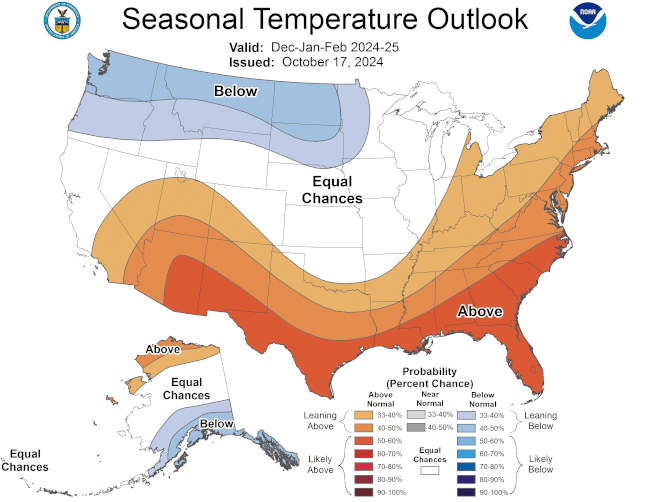
The 2024-2025 U.S. Winter Outlook map for temperature shows the greatest chances for cooler-than-average conditions in the Pacific Northwest of the U.S. Image credit: NOAA.


Temperature

• Warmer-than-average temperatures are favored from the southern tier of the U.S. to the eastern Great Lakes, eastern seaboard, New England and northern Alaska. These probabilities are strongest along the Gulf Coast and for most of Texas.
• Below-average temperatures are most likely in southern Alaska, with below-average temperatures slightly favored from the Pacific Northwest to the northern High Plains.
• The remaining areas have equal chances of below-, near-, or above-average seasonal mean temperatures.

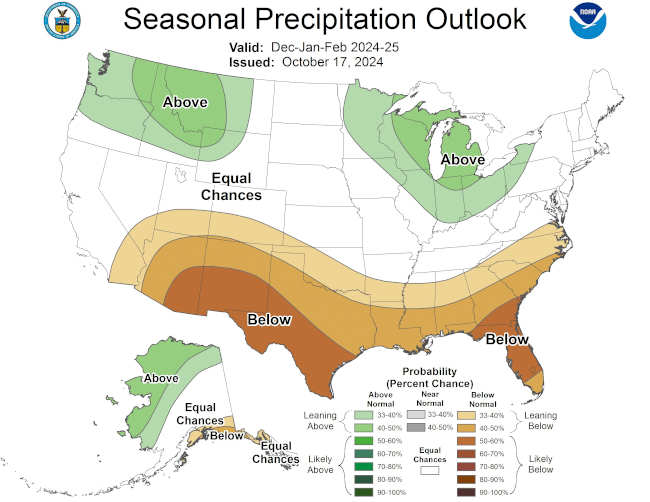
The 2024-2025 U.S. Winter Outlook map for precipitation shows wetter-than-average conditions are most likely across the Great Lakes region of the U.S.. Drier-than-average conditions are forecast for parts of the U.S. Gulf Coast. Image credit: NOAA.

Precipitation

• Wetter-than-average conditions are most likely in the Great Lakes states, and above-average precipitation is also favored in northern and western Alaska, the Pacific Northwest and across the northern tier of the U.S. These probabilities are strongest in portions of Ohio, Indiana and Kentucky.
• The greatest likelihood for drier-than-average conditions are in states bordering the Gulf of Mexico, as well as in Texas and southern New Mexico.
• Much of California, the central Plains states and the I-95 corridor from Boston to Washington, D.C., have equal chances of below-average, near-average or above-average seasonal total precipitation.

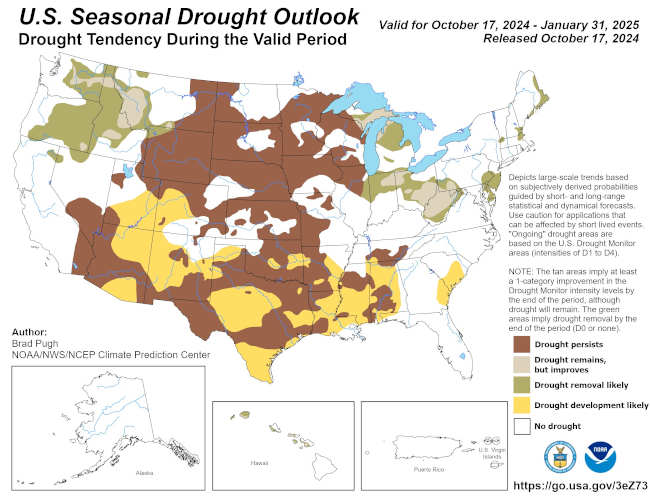
The U.S. Drought Outlook map for November 2024 through January 2025 predicts drought improvement in the Ohio River Valley and the northern Rockies. Drought is likely to persist in portions of the Great Plains and the Midwest. Drought development is expected from the Four Corners region to the western Gulf coast. Image credit: NOAA.


Drought

• Widespread moderate to extreme drought continues across much of the Great Plains and in portions of the Rocky Mountains, especially farther south.
• Drought conditions are expected to improve or end in the Ohio River Valley, the Great Lakes region and portions of the northwestern U.S., including eastern Washington and Oregon and northern and central Idaho.
• Drought conditions are expected to persist across the Great Plains.
• Drought is likely to develop or worsen across portions of the Southwest and Gulf Coast.

Purrfect Pals: Young cats and kittens

LAKE COUNTY, Calif. — As kitten season winds down, Lake County Animal Care and Control still has many young cats and kittens waiting to be adopted.

The cats at the shelter that are shown on this page have been cleared for adoption.

Call Lake County Animal Care and Control at 707-263-0278 or visit the shelter online for information on visiting or adopting.

The shelter is located at 4949 Helbush in Lakeport.

Email Elizabeth Larson at This email address is being protected from spambots. You need JavaScript enabled to view it.. Follow her on Twitter, @ERLarson, or Lake County News, @LakeCoNews.


A#70a(green collar)'s preview photo
A#70a(green collar)

A#70b(yellow collar)'s preview photo
A#70b(yellow collar)

A#70c's preview photo
A#70c

A#70d's preview photo
A#70d

A#106a's preview photo
A#106a

A#55's preview photo
A#55

A#146b's preview photo
A#146b

A#146a's preview photo
A#146a


A#52a's preview photo
A#52a


Why is Halloween spending growing when Americans are supposedly cutting back?


Of course you can buy an evil clown at Home Depot. Frederic J. Brown/AFP/Getty Images

Halloween was once a time of both tricks and treats. Lately, Halloween has become one big treat for businesses, with consumers spending an estimated US$11.6 billion on this one-night holiday. That’s roughly the same amount of money as Americans spend on children’s books each year.

This massive amount of spending is puzzling, given the media is filled with stories about the economic hardships many families face.

As a business school professor who has written previously about Halloween, I was curious why Halloween spending is just below all-time highs at the same time many people report high levels of economic angst.

Americans spend billions every Halloween

The best data on Halloween spending comes each year from the National Retail Federation, which surveys Americans about their shopping plans just before the holiday. It found that U.S. consumers will spend over $11 billion this year, which is about half the amount spent annually on dental care for children under age 17.

The most recent survey also shows that about three out of four Americans will celebrate in some fashion. Because not everyone observes the holiday, the federation calculates that the typical person celebrating will spend $104 on Halloween.

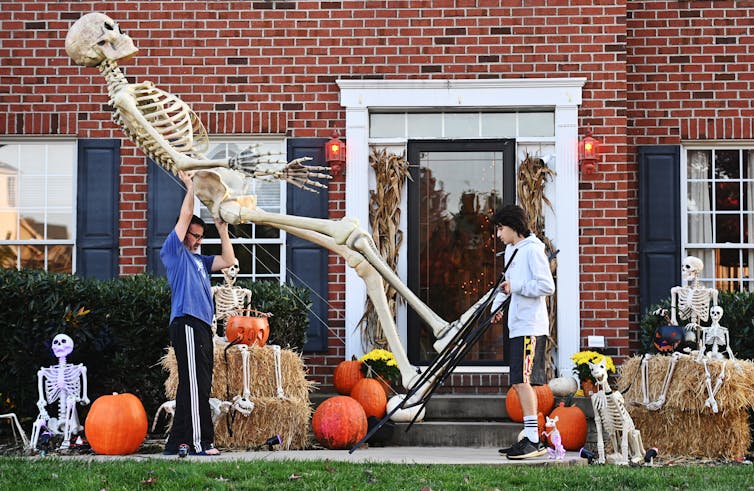
A father and son are photographed outside their home, carrying a 12-foot decorative skeleton from Home Depot.
Twelve-foot skeletons don’t come cheap. Marvin Joseph/The Washington Post via Getty Images

The federation breaks down spending into four categories. About one-third of spending will be on costumes for children, adults and pets. Another third will be spent on decorations like giant skeletons. About a final third is spent on candy, and the remaining sliver is spent on greeting cards.

Back in 2005, the federation estimated the holiday would generate only $3.3 billion of spending. This means Halloween spending has grown dramatically, by about three and a half times, in just two decades, or about double if we are adjusting for inflation.

Unmasking the causes of rising Halloween spending

What has driven Halloween spending skyward? Some of the growth is due to inflation, which has increased prices by about 65% over the past two decades. Some of the growth is due to more people living in the U.S. In 2005, the U.S. had about 290 million people, while today the figure is closing in on 340 million.

While these two factors explain some of the growth, they don’t explain it all.

To understand more, I looked at some government data:

The U.S. tracks what the typical family spends on a wide variety of products and services to measure the cost of living. Spending each year is monitored via the Consumer Expenditure Survey. This survey has publicly provided data on annual candy spending since 2013, when it found the typical family spent $88 a year on candy.

The latest figures for 2023 show U.S. families have developed a very sweet tooth: Candy spending by the typical family is now at $164, which means candy outlays have almost doubled from a bit over a decade ago.

While this increase in candy consumption undoubtedly boosts spending at Halloween, it also has a downside. The American Dental Association has shown a dramatic increase in spending at the dentist office, as many people make emergency dentist visits as teeth get cracked on candy.

Spending on costumes has also soared.

In 2005, the best estimate was that $1.2 billion would be spent on just dressing up, while this year the figure is $3.8 billion.

Why so much? Costumes used to be just for children, but today many adults are dressing up. About 1 in 5 adults say they will be wearing a costume for Halloween. Beyond costumes for people, Americans spend millions of dollars on costumes for their pets.

The National Retail Federation has not tracked my favorite Halloween category, pumpkin sales, but the U.S. Department of Agriculture has. When I was young, each family in my neighborhood typically had one pumpkin on their doorstep. Now, I routinely see houses with many – both in my old neighborhood and my new one, which is a few miles away in another part of Boston.

It seems it’s not just my neighbors who are buying more gourds. In 2005, the USDA calculated that there were about four and a half pounds of pumpkins for sale for every person just before the holiday. In 2023, the amount had risen to almost six pounds per person. This means there are about 50% more pumpkins available for carving and for making pies.

While polls suggest many Americans are feeling financially fragile, the data indicates it isn’t having much impact on Halloween spending. After all, over the past two decades, Halloween has become an ever-bigger commercial holiday.

Halloween can be scary, but it doesn’t have to be scary for your finances. If you are struggling financially this year, before buying on credit giant candy bars that only get half-eaten, or cute pet costumes most animals probably don’t want to wear, think about maybe cutting back.The Conversation

Jay L. Zagorsky, Associate Professor of Markets, Public Policy and Law, Boston University

This article is republished from The Conversation under a Creative Commons license. Read the original article.

City of Lakeport receives grants for Silveira Center improvements

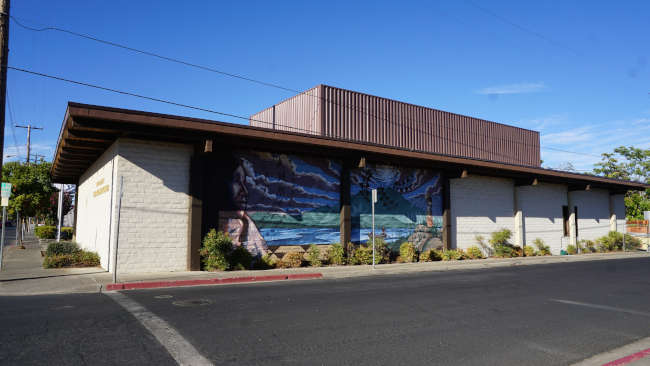
The mural on the Silveira Community Center in Lakeport, California. Photo by Elizabeth Larson/Lake County News.

LAKEPORT, Calif. — The city of Lakeport’s Silveira Community Center is due to undergo more improvements thanks to grant funding.

The building, located at 500 N. Main St., was built in 1969 and served as the Bank of America building until its closure in November 2017.

In March 2019, thanks to the work of then-City Manager Margaret Silveira, the city acquired the building, which Bank of America donated.

Since then, the city has been working through the process of updating the building.

In September, the city announced that it had been awarded a $1.2 million grant to support the center’s ongoing renovations.

The city said that funding, along with a $1 million grant from a Community Development Block Grant, will help it make critical improvements to the electrical and HVAC systems, enhancing safety and energy efficiency at the center.

The $1 million grant is being used for electrical upgrades. The city is bringing the facility up to current electrical codes by replacing outdated panels and wiring.

As a result, the system will be able to handle the increased load from the new HVAC units, ensuring long-term reliability and safety.

Those funds also are covering the installation of energy-efficient heating, ventilation and air conditioning systems, including new ductwork, air handlers and compressors. The upgrades will improve climate control and reduce the center’s operational costs, making the facility more sustainable.

Regarding the $1.2 million grant, the city said it will focus on improving accessibility throughout the center.

Planned improvements include ramps, wider doorways and fully renovated restrooms, ensuring compliance with ADA standards. The improvements will provide better access for individuals with disabilities, as well as seniors and families.

Beyond accessibility, the city said the funding will enhance the building's functionality and safety, making it more usable for a variety of community events, including social, recreational and educational activities.

The grant-funded project also will include upgrades to the building’s overall infrastructure to improve long-term use and community benefit.

“These projects will begin to transform the Silveira Community Center into a modern, accessible, and efficient facility for all. The city is committed to ensuring that the project is carried out smoothly and in compliance with all regulations and safety standards,” the city said in a statement on the project.

Other improvements already completed over the last several years include a mural that was painted on the side of the building facing Fifth Street and a microtreatment that was completed on its parking lot.

While the building has had limited usage so far, it was used as a vaccination site by the county during the pandemic.

Building on that use, at its Sept. 4 meeting, the Lakeport City Council approved an agreement for the building’s use with the Lake County Health Department.

Under that agreement, the county will be able to use the center and its parking lot for medical respite use during disasters. It also will allow for reimbursement of funds in an emergency and help the city pursue additional grant funding for improvements.

“We are really excited to start using this building more,” said Council member Stacey Mattina.

Email Elizabeth Larson at This email address is being protected from spambots. You need JavaScript enabled to view it.. Follow her on Twitter, @ERLarson, or Lake County News, @LakeCoNews.


The Silveira Community Center in Lakeport, California. Photo by Elizabeth Larson/Lake County News.

Early week rain in the forecast

LAKE COUNTY, Calif. — Forecasters said the new week is expected to begin with fall rain.

The National Weather Service is predicting rain on Sunday and Monday, with less than a quarter of an inch expected both days. Temperatures will be in the mid-60s during the day and low 40s at night.

Those two days also are anticipated to see winds with gusts of more than 20 miles per hour.

Conditions are forecast to clear on Tuesday, with temperatures in roughly the same range as the two previous days.

From Wednesday through Saturday, the National Weather Service forecasts chances of rain, with daytime highs ranging from the high 50s to low 60s, and nighttime conditions in the 40s.

The long-term forecast says a “much colder air mass” is expected to bring freezing overnight temperatures early next week.

Email Elizabeth Larson at This email address is being protected from spambots. You need JavaScript enabled to view it.. Follow her on Twitter, @ERLarson, or Lake County News, @LakeCoNews.

More kids than ever need special education, but burnout has caused a teacher shortage


Many special education teachers quit after less than five years on the job. 10'000 Hours/Digital Vision via Getty Images

A growing number of students in public schools – right now, about 15% of them – are eligible for special education services. These services include specially designed instruction for students with autism, learning or physical disabilities, or traumatic brain injuries. But going into the current school year, more than half of U.S. public schools anticipate being short-staffed in special education. Dr. Kimber Wilkerson, a professor of special education and department chair at the University of Wisconsin-Madison, explains why there’s a shortage and what needs to be done to close the gap.

Dr. Kimber Wilkerson discusses the special education teacher shortage.

The Conversation has collaborated with SciLine to bring you highlights from the discussion, which have been edited for brevity and clarity.

Which students receive special education services?

Kimber Wilkerson: Students with a disability label receive special education services. They need these additional services and sometimes instruction in school so they can access the curriculum and thrive like their peers.

What is happening with staffing for special education?

Wilkerson: Since special education became a thing in the ’70s, there have always been challenges in filling all the special education positions.

In the past 10 years preceding the COVID-19 pandemic, those challenges started to increase. There were more open positions in special education at the beginning of each school year than in previous decades. In the 2023-24 school year, 42 states plus the District of Columbia reported teacher shortages in special education.

What is causing these shortages?

Wilkerson: One, there are fewer young people choosing teaching as a major in college and as a profession. And special education is affected by these lower rates more than other forms of education.

Also, there’s more attrition – people leaving their teaching job sooner than you might expect – not because they’re retiring, but because they are tired of the job.

They want to do something different. They want to go back to school. Sometimes it’s life circumstances, but the number of people leaving the job before retirement age has increased. And in our state, Wisconsin, about 35% of all educators leave the field before they hit their fifth year.

That number is even higher for special educators. About half of special educators are out of the profession within five years.

Why do special education teachers leave the profession?

Wilkerson: There’s not a national study that speaks to that reason. There are some localized studies, and people report things like too much paperwork or too many administrative tasks associated with the job. Sometimes they report the students’ behavioral challenges. Sometimes it’s a feeling of isolation, or a lack of support from the school.

How are students with disabilities affected when their school does not have enough special educators?

Wilkerson: In a school that’s one special educator short, the other special educators have to take over that caseload. Instead of having 12 students on their caseload, maybe now they have 20. So, the amount of individual attention given to each student with a disability decreases.

Also, when teachers with experience leave the profession, they leave behind a less experienced group of teachers. This means the students are losing out on the benefit of those years of wisdom and experience.

What are some strategies to recruit and retain more special education teachers?

Wilkerson: There’s a range of strategies that different universities, states and school districts have taken, like residency programs.

In these programs, the person who is learning to be a teacher, and who is referred to as a teaching resident, works alongside a mentor teacher for an entire year in a school, and they get paid to do so. They’re not the teacher of record, but they’re learning and getting paid, and they’re in that school community.

Can you tell us about your recent study on supporting new special education teachers?

Wilkerson: One thing that made a big difference is when the teachers in our study, which is now under review, had access to a mentor and a group of their peers. We called this facilitated peer-to-peer group of teachers a “community of practice.” Every other week, on Zoom, we’d get these new special education teachers from different school districts together, along with experienced teachers. And they would do some sort of work on problems, bringing in the things that were challenging, and work on possible solutions as a group.

We also used Zoom to do one-on-one mentoring. And what people liked about it was that they could talk to someone who wasn’t right in their building and right in their district who they could be open and vulnerable with.

Sometimes, special educators can be isolated because they’re not necessarily a part of a grade-level team. They work with kids across a lot of classrooms. This gave them an opportunity to have their own kind of community, and that made a difference.

We also surveyed their level of burnout and how good they felt about the job they did. And then we surveyed special education teachers who weren’t participating in our community of practice.

At the end of the year, those people who had that mentoring and the community of practice felt less burnt out, and they also felt more effective in the area of classroom management. And that’s critical, because burnout is one of the primary reasons people leave the profession.

So if we can make people feel like they’re better equipped to handle this challenging position, then that’s one strategy to increase the number of people wanting to stay in their job year after year.

Watch the full interview to hear more.

SciLine is a free service based at the American Association for the Advancement of Science, a nonprofit that helps journalists include scientific evidence and experts in their news stories.The Conversation

Kimber Wilkerson, Professor of Special Education, University of Wisconsin-Madison

This article is republished from The Conversation under a Creative Commons license. Read the original article.

  • 375
  • 376
  • 377
  • 378
  • 379
  • 380
  • 381
  • 382
  • 383
  • 384

Community

  • Sheriff’s Activities League and Clearlake Bassmasters offer youth fishing clinic

  • City Nature Challenge takes place April 24 to 27

Public Safety

  • Lakeport Police logs: Wednesday, Feb. 11

  • Lakeport Police logs: Tuesday, Feb. 10

Education

  • Ramos measure requiring school officer training in use of anti-opioid drug moves forward

  • Lake County Chapter of CWA announces annual scholarships 

Health

  • California ranks 24th in America’s Health Rankings Annual Report from United Health Foundation

  • Healthy blood donors especially vital during active flu season

Business

  • Employment law summit takes place March 9

  • Two Lake County Mediacom employees earn company’s top service awards

Obituaries

  • Terry Knight

  • Ellen Thomas

Opinion & Letters

  • Who should pay for AI’s power? Not California ratepayers

  • Crandell: Supporting nephew for reelection in supervisorial race

Veterans

  • State honors fallen chief warrant officer killed in conflict in Iran

  • CalVet and CSU Long Beach team up to improve data collection related to veteran suicides

Recreation

  • April Audubon program will show how volunteers can help monitor local osprey nests

  • First guided nature walk of spring at Anderson Marsh State Historic Park April 11

  • Second Saturday guided nature walks continue at Anderson Marsh State Historic Park

  • Wet weather trail closure in effect on Upper Lake Ranger District

Religion

  • Kelseyville Presbyterian Church plans Easter service

  • Easter ‘Sonrise’ Service returns to Xabatin Community Park

Arts & Life

  • ‘CIA’ delves into the shadowy world of an espionage thriller

  • ‘War Machine’ shifts the battlefield into uncharted territory

Government & Politics

  • Lake County Democratic Central Committee endorses Falkenberg

  • Crandell launches reelection campaign plans March 15 event

Legals

  • April 23 hearing on Lake Coco Farms Major Use Permit

  • NOTICE OF 30-DAY PUBLIC COMMENT PERIOD & NOTICE OF PUBLIC HEARING

How to resolve AdBlock issue?

Refresh this page