How to resolve AdBlock issue?
News
The taxes potentially involved are federal estate taxes, federal and state personal income taxes, federal and state fiduciary income taxes, and local real property taxes. Let’s examine them separately.
Federal estate taxes now only affect persons transferring more than $3.5 million at death to their surviving family, excluding gifts left to the surviving spouse – there is an unlimited marital deduction for transfers to surviving spouses.
The $3.5 million is the net worth of the decedent considering all assets, including life insurance. Also, a generation skipping transfer tax may apply when more than $3.5 million is left to related persons more than one generation younger than the decedent (e.g., grandchildren), unless the intervening generation has predeceased the decedent, or is left to unrelated persons who are more than 37.5 years younger.
What about personal income tax? Personal income tax only applies to transfers of items of income in respect of a decedent (IRD).
What is IRD? IRD is anything that would have been included as ordinary income on the decedent’s annual tax return, if received while alive.
Examples include unpaid retirement monies (such as IRAs, annuities, and 401(k)s) and earned but unpaid compensation. Not included as IRD is life insurance. The proceeds are not subject to income tax unless an exception to the “no taxation” of life insurance proceeds applies.
The receipt of property – other than IRD – is not income taxable; there is, however, often an income tax opportunity for the beneficiary who receives property from a decedent. Specifically, any appreciation in value that occurred while the decedent owned the property is eliminated at death and will not be subject to capital gains income tax. That is, the beneficiary receives a so-called “step up in basis” based on date of death appraisal.
For example, if the decedent bought his house in 1970 for $75,000, the decedent had a purchase cost basis of $75,000. If he dies on June 25, 2009, when it is worth $250,000 and leaves it all to his son, then the son’s basis for income tax purposes is stepped up to $250,000, thus eliminating all $175,000 of appreciation when the son sells.
If a deceased person’s estate is held within a trust or probate estate, then a so-called fiduciary income tax return is usually required, and taxes may be due at the estate level. Because trusts pay taxes at the highest graduated rate once their taxable income reaches around $11,000, it is prudent to distribute the taxable income out to the beneficiaries prior to the trust’s own tax year end to avoid paying higher trust tax rates. Taxation of trusts is a very complex, so rely on a qualified tax expert here.
Next, death can trigger a reassessment in value for local (county) real property taxes. With the exceptions of the interspousal transfer exclusion and parent child transfer exclusion for transfers of one’s primary residence and up to one million dollars in other additional real property to surviving children (and sometimes grandchildren), all other transfers trigger a reassessment in tax value to the recipient at time of transfer.
Accordingly, when a decedent’s estate consists of real property and other substantial assets and one child wants to receive a particular real property asset, there is a planning opportunity if the real property in question is left directly by the parent to that child.
Otherwise, if that child buys out his or her siblings, then the portion that is purchased from the other siblings will be reassessed, as there is no exclusion for transfers between siblings.
In conclusion, there are numerous tax opportunities and pitfalls to be considered carefully when planning and subsequently administering a person’s estate.
Dennis A. Fordham, attorney (LL.M. tax studies), is a State Bar Certified Specialist in Estate Planning, Probate and Trust Law. His office is at 55 1st St., Lakeport, California. Dennis can be reached by e-mail at
The issues were included in the latest grand jury report, released in July, and addressed in the Lake County Office of Education's formal response to the grand jury, released last month.
In that response to the grand jury, Dave Geck admits mistakes and misunderstandings, but also points to what he said are inaccuracies in the grand jury's report.
District Attorney Jon Hopkins confirmed that the grand jury contacted him about the case, which he investigated. Hopkins said he found no evidence of wrongdoing.
The grand jury asked Geck and his office to explain why he signed the document and provided inaccurate information in last year's response, and why he allowed Allison Hillix, the former director of career technical education, to remain in her job without immediately terminating her when it was discovered she didn't hold the appropriate qualifications.
Hillix, who no longer works for the Lake County Office of Education, would not comment when contacted by Lake County News.
The Lake County Office of Education's responses to the report included an admission that Geck showed “poor judgment” in not checking the accuracy of dates on an application Hillix made for a credentialing program.
The grand jury also recommended that all expenses reimbursed to both Hillix and Geck be audited. The report stated that Hillix was reimbursed $10,000 in expenses in an eight-month period.
Geck said he discussed the report with his board of trustees, who participated in the formal response.
“This reflects on the whole Office of Education,” said Geck.
The agency – which has an annual budget of about $16 million, $2 million of which is for supporting districts in business and human resources – has 120 employees, include 25 full-time staffers in the main office. It also has many part-time staffers.
It's been the focus of two years of grand jury investigative efforts and was mentioned in the last two grand jury reports.
“The initial complaint received by the Grand Jury suggested that a high-ranking administrative position was given to an individual that received administrative credentials under false pretenses,” the grand jury stated in its recent report.
In that report, the grand jury faulted Geck for signing a document attesting to the required teaching experience for Hillix, who was applying for a certification program. In her position she oversaw ROP courses, programs and services in the agency.
The certification would allow Hillix to be at an administrator level, said Geck. Without it, she could still be a manager, which would be at a lower step and pay level.
“I never denied that I messed up and made a mistake” on the certification of experience, Geck said.
Geck said Hillix had filled out the form and then had him sign it. “I didn't do a good job of checking that.”
Geck gets plenty of documents to sign, but said that's no excuse.
“When you make a mistake you have to pay the price,” Geck said.
As a result, Geck said his office now has a new administrative policy in which two administrators must verify such a form before it's signed. “That should not happen again,” said Geck.
The investigation by the grand jury's Public Services Committee also revealed that Geck authorized the $10,000 in expense reimbursements to Hillix.
The grand jury report further stated that Hillix had been reimbursed for alcohol purchases while at a conference, but the district's director of business services reported that no such alcohol purchase were reimbursed based on her review of the documentation, according to the district's response to the report.
Geck said the Lake County Office of Education has added a per diem limit. He said the change wasn't necessarily due to the grand jury's investigation, but rather was part of an effort to reduce expenses.
The grand jury report also faulted Geck for saying he didn't have the form in question, which the office's human resources director, Ed Skeen, later produced.
Geck said the issue was due to a misunderstanding, because he thought they were talking about another document. The formal response to the grand jury also maintains that the issue came down to a misunderstanding.
Last year, Geck's office had sent the grand jury a brochure on the Sacramento State program to clear up the misunderstanding. He said they plan to share the document with the grand jury again this year.
The grand jury also stated that Hillix was allowed to resign two months after the credential was invalidated, but Geck said that's incorrect. He said the grand jury had Hillix's personnel files and the resignation dates, along with the district's personnel policies, which his office sent them.
On Aug. 28, 2008, the California Commission on Teacher Credentialing notified Geck's office via e-mail that the state university was requesting the credential be denied, according to the response to the grand jury's finding.
At the same time, Hillix discovered her credential was no longer listed on Sacramento State's credentialing Web site. Geck said she investigated appealing it at the start of September. The grand jury's findings held that Hillix should have been immediately terminated.
Skeen then sent the grand jury a notice on Sept. 10, 2008, saying that the credential was invalidated, Geck said.
Hillix wasn't able to file an appeal due to a statute of limitations issues. “Once she wasn't able to appeal she resigned,” said Geck.
It was 36 days between the time Geck's office received notice that the credential was being invalidated to Hillix's resignation, not two months as the grand jury said, according to the Lake County Office of Education's response to the findings.
Based on the Lake County Office of Education's attorney's opinion, “our delay in terminating the employee was based on providing the employee with sufficient time to pursue an appeal, and to not compromise any 'due process' rights that the employee might have,” the response stated.
A document provided by Skeen showed that the career technical education director position, which was paid $82,325 annually, became vacant upon Hillix's resignation on Oct. 6, 2008, after she was in the position for 217 days.
Geck said she continued nonadministrative employment “on a very limited, temporary, timesheet basis to complete some projects for the ROP office,” and is no longer employed in any capacity within the office.
During the investigation, the grand jury drew on its rarely used subpoena power to call in Geck and several others. He said he doesn't know how many subpoenas were issued, but became aware that some people in his office were called to testify more than once. In all, the grand jury report noted it drew from 42 hours of testimony in its final report.
Geck's testimony, which was the basis of this year's grand jury report, actually was given in the first half of 2008 under subpoena, he said.
Based on the grand jury's report 2007-08 report, the District Attorney's Office subpoenaed district documents and said they would follow up. Geck said if the document signing had been fraudulent, he would have heard from the District Attorney's Office.
Hopkins said his office, along with county counsel and the presiding judge, act as advisors to the grand jury.
The grand jury, Hopkins said, “did come to us and ask us to investigate potential criminal charges.”
He continued, “We did a lot of extra investigation beyond what they had done in regard to that and determined there was no basis for filing criminal charges.”
Geck said he doesn't believe further grand jury investigations are in the offing. “As far as we know this is a final report.”
He said he felt the structure of the investigation created an adversarial process, and said he would have preferred it if people who had issues with the agency came to him directly.
“I'm just looking for a way to make this a positive process,” said Geck.
He added, “Our goal is to get better and improve at all times.”
Geck said he doesn't want the mistake he made to denigrate the entire Lake County Office of Education, and he's concerned about the community's perception. “We have great people doing great programs.”
He continued, “I did make a mistake but I don't want to make that an excuse.”
The Lake County Office of Education also is implementing grand jury recommendations, including explaining the issues with the credential program and undertaking an audit of the expenses reimbursed to both Geck and Hillix, according to its response document.
In September 2008 the Lake County Office of Education initiated an audit on their own, Geck said. That audit was included in the agency's regular annual audit.
That audit, by Robertson & Associates, was expected to be done by this past Sept. 4. However, Geck said that the auditing firm is backlogged and the document hasn't yet been delivered, although he's expecting it soon.
Geck asserted that, overall, this latest grand jury report was “positive by omission,” since many issues mentioned in last year's report didn't arise in this latest report.
Brock Falkenberg now holds Hillix's old job.
“I think things are going well,” said Geck.
All of the ROP programs got a 15 percent cut in 2008-09 and are looking at another 5 percent cut for 2009-10. Geck said he hopes the programs aren't further reduced.
E-mail Elizabeth Larson at
Lake County’s joint fire and Air Quality Management District’s open burning program has incorporated both fire safety and air quality management since 1987.
Air Quality Management District officials reported that the program has greatly contributed to the community’s superior fire safety and air quality.
Burn permits are required for all burning in the Lake County Air Basin. Contact your local fire protection agency for a burn permit or the Lake County Air Quality Management District to obtain a smoke management plan.
A smoke management plan is required for all burns over 20 acres in size, multi-day burns, standing vegetation burns, and whole tree or vine removals over an acre.
A fee is required for all burn permits, payable at the time the permit is issued. Agricultural and residential burn permits, as well as smoke management plans, are $22 and land development/lot clearing burn permits are $68.
Only clean, dry vegetation that was grown on the property may be burned. Residential burn permits require a one-acre or larger lot, a burn location that is located at least 100 feet from all neighbors and 30 feet from any structure.
Lot clearing burns require special permits available at your local fire agency. Burn only the amount of material that can be completely consumed during the allowed burning hours. Read your “burn permit” carefully and follow all the conditions.
Each day of the burning season is designated as a “no burn day,” a “limited burn day,” or a “permissive burn day.”
On “no burn days” all open burning is prohibited, unless an exemption has been given for a specific burn. Burning is generally allowed from 9 a.m. to 3 p.m. only on permissive burn days. Read your permit for allowed hours of burning.
To determine the daily “burn day” status, use the contact information found on your issued burn permit. Consider using the vegetative waste pickup provided with your waste collection services or composting as an alternative to burning leaves.
Contact your local fire safe council for chipping information. For south county go to www.southlakefiresafecouncil.org or your local fire station, for all other areas of the county call 707-279-2968.
The law requires that an able-bodied adult supervise all fires. Burning even a small amount of illegal material can result in toxic ash and smoke that contain cancer-causing substances and contribute to other health problems. Burning prohibited materials can also result in significant fines. Some people have smoke allergies and/or respiratory problems and their health is degraded by even small amounts of smoke.
Please be considerate of your neighbors. A permit does not allow you to create health problems for others and you can be liable for fines and other costs associated with your burning.
Lake County Air Quality Management District thanks the community for its cooperation this fire season.
Christopher John Belknap, 36, a transient from Ukiah, died following the confrontation with a Mendocino County Sheriff's sergeant and a sergeant with the Ukiah Police Department, as Lake County News has reported.
Lt. Rusty Noe of the Mendocino County Sheriff's Office reported that Belknap was released from San Quentin State Prison last Saturday.
Belknap attacked a Mendocino County Sheriff's Sergeant Monday at around 8 p.m. as he was parked using his cell phone in the 700 block of S. State Street, Noe said.
While defending himself the sergeant deployed his taser and Belknap was stunned twice before he was able to disengage the taser probes. Noe said Belknap resumed his attack and was punching the sergeant when a Ukiah Police Sergeant arrived to assist.
The Ukiah Police sergeant deployed his taser and Belknap was restrained. Noe said officers were still struggling with Belknap placing him in leg restraints. Belknap became unresponsive and paramedics were called.
Noe said Belknap was transported to the hospital where he was later pronounced dead.
Tests done at the hospital prior to Belknap's death showed positive for the use of methamphetamine, Noe said.
Belknap had a long history of drug abuse and assault including several incidents of resisting arrest, according to Noe.
In April of 2009 Belknap was contacted by sheriff's deputies and arrested for resisting arrest and breaking out a window in a patrol car, Noe said. Charges were referred to state parole and he was sent to state prison for six months on a violation.
Noe said the investigation is continuing with the Mendocino County District Attorney working with the sheriff's office and Ukiah Police.
The cause of death is still pending toxicology testing. Results of an autopsy conducted Tuesday are also pending, Noe said.

CLEARLAKE – As trustees of the Yuba Community College District Board prepared to begin their regular meeting Wednesday afternoon, they found waiting for them dozens of classified employees, sporting blue and white t-shirts and signs.
“What do we want? A fair share, not a full share!” the employees chanted repeatedly in the minutes before the meeting started at the college's Clear Lake Campus on Dam Road Extension.
Close to four hours later, as the board's meeting neared its end, there would be more chanting.
“Shame on you! Shame on you!” Classified employees shouted in unison outside the meeting room following unanimous votes to accept the 2010 budget and lay off 56 classified employees across the district, out of a total of 210 members of the local chapter of the California School Employees Association (CSEA).
Outraged CSEA members continued to chant while the meeting went on inside. Finally, a campus police officer closed the building's windows to shut out the sound. Talk then turned to the need to recall the board.
Officials said at Wednesday's meeting that they had little choice in making the decision for the district, which has three campuses serving eight counties.
With a 2009-10 budget that anticipates $45.5 million in revenue and $48.8 million in expenses, Vice Chancellor Albert Alt reported that 86 percent of the budget goes to personnel and there are few other places to make cuts.
But union members insisted that they had tried to offer alternatives to the district, to no avail. They also charged that during the recent financial crisis the district had continued to hire administrative positions while trying to balance the budget at the expense of lower-paid employees who offer the bulk of student support services.
Close to 80 people – classified employees, faculty, students and community members – were present for the lengthy meeting, which lasted from 4 p.m. until just before 8 p.m.
Many of the classified staff had carpooled from Woodland and Marysville to be at the meeting, which included not just a budget session and discussions of potential layoffs, but appeals from many groups to save programs said to be in danger.
Library services and the MESA program were two areas members of the public brought to the board, along with complaints from students that cuts to the college were impacting their ability to meet their course requirements.
Elena Heilman, a college librarian, said library services was looking at an 8-percent cut. She questioned how they could continue maintaining a functional library with such cuts, and pointed out that those reductions included laying off the entire staff of Woodland Community College's library.
The MESA program offers assistance and support and tutoring help to science and engineering students. Students who rely on the program said it's made their education possible.
During their reports, trustees told the staff and faculty that they were concerned about the budget cuts they were facing and the possible impacts on everyone. Several of them referenced postcards and letters they're received about the proposed cuts.
“My answers aren't going to please you in many cases,” said Trustee George Nicholau, who has been on the board for nearly 30 years. “I'm thinking in terms of he whole district, and it's very difficult.”
Trustee Brent Hastey said the district is proposing a 3-percent, across-the-board cut to save all jobs, but he's hearing that employees are unwilling to consider it. “Unlike the federal government, we don't get to print money,” he said.
But classified staff representatives, during their address to the board, said they had not heard about the 3-percent cut proposal, which was mentioned later in the meeting by Yuba College Chancellor Nicki Harrington, and which they said Board Chair Alan Flory was quoted as mentioning in a newspaper article in Marysville.
Minerva Lemus, vice president of the CSEA chapter, said she and others were laid off illegally according to the terms of their contract.
She said they received verbal notices on Sept. 22 and 23; the contract requires they receive something in writing 35 work days prior to such verbal notification. Some senior employees also were laid off, when those with the least seniority must be laid off first.
The demand she laid before the board was reinstatement of all employees and, if necessary, the beginning of a process which follows the contract.
Harrington said there have been no layoff notices issued, and no one has been laid off.
Clear Lake Campus Dean Bryon Bell tried to emphasize good news items to the group during his board report, noting they have an amazing group of new and returning students.
He said said the campus was poised to take the next steps in expanding student services and programs, but that's where the bad news came in.
“There's no money for growth, there's no money even to maintain the status quo,” he said.
As he ended his report, Bell noted, “The better days ahead cannot get here quickly enough.”
Harrington told the board that the administrative budgets had been cut in half, noting they were looking at “every nook and cranny.”
However, the board didn't agree to cut its $17,000 travel budget, voting down for the second meeting in a row a motion to do just that.
Associated Students of Yuba College President Juan Cervantes had challenged the board at its Sept. 9 meeting and again on Wednesday to cut the travel budget.
Budget challenges ahead
Alt went over the district's budget challenges. He said the community college system was looking at $649 million in cuts, which translated into 10 percent for Yuba College.
Yuba took a $2.3 million hit at the end of last year after cutting $500,000 in expenses out of its $48 million 2008-09 budget. The district also has been promised $570,000 from the system office that it's not likely to see, said Alt.
He recommended a 7-percent reserve, which is less than the 10-percent level the firm handling the Measure J facilities bond sales wants to reach a better credit rating.
Alt said if the board approved the budget and layoff recommendations – which he said during the meeting were among the worst he'd ever had to offer – that he would begin meeting with CSEA and the campus police associations to make reductions as part of bargaining.
During public comment, Douglas Harris, who teaches human services classes in Clearlake, spoke to the board on behalf of district's adjunct – or part-time – faculty.
Harris said they've lost 69 positions since the spring, with more to come. He estimated that adjunct faculty, many of them retirees who use the income to supplement their retirement, teach about half of the district's course offerings.
“That makes us very important. Without us what to do you have? So adjuncts matter,” Harris said.
Harris also brought the focus back around to students, without whom “none of us has any purpose here.”
He pointed out that classified employees are essential in providing support and services to students.
In order to protect their classified colleagues from cuts, Harris said the adjunct faculty were willing to consider sharing some kinds of concessions – in a proportional manner – to reduce the need for layoffs, an offer which drew enthusiastic response from the dozens of people who had sat for hours in the audience.
Mary Benson, another adjunct faculty member who teaches business classes at the Clear Lake campus, said next semester she'll be the 70th adjunct faculty member to be laid off.
Benson pointed out that as the district has neared the time for cuts it also has added six new administrative positions.
“It's hard for me to wrap my mind around why, when we're cutting so many services, administration can be growing,” she said.
The board, she added, should have considered cutting its travel budget because, despite it being only $17,000, it would have been a symbolic gesture that meant a lot to everybody.
The board voted unanimously to accept the budget before moving to accept the classified layoffs, presented in two separate resolutions based on how the positions were funded in the budget.
Teresa Paras, an instructional assistant at the Marysville campus, was one of the people whose jobs were on the chopping block. As she spoke, more than 40 fellow classified employees stood up in the audience.
Paras said her seniority might allow her to “bump” another less-senior employee, but that didn't make her happy. She said many of her colleagues are suffering from stress because of the situation.
She said the classified employees had offered the board suggestions they didn't take. Now, the board was considering laying off 56 employees. “How do you call that fair? It's devastating.”
Loretta Richard, another CSEA member targeted for layoff who works at Woodland Community College, emphasized that classified cuts hurt students.
“Balancing the budget on the backs of classified staff is a travesty,” she said.
The proposed cuts included laying off half of the Woodland campus' support staff, and the elimination of the tutoring center, which helps 500 students annually, Richard said.
Despite the outcry, the layoff resolutions both passed unanimously.
A woman from the back of the audience yelled “Shame!” after the votes.
Outside, as angry classified workers chanted “Shame on you!” to the board, Donna Veal-Spenser, a CSEA representative, wept, as other union members discussed what actions to take next.
E-mail Elizabeth Larson at
LAKE COUNTY – Tuesday's heavy rains were welcomed by many around the county, but the big fall storm also brought with it car crashes, landslides and downed trees.
The National Weather Service predicted between 3 and 7 inches of rain would fall through Wednesday morning. A flash flood watch also was in effect through Wednesday morning for northern Lake County.
Concerns about the storm and its impacts around the state led Gov. Arnold Schwarzenegger's office to direct state departments and agencies to prepare to respond to emergencies.
Caltrans crews were clearing drains and debris and posting warning signs where possible, and officials urged motorists to delay trips when possible and drive very carefully if they are on the road as crews may not have reached a particular area yet.
Cal Fire officials also reported that crews were on standby for emergency response, and had been busy responding to numerous vehicle crashes and downed power lines around the region on Tuesday.
The slippery road conditions led to numerous crashes around the Lake County, according to the California Highway Patrol. Late in the day, one woman's pickup was reported to be partially in the lake at a location along the Northshore.
“The roads are pretty slick out there,” said Northshore Fire Chief Jim Robbins, whose department had responded to some of the accidents reported on Tuesday.
In areas along Highways 20 and 29 loose boulders were reported to be blocking lanes, the CHP reported.
Lake County's Department of Public Works reported that Elk Mountain Road at Soda Creek was closed during the day to all traffic due to a landslide. The road was expected to be reopened by midnight Wednesday morning.
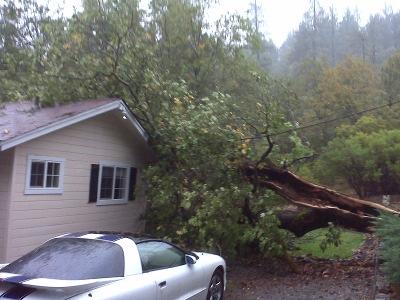
The wet weather also led to some downed trees.
One, in particular, fell on Cobb resident Roger's Kinney's home on Tuesday. Kinney said he wasn't sure of the exact damage caused by the falling tree.
One of the storm's important benefits is replenishing Clear Lake and the county's creeks.
US Geological Survey stream gauges showed dramatic increases in stream volume in many of the areas around Lake County. Clear Lake's level also showed a marked improvement over the course of Tuesday.
E-mail Elizabeth Larson at