How to resolve AdBlock issue?
News
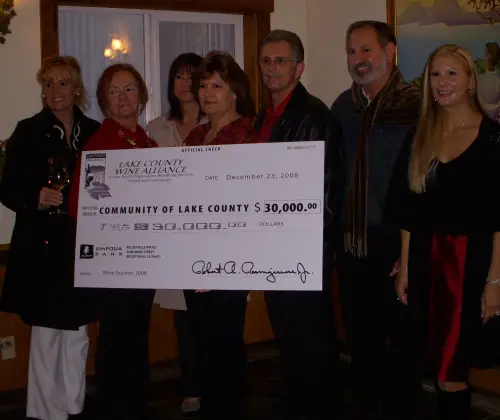
KELSEYVILLE – The Lake County Wine Alliance on Tuesday spread some holiday cheer and handed out some large checks to several local groups who work to make Lake County a better place.
The proceeds from the alliance's ninth annual Lake County Wine Auction – held in September at Buckingham Golf and Country Club – were distributed at a festive pre-Christmas gathering at Marie Beery's Saw Shop Gallery Bistro Tuesday afternoon.
In all, 16 community nonprofits shared $91,500.
“We had an incredible year,” said Wine Alliance Treasurer Rob Roumiguiere.
Since it began in 2000, the Lake County Wine Auction has contributed approximately $713,002 to community organizations, alliance board members reported. The group's charter directs it to foster the arts, benefit health services and support the community while, at the same time, promoting Lake County as a wine-growing region.
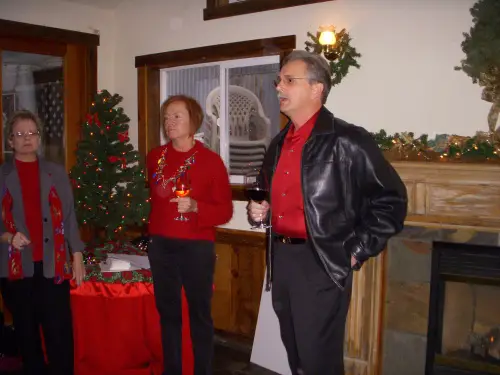
Joining Roumiguiere in making the check presentations were fellow Wine Alliance Board of Directors members including President Margaret Walker-Stimmel, Vice President Marie Beery, Secretary Pamela Shine-Duncan; and directors Judy Luchsinger, Wilda Shock and Janet Thompson. Jim Fetzer, another director, didn't attend.
This year, the Wine Alliance took its signature event in a different direction, adding new facets to it – such as a cooking presentation with noted chef John Ash, Roumiguiere said.
“This event really has become the premier event for Lake County,” he said, adding that about 400 people attended this year.
Recipients were categorized into three major groups – arts, health and community – each of which divided up $30,000. An additional $1,500 went to the Buckingham Junior Golf Program to fund Lake County Junior Golf Council activities.
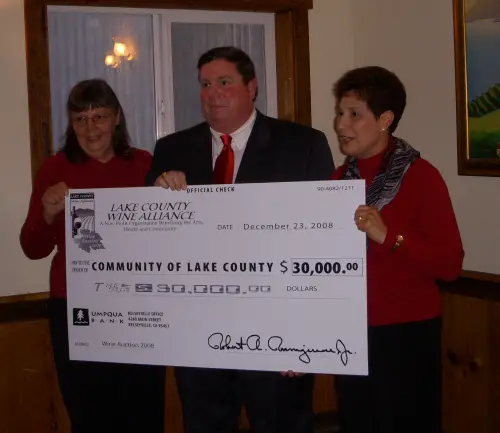
In the arts, $5,000 went to Kids 4 Broadway, which provides tuition scholarships for children ages 6 through 14 to participate in theater productions, plus $5,000 each to the fine arts programs at Clear Lake High School, Kelseyville High School, Lower Lake High School, Middletown High School and Upper Lake High School.
Health-related groups included Lake County Special Olympics, $2,500, for sports equipment, uniforms, training supplies and transportation costs; Wiloth Equine Therapy and Riding Center, $2,500, for equine-assisted therapy programs for special needs youth; Adult Day Care/Respite of Clearlake, $12,500, providing a caring, accepting environment for dementia-impaired adults; and Hospice Services of Lake County, $12,500, offering high-quality, end-of-life services to county residents.
Susie Wiloth said her therapy and riding center, located between Lower Lake and Middletown, will use the $2,500 it received to sponsor children who are students of the school. She said the school will provide matching funds to provide more therapeutic riding opportunities for the students.
In the community category, the United Veterans Council Military Funeral Honors Team received $2,500, as did Church Women United. Operation Tango Mike was awarded $5,000, while the Lake Family Resource Center and the Lake County Literacy Coalition each received $10,000.
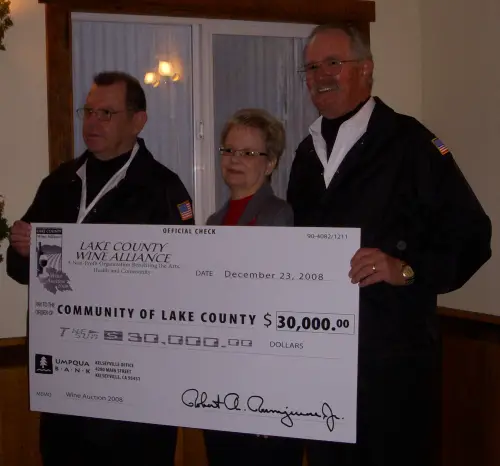
The $2,500 that went to the Military Funeral Honors Team will go toward uniforms and team operations, said team member and United Veterans Council President Frank Parker. The funds also will help cover a recent engine overhaul for the group's bus, which carries team members to veterans' funerals and military-related events.
“We operate strictly on donations,” said Parker.
Ginny Craven, founder of Operation Tango Mike – which sends care packages to local troops overseas – said the $5,000 her group received will help ensure several more months of supplies to members of the military.
To send between 80 and 100 packages a month averages about $1,000 in shipping costs each time the packages go out, Craven said, adding that shipping costs will go up after the start of the new year.
Church Women United will use their funds to provide shoes and socks for school-age children in need and the Lake Family Resource Center will operate separate summer camps for young men and women ages 12 through 17. The Literacy Coalition plans to train more tutors to serve adults needing help reading and writing English.
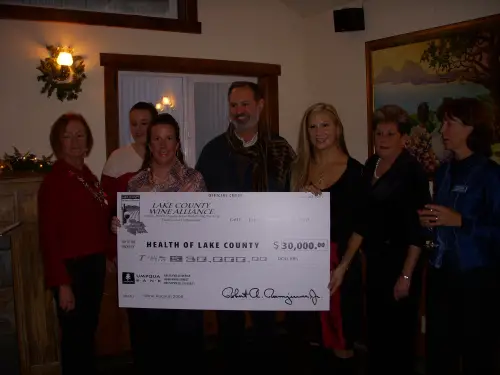
Despite the tough economy, Roumiguiere said this year's distribution was the same as last year's. “It's pretty incredible,” he said.
The auction's administrative costs are covered by ticket sales and sponsors, which allows them to put more of the proceeds back into the local groups that they select as beneficiaries this year.
Roumiguiere hopes to see the event grow even larger next year.
“The bigger we can make this event the more we can give away,” he said.
The Wine Alliance is now taking applications from nonprofits that wish to be considered as recipients of the 2009 Wine Auction proceeds. The deadline for applications is March 1, 2009.
For more information, contact Judy Luchsinger,
E-mail Elizabeth Larson at
{mos_sb_discuss:2}
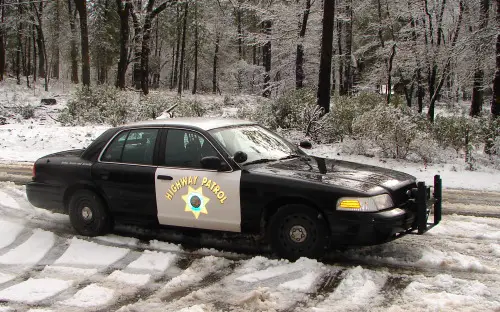
LAKE COUNTY – If you chose to drink and drive this holiday season, those flashing red lights in your rear-view mirror won’t belong to a red-nosed reindeer, but to a California Highway Patrol (CHP) officer’s vehicle.
In an effort to keep California’s roads safe, every available CHP officer will be out on the road during the upcoming Christmas Maximum Enforcement Period (MEP) which begins Wednesday, Dec. 24, at 6 p.m. and continues through midnight, Sunday, Dec. 28.
“Consider this a warning,” said Clear Lake Area CHP Lieutenant Mark Loveless. “We will be out there taking a zero tolerance approach and will arrest you if you are drinking and driving.”
CHP officers arrested 1,661 motorists statewide for driving under the influence (DUI) during last year’s Christmas MEP.
During that same time period, 43 people died in the 4,613 collisions that occurred in California. Among those killed, 18 lost their lives in alcohol-related crashes.
“Remember to designate a non-drinking driver before the celebrating begins, watch your speed and always wear your seatbelt,” Loveless added.
Along with the increased enforcement effort, the CHP is asking motorists to help keep the state’s roadways safe by calling 911 to report a suspected drunk driver. Callers should be prepared to provide dispatchers a description of the vehicle, its location and direction of travel.
“The holiday season is a time for family, friends, and celebrations; unfortunately it is also a time when we see too many alcohol-related highway fatalities,” said CHP Commissioner Joe Farrow. “Even if we save just one life by getting the message out, that is one life that has been spared.”
The CHP will conduct a similar maximum enforcement effort over the New Year’s holiday weekend which begins Wednesday, Dec. 31, at 6 p.m. and continues through midnight, Sunday, Jan. 4, 2009.
{mos_sb_discuss:2}
The collision occurred on westbound Highway 20 about 15 miles west of Highway 16, according to the California Highway Patrol.
The vehicles involved were said to be a silver Honda Civic and a pickup truck. One of the vehicles was off the roadway, according to the CHP.
The CHP and the Lake County Sheriff's Office reported to the scene, where the roadway was reported to be partially blocked.
At least one person was transported to St. Helena Hospital-Clearlake, but CHP did not release information about the names of the crash victims.
The roadway was reported to be open shortly before 8:30 p.m.
Information also was not available Tuesday on a crash that occurred Monday evening on Highway 53 near Clearlake.
E-mail Elizabeth Larson at
{mos_sb_discuss:2}
“The report reveals that some fundraising campaigns are wildly successful and others are profound disappointments,” Attorney General Brown said. “In some cases, commercial fundraisers have stunning successes, generating millions for good causes. In others, the overhead costs outpace the dollars raised, and the charities have to foot the bill.”
The Attorney General’s Charitable Solicitation Report found that in 2007, commercial fundraisers collected $370.33 million from Californians in donations.
In total, just $161.6 million – or 43.6 percent of the donations raised actually made it to the charities. The remainder went to commercial fundraisers who receive a percentage from each donation or a flat fee as payment.
These figures, however, are averages and do not provide the full picture.
There are some cases where the vast majority of funds make it to the charity. For instance:
A commercial company raised $15.9 million for the March of Dimes Foundation, which received $11 million, or more than 70 percent.
A commercial company raised $1.2 million for the Alzheimer’s Association, which received $873,606, or 72 percent.
But other cases are not so successful, where the charity can find itself tens of thousands of dollars in the red.
The California Legislature passed a law in 1989 requiring commercial fundraisers to file these financial reports with the Attorney General. This is the 16th year that the Attorney General has published this annual report.
The report also describes and provides statistics for automobile donations and thrift store operations.
The Attorney General also publishes the Guide to Charitable Giving for Donors that provides advice, guidelines and information to help donors in making giving decisions. The guide suggests that donors:
Ask the solicitor how a donation will be distributed.
Ask what percentage of donations pays for fundraising expenses.
Learn about the charitable organization, its activities and its fundraising practices. Research charities by going to the Attorney General’s Web site. Check with the Wise Giving Alliance (www.give.org), Council of Better Business Bureaus (www.bbb.org) and the American Institute of Philanthropy ( www.charitywatch.org).
Ask if the solicitor works for a commercial fundraiser and is being paid to solicit.
Avoid cash donations.
Avoid giving credit card information to a telephone solicitor or in response to a telephone solicitation.
The guide is available on the Attorney General’s Web site at http://ag.ca.gov/charities/ or a copy can be requested by writing to the Attorney General’s Registry of Charitable Trusts, P.O. Box 903447, Sacramento, CA 94203-4470.
{mos_sb_discuss:2}
Wal-Mart officials met with city of Clearlake staff on Dec. 5, at which time they submitted an application to expand their current store on Dam Road, said City Administrator Dale Neiman.
Kevin Loscotoff, a Wal-Mart spokesman, confirmed the plans.
He said the Clearlake Wal-Mart was built in 1994 and is 109,000 square feet, an “average-sized” store for the time in which it was built.
Loscotoff told Lake County News that the corporation wants to expand the store to about 148,000 square feet. The expanded store isn't being called a supercenter.
Stores are designed specifically for the communities they're meant to serve, said Loscotoff.
The reason Wal-Mart is moving forward with its expansion is that the demand from the community has grown so significantly that “it's actually surpassed the intended original customer demand,” Loscotoff said.
As part of the expansion, Loscotoff said the store's exterior and interior will be updated, with new fixtures and design, and wider aisles to make shopping more comfortable and convenient. The exterior will feature updated but no new signage.
“It is intended to be a store of the community,” he said, noting that the corporation is very excited about the expansion.
Perhaps the most notable changes will be that the tire and lube express services will be replaced by new general merchandise and a full service grocery, according to Loscotoff.
He said Wal-Mart has been expanding its grocery services at stores all over the country due to demand.
Wal-Mart is reported to be the world's largest retailer, with grocery sales also on the rise. The corporation owns a chain called Neighborhood Markets, which are groceries only, said Loscotoff.
Despite the recession, Wal-Mart has continued to show rising profits. Its November sales report shows a 6.5-percent growth rate for its US stores that the corporation said exceeded expectations, and was punctuated by a strong Black Friday, the day after Thanksgiving.
Loscotoff said they don't have a timeline for the expansion at this point, which he said will be dictated by the city's administrative process.
Neiman also, couldn't specifically outline a timeframe for the expansion.
“What we told them was that they were going to have to do an EIR (environmental impact report),” said Neiman. “They already knew that.”
Neiman said an EIR was completed on the prior project, which city staff is currently reviewing to see if it is applicable here and how much remains valid. Once city staff is done with the review, they'll discuss with Wal-Mart what they've found.
He said he suspects there are a lot of issues from the prior EIR that won't need to be addressed this time. However, Neiman added that he expect Wal-Mart will have to conduct a drainage study and build a retention basin for the site. He believes that the building's current facilities have been sized for full development.
Neiman confirmed that Wal-Mart officials didn't bring up the “supercenter” designation, which he said usually covers much larger stores closer to 200,000 square feet or above.
In the city's review, they also will look at potential square footage limitations. Neiman said that, based on the city's zoning ordinance, there are three factors that affect building size – landscaping, parking and current building size.
“Typically it's those three factors in relation to lot size that tell you what you can do or can't do,” he said.
Loscotoff said the expansion will result in new job opportunities for the community, but he didn't have a projected number of jobs that will be created at this time.
Wal-Mart is carrying on several other store expansions around Northern California at this time, said Loscotoff. “We continue to see strong demand from the customers,” he said.
As one example, the company reported that it is expanding its Willows store to a supercenter.
“We're proud of our ability to be able to allow our customers to save money so they can live better,” Loscotoff said.
Other local businesses were concerned at the news of the Clearlake Wal-Mart's proposed expansion into the grocery business.
Dennis Darling, president of Foods Etc., anticipates the expansion will make it difficult for other area grocers.
The city already has several grocery stores – Foods Etc., Ray's Food Place and Safeway, said Darling.
“Clearlake doesn't need another 50,000 square feet of grocery, I can tell you that,” said Darling.
Darling likened Wal-Mart to the Borg Collective from the “Star Trek: The Next Generation” television series. The collective is made up of cyborgs that go around assimilating everything in its path.
“They're not good for local communities,” Darling of Wal-Mart.
He added that the idea that Wal-Mart will generate more money for the community has been proved wrong time and again. Rather, he said they cannibalize current businesses.
Ray's Food Place, located next door to the Clearlake Wal-Mart on Dam Road, could be affected the most.
Dan Cepeda, director of marketing for C&K Market Inc. of Brookings, Ore., which owns 60 Ray's Food Place and Shop Smart stores in California and Oregon, said they've been affected by Wal-Mart expansions in other markets.
“Wal-Mart definitely impacts local business whenever they bring their stores to a town, either new builds or expansions such as a supercenter,” Cepeda said.
He added, “We definitely would expect to be impacted by that move of theirs,” at the Clearlake store.
Cepeda said Ray's Food Place will continue focusing on its strengths – customer service, clean stores and fully stocked merchandise. Bigger retailers can't quite match them on that level, he said.
Ray's Food Place has six stores in the greater Grants Pass, Ore. area, said Cepeda. In the same area, Wal-Mart expanded a store to a supercenter. “Our stores fared very well,” he said. “Sales continue to be strong.”
Initially, there is always a drop off in sales, and then it begins to pick up again, he said.
Customers usually come back, said Cepeda. “Once the thrill of a new retailer is gone, they decide what it is they really want most.”
Neiman said Wal-Mart's proposed expansion is one of several commercial projects currently before the city, including a proposed Walgreens and Starbucks, a new Rite Aid, a Calvary Chapel project and the ongoing negotiations for the city's airport property.
E-mail Elizabeth Larson at
{mos_sb_discuss:2}
The quakes began after 1 a.m. Sunday morning, culminating in a 3.0-magnitude quake that occurred at 4:36 p.m. Sunday, according to the US Geological Survey.
Recorded at a depth of eight-tenths of a mile, the 3.0 quake was centered one mile from The Geysers, four miles west southwest of Cobb and six miles west northwest of Anderson Springs.
Over the following hour, a series of smaller quakes – some as large as 2.4 in magnitude – followed in The Geysers and Anderson Springs areas.
In all, 25 quakes hit Anderson Springs, Cobb and The Geysers on Sunday, the US Geological Service reported.
Cobb resident Roger Kinney, who regularly updates Lake County News on happenings in his area, reported that the earthquake activity had seemed to spike about 5:30 p.m. Sunday.
Kinney said the earthquakes usually calm down a bit in winter, but they've continued coming this year.
The quakes continued into Monday. Kinney said he felt a quake shortly after 10 a.m. that he described as “more of a rolling motion than the usual, BANG-SHAKE type of quakes.”
A 2.9-magnitude quake that occurred shortly before 6 a.m. woke up Anderson Springs resident Joan Clay.
Clay said she immediately called Calpine's hotline to report the quake.
She said the severity of the quakes depends on where a person lives in Anderson Springs.
Clay added that the quakes seem to occur when it's raining.
“We have them all the time,” she said.
The last time an earthquake measuring 3.0 in magnitude or above hit that area was on Dec. 14, when a 3.1 was recorded near The Geysers.
E-mail Elizabeth Larson at
{mos_sb_discuss:2}