 How to resolve AdBlock issue?
News

MORE PHOTOS HAVE BEEN ADDED TO THIS STORY.
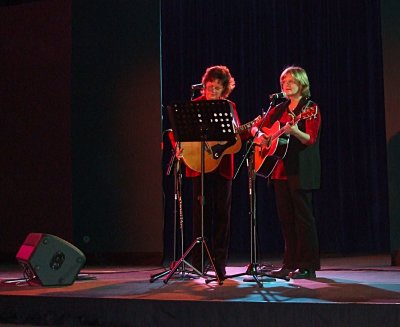
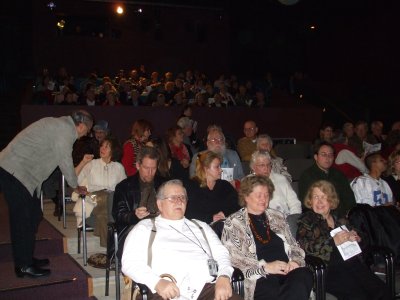
LAKEPORT – While it was only a "temporary" grand opening at the Soper-Reese Community Theater on Saturday night, when the lights went down and the performers took the stage for the Winter Music Fest, the excitement in the audience was palpable.
The event provided Lake County residents with their first glimpse of the dream of a state-of-the-art performing arts center coming true.
"It's exciting," said Joan Holman, mistress of ceremonies for the evening, who also will be starring in the upcoming production of The Solid Gold Cadillac which opens in March.
"I remember scraping gum off the floor and cleaning years ago ... we've come a long way," Holman said.
A long way indeed. The lobby has been refurbished, the auditorium gutted and repaired, the building water-proofed from flooding, plus there's a new roof, heating and air conditioning, a sprinkler system, interior paint and more.
However, the theater is not finished yet.
"This is just the interlude," said Mike Adams, who leads the construction subcommittee. “We still have a lot more to do."
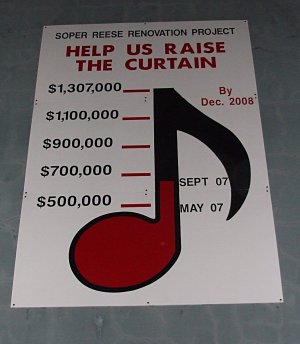
Adams is hoping the community will continue to step up and support the reconstruction efforts.
The 16th annual Winter Music Fest Vaudeville 2008, presented by the Lake County Arts Council, was held at the Soper-Reese for the first time this weekend and "coming home at last," was the theme for the evening as volunteers, sponsors and donors were thanked at a champagne reception before the performances began.
John Ross, chair of the renovation committee, held up a list of the community members and businesses who have donated their time, talents and money to make the event and the future of a top-notch performing arts venue in Lake County a reality. Ross thanked them all.
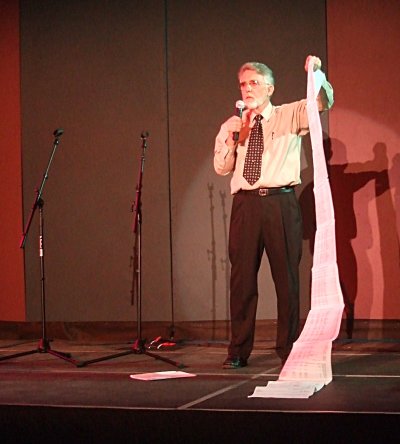
"I feel the excitement in the air tonight," said local actor and business owner Martin Squier. "There's a sense of finding a home for entertainers to perform and the community to enjoy."
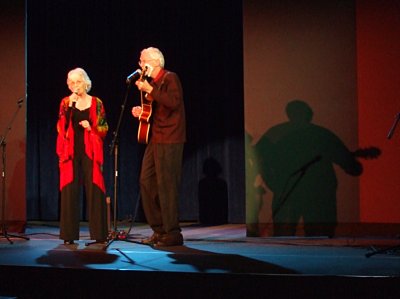
The nearly sold-out show on Saturday evening had 17 different acts with as many different styles of singing.
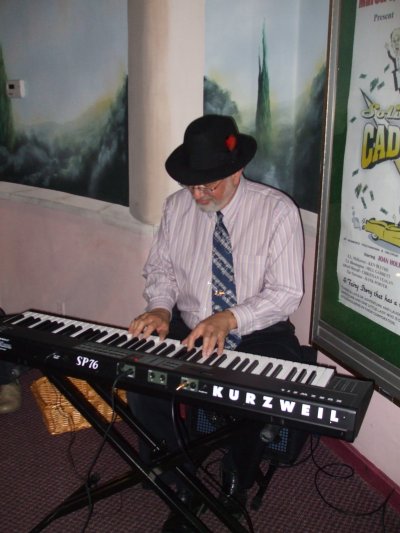
From ragtime to pop, show tunes to Flamenco, folk songs to love songs and more – and the audience loved them all, especially the musical antics of Bert Hutt (who even played the spoons) and pianist David Neft, who kept the audience entertained between performers.
Now that the first stage of the reconstruction effort has been fully paid for and completed, fundraising will continue for the second and final phase.
Upcoming performances at the theater include The Poetry Out Loud competition in February and a play, The Solid Gold Cadillac, in March.
Donations to support the reconstruction efforts of Soper-Reese can be sent to: Soper-Reese Fund, P.O. Box 756, Lakeport, 95453. Contributions are tax-deductible. For more information on the theater or to schedule a private tour, please call Nina Marino at 279-4082.
E-mail Terre Logsdon at
{mos_sb_discuss:5}


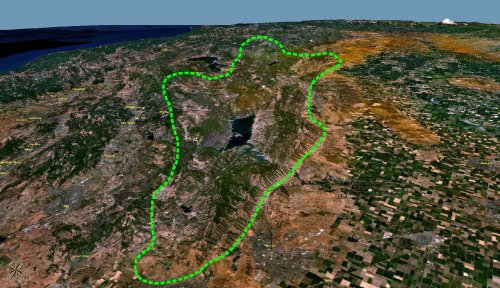
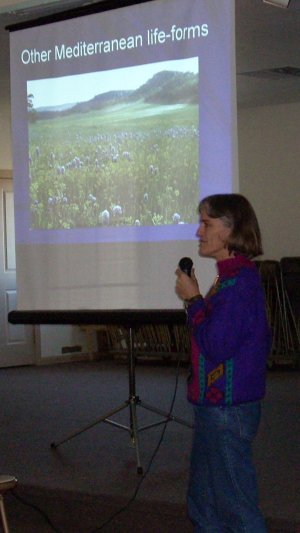
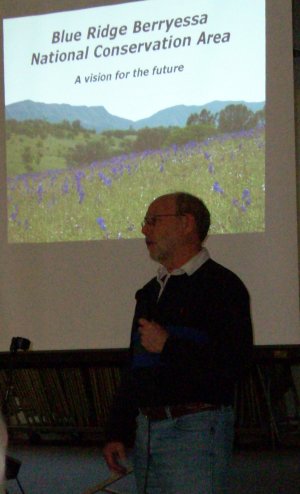
LOWER LAKE – At a presentation on Saturday, Jan. 19, more than 50 people gathered to learn what a Natural Conservation Area designation would mean to 800,000 acres, which may include a large portion of Lake County.
The Sierra Club Lake Group hosted the town hall at the Brick Hall in Lower Lake.
Victoria Brandon – chair of the Sierra Club Lake Group and board member of Tuleyome, a nonprofit organization that advocates and protects the Cache Creek and Putah Creek regions – introduced two speakers to give an overview of why a Natural Conservation Area designation would be beneficial to Lake County.
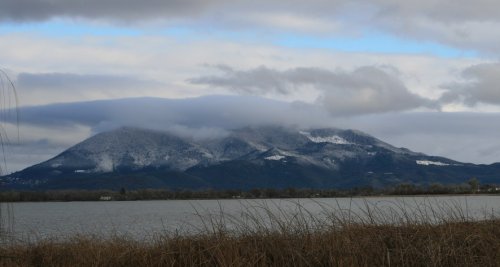
The proposed Natural Conservation Area runs from Fairfield and Vacaville in Solano County to the south, west to Middletown, east to Rumsey and along the mountains of the Northshore up into Mendocino National Forest and possibly to include the Snow Mountain Wilderness, although the exact boundaries have not yet been determined.
“I think it’s wonderful, and I support the concept. I hope we can make it happen,” said District 1 Supervisor Ed Robey, who attended the town hall event.
The proposed Natural Conservation Area would include a large portion of Lake County’s District 1.
Bob Schneider, president of Tuleyome, which was instrumental in ensuring that Cache Creek was designated as a California Wild and Scenic River, said the Natural Conservation Area designation would “protect agricultural lands, provide new opportunities for recreation, conservation and stewardship and support the local economies of the adjacent communities.”
A Natural Conservation Area designation, “will have no effect on local jurisdiction or on water rights,” Schneider said.
The public lands in the proposed Natural Conservation Area, according to Dr. Susan Harrison, an expert on botany and serpentine soils with the Department of Environmental Science and Policy, are listed as one of the world’s 25 biodiversity “hot spots.”
Harrison gave an overview of the unique environmental factors – the Mediterranean climate, the topography and soil types – that make designating this area as a Natural Conservation Area critical for conservation.
The designation will not affect private lands within the area unless landowners choose to participate in some way, it will only affect public lands, the speakers explained.
“If we’re going to protect this region,” Schneider said, “We’re going to have to preserve the agricultural heritage,” but private land owner participation is voluntary.
One way a Natural Conservation Area designation can assist private landowners within the the area is by providing conservation easements to ranchers because “ranchers benefit from and play a critical role in sustaining the regional landscape,” Schneider explained and they are, “increasingly jeopardized by development,” in this area.
According to research by the California Department of Finance, the fast growing counties of Yolo, Napa, Lake, Colusa and Solano, which all have lands in the proposed Natural Conservation Area, are expected to grow by 28 percent. That means an increase of 200,000 residents by 2020, which will severely impact the agricultural and wild lands within the proposed Natural Conservation Area according to Tuleyome’s Web site.
Schneider told the audience that there would be an economic benefit for the Natural Conservation Area designation because it is a national-level designation and the entire Blue Ridge Berryessa Natural Conservation Area can be promoted as a destination for recreation and tourism.
What a Natural Conservation Area designation does, Schneider explained, is to create a formal name for the geographic area, Congressional recognition of the region, establishes a public advisory committee and will provide funding for multiple agencies (National Forest Service, U.S. Bureau of Land Management, U. S. Bureau of Reclamation, California Department of Parks and Recreation, County governments) to come together and develop a regional management plan for the public lands.
For more information on the Natural Conservation Area proposal, visit http://tuleyome.org/projects/campaigns/blueridge/index.html; to see a slide show of photos taken in the proposed area, visit http://tuleyome.org/docs/EarthDaySlideshow.swf.
E-mail Terre Logsdon at
{mos_sb_discuss:2}
Caltrans and the California Highway Patrol reopened the highway at about 5 a.m. Saturday.
The highway was closed late Friday night due to flooding and mudslides.
CHP is still reporting mud and debris at other points along the highway as it follows the Northshore, specifically near Clearlake Oaks.
Friday's heavy rains triggered the flooding and slide activity.
E-mail Elizabeth Larson at
{mos_sb_discuss:2}
Chief Deputy District Attorney Richard Hinchcliff reported Friday that James Booth, Michael Johnson and Michael Bruins pleaded no contest on Tuesday to possessing more than the legal limit for crappie and received fines totaling more than $7,000.
The legal limit of crappie in Clear Lake is 25 per day and 25 in possession, said Hinchcliff.
He explained that the possession limitation means that no matter how many days a person spends fishing, they can possess no more than 25 crappie at one time.
Hinchcliff said that on Nov. 15, 2007, state Department of Fish and Game Wardens Loren Freeman and Nick Buckler received an anonymous tip of fishermen taking and keeping more than the legal limit of crappie.
Freeman and Buckler set up surveillance in the Kono Tayee area and observed a black bass boat with three men catching crappie, according to Hinchcliff's report.
After the men left the area, the wardens contacted them at Indian Beach Resort, said Hinchcliff, where the three men told Freeman and Buckler the fishing had not been very good.
The wardens found only 12 fish in the boat, which were all the fish the men claimed to possess, said Hinchcliff.
However, Booth, Johnson and Bruins admitted they had fish in a freezer at their motel after the wardens told the men that they could inspect their vehicle and any freezers or ice chests, and that failing to exhibit all fish was an additional crime, Hinchcliff reported.
In all, the two game wardens found a total of 151 crappie, said Hinchcliff.
Hinchcliff said he charged Booth with possessing 18 fish over the limit, Johnson with 18 fish over the limit and Bruins with 40 fish over the limit.
He said the standard fine is $780 for the first fish over the limit and $68 for each additional fish over the limit.
After the men pleaded no contest to the charges Tuesday, Judge Stephen O. Hedstrom fined Johnson and Booth $1,900 each, and Bruins was ordered to pay a fine of $3,447.
Hinchcliff, who oversees the poaching cases that come through the District Attorney's Office, said crappie and deer are the major poaching victims in Lake County.
As or crappie, “The last couple of years we've prosecuted at least half a dozen people for catching over limits,” said Hinchcliff.
In 2003 Hinchcliff prosecuted an out-of-county poacher who was found in possession of 122 crappie over the limit and received thousands in fines.
Crappie used to be seen in more abundance in Clear Lake, said Hinchcliff, who grew up locally and fished for them himself.
“They pretty much disappeared for a long time,” he said, adding that the fish population has its ups and downs.
E-mail Elizabeth Larson at
{mos_sb_discuss:2}
The California Highway Patrol and Caltrans reported that Highway 20 was closed in both directions from its junction with Highway 53 to Interstate 5 in Williams due to flooding over the roadway and rock slides.
Flooding in the road was reported at early as 5:30 p.m., but it wasn't until nearly five hours later that officials finally closed the roadway, according to the CHP incident logs.
Farther up along the highway, at Hillside Lane at Clearlake Oaks, CHP reported that rocks were falling into the roadway.
CHP's Ukiah Dispatch Center said it was unknown when the highway would reopen.
E-mail Elizabeth Larson at
{mos_sb_discuss:2}
Education
Health
Business
Obituaries
Opinion & Letters
Veterans
Recreation

Religion
Arts & Life
Government & Politics