How to resolve AdBlock issue?
Refresh this page
Lake County News,California
  • Home
    • Registration Form
  • News
    • Education
    • Veterans
    • Community
      • Obituaries
      • Letters
      • Commentary
    • Police Logs
    • Business
    • Recreation
    • Health
    • Religion
    • Legals
    • Arts & Life
    • Regional
  • Calendar
  • Contact us
    • FAQs
    • Phones, E-Mail
    • Subscribe
  • Advertise Here
  • Login
How to resolve AdBlock issue?
Refresh this page

News

City of Lakeport welcomes applicants for Lakeport FIre District Board of Directors

LAKEPORT, Calif. — The Lakeport City Council invites interested residents to submit an application for appointment to serve on the Lakeport Fire Protection District Board of Directors.

This recruitment is open to any resident of the fire district.  

Applications will be accepted until Jan. 26, 2026 at 5 p.m.  

The Lakeport Fire District is governed by the Lakeport Fire District Board of Directors, which is composed of five citizens that live within the district. This includes two board members appointed by the Lakeport City Council on the basis of interest and qualifications. 

This recruitment is to fill a mid-term vacancy due to the resignation of the incumbent. The term of office for this appointment expires Dec. 31, 2026.

The Fire District Board of Directors meet at 5:30 p.m. on the second Tuesday of each month at the Main Street Station.

Membership on this board is voluntary. If you are interested in serving on the board, applications are available on the city’s website here.

For additional information, contact Deputy City Clerk Hilary Britton at 707-263-5615, Extension 102, or by e-mail at This email address is being protected from spambots. You need JavaScript enabled to view it.. 

How your electric bill may be paying for big data centers’ energy use

Your power bill may be hiding something. photoschmidt/iStock/Getty Images Plus

In the race to develop artificial intelligence, large technology companies such as Google and Meta are trying to secure massive amounts of electricity to power new data centers. Electric utilities see the prospect of earning large profits by providing electricity to these power-hungry facilities and are competing for their business by offering discounts not available to average consumers.

In our paper Extracting Profits from the Public, we explain how utilities are forcing regular ratepayers to pay for the discounts enjoyed by some of the nation’s largest companies and identify ways policymakers can limit the costs to the public.

Shifting costs

In much of the U.S., utilities are monopolists. Within their service territories, they are the only companies allowed to deliver electricity to consumers. To fund their operations, utilities split the costs of maintaining and expanding their systems among all ratepayers – homeowners, businesses, warehouses, factories and anyone else who uses electricity.

Historically, a utility expanded its system to meet growing demand for electricity from new factories, businesses and homes. To pay for its expansion − new power plants, new transmission lines and other equipment − the utility would propose to raise electricity rates by different amounts for various types of consumers.

Public utility commissions are state agencies charged with ensuring that the public gets a fair deal. These commissions monitor how much money the utility spends to provide electric service and how its costs are shared among various types of ratepayers, including residential, commercial and industrial consumers. Ultimately, the public utility commission is supposed to approve any rate increases based on its assessment of what’s fair to consumers.

Splitting the utility’s costs among all consumers made perfect sense when population growth and economic development across the economy stimulated the need for new infrastructure. But today, in many utility service territories, most of the projected growth in electricity demand is due to new data centers.

Here’s the problem for consumers: To meet data center demand, utilities are building new power plants and power lines that are needed only because of data center growth. If state regulators allow utilities to follow the standard approach of splitting the costs of new infrastructure among all consumers, the public will end up paying to supply data centers with all that power.

A drawing of various large buildings.
An artist’s rendering of a proposed Meta data center in Richland Parish, La. Meta via Facebook

A big price tag

One particularly acute example is in Louisiana. A Meta data center under development in the northeastern corner of the state is projected to use, by our calculations, twice as much energy as the city of New Orleans.

Entergy, the regional monopoly utility, is proposing to build more than US$3 billion worth of new gas-fired power plants and delivery infrastructure to meet the data center’s energy demand. Rather than billing Meta directly for these costs, Entergy is proposing to include the costs in rates paid by all customers.

Entergy claims its contract with Meta will cover some portion of the $3 billion price tag and that will mitigate any increases in consumers’ bills. But Entergy has asked state regulators to keep key terms of the contract secret, and only a redacted version of its application is available online.

The public has no idea how much it might pay if the commission approves the contract. And if the Meta data center ends up using much less power than the company anticipates, the public does not know whether it would be on the hook to pay higher electricity rates for longer periods to guarantee Entergy a profit.

A close-up of a rack of electronics.
The electronics in data centers consume large amounts of electricity. RJ Sangosti/MediaNews Group/The Denver Post via Getty Images

Secret agreements

Our research, reviewing nearly 50 public utility commission proceedings about data centers’ power needs across 10 states, uncovered dozens of secretive contracts between utilities and data centers. Unlike Louisiana, most states require utilities to submit to the public utility commission their one-off deals with data centers, but they allow utilities to conceal the pricing terms from the public.

In normal rate-review cases, numerous parties advocate for their interests in a public proceeding, including members of the public, industry groups and the utility itself. But as our paper finds, utility commission reviews of data center contracts are based on confidential utility filings that are inaccessible to the general public. Few, if any, outsiders participate, and as a result the commission often hears only the utility’s version of the deal.

Because the pricing terms are secret, it is impossible to know whether the deal that a utility is offering to a data center is too low to cover the utility’s costs of providing power to the data center, which would mean that the public is subsidizing the deal. History shows, however, that utilities have a long history of exploiting their monopolies to shift costs to the public, including through secret contracts.

A group of large metal structures holding electric wires.
Electric utilities also charge customers for the costs of building and maintaining transmission networks. Jay L. Clendenin/Getty Images

Other public costs

Our paper also explores other ways that the public pays for data center energy costs. For instance, many high-voltage interstate transmission projects, which connect large power plants to local delivery systems, are developed through regional planning processes run by numerous utilities. These alliances have complex rules for splitting the costs of new transmission lines and equipment among their utility members.

Once a utility is charged its share, it spreads the costs of new transmission projects among its local ratepayers. Because some regions are building new transmission capacity to accommodate data centers, our analysis finds that the public has been forced to pay billions of dollars for data center growth.

Data center energy costs can also be shifted when data centers connect directly to existing power plants. Under what are called “co-location” deals, the power plant stops selling energy to the wider public and just sells to the data center. With less supply in the overall market, prices go up and the public faces higher bills as a result.

Many state legislatures are noticing these problems and working to figure out how to address them. Several recent bills would set new terms and conditions for future data center deals that could help protect the public from data center energy costs.The Conversation

Ari Peskoe, Lecturer on Law, Harvard University and Eliza Martin, Legal Fellow, Environmental and Energy Law Program, Harvard University

This article is republished from The Conversation under a Creative Commons license. Read the original article.
Census: Tribally owned casinos may improve economic conditions on reservations and lower unemployment for nearby people of all races

American Indians on tribal lands in the United States have historically faced some of the nation’s worst economic conditions.

The proportion of American Indian people living below the poverty line in 1989 was 31%, considerably higher than the 13% national poverty rate at the time.

The expansion of tribal casinos that began in the 1990s helped improve economic conditions faster for American Indians relative to the U.S. population as a whole, according to joint U.S. Census Bureau and university research, though there is still progress to be made: the American Indian poverty rate was 19.6% in 2024, greater than that year’s national average of 12.1%, according to Census Bureau data.

A working paper, written by Maggie R. Jones (Census Bureau),  Randall Akee (Census Bureau and University of California Los Angeles) and Emilia Simeonova (Johns Hopkins University) used census data to evaluate the ZIP-code-level economic impact of tribal casinos on nearby people and places.

Casino economy

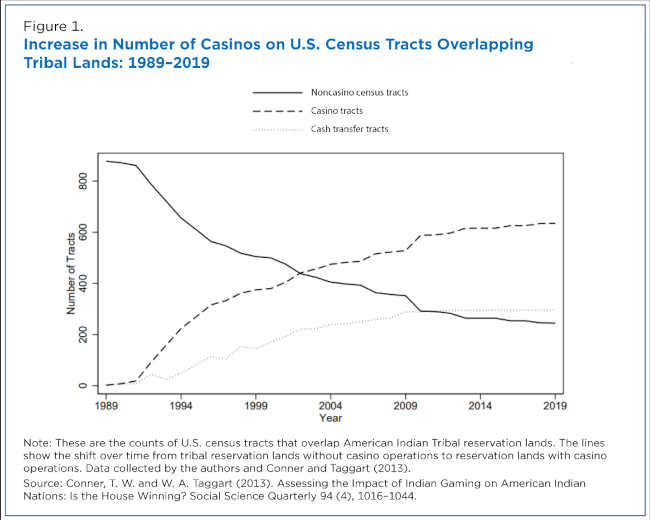
After Congress passed the Indian Gaming Regulatory Act (IGRA) in 1988, the number of U.S. census tracts with an American Indian tribal casino operation surged from near zero in 1989 to nearly 600 by 2019 (Figure 1).

The research shows that tribal casino operations boost wages for American Indians and reduce unemployment for nearby people of all races employed in casino-related industries (Accommodation, Food Service and Arts and Entertainment) when compared with non-casino reservation ZIP codes in the same state.

It also indicates that direct cash transfer programs (i.e., per capita payments of casino profits) may have contributed to improved living standards, on average, for tribal citizens living on reservations.

Sovereignty and solvency

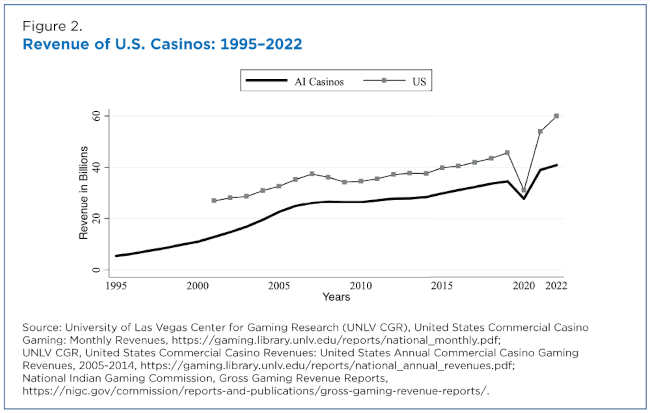
In recent years, the American Indian gaming industry generated more than $40 billion annually (Figure 2).

How do American Indian tribes “split the pot”?

Under the IGRA, tribe-owned casino revenue must support tribal economic development and welfare, including local charities and, in some cases, sharing it with state and local governments. 

This means the IGRA, by permitting casino operations, can be viewed as a “place-based” policy that targets specific geographies for economic development.

The law not only re-affirmed tribal nation’s sovereign right to form government-owned enterprises — it enabled the large-scale tribal gaming industry as it exists today.

Prior to 1988, tribal gaming was limited to small-scale bingo and card games on reservations in California and Florida. High-stakes casinos only existed in Nevada and New Jersey.

Tribal casino operations, post-IGRA, created a revenue stream almost exclusive to reservation lands in much of the United States.

The benefits of casino ownership

Economic conditions for American Indians living on reservations improved significantly as the tribal casino industry took off in the first two decades of the IGRA, according to the research.

During this time, American Indians living on reservation lands (regardless of the presence of a casino or cash transfer program) saw a 46.5% rise in real per capita income compared to 7.8% for the United States as a whole.

Casino revenues helped tribes develop their economic base through investments in infrastructure and expanded employment. Additionally, some tribal nations provided their citizens with unconditional cash transfers (from casino profits) designed to improve tribal development and welfare.

Citizens of casino-owning tribal nations received a significant cash infusion when their government adopted cash-transfer policies. Provided that the tribal nation has opted for unconditional cash transfers, all tribal citizens are eligible to receive the transfers, regardless of whether they live on a reservation.

These programs are among the earliest and longest running examples of universal basic income in the United States.

But added income wasn’t the only benefit, according to the study.  

In the first two decades after IGRA’s passage American Indians living on reservations experienced:

• About an 11% decrease in childhood poverty compared to no significant change for the country as a whole.
• A roughly 7% increase in labor force participation by American Indian women, compared to 3% for the country as a whole.
• A 4% reduction in overall unemployment compared to no significant change for the country as a whole.

To access this and other working papers, visit the Census Working Papers website. Working papers are intended to make Census Bureau research accessible and have not undergone the standard review and editorial process of other Census Bureau publications.

Travis Shoemaker is a writer/editor at the U.S. Census Bureau.

Police attempt to locate missing 16-year-old

Abby Herrin. Courtesy photo.


CLEARLAKE, Calif. — The Clearlake Police Department is working to locate a missing 16-year-old girl.

Abby Herrin was last seen in the Middletown area, wearing a white tank top or black sweater.

She is described as a white female, standing 5 feet 3 inches tall and weighing 135 pounds, with blonde hair and blue eyes. 

If you have any information regarding her whereabouts please contact the Clearlake Police Department at 707-994-8251, Extension 1 for dispatch.

Lake County Animal Care and Control: Three horses and a pig

LAKE COUNTY, Calif. — Lake County Animal Care and Control has livestock this week available for adoption.

The agency is offering three horses and a pig to new homes.

The horses are:

• Ice, a 14-year-old male pinto. It was not reported if he was gelded.
• Belle, a 6-year-old bay mare.
• Sugar, a 10-year-old sorrel mare. 

The pig is a 1-year-old male with a gray and white coat.

Call Lake County Animal Care and Control at 707-263-0278 or visit the shelter online for information on visiting or adopting.

The shelter is located at 4949 Helbush in Lakeport.

Email Elizabeth Larson at This email address is being protected from spambots. You need JavaScript enabled to view it.. Follow her on Twitter, @ERLarson, and on Bluesky, @erlarson.bsky.social. Find Lake County News on the following platforms: Facebook, @LakeCoNews; X, @LakeCoNews; Threads, @lakeconews, and on Bluesky, @lakeconews.bsky.social. 


Ice 's preview photo
Ice

Bella 's preview photo
Bella


Sugar 's preview photo
Sugar


Upper Pen#1's preview photo

Upper Pen#1

Understanding climate change in America: Skepticism, dogmatism and personal experience

Warmer temperatures can supercharge storms. Joe Raedle/Getty Images

Scientists are trained to be professional skeptics: to always judge the validity of a claim or finding on the basis of objective, empirical evidence. They are not cynics; they just ask themselves and each other a lot of questions.

If they see a claim that a finding is true, they will ask: “Why?” They may hypothesize that if that finding is true, then some related findings must also be true. If it’s unclear whether one or more of those other findings is true, they will do more work to find out.

It is no wonder that science moves so slowly, especially on really important topics such as climate change.

Dogmatism is the opposite of skepticism. It is the proclivity to assert opinions as unequivocally true without taking account of contrary evidence or the contradictory findings. It is why public debate over scientific findings never seems to go away.

An example of the difference is the reaction to the Intergovernmental Panel on Climate Change’s finding in 1995 that “evidence suggests a discernible human influence on global climate.” The IPCC’s assessment reports involve hundreds of researchers from around the world who reviewed the global scientific understanding of the planet’s changing climate.

It’s an instructive case in the differences between skepticism and dogmatism, and it’s something to think about as you hear people talk about climate change.

Origins of a dogmatic response

Shortly after the IPCC released that finding in 1995, persistent and well-organized attacks on the science began. Many came from groups supported by the owners of Koch Industries, a conglomerate involved in oil refining and chemicals.

Their strategies mimicked earlier assaults on science and scientists who had warned the public that smoking posed a serious threat to their health. This time it was a warning about fossil fuels’ impact on the climate.

The similarity should not be a surprise. Science historians Naomi Oreskes and Erik Conway, in their 2011 book “Merchants of Doubt,” and American historian Nancy MacLean, in her 2010 book “Democracy in Chains,” have explained how the strategy was written by some of the same people who had tried to stop efforts to tighten tobacco regulations a decade or so earlier.

The dogma presented to the public for fighting regulation held that personal freedoms are paramount and that they are not to be diminished by any efforts designed explicitly to improve the general welfare.

What a skeptical response looks like

Climate scientists understood in 1995 that they must provide more than laboratory results, which go back to Svante Arrhenius’ work in 1895 demonstrating a causal correlation between increasing carbon dioxide concentrations and rising temperatures.

They also accepted the challenge of exploring collections of associated effects that should also be true if human activity was changing the climate.

Scientists have since examined dozens of different independently monitored aspects of climate change and confirmed the expected fingerprints of climate change all around the world.

Since the upper layers of the oceans absorb 90% of the atmosphere’s excess heat, they should be persistently warming as global temperatures rise. Has that happened? Yes, it has.

Since land-based ice melts when temperatures get too warm, global sea level should rise. And it should rise by more than would happen with thermal expansion of warming ocean water alone. Is it? Data shows that it is.

A line chart showing meltwater as the top contributor, followed by thermal expansion
The major contributors to sea level rise. NOAA Climate.gov

Syukuro Manabe and Richard Wetherald argued in 1967 that the upper atmosphere should cool while surface temperatures rise in response to higher carbon dioxide concentrations. Has it cooled over the past 50 years? Yes, it has, just as Manabe predicted.

A temperature map of the atmosphere shows cooling in the upper atmosphere, above the tropopause, and warming below it, over the past two decades.
The upper atmosphere has been cooling while the lower atosphere, close to Earth’s surface, has warmed over the past two decades. The gray line marks the tropopause, between the lower troposphere and higher stratosphere. IPCC 6th Assessment Report

By 2021, as the evidence piled up, the IPCC’s Sixth Assessment stated: “It is unequivocal that human influence has warmed the global climate system since pre-industrial times. Combining the evidence from across the climate system increases the level of confidence in the attribution of observed climate change to human influence and reduces the uncertainties associated with assessments based on single variables. Large-scale indicators of climate change in the atmosphere, ocean, cryosphere and at the land surface show clear responses to human influence consistent with those expected based on model simulations and physical understanding.”

Convincing the public

But has the public been convinced? The data on this is mixed.

Annual surveys conducted by the Yale Program on Climate Change Communication have found that the percentage of Americans “alarmed” about climate change rose over the past 11 years – from 15% in 2014 to 26% in 2024. And they show that much of that increase came from an increase in concern among Americans who earlier considered themselves “concerned” or “cautious.”

Over the same time period, though, the proportion of citizens in the survey who considered themselves “disengaged,” “doubtful” or “dismissive” shrank only modestly, from 29% to 27%.

Other surveys suggest that personal experience likely plays a significant role in how people understand climate change.

Many local and national news stations have mentioned climate change as a contributing factor in their extensive coverage of destructive wildfires in Los Angeles and Hawaii, flash floods in North Carolina and Texas, persistent drought across the Southwest, extreme heat waves and destructive hurricanes.

Some of their viewers could certainly be coming around to believing what evidence shows: that climate-related disasters have become more frequent and more intense.

Americans are also directly experiencing other effects of climate change on their homes, health and wallets. For example:

  • Doctors in the North are seeing increasing cases of Lyme disease. Those in the South have been witnessing a rising number of cases of dengue fever. Both are spread by insects whose ranges are expanding as temperatures rise.

  • Lobster populations have collapsed in Long Island Sound and flourished farther north in Canada’s Bay of Fundy.

  • Residents in southern New England now enjoy feeding bluebirds in winter.

  • Homeowners across the U.S. are seeing their property insurance premiums quickly rise as disaster risks increase. Many others can’t get coverage from insurance companies at all because of their area’s disaster risks.

Stories like these do not make the national news very often, but they do show up in conversations around the kitchen table.

Reaching those with dismissive views

So, how can those Americans who are dismissive of climate change be reached? Some dogmatically believe claims that “climate change is a hoax” despite ever-growing evidence to the contrary.

Talking about personal experiences with extreme weather events, wildfires or droughts and their connections to rising global temperatures can help.

It might also help to remind them of failed dogma from the past that was disproved by science, yet people continued for years to believe them. For example, we know today that the Earth is not flat, the Sun does not circle the Earth, and living organisms cannot materialize spontaneously from nonliving matter.

The shift in public perceptions of climate risks leaves me hopeful that more people are acknowledging the scientific understanding of climate change and catching up with the climate scientists who have produced, questioned, reexamined and reaffirmed their findings through rigorous application of the scientific method.The Conversation

Gary W. Yohe, Professor of Economics and Environmental Studies, Wesleyan University

This article is republished from The Conversation under a Creative Commons license. Read the original article.

  • 74
  • 75
  • 76
  • 77
  • 78
  • 79
  • 80
  • 81
  • 82
  • 83

Community

  • Sheriff’s Activities League and Clearlake Bassmasters offer youth fishing clinic

  • City Nature Challenge takes place April 24 to 27

Public Safety

  • Lakeport Police logs: Wednesday, Feb. 11

  • Lakeport Police logs: Tuesday, Feb. 10

Education

  • Ramos measure requiring school officer training in use of anti-opioid drug moves forward

  • Lake County Chapter of CWA announces annual scholarships 

Health

  • California ranks 24th in America’s Health Rankings Annual Report from United Health Foundation

  • Healthy blood donors especially vital during active flu season

Business

  • Employment law summit takes place March 9

  • Two Lake County Mediacom employees earn company’s top service awards

Obituaries

  • Terry Knight

  • Ellen Thomas

Opinion & Letters

  • Who should pay for AI’s power? Not California ratepayers

  • Crandell: Supporting nephew for reelection in supervisorial race

Veterans

  • State honors fallen chief warrant officer killed in conflict in Iran

  • CalVet and CSU Long Beach team up to improve data collection related to veteran suicides

Recreation

  • April Audubon program will show how volunteers can help monitor local osprey nests

  • First guided nature walk of spring at Anderson Marsh State Historic Park April 11

  • Second Saturday guided nature walks continue at Anderson Marsh State Historic Park

  • Wet weather trail closure in effect on Upper Lake Ranger District

Religion

  • Kelseyville Presbyterian Church plans Easter service

  • Easter ‘Sonrise’ Service returns to Xabatin Community Park

Arts & Life

  • ‘CIA’ delves into the shadowy world of an espionage thriller

  • ‘War Machine’ shifts the battlefield into uncharted territory

Government & Politics

  • Lake County Democratic Central Committee endorses Falkenberg

  • Crandell launches reelection campaign plans March 15 event

Legals

  • April 23 hearing on Lake Coco Farms Major Use Permit

  • NOTICE OF 30-DAY PUBLIC COMMENT PERIOD & NOTICE OF PUBLIC HEARING

How to resolve AdBlock issue?
Refresh this page