How to resolve AdBlock issue?
Refresh this page
Lake County News,California
  • Home
    • Registration Form
  • News
    • Education
    • Veterans
    • Community
      • Obituaries
      • Letters
      • Commentary
    • Police Logs
    • Business
    • Recreation
    • Health
    • Religion
    • Legals
    • Arts & Life
    • Regional
  • Calendar
  • Contact us
    • FAQs
    • Phones, E-Mail
    • Subscribe
  • Advertise Here
  • Login
How to resolve AdBlock issue?

Refresh this page

News

Helping Paws: Dogs for Christmas

LAKE COUNTY, Calif. — During this Christmas week, there are many dogs at Lake County Animal Care and Control that would like to have new homes of their own for the holidays.

The dogs available for adoption this week include mixes of border collie, bulldog, cattle dog, Chihuahua, Doberman Pinscher, German shepherd, Great Pyrenees, husky, Labrador Retriever, pit bull terrier, terrier and shepherd.

Dogs that are adopted from Lake County Animal Care and Control are either neutered or spayed, microchipped and, if old enough, given a rabies shot and county license before being released to their new owner. License fees do not apply to residents of the cities of Lakeport or Clearlake.

Those animals shown on this page at the Lake County Animal Care and Control shelter have been cleared for adoption.

Call Lake County Animal Care and Control at 707-263-0278 or visit the shelter online for information on visiting or adopting.

The shelter is located at 4949 Helbush in Lakeport.

Email Elizabeth Larson at This email address is being protected from spambots. You need JavaScript enabled to view it.. Follow her on Twitter, @ERLarson, and on Bluesky, @erlarson.bsky.social. Find Lake County News on the following platforms: Facebook, @LakeCoNews; X, @LakeCoNews; Threads, @lakeconews, and on Bluesky, @lakeconews.bsky.social. 


Kennel#17 Sugar's preview photo

Kennel#17 Sugar

Kennel#14 Chief's preview photo
Kennel#14 Chief

Kennel#32 Feather's preview photo
Kennel#32 Feather

Kennel#12 Shylah's preview photo
Kennel#12 Shylah

Kennel#28 Mitzy's preview photo
Kennel#28 Mitzy

 Kennel#20 Gracie's preview photo
Kennel#20 Gracie

Kennel #29 Star's preview photo
Kennel #29 Star

Kennel#27 Lola's preview photo
Kennel#27 Lola

Kennel#9 Amore's preview photo
Kennel#9 Amore

Kennel#25a Charlie's preview photo
Kennel#25a Charlie

Kennel#25b Bear's preview photo
Kennel#25b Bear

Kennel#31a(Cleo)'s preview photo
Kennel#31a(Cleo)

Kennel#31b Baxter's preview photo
Kennel#31b Baxter

Kennel#24 Nelly's preview photo
Kennel#24 Nelly

Kennel#30 Rosa's preview photo
Kennel#30 Rosa

Kennel#8(Brut)'s preview photo
Kennel#8(Brut)

 
Kennel#15a Mufasa's preview photo
Kennel#15a Mufasa

Kennel#15b Terrance's preview photo
Kennel#15b Terrance

Kennel#3(Buddy)'s preview photo
Kennel#3(Buddy)

Kennel#4(Chance)'s preview photo
Kennel#4(Chance)

Kennel#26 Theo's preview photo
Kennel#26 Theo

Kennel#18 Ivy's preview photo
Kennel#18 Ivy

Kennel#13 Rosie's preview photo
Kennel#13 Rosie

Kennel#10's preview photo
Kennel#10

Kennel#11a's preview photo
Kennel#11a

Kennel#11b's preview photo
Kennel#11b
Kennel#7's preview photo
Kennel#7

Kennel#6's preview photo
Kennel#6

 Kennel#22a's preview photo
Kennel#22a

 Kennel#22b's preview photo
Kennel#22b

 Kennel#22c's preview photo
Kennel#22c

Kennel#34a's preview photo
Kennel#34a

Kennel#34b's preview photo
Kennel#34b

B#54 Little Lady's preview photo
B#54 Little Lady

Willow's preview photo
Willow

B#11(Brutus)'s preview photo
B#11(Brutus)

Kennel#19a Stella's preview photo
Kennel#19a Stella

Kennel#19b Aurora's preview photo
Kennel#19b Aurora

Kennel#19c Celeste's preview photo
Kennel#19c Celeste

Kennel#16 Polar's preview photo
Kennel#16 Polar


How to reduce gift-giving stress with your kids – a child psychologist’s tips for making magic and avoiding tears

’Tis the season … for gift-buying stress. Photo by Ryan Miller/Invision/AP

As a child, I loved being the center of attention. So it was a problem when my baby brother was born a day before my birthday. For years, I would beg my parents for a birthday gift “one day early.” My laid-back brother remembers thinking, “I don’t care about presents. Just give her mine!”

As an associate professor and child psychologist at the University of Denver who studies child development and parenting, I’ve come to learn about these types of challenges associated with gift giving. The holidays, while a magical time, can also be stressful. Society places an expectation on parents to buy gifts, regardless of their financial circumstances, and children themselves often feel a variety of complex emotions.

How children react to getting presents is partially linked to temperament, which is the variety of ways that children experience, perceive and interact with the world. Temperament is the precursor to personality – some people are introverts, while others are extroverts. Temperament is partially heritable. That means an introverted parent who feels social pressure to buy many gifts for their shy and easily overwhelmed child may be inadvertently causing stress.

Faced with this holiday conundrum, I’m often asked questions like “Is there a magic number of gifts to give my kids?” or “What gifts will hold my child’s attention the longest?”

While there isn’t an easy answer to either question, these tips and tricks can help parents be more thoughtful and intentional about gift giving, especially for children who are young.

The age rule

Young children cannot focus on a lot of things at once. A good rule of thumb is that a 1-year-old can focus only on one thing at a time. A 2-year-old can maybe focus on two things at most, and a 3-year-old maybe three things, and so on. Stop at five. Very few children actually need more than five gifts, so feel free to go lower.

The attention rule

I have often searched for the magical gift that will keep my children occupied for hours, and so far I haven’t found it. What I have found is that my children – ages 5 and 7 – get excited about the things that I get excited about. So I try to buy things that I think are fun. Ask yourself what you would like to play with if you got to be a child again. I bet your children would be eager to join you in those things.

The games rule

Card and board games are great gifts, often inexpensive, fun for many ages – excepting babies, of course – and capable of holding attention for a long time. Plus, they usually don’t take up much storage space. I love giving my kids games that are not only fun but also teach them helpful skills.

Collaborative games for preschoolers and early school-age children like the Fairy Game and Outfoxed teach problem-solving, teamwork and early reasoning skills. Games for elementary-age children, such as Sorry and Battleship, teach kids how to manage difficult situations, like not always being in the lead, being a good sport even if you’re behind, and losing gracefully.

Timeless card games like Uno and Memory, and newer ones like Sleeping Queens and Exploding Kittens, are great for using working memory, thinking flexibly, persisting and strategizing. Most importantly, playing games together supports positive family time, which is an excellent antidote to stress, bad moods or boredom.

The pressure rule

Imagine the holiday experience through the eyes of each of your children. Some children relish receiving gifts, like I did. Others, however, may feel self-conscious, overwhelmed by the sensory overload – all the textures, commotion and bright colors, not to mention people staring at them. The elements of surprise combined with the unspoken social pressure to be gracious and well regulated are challenging for any young child.

We expect small children to contain their excitement, delay gratification and react positively to the surprise. And then come up with a polite response. These are all complex requests, rarely directly or explicitly taught. It’s no wonder that many children show negative emotions, have tantrums, or even just say, “I’m tired!” during holiday celebrations.

That’s why beyond the precise nature of “the perfect gift,” we shouldn’t lose sight of what we should be doing. And that is investing in togetherness and helping kids learn skills like being patient and taking turns, strengthening memory capacities, planning ahead, not giving up, and that being a team player will pay off later. These skills pave the way for longer sustained attention, focus and concentration, as well as confidence.

My 7-year-old is becoming a skillful chess player because we have taught him the rules and strategy and helped him practice. Maybe this is the real magical gift – not the purchase itself, but the decision to invest in time with your child early.The Conversation

Angela J. Narayan, Associate Professor, Clinical Child Psychology Ph.D. program, University of Denver

This article is republished from The Conversation under a Creative Commons license. Read the original article.

Space News: What's powering these mysterious, bright blue cosmic flashes? Astronomers find a clue

AT 2024wpp, a luminous fast blue optical transient, or LFBOT, is the bright blue spot at the upper right edge of its host galaxy, which is 1.1 billion light-years from Earth. (Image credit: Aidan Martas/UC Berkeley)


Among the more puzzling cosmic phenomena discovered over the past few decades are brief and very bright flashes of blue and ultraviolet light that gradually fade away, leaving behind faint X-ray and radio emissions. 

With slightly more than a dozen discovered so far, astronomers have debated whether they are produced by an unusual type of supernova or by interstellar gas falling into a black hole.

Analysis of the brightest such burst to date, discovered last year, shows that they’re neither.

Instead, a team of astronomers led by researchers from the University of California, Berkeley, concluded that these so-called luminous fast blue optical transients, or LFBOTs, are caused by an extreme tidal disruption, where a black hole of up to 100 times the mass of our sun completely shreds its massive star companion within days. 

The discovery resolves a decade-long conundrum but also illustrates the many varieties of stellar calamities that astronomers encounter, each with its characteristic spectrum of light — different wavelengths, different intensities — that evolves over time. 

Figuring out the processes that produce these unique light signatures tests current knowledge of the physics of black holes and helps astronomers understand the evolution of stars in our universe.

The inferred mass of the black hole — in a range sometimes referred to as intermediate-mass black holes — is also intriguing for astronomers. 

While black holes of more than 100 solar masses are known to exist because their mergers have been detected by gravitational wave experiments like the Laser Interferometer Gravitational-Wave Observatory, or LIGO, they’ve never been directly observed and how they grow to that size is still a mystery. 

Study of this and similar events could shed light on the stellar environment in which large black holes evolve alongside a massive stellar companion.

“Theorists have come up with many ways to explain how we get these large black holes, to explain what LIGO sees,” said Raffaella Margutti, UC Berkeley associate professor of astronomy and physics. “LFBOTs allow you to get at this question from a completely different angle. They also allow us to characterize the precise location where these things are inside their host galaxy, which adds more context in trying to understand how we end up with this setup — a very large black hole and a companion.”

LFBOTs got their name because they are bright — they’re visible over distances of hundreds of millions to billions of light-years — and last for only a few days, producing high-energy light ranging from the blue end of the optical spectrum through ultraviolet and X-ray. 

The first was seen in 2014, but the first with sufficient data to analyze was recorded in 2018 and, per the standard naming convention, was called AT 2018cow. 

The name led researchers to refer to it as the Cow, and subsequent LFBOTs have been called, tongue in cheek, the Koala (ZTF18abvkwla), the Tasmanian Devil (AT2022tsd) and the Finch (AT2023fhn).

The newest LFBOT, named AT 2024wpp (the Woodpecker, perhaps?), is analyzed in two papers recently accepted by The Astrophysical Journal Letters. UC Berkeley postdoctoral fellow Nayana A.J. is first author of an analysis of X-ray and radio emissions from AT 2024wpp, while Berkeley graduate student Natalie LeBaron is first author of an analysis of the optical, ultraviolet and near infrared emissions. Margutti is the senior author of both papers.

The realization that the transient outburst could not have resulted from a supernova came after the researchers calculated the energy emitted. It turned out to be 100 times greater than what would be produced in a normal supernova, which would require the conversion of about 10% of the rest-mass of the sun into energy over a very short time scale, mere weeks.

“The sheer amount of radiated energy from these bursts is so large that you can't power them with the collapse and explosion of a massive star — or any other type of normal stellar explosion,” LeBaron said. “The main message from AT 2024wpp is that the model that we started off with is wrong. It’s definitely not caused by an exploding star.”

The researchers hypothesize that the intense, high-energy light emitted during this extreme tidal disruption was a consequence of the long parasitic history of the black hole binary system. As they reconstruct this history, the black hole had been sucking material from its companion for a long time, completely enshrouding itself in a halo of material too far from the black hole for it to swallow.

Then, when the companion star finally got too close and was torn apart, the new material became entrained into a rotating disk of debris, called an accretion disk, and slammed against the existing material, generating X-ray, UV and blue light. Much of the gas from the companion also ended up swirling toward the poles of the black hole, where it was ejected as a jet of material. They calculated that the jets were traveling about 40% of the speed of light and generated radio waves when they encountered surrounding gas.

The estimated mass of the companion star that was shredded was more than 10 times the mass of the sun. It may have been what’s known as a Wolf-Rayet star, which are very hot and evolved, having already used up much of their hydrogen. This would explain the weak hydrogen emission from AT 2024wpp.

Like most LFBOTs, AT 2024wpp is located in a galaxy with active star formation, so large, young stars like these are expected. AT 2024wpp is 1.1 billion light-years away and between five and 10 times more luminous than AT 2018cow.

A large collection of telescopes was used to measure the various wavelengths of light emitted by the LFBOT. 

These included three X-ray telescopes, NASA’s Chandra X-ray Observatory, Swift-XRT and the Nuclear Spectroscopic Telescope Array (NuSTAR); radio telescopes such as the Atacama Large Millimeter/submillimeter Array (ALMA) and CSIRO’s Australia Telescope Compact Array (ATCA); the Ultra-Violet/Optical Telescope (UVOT) on NASA’s Neil Gehrels Swift Observatory; and ground-based optical telescopes, including the Keck, Lick and Gemini Observatories.

Because LFBOTs produce copious amounts of UV, the researchers are looking forward to the launch of two planned UV telescopes — ULTRASAT and UVEX, which involves numerous Berkeley scientists and will be operated by the Space Sciences Laboratory — in the coming years. 

These telescopes will be critical for discovering and rapidly characterizing more LFBOTs before they reach peak brightness, allowing astronomers to systematically probe the diversity of their environments and progenitor systems.

“Right now, we find only about one LFBOT per year. But once we have UV telescopes in place in space, then finding LFBOTs will become routine, like detecting gamma ray bursts today,” Nayana A.J. said.

Margutti is supported by the National Science Foundation (AST-2224255) and National Aeronautics and Space Administration (80NSSC22K1587, 80NSSC25K7591, 80NSSC22K0898).

Robert Sanders writes for the UC Berkeley News Center.

Agencies, organizations partner to bring Christmas to child victims of crime

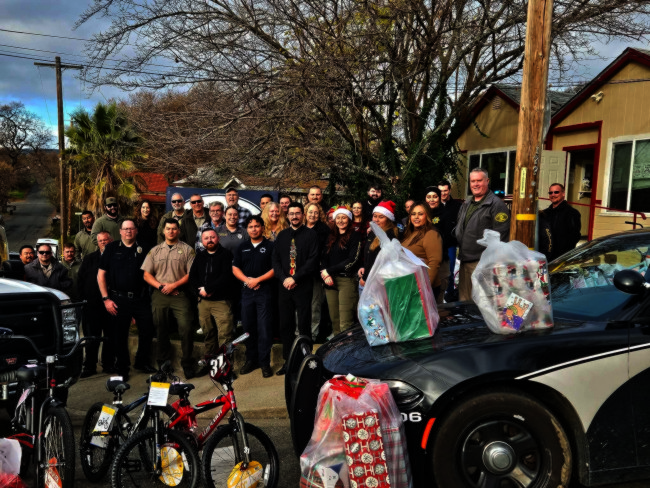
The Lake County District Attorney’s Office Victim/Witness Division and its partners gathered to bring Christmas to children who have suffered trauma. Courtesy photo.


LAKE COUNTY, Calif. — This Christmas, several county agencies have once again partnered with churches, schools and other organizations to bring Christmas to children in need.

Every year, the Lake County District Attorney’s Office Victim/Witness Division assists over 1,000 people through their traumatic experiences, and many of them are
children.

It has been a long-standing tradition during Christmas, where the Victim/Witness Division teams up with local organizations and law enforcement agencies around the lake to spread holiday cheer.

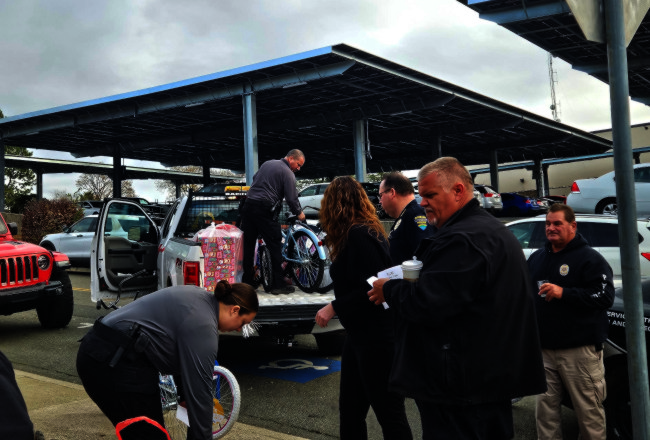
The local organizations supply all the gifts, and the law enforcement agencies deliver the gifts to bring a brighter Christmas to the children that have experienced trauma. 

The agencies and organizations collected Christmas gifts, including bicycles. Courtesy photo.


This year, they delivered presents to 92 children in our community, and they said they could not have done it without the assistance and generosity of several people and organizations.

Those who assisted the effort include the Guy Fieri Foundation, Pastor Rick Barnes, Pastor David Moon-Wainwright, Lake County Bible Fellowship, United Christian Parish, Rotary Club of Lakeport, Galilee Lutheran Church, Konocti Christian Academy, Lake County Auditor’s Office and the Lake County Assessor-Recorder’s Office.

The Victim/Witness Division offered huge thanks to the law enforcement partners who every year assist them in delivering all the gifts.

Those partners include the Clearlake Police Department, Lake County Sheriff’s Office, Lakeport Police Department and Lake County Probation.

Law enforcement agencies delivered the gifts to the families. Courtesy photo.

Continuing atmospheric river storm forecast leads to flood watch for Lake County            

LAKE COUNTY, Calif. — After a Friday of steady rain and with an atmospheric river storm incoming, Lake County is set to go under a flood watch through the weekend.

The National Weather Service has issued a flood watch that will be in effect from 4 p.m. Saturday through 4 p.m. Monday.

The forecast says a Pacific storm track is bringing an atmospheric river that will move into Mendocino and Lake counties starting Saturday afternoon and continuing into Monday.

That storm track could potentially bring more heavy rainfall and strong southerly winds through much of next week, the National Weather Service reported.

The National Weather Service’s Eureka office said 3 to 5 inches of rain could fall during the duration of the flood watch.

That raises concerns for rising creeks and drainages, as well as rock and mudslides along roads and highways.

Besides heavy rain, the flood watch said there is the possibility that by early next week, snow levels could fall to as low as 3,500 to 4,500 feet.

The Lake County forecast expects rain through next Friday, with no break for Christmas.

Temperatures over the coming week are forecast to be in the low 50s during the day and the low 40s at night. 

Winds with gusts of more than 20 miles per hour are also in the forecast through the weekend.

Email Elizabeth Larson at This email address is being protected from spambots. You need JavaScript enabled to view it.. Follow her on Twitter, @ERLarson, and on Bluesky, @erlarson.bsky.social. Find Lake County News on the following platforms: Facebook, @LakeCoNews; X, @LakeCoNews; Threads, @lakeconews, and on Bluesky, @lakeconews.bsky.social. 

Where the wild things thrive: Finding and protecting nature’s climate change safe havens

Much wildlife relies on cool streams and lush meadows in the Sierra Nevada. Ron and Patty Thomas/E+ via Getty Images

The idea began in California’s Sierra Nevada, a towering spine of rock and ice where rising temperatures and the decline of snowpack are transforming ecosystems, sometimes with catastrophic consequences for wildlife.

The prairie-doglike Belding’s ground squirrel (Urocitellus beldingi) had been struggling there as the mountain meadows it relies on dry out in years with less snowmelt and more unpredictable weather. At lower elevations, the foothill yellow-legged frog (Rana boylii) was also being hit hard by rising temperatures, because it needs cool, shaded streams to breed and survive.

A ground squirrel with a skinny tail sits up on its back legs.
A Belding’s ground squirrel in the Sierra Nevada. Toni Lyn Morelli

As we studied these and other species in the Sierra Nevada, we discovered a ray of hope: The effects of warming weren’t uniform.

We were able to locate meadows that are less vulnerable to climate change, where the squirrels would have a better chance of thriving. We also identified streams that would stay cool for the frogs even as the climate heats up. Some are shaded by tree canopy. Others are in valleys with cool air or near deep lakes or springs.

These special areas are what we call climate change refugia.

Identifying these pockets of resilient habitat – a field of research that was inspired by our work with natural resource managers in the Sierra Nevada – is now helping national parks and other public and private land managers to take action to protect these refugia from other threats, including fighting invasive species and pollution and connecting landscapes, giving threatened species their best chance for survival in a changing climate.

An illustration shows protected lakes and glaciers and shaded streams
Examples of climate change refugia. Toni Lyn Morelli, et al., 2016, PLoS ONE, CC BY

Across the world, from the increasingly fire-prone landscapes of Australia to the glacial ecosystems at the southern tip of Chile, researchers, managers and local communities are working together to find and protect similar climate change refugia that can provide pockets of stability for local species as the planet warms.

A new collection of scientific papers examines some of the most promising examples of climate change refugia conservation. In that collection, over 100 scientists from four continents explain how frogs, trees, ducks and lions stand to benefit when refugia in their habitats are identified and safeguarded.

People walk along a mountain ridge with a glacier in the background.
Chile has been rapidly losing its glaciers as global temperatures rise. Humans and wildlife depend on them for water. Joaquin Fernandez

Saving songbirds in New England

The study of climate change refugia – places that are buffered from the worst effects of global warming – has grown rapidly in recent years.

In New England, managers at national parks and other protected areas were worried about how species are being affected by changes in climate and habitat. For example, the grasshopper sparrow (Ammodramus savannarum), a little grassland songbird that nests in the open fields in the eastern U.S. and southern Canada, appears to be in trouble.

We studied its habitats and projected that less than 6% of its summer northeastern U.S. range will have the right temperature and precipitation conditions by 2080.

The grasshopper sparrow. American Bird Conservancy

The loss of songbirds is not only a loss of beauty and music. These birds eat insects and are important to the balance of the ecosystem.

The sand plain grasslands that the grasshopper sparrow relies on in the northeastern U.S. are under threat not only from changes in climate but also changes in how people use the land. Public land managers in Montague, Massachusetts, have used burning and mowing to maintain habitat for nesting grasshopper sparrows. That effort also brought back the rare frosted elfin butterfly for the first time in decades.

Protecting Canada’s vast forest ecosystems

In Canada, the climate is warming at about twice the global average, posing a threat to its vast forested landscapes, which face intensifying drought, insect outbreaks and destructive wildfires.

We have been actively mapping refugia in British Columbia, looking for shadier, wetter or more sheltered places that naturally resist the worst effects of climate change.

A young moose and an adult moose run through a meadow.
Forests and wetlands used by moose and other wildlife are becoming more vulnerable to climate change as temperatures rise. Alexej Sirén, Northeast Wildlife Monitoring Network

The mapping project will help to identify important habitat for wildlife such as moose and caribou. Knowing where these climate change refugia are allows land-use planners and Indigenous communities to protect the most promising habitats from development, resource extraction and other stressors.

British Columbia is undertaking major changes to forest landscape planning in partnership with First Nations and communities.

Lions, giraffes and elephants (oh, my!)

On the sweeping vistas of East Africa, dozens of species interact in hot spots of global biodiversity. Unfortunately, rising temperatures, prolonged drought and shifting seasons are threatening their very existence.

In Tanzania, working with government agencies and conservation groups through past USAID funding, we mapped potential refugia for iconic savanna species including lions, giraffes and elephants. These areas include places that will hold water in drought and remain cooler during heat waves. The iconic Serengeti National Park, home to some of the world’s most famous wildlife, emerged as a key location for climate change refugia.

Giraffe wander among trees with a mountain in the distance.
In East Africa, climate change refugia remain cooler and hold water during droughts. Protecting them can help protect the region’s iconic wildlife. Toni Lyn Morelli

Combining local knowledge with spatial analysis is helping prioritize areas where big cats, antelope, elephants and the other great beasts of the Serengeti ecosystem can continue to thrive – provided other, nonclimate threats such as habitat loss and overharvesting are kept at bay.

The Tanzanian government has already been working with U.S.-funded partners to identify corridors that can help connect biodiversity hot spots.

Hope for the future

By identifying and protecting the places where species can survive the longest, we can buy crucial decades for ecosystems while conservation efforts are underway and the world takes steps to slow climate change.

Across continents and climates, the message is the same: Amid our rapidly warming world, pockets of resilience remain for now. With careful science and strong partnerships, we can find climate change refugia, protect them and help the wild things continue to thrive.The Conversation

Toni Lyn Morelli, Adjunct Full Professor of Environmental Conservation, UMass Amherst; U.S. Geological Survey and Diana Stralberg, Adjunct professor, Department of Renewable Resources, University of Alberta

This article is republished from The Conversation under a Creative Commons license. Read the original article.

  • 80
  • 81
  • 82
  • 83
  • 84
  • 85
  • 86
  • 87
  • 88
  • 89

Community

  • Sheriff’s Activities League and Clearlake Bassmasters offer youth fishing clinic

  • City Nature Challenge takes place April 24 to 27

Public Safety

  • Lakeport Police logs: Wednesday, Feb. 11

  • Lakeport Police logs: Tuesday, Feb. 10

Education

  • Ramos measure requiring school officer training in use of anti-opioid drug moves forward

  • Lake County Chapter of CWA announces annual scholarships 

Health

  • California ranks 24th in America’s Health Rankings Annual Report from United Health Foundation

  • Healthy blood donors especially vital during active flu season

Business

  • Employment law summit takes place March 9

  • Two Lake County Mediacom employees earn company’s top service awards

Obituaries

  • Terry Knight

  • Ellen Thomas

Opinion & Letters

  • Who should pay for AI’s power? Not California ratepayers

  • Crandell: Supporting nephew for reelection in supervisorial race

Veterans

  • State honors fallen chief warrant officer killed in conflict in Iran

  • CalVet and CSU Long Beach team up to improve data collection related to veteran suicides

Recreation

  • April Audubon program will show how volunteers can help monitor local osprey nests

  • First guided nature walk of spring at Anderson Marsh State Historic Park April 11

  • Second Saturday guided nature walks continue at Anderson Marsh State Historic Park

  • Wet weather trail closure in effect on Upper Lake Ranger District

Religion

  • Kelseyville Presbyterian Church plans Easter service

  • Easter ‘Sonrise’ Service returns to Xabatin Community Park

Arts & Life

  • ‘CIA’ delves into the shadowy world of an espionage thriller

  • ‘War Machine’ shifts the battlefield into uncharted territory

Government & Politics

  • Lake County Democratic Central Committee endorses Falkenberg

  • Crandell launches reelection campaign plans March 15 event

Legals

  • April 23 hearing on Lake Coco Farms Major Use Permit

  • NOTICE OF 30-DAY PUBLIC COMMENT PERIOD & NOTICE OF PUBLIC HEARING

How to resolve AdBlock issue?

Refresh this page