How to resolve AdBlock issue?
Refresh this page
Lake County News,California
  • Home
    • Registration Form
  • News
    • Education
    • Veterans
    • Community
      • Obituaries
      • Letters
      • Commentary
    • Police Logs
    • Business
    • Recreation
    • Health
    • Religion
    • Legals
    • Arts & Life
    • Regional
  • Calendar
  • Contact us
    • FAQs
    • Phones, E-Mail
    • Subscribe
  • Advertise Here
  • Login
How to resolve AdBlock issue?
Refresh this page

News

Powerful solar storm gives Lake County an aurora show

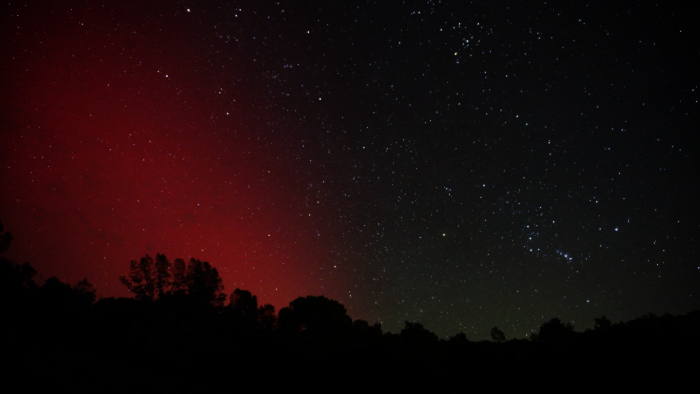
Red and green auroras, with the constellation Orion to the right, seen from Lucerne, California, on Tuesday, Nov. 11, 2025. Photo by Elizabeth Larson/Lake County News.


LAKE COUNTY, Calif. — Veterans Day ended with a spectacular solar storm that brought the aurora borealis to areas across the United States — including Lake County — that don’t normally get to see the northern lights.

In Lake County, a camera was needed to fully capture the display, with residents posting pictures of the auroras on social media.

The California Aurora Chasers Facebook page features pictures from around the state capturing the phenomenon.

The most common color was red, which is due to oxygen at altitudes above 150 miles, along with green, between 50 and 150 miles high. 

Shawn Dahl of the NOAA Space Weather Prediction Center in Boulder, Colorado, said in a Tuesday night video that a geomagnetic storm had resulted in the auroras.

By that point, Dahl said there already had been two of three anticipated coronal mass ejections, which were stronger than anticipated.

Those two storms, on the geomagnetic storm scale of G1 to G5,  were rated at the G4 level, which is ranked as “severe,” while the watches issued had been between G2, or moderate, and G3, which is strong.

A third and potentially stronger coronal mass is expected to occur beginning around midway on Wednesday. 

The third storm was traveling significantly faster than the previous two, and Dahl said they think it will “pack even a stronger punch than what we’ve already experienced.”

He said there are slight chances of a storm that could be a G5, which on the geomagnetic storm scale is ranked as “severe.”

Dahl said such geomagnetic storms are variable and dynamic. 

On the everyday level, the storm could impact GPS systems. 

As for potentially larger issues the storms could cause, NOAA also is talking to government officials about space launches and possible impacts to the power grid, Dahl said.

Lake County and other parts of the nation that don’t usually get to see the northern lights previously experienced an aurora show in May of 2024.

To get the latest aurora forecasts, visit NOAA’s Space Weather Prediction Center aurora forecast page.

Email Elizabeth Larson at This email address is being protected from spambots. You need JavaScript enabled to view it.. Follow her on Twitter, @ERLarson, and on Bluesky, @erlarson.bsky.social. Find Lake County News on the following platforms: Facebook, @LakeCoNews; X, @LakeCoNews; Threads, @lakeconews, and on Bluesky, @lakeconews.bsky.social. 

Middletown Area Town Hall to meet Nov. 13

MIDDLETOWN, Calif. — The Middletown Area Town Hall, or MATH, will meet this week to discuss community projects and board nominations.

MATH will meet at 7 p.m. Thursday, Nov. 13, in the Middletown Community Meeting Room/Library at 21256 Washington St., Middletown. The meeting is open to the public.

Zoom will not be available. Viewers can participate via PEG TV at www.youtube.com/LakeCountyPegTV.  

On the agenda is a presentation on the Lake County Zero-Emission Vehicle Plan, led by Alexandra Haag, a transportation engineer and planner with the Lake Area Planning Council. There also will be a question and answer session, and community input on potential locations for chargers.

District 1 Supervisor Helen Owen also is on the agenda to offer an update on community and county projects.

There also will be a beginning discussion on the naming of the library park and nominations for board seats will continue.

MATH — established by resolution of the Lake County Board of Supervisors on Dec. 12, 2006 — is a municipal advisory council serving the residents of Anderson Springs, Cobb, Coyote Valley (including Hidden Valley Lake), Long Valley and Middletown.

For more information email This email address is being protected from spambots. You need JavaScript enabled to view it.. 

Email Elizabeth Larson at This email address is being protected from spambots. You need JavaScript enabled to view it.. Follow her on Twitter, @ERLarson, and on Bluesky, @erlarson.bsky.social. Find Lake County News on the following platforms: Facebook, @LakeCoNews; X, @LakeCoNews; Threads, @lakeconews, and on Bluesky, @lakeconews.bsky.social. 

How nursing home residents got caught in the opioid backlash

Since the height of the opioid epidemic, doctors have been prescribing fewer of these medications. 

A new study from UC San Francisco shows this trend extends to nursing home residents who may need opioids to manage chronic pain.

Analyzing data on nearly 3 million U.S. nursing home residents between 2011 and 2022, researchers found the probability of receiving an opioid declined across the board, even for nursing home residents with severe chronic pain.

The study, which uses data from the Centers for Medicare & Medicaid Services (CMS), is the first to examine opioid prescribing trends in nursing homes and to examine these trends by race, ethnicity, and pain level. It appears Nov. 3 in JAMA Internal Medicine.

In 2016, the Centers for Disease Control and Prevention, or CDC, released opioid guidelines designed to reduce overprescribing in outpatient care. Yet this seems to have unintentionally shifted prescribing practices in other settings.

“Older adults in nursing homes really shouldn’t be as impacted by the CDC opioid guidelines,” said the paper’s first author, Ulrike Muench, PhD, associate professor in the Department of Social and Behavioral Sciences in the UCSF School of Nursing. “The prevalence of chronic pain in nursing homes is high because of the multiple medical issues that often accompany older age, and these residents are not the ones most at risk for misusing these medications.”

The chances of nursing home residents receiving any type of opioid dropped from 48% to 33.5%, but the researchers found the reduction was not felt equally. Black, Hispanic, Asian, and American Indian or Alaska Native residents were consistently less likely than white residents to receive opioids. They also were less likely to receive higher doses of opioids, no matter their level of pain.

While the authors emphasized the importance of minimizing unnecessary opioid use, they noted that pain care is essential to healthy aging and maintaining quality of life.

“It really surprised us that even when people reported having very severe chronic pain, white nursing home residents were more likely to receive opioids — and receive them at higher doses than residents from other racial and ethnic groups,” Muench said.

Authors: Other UCSF authors include, Matthew Jura, PhD, Krista L. Harrison, PhD, Alexander K. Smith, MD, MPH, Kenneth Covinsky, MD, MPH, and Lauren J. Hunt, PhD, RN.

Funding: The study was funded by grant (3P01 AG066605-03S1) from the National Institute on Aging.

Victoria Colliver writes for UC San Francisco.

Blame the shutdown on citizens who prefer politicians to vanquish their opponents rather than to work for the common good

Who is really responsible for the longest government shutdown in history? iStock/Getty Images Plus

The United States was founded on the idea that government exists to serve its people. To do this, government must deliver services that promote the common good. When the government shuts down, it fails to meet its fundamental purpose.

While government shutdowns are not new in the U.S., most have lasted less than a week. At 40 days, the current shutdown may well be on the way to an end this week, as enough Senate Democratic caucus members have voted with Republicans on a measure to reopen the government. But it will remain the longest in the history of the nation.

When the government shuts down for such a long time, it inflicts hardships, anxieties and irritations on its citizens. You might wonder why elected officials allow lengthy disruptions to happen.

It is common to blame the politicians for the shutdown. However, as a philosopher who researches democracy, I think the fault lies also with us, the citizens. In a democracy, we generally get the politics we ask for, and the electorate has developed a taste for political spectacle over competent leadership.

American democracy has grown increasingly tribal, leading us to become more invested in punishing our partisan rivals than in demanding competent government. We are infatuated with the spectacle of our side dominating the other.

Understandably, politicians have embraced obstruction. They have learned that deadlock can pay, because they have the support of their voters in behaving this way. Politics is no longer about representation and policy, it’s now about vanquishing and even humiliating the other side.

Three women and two men on a stage with American flags flanking them, and one of them speaking at a lectern.
U.S. Sen. Maggie Hassan speaks at a press conference with other Senate Democratic caucus members who voted to restore government funding, in Washington, D.C., on Nov. 9, 2025. Nathan Posner/Anadolu via Getty Images

More fervent, not better informed

To see this, we must examine polarization. Let’s start by distinguishing two kinds of polarization.

First is political polarization. It measures the divide between the U.S.’s two major parties. When political polarization is severe, the common ground among the parties falls away. This naturally undermines cooperation. That Republicans and Democrats are politically polarized is certainly part of the explanation for the shutdown.

But that’s not the entire story. As I argue in my book “Civic Solitude,” the deeper trouble has to do with belief polarization.

Unlike political polarization, which measures the distance between opposing groups, belief polarization occurs within a single group. In belief polarization, like-minded people transform into more extreme version of themselves: Liberals become more liberal, conservatives become more conservative, Second Amendment advocates become more pro-gun, environmentalists become more green, and so on.

Importantly, this shift is driven by the desire to fit in with one’s peers, not by evidence or reason. Hence, we become more fervent but no better informed.

Additionally, our more extreme selves are also more tribal and conformist. As we shift, we become more antagonistic toward outsiders. We also become more insistent on uniformity within our group, less tolerant of differences.

Animosity and obstruction

The combination of intensifying antagonism toward those on the “other side” and escalating cohesion among those on “your side” turns all aspects of life into politics.

In the U.S. today, liberals and conservatives are heavily socially segregated. They live in different neighborhoods, work in different professions, vacation in different locations, drive different vehicles and shop in different stores. Everyday behavior has become an extension of partisan affiliation.

Ironically, as everyday life becomes politically saturated, politics itself becomes more about lifestyle and less about policy. Research suggests that while animosity across the parties has intensified significantly, citizens’ disagreements over policy have either remained stable or eased. We dislike one another more intensely yet are not more divided.

This paints a grim portrait of U.S. democracy. Note that this condition incentivizes politicians to amplify their contempt for political rivals. Politicians seek to win elections, and stoking negative feelings such as fear and indignation are potent triggers of political behavior, including voting.

Consequently, when citizens are belief-polarized, animosity and obstruction become winning electoral strategies. Meanwhile, politicians are released from the task of serving the common good.

A group of people standing behind a man who's standing at a lectern, behind a sign that says 'The DEMOCRAT SHUTDOWN.'
U.S. Speaker of the House Mike Johnson speaks during a news conference with House Republican leadership at the U.S. Capitol on Nov. 6, 2025. Saul Loeb/AFP via Getty Images

Channeling contempt

It is no surprise that discussions of the shutdown have consistently focused on blame.

The Republicans, who hold the congressional majority, have sought to score points by depicting the shutdown as the Democrats’ fault. Several official websites maintained by the federal government included statements denouncing the shutdown as strictly the doing of the Democrats. Their aim has been to channel citizens’ frustration into contempt for the Democratic Party.

At the beginning of the shutdown, House Speaker Mike Johnson claimed that there was “literally nothing to negotiate” with congressional Democrats.

But there’s the rub. Democratic government is fundamentally a matter of negotiation. Neither winning an election nor being a member of the majority party means that you can simply call the shots. The constitutional procedures by which our representatives govern are designed to force cooperation, collaboration and compromise.

Thanks to polarization, however, these noble ideals of political give-and-take have dissolved. Cooperation is now seen as surrender to political enemies. That’s very clear in many Democrats’ outraged reactions to the eight senators from their caucus who have now voted with Republicans to end the shutdown.

Meanwhile, more than 1 million government employees haven’t been paid, many crucial government services have been interrupted, diminished or suspended, and, with the Thanksgiving holiday approaching, travelers are experiencing flight disruptions. While there may be an end to the shutdown on the near horizon, any deal could simply postpone crucial policy debates and could well end in another shutdown in the new year.

The key to avoiding this kind of failure is to become a citizenry that demands competent government over partisan domination.The Conversation

Robert B. Talisse, W. Alton Jones Professor of Philosophy, Vanderbilt University

This article is republished from The Conversation under a Creative Commons license. Read the original article.

Lake County Planning Commission to discuss housing element, cannabis projects

LAKEPORT, Calif. — The Lake County Planning Commission has several items of business this week, including the county’s housing element and cannabis projects.

The meeting will begin at 9 a.m. Thursday, Nov. 13, in the board chambers on the first floor of the Lake County Courthouse, 255 N. Forbes St., Lakeport.

The agenda is here.

To participate in real-time, join the Zoom meeting by clicking this link. 

The webinar ID is 994 1760 2765, the pass code is 155982. 

Access the meeting via one tap mobile at +16699006833,,99417602765#,,,,*155982# or dial in at 669-900-6833.

The meeting also can be viewed on the county’s website or Facebook page.

At 9:05 a.m., the commission will hold a public hearing to consider making a recommendation to the Board of Supervisors to adopt an ordinance amending Chapter 21, Articles 11 and 12 of the Lake County Zoning Code to implement General Plan Sixth Cycle Housing Element Policy HE-58. That policy pertains to affordable housing.

At 9:10 a.m., a public hearing is scheduled for the purpose of considering a major use permit application for Wellness Ranch 3, proposed by Luis Martinez. There also is a subsequent negative declaration for approval of 107,120 square feet of outdoor canopy and 8,820 square feet of indoor canopy located at 6751 Ridge Road, Lakeport.

At 9:15 a.m., the commission will hold a public hearing to consider a major user permit and mitigated negative declaration for commercial cannabis cultivation for 19.6 acres of outdoor canopy and a type 13 distributor, self transport only license sought by Rancho Lake LLC at 19955, 19986, 20110 and 22222 Grange Road, Middletown.

A request for a continuance has been submitted for a public hearing, scheduled for 9:20 a.m., regarding adoption of an ordinance to amend Chapter 21, Article 27 of the Lake County Municipal Code for commercial cannabis uses.

Email Elizabeth Larson at This email address is being protected from spambots. You need JavaScript enabled to view it.. Follow her on Twitter, @ERLarson, and on Bluesky, @erlarson.bsky.social. Find Lake County News on the following platforms: Facebook, @LakeCoNews; X, @LakeCoNews; Threads, @lakeconews, and on Bluesky, @lakeconews.bsky.social. 

Police seek missing man 

CLEARLAKE, Calif. — The Clearlake Police Department is attempting to locate a missing man.

Baraquiel Ruiz, 39, was last seen in the area of Lakeshore Drive in Clearlake. 

He is described as a Hispanic male adult, 5 feet 5 inches tall and 160 pounds with black hair, brown eyes. 

Ruiz was last seen wearing a black and white checkered jacket, blue ripped jeans and black shoes.

If you have any information regarding his whereabouts please contact the Clearlake Police Department at 707-994-8251, Extension 1 for dispatch.

  • 107
  • 108
  • 109
  • 110
  • 111
  • 112
  • 113
  • 114
  • 115
  • 116

Community

  • Sheriff’s Activities League and Clearlake Bassmasters offer youth fishing clinic

  • City Nature Challenge takes place April 24 to 27

Public Safety

  • Lakeport Police logs: Wednesday, Feb. 11

  • Lakeport Police logs: Tuesday, Feb. 10

Education

  • Ramos measure requiring school officer training in use of anti-opioid drug moves forward

  • Lake County Chapter of CWA announces annual scholarships 

Health

  • California ranks 24th in America’s Health Rankings Annual Report from United Health Foundation

  • Healthy blood donors especially vital during active flu season

Business

  • Employment law summit takes place March 9

  • Two Lake County Mediacom employees earn company’s top service awards

Obituaries

  • Terry Knight

  • Ellen Thomas

Opinion & Letters

  • Who should pay for AI’s power? Not California ratepayers

  • Crandell: Supporting nephew for reelection in supervisorial race

Veterans

  • State honors fallen chief warrant officer killed in conflict in Iran

  • CalVet and CSU Long Beach team up to improve data collection related to veteran suicides

Recreation

  • April Audubon program will show how volunteers can help monitor local osprey nests

  • First guided nature walk of spring at Anderson Marsh State Historic Park April 11

  • Second Saturday guided nature walks continue at Anderson Marsh State Historic Park

  • Wet weather trail closure in effect on Upper Lake Ranger District

Religion

  • Kelseyville Presbyterian Church plans Easter service

  • Easter ‘Sonrise’ Service returns to Xabatin Community Park

Arts & Life

  • ‘CIA’ delves into the shadowy world of an espionage thriller

  • ‘War Machine’ shifts the battlefield into uncharted territory

Government & Politics

  • Lake County Democratic Central Committee endorses Falkenberg

  • Crandell launches reelection campaign plans March 15 event

Legals

  • April 23 hearing on Lake Coco Farms Major Use Permit

  • NOTICE OF 30-DAY PUBLIC COMMENT PERIOD & NOTICE OF PUBLIC HEARING

How to resolve AdBlock issue?
Refresh this page