How to resolve AdBlock issue?
Refresh this page
Lake County News,California
  • Home
    • Registration Form
  • News
    • Education
    • Veterans
    • Community
      • Obituaries
      • Letters
      • Commentary
    • Police Logs
    • Business
    • Recreation
    • Health
    • Religion
    • Legals
    • Arts & Life
    • Regional
  • Calendar
  • Contact us
    • FAQs
    • Phones, E-Mail
    • Subscribe
  • Advertise Here
  • Login
How to resolve AdBlock issue?
Refresh this page

News

Applicants sought for Lake County Regional Housing Trust Fund

LAKE COUNTY, Calif. — The Lake County Regional Housing Trust Fund, or LCRHTF, is seeking applicants to fill three vacancies on the Lake Country Regional Housing Trust Fund Board of Trustees. 

The board will include individuals with diverse backgrounds and skills to support the trust’s purpose: “To promote thriving, sustainable communities throughout Lake County, California (including incorporated cities), by providing flexible financing for development and preservation of housing that serves a range of income levels and fosters environmental responsibility, economic growth, and a high quality of life for all residents, while preserving the rural characteristics of Lake County.”

Preference for these vacancies will be given to those with professional expertise in fields such as real estate related fields, banking, finance, tribal fields with housing affiliation, architecture, planning, publicly funded housing programs, experience with the Tax Credit Allocation Committee.

Initial review of submitted applications will take place during the Regional Housing Trust Administrative Board’s Wednesday, Dec. 3, meeting.

Please submit your application no later than the end of the day on Monday, Dec. 1.

Download the application here.

The purpose of the Board of Trustees is to act as the Lake County Regional Housing Trust Fund’s loan committee. 

This board will confer and make recommendations to the administrative board concerning loan policies and procedures and individual loan applications.

Interested parties must be able to commit to a two-year term. 

Further information is accessible at https://www.lakecountyca.gov/1893/Housing. 

What to know as hundreds of flights are grounded across the US – an air travel expert explains

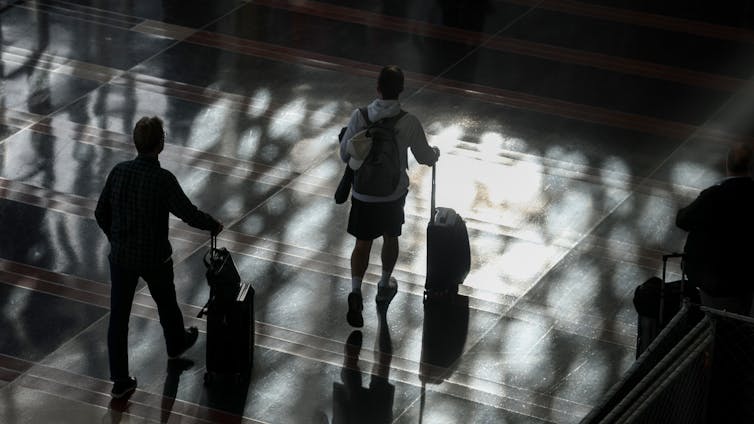
Passengers walk through the Ronald Reagan Washington National Airport on Nov. 7, 2025. Anna Moneymaker/Getty Images

Major airports across the United States were subject to a 4% reduction in flights on Nov. 7, 2025, as the government shutdown began to affect travelers.

The move by the Federal Aviation Administration is intended to ease pressure on air traffic controllers, many of whom have been working for weeks without pay after the government shut down on Oct. 1. While nonessential employees were furloughed, workers deemed essential, such as air traffic controllers, have continued to do their jobs.

But what does that mean for the many Americans who take to the skies every day? To find out, The Conversation U.S. spoke with Laurie A. Garrow, a civil aviation expert at Georgia Tech.

What do we know about the FAA’s plans so far?

The first thing to note is that things can change fast. But as of this morning, 4% of flights are being canceled across 40 “high-volume” airports. The list is publicly available, but it includes most of the big hubs across the United States, such as Atlanta, New York’s airports, Chicago O'Hare, Los Angeles International and Dallas/Fort Worth.

The plan is to ramp this up to 10% by Nov. 14 should the shutdown extend that long.

The FAA, the U.S. Department of Transportation and the airlines are working together on the details of which flights and routes are affected – and this will no doubt be monitored as the days go on.

But they are trying to make the cancellations in a way that cause the least disruption to customers.

So we are looking at cuts to domestic, not international, flights – flights across the Atlantic, Pacific and to Latin America are not, for now at least, subject to cuts.

The 4% of cancellations we are seeing are really targeting the high-frequency routes. This should help mitigate the impact. For example, typically American Airlines flies nine flights a day from Miami to Orlando, but they are planning to fly eight this weekend.

And carriers are looking at reducing regional flights. For example, my mom lives near Erie, Pennsylvania, where American Airlines flies three daily flights to their hub in Charlotte – I would expect that to go down to two, or one.

But the FAA was clear that it wasn’t going to cut flights to markets entirely, just reduce them.

What will this mean for existing flights?

For starters, you are going to see more passengers on them. It is fortunate that we are in the lull before Thanksgiving. This isn’t like the summer. There is more slack in the system – so there are extra seats available. If one flight gets canceled on a busy route, it will at this stage be fairly easy to accommodate on another flight.

And I expect customers will be asked to get to airports a little earlier than they would normally.

But people should expect more delays on existing flights. This is because of the way we maintain safety in the air transportation system. Air traffic control can only safely watch a certain number of flights. So when you have someone not at work, or a reduction in number of controllers, you will need to reduce the number of airplanes in the sky. You can’t ask a controller to watch, say, 20 flights when they usually watch 10. So what you do is put in more ground delay programs to limit the number of aircraft coming into or out of an airport. This causes delays but is necessary in peak periods.

What impact will this have on airlines?

At 4%, probably not too much of an impact. When you look at the list of airports affected, it is balanced from the point of view that many are large hubs and the pain is being shared across all U.S. carriers.

As for the impact on other types of businesses, at the moment it is mainly the industries that air transportation supports. According to the International Air Transport Association, the air transport sector in the U.S. – covering airlines, airports and tourism enabled by aviation –contributes about US$1.3 trillion, or about 4.7%, to GDP and supports about 7.6 million jobs. If these wider sectors are severely affected, it could create a longer-term impact on the economy.

And if this continues into the holiday season?

That is when it will get painful for the carriers. If we are looking at reduction of 10% going into the holiday season with additional delays, then that is when the real pain will be felt.

Will this affect how Americans choose to travel?

Air travel is what I call an emotional mode of transport – we use it for the events that are most significant in our life, such as big family meet-ups, holidays and major face-to-face business deals. So this may affect how people choose to travel going into the holiday season if it is more difficult to get people back to their families in time.

Robert Isom, CEO of American Airlines, said on Nov. 7 that they are seeing an impact on bookings, with people postponing and rescheduling travel.

I certainly think for people looking at a 500- to 600-mile trip, the option of traveling by car is looking more appealing right now.

Will passengers be compensated for canceled flights?

Typically, compensation depends on whether the delay or cancellation was within the airline’s control. The U.S. Department of Transportation has created a dashboard showing “what services U.S. airlines provide to mitigate passenger inconveniences when the cause of a cancellation or delay was due to circumstances within the airline’s control.”

However, delays and cancellations caused by ATC staffing shortages are not considered to be within the airline’s control, and it is up to each airline to decide if and how they will compensate passengers.

As of Nov. 7, many airlines had announced they were allowing customers to change their flights or request a refund without penalty, including nonrefundable fares such as basic economy.

After all, it is in their interest, too, that people continue to fly.

Typically, major carriers offer more services for delayed and canceled flights within their control than low-cost carriers.
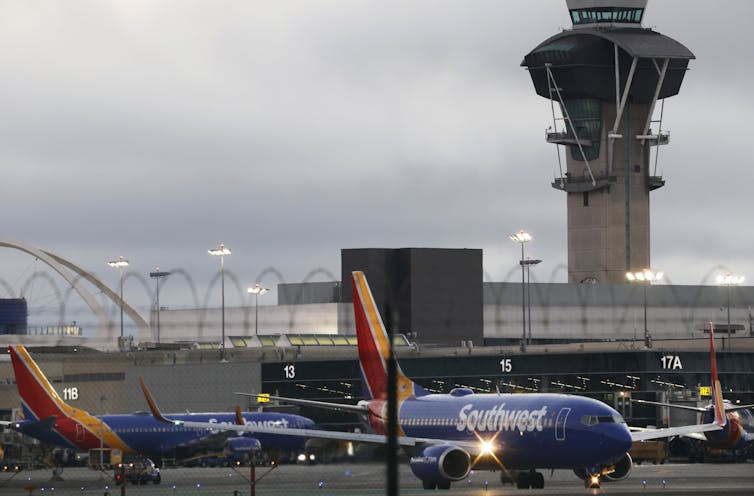
A large building is seen behind a blue plane.
A Southwest Airlines plane taxis in front of the air traffic control tower at Los Angeles International Airport. Mario Tama/Getty Images

Is there any precedent for this? What happened then?

There is no real precedent for what we are seeing: a 4% to 10% reduction across the board due to a government shutdown. But we have seen major disruptions, such as after the Sept. 11, 2001, terrorist attacks and during the pandemic, when COVID-19 ran through flight attendants and pilots before the holidays – that caused flight cancellations and delays.

Historically, when we have seen something like this, we have seen consumer behavior change for a short period. After 9/11, when U.S. travelers had the hassle of increased security, there was a shift to more automobile travel for those 500- to 600-mile journeys.

What advice would you give would-be flyers now?

First off, download the app for the airport and airline carrier so you get up-to-date, reliable information. And if you can book for a day earlier than you normally would for a major event, do so – it provides a buffer in case your flight is delayed or canceled.

And try to avoid connections at all costs. The fewer legs, the fewer things can go wrong.

Also, don’t check bags if you can. There is nothing worse than getting to an airport, finding your flight is canceled, and then having to wait for your luggage to get returned.The Conversation

Laurie A. Garrow, Professor of Civil and Environmental Engineering, Georgia Institute of Technology

This article is republished from The Conversation under a Creative Commons license. Read the original article.

United Veterans Council to host Veterans Day commemoration

LAKE COUNTY, Calif. — Those who served in the military will be honored this week.

The Lake County United Veterans Council will hold its annual Veterans Day event on Tuesday, Nov. 11, at Konocti Vista Casino, 2755 Mission Rancheria Road, Lakeport.

Doors open at 10 a.m. The event begins at 11 a.m.

The Clear Lake High School Band will perform, and there will be local speakers and a three-volley gun salute honoring those who served.

A complimentary lunch and beverages will be provided following the ceremony, while supplies last.

For more information, visit the event’s Facebook page.

Lakeport Planning Commission meets Nov. 12

LAKEPORT, Calif. — The Lakeport Planning Commission will consider applications for residential accessory use in a commercial building and updated signage in the downtown.

The commission will meet at 5:30 p.m. Wednesday, Nov. 12, in the council chambers at Lakeport City Hall, 225 Park St.

The agenda is available here.

To speak on an agenda item, access the meeting remotely here; the meeting ID is 814 1135 4347, pass code is 847985. 

To join by phone, dial 1-669-444-9171; for one tap mobile, +16694449171,,81411354347#,,,,*847985#.

Comments can be submitted by email to This email address is being protected from spambots. You need JavaScript enabled to view it.. To give the city clerk adequate time to print out comments for consideration at the meeting, please submit written comments before 4:30 p.m. on Wednesday, Nov. 12.

On Wednesday, the commission will consider Ronald Love’s application for a use permit to allow a residential accessory use in conjunction with a commercial use at  240 N. Main St.

The building, located in the city’s downtown central business district, currently has tenants, including a real estate company and a barber shop. Love recently obtained a business license for Herbal Innovations, a wholesale and ecommerce business that will be located in the building.

The staff report said the residential conversion will happen at the back of the building , which is not visible from Main Street “and is physically separated from the commercial frontage, ensuring the property’s primary character remains commercial in nature” and consistent with the intent of city code, “which allows residential uses in conjunction with commercial uses subject to a use permit.”

The commission also will discuss an application from Country Air Properties for a freestanding sign. 

The project proposes to replace a portion of an existing freestanding sign to be replaced by an LED sign at 460 S. Main St.

The commission will next meet on Dec. 10.

Email Elizabeth Larson at This email address is being protected from spambots. You need JavaScript enabled to view it.. Follow her on Twitter, @ERLarson, and on Bluesky, @erlarson.bsky.social. Find Lake County News on the following platforms: Facebook, @LakeCoNews; X, @LakeCoNews; Threads, @lakeconews, and on Bluesky, @lakeconews.bsky.social. 

Cal Fire graduates 39 new company officers at Ione, maintaining record training pace

A new class of company officers graduated from the Cal Fire Training Center in Ione, California, on Friday, Nov. 7, 2025. Photo courtesy of Cal Fire.

IONE, Calif. — The California Department of Forestry and Fire Protection, or Cal Fire, on Friday celebrated the graduation of 39 new company officers from the Ione Training Center. 

This ceremony marks the successful completion of the intensive training for Fire Control Class 25-12, preparing the graduates for leadership roles across the state.

Top-level department leadership attended, including Director/Fire Chief Joe Tyler, Chief Deputy Director of Operations Anale Burlew and Cooperative Fire Protection Deputy Director Matthew Sully, alongside numerous Cal Fire Region and Unit Chiefs.

Director/Fire Chief Tyler delivered the keynote address and administered the official oath to the graduating class.

“Today we celebrate the achievement of Fire Control Class 25-12—a result of the commitment and focus these 39 officers maintained throughout their rigorous 10 weeks of training,” said Director/Fire Chief Tyler. “We also recognize the dedicated leadership of our training staff, whose efforts are essential in sustaining this record-setting pace for the future of Cal Fire.”

Setting a new benchmark in training capacity

With the graduation of Fire Control Class 25-12, Cal Fire has now trained over 575 new company officers in 2025. This robust training schedule is on track to surpass the goal of graduating more than 650 company officers by the end of the year, setting a new record for the Cal Fire Training Program.

This expanded capacity was made possible, in part, by the addition of the Atwater Training Center in July 2025 — the department’s fourth training location — which held its inaugural graduation ceremony on Oct. 24.

The critical role of the company officer

The Cal Fire company officer serves as the vital first-line supervisor and tactical field leader. 

Graduates from this standardized academy are now prepared to assume command and management responsibilities, directing the safe and effective deployment of crews and equipment during emergency incidents.

Beyond active emergencies, company officers are essential during non-emergency periods, leading crucial crew training, ensuring station readiness and directing fire prevention efforts such as defensible space inspections and public education initiatives.

Learn more about the Cal Fire Training Center.

Who gets SNAP benefits to buy groceries and what the government pays for the program – in 5 charts

Some 42 million Americans rely on SNAP benefits to put food on the table. Robert Nickelsberg/Getty Images News

The Supplemental Nutrition Assistance Program has helped low-income Americans buy groceries for decades with few disruptions.

But on Nov. 1, 2025, the federal government halted the flow of funds to states to distribute as SNAP benefits. The Trump administration blames this unprecedented disruption on the federal government shutdown, which began a month earlier. Following multiple court orders, federal officials said they plan to distribute at least a portion of the US$8 billion that’s supposed to flow monthly to the states to cover the costs of the program’s benefits. On Nov. 6, another judge ordered the distribution of all SNAP funds that were due in November.

Although the program costs billions, the benefits that families and individuals can receive from it are modest. The most a person living on their own can get is $298 a month, but many people receive far less. The average benefit is an estimated $6.17 daily – which falls below some estimates of the minimum cost of eating a nutritious diet in the United States.

The Conversation U.S. asked Tracy Roof, a political scientist who has researched the history of government nutrition programs, to explain who SNAP helps, how enrollment varies from state to state and what the program costs to run.

How many Americans are enrolled in SNAP?

The number of people getting SNAP benefits soared during the Great Recession, a big downturn that began in December 2007 and had long-lasting effects on the economy.

Because of high unemployment and poverty rates, more people were eligible for SNAP during those years. Many states, eager to bring dollars into their economies from federally funded SNAP benefits, made unprecedented efforts to enroll eligible families. SNAP enrollment peaked in 2013 at roughly 15% of Americans. The number of the program’s participants fell as the economy recovered, but never returned to pre-recession levels because a greater share of eligible families continued to enroll in the program after the economic crisis than before.

When the COVID-19 pandemic upended the U.S. economy in 2020, the number of people with SNAP benefits soared again. President Donald Trump has blamed high enrollment in SNAP on the Biden administration “haphazardly” handing benefits “to anyone for the asking.”

That assertion is misleading. While the Biden White House increased benefits, it did not expand who was eligible for SNAP. In fact, President Joe Biden agreed to apply work requirements and time limits to more SNAP recipients. Moreover, states, not the federal government, are primarily responsible for determining eligibility and enrolling people in SNAP. The number of people who received SNAP benefits during Biden’s presidency never exceeded 43 million – the peak reached in September 2020 during the first Trump administration.

The number of people using SNAP benefits to buy groceries has not fallen substantially because the number of people in poverty and the cost of living, including what Americans pay for food, have both increased since 2020.

How much does the program cost the federal government?

In inflation-adjusted 2024 dollars, spending peaked at $128 billion in 2021 and fell to $100 billion in 2024 – nearing pre-pandemic levels.

The program’s spending had previously increased significantly during the Great Recession because SNAP enrollment rose and benefits were temporarily increased. Spending declined as the economy gradually recovered.

While the number of people on SNAP during the pandemic and its aftermath never reached the peak of the Great Recession, the level of spending did reach much higher levels. This was because of three steps taken to increase benefits by more sizable amounts than during the Great Recession.

  1. The Families First Act, which Trump signed into law in March 2020, offered “emergency allotments” that increased monthly benefits for many households receiving SNAP. Biden extended emergency benefits to all households enrolled in the program in April 2021, driving spending even higher. Budget legislation that Congress passed in December 2022 ended the emergency benefits in February 2023.

  2. Biden signed two pieces of legislation in 2021 that temporarily increased the maximum SNAP benefit by 15% through September 2021 – the height of the pandemic’s effects on the economy.

  3. The Biden administration adjusted the basis for calculating monthly benefits in October 2021, just as the temporary increase was expiring. That change permanently increased benefits.

Most households getting SNAP benefits include children and older people

Nearly 60% of Americans enrolled in SNAP are either children under 18 or adults who are 60 or older.

About 1 in 5 non-elderly adults with SNAP benefits have a disability.

Less than 10% of all the people receiving SNAP benefits are able-bodied adults without children who are between the ages of 19 and 49.

Around 55% of all families with children that receive SNAP benefits include at least one employed adult.

Enrollment ranges widely from state to state

In some states, 1 in 5 people receive SNAP benefits. In others, it’s 1 in 20.

The share of a state’s population getting SNAP is determined both by its poverty rate and its policies. Those policies can affect who is eligible and the share of eligible families and individuals who enroll in the program.

Of the 10 states with the highest percentage of people on SNAP, five are also in the top 10 for the percentage of the population in poverty: New Mexico, Louisiana, Oklahoma, West Virginia and Nevada.

According to 2022 data, nine of those 10 states have enrolled nearly all families who are eligible for SNAP benefits: New Mexico, Louisiana, Oregon, Oklahoma, West Virginia, Massachusetts, Nevada, Pennsylvania and Illinois.

States vary widely in terms of the percentage of eligible families who obtain SNAP benefits. In the bottom quarter of states, fewer than 81% of eligible residents in 2022 were getting benefits. The percentage in Arkansas was the lowest: 59%.

States with the highest enrollment numbers tend to make it easier for their residents to get SNAP benefits by minimizing red tape and engaging in more outreach to eligible families. They also adopt policies that allow some people to qualify for SNAP at higher incomes or with more assets.

Americans of all races and ethnic backgrounds rely on SNAP

A little over 35% of people who get SNAP benefits are white, more than any other racial or ethnic group. Around 26% are Black and 16% are Hispanic.

Although more white people are enrolled in SNAP, Census data shows that greater percentages of Black and Hispanic people get these benefits: 24.4% of Black people and 17.2% of Hispanic people compared with 9.7% of white people. This is because these groups are disproportionately poor.

Undocumented immigrants are not eligible for SNAP. Only 4.4% of SNAP recipients in the 2023 fiscal year were immigrants who were not citizens but legally present in the U.S., such as refugees.

The “big” tax-and-spending package Trump signed into law on July 4, 2025, however, ended SNAP eligibility for most of those immigrants.

The Conversation

Tracy Roof, Associate Professor of Political Science, University of Richmond

This article is republished from The Conversation under a Creative Commons license. Read the original article.

  • 108
  • 109
  • 110
  • 111
  • 112
  • 113
  • 114
  • 115
  • 116
  • 117

Community

  • Sheriff’s Activities League and Clearlake Bassmasters offer youth fishing clinic

  • City Nature Challenge takes place April 24 to 27

Public Safety

  • Lakeport Police logs: Wednesday, Feb. 11

  • Lakeport Police logs: Tuesday, Feb. 10

Education

  • Ramos measure requiring school officer training in use of anti-opioid drug moves forward

  • Lake County Chapter of CWA announces annual scholarships 

Health

  • California ranks 24th in America’s Health Rankings Annual Report from United Health Foundation

  • Healthy blood donors especially vital during active flu season

Business

  • Employment law summit takes place March 9

  • Two Lake County Mediacom employees earn company’s top service awards

Obituaries

  • Terry Knight

  • Ellen Thomas

Opinion & Letters

  • Who should pay for AI’s power? Not California ratepayers

  • Crandell: Supporting nephew for reelection in supervisorial race

Veterans

  • State honors fallen chief warrant officer killed in conflict in Iran

  • CalVet and CSU Long Beach team up to improve data collection related to veteran suicides

Recreation

  • April Audubon program will show how volunteers can help monitor local osprey nests

  • First guided nature walk of spring at Anderson Marsh State Historic Park April 11

  • Second Saturday guided nature walks continue at Anderson Marsh State Historic Park

  • Wet weather trail closure in effect on Upper Lake Ranger District

Religion

  • Kelseyville Presbyterian Church plans Easter service

  • Easter ‘Sonrise’ Service returns to Xabatin Community Park

Arts & Life

  • ‘CIA’ delves into the shadowy world of an espionage thriller

  • ‘War Machine’ shifts the battlefield into uncharted territory

Government & Politics

  • Lake County Democratic Central Committee endorses Falkenberg

  • Crandell launches reelection campaign plans March 15 event

Legals

  • April 23 hearing on Lake Coco Farms Major Use Permit

  • NOTICE OF 30-DAY PUBLIC COMMENT PERIOD & NOTICE OF PUBLIC HEARING

How to resolve AdBlock issue?
Refresh this page