 How to resolve AdBlock issue?
Opinion
- Details
- Written by: Phil Murphy
In reality, no one should be shocked that Obama's primary spiritual advisor suggested that some of the inequities between whites and blacks in this country were damnable sins and that 9-11 was a result of American foreign policy gone wrong, because the facts fully support him. Bin Laden has stated that 9-11 was retaliation for America killing Palestinians and Iraqis by the hundreds of thousands, and no sane person can argue that the playing field between blacks and whites in America has been fully leveled and the past put completely behind us.
But forget for a minute that preacher Wright was correct and think back just a few short years to when the last Nixon tapes were released. American icon Rev. Billy Graham was heard on the recordings urging Nixon to bomb the dikes and dams of North Vietnam in order to win the war, a plan which Nixon reckoned would kill a million civilians.
Graham went on to complain that the country was going down the drain due to the Jewish "stranglehold" on the media, and even blamed the "Satanic" Jews for pornography! Graham backed the war to the end, and never offered an explanation as to why a man of God would advocate for the mass-murder of innocents or why he secretly hated Jews, and yet he's still revered by many.
So the new standard is that if you say Palestinians should get a fair shake you're an anti-Semite, but if you blame Jews for virtually every societal evil under the sun you're not – got it? Such is the logic in the right wing radio/FOX News echo chamber and the Clinton campaign, which has dragged much of the public along for the ride as well. This time the double standard is likely more a product of desperation than racism, because the Republicans and Clintons know that Obama is poised to trounce them both, and the time for little lies had passed.
If courage wasn't in such short supply in the Democratic Party the party heavy-hitters like Al Gore and John Edwards would have stepped in and told Hillary to go home, or at least would have told Bill to tell Hillary that it was time to call it quits for the sake of the party's obvious choice.
Or we'd have Hillary super delegates like Mike Thompson realize that many Californians voted weeks before the election when Obama was still a long shot, and now with his momentum and exposure many Hillary voters would change their vote to Obama, along with Edwards and Kucinich voters.
If Thompson wasn't thinking more about his own future than the country's he'd have realized his district will see a strong Nader effort if Hillary is the nominee, and the Republicans will be revitalized as well. Obama will have the opposite effect, but Thompson doesn't have the guts to face the old guard party bosses like Feinstein and tell her he's jumping ship in order to try to stop a convention train wreck.
Hillary can only win by destroying the party, and she seems inclined to do just that, unless she runs out of mud to throw or grownups step in to restore order in the Democratic Party.
But don't hold your breath waiting for common sense to prevail, as we are talking about Rush Limbaugh and the Clintons here, AGAIN!
Phil Murphy lives in Finley.
{mos_sb_discuss:4}
- Details
Tibetans were a people who, before embracing Buddhism, had never been defeated in war ... and they were aggressive, war-like. After becoming primarily Buddhists, they never again waged war on anyone, becoming a nonviolent, peaceful, deeply spiritual people. They became as intensely and effectively committed to the Buddhist concept of overcoming the limits of this world spiritually as they were previously committed to overcoming their enemies.
Then came Mao, and its army ... Nuns were raped, children were forced to shoot and kill their own parents to amuse the Chinese soldiers, Tibet was being "liberated" with bombs, bullets, bayonets and rape, and the world turned its back on the Tibetans who everywhere went to ask for help, believing in the universal decency of human kind, in the Buddhist idea of compassion.
Today, decades of unbearable oppression and gross abuse by China have apparently erased centuries of a nonviolent tradition embodied by the Dalai Lama, and made thousands of Tibetans desperately angry, with nothing to loose but a life they no longer cherish.
Would you have anything left to loose if your nation had been invaded and occupied by a foreign power, your flag had been outlawed, your centuries-old temples and monasteries were destroyed, your sacred manuscripts burned, your spiritual leaders imprisoned, tortured and killed, your culture regarded as inadequate and your traditions and language to be replaced by those of the invader, the young women of your nation sterilized against their will, your natural resources taken, your children indoctrinated, your most sacred places deliberately disfigured and trashed by a blatant disrespect for your culture and your race, and you were made a minority of impoverished, despised, second-class citizens on your own land?
Come to think of it, it might sound familiar to some among you ... next thing you know, after having destroyed Tibetan culture and severely damaged the spirit of Tibetan people, the Chinese will accuse them of lacking self-respect, the way Native Americans are criticized by rednecks and other ignorant and racist bullies on this continent.
Back to Tibet: China has absolutely no business being in Tibet, and cannot in any way justify its aggression, invasion and occupation of a formally sovereign and nonthreatening nation. China cannot legitimize its current and ongoing oppression of Tibetans, and its agendas of cultural genocide and ethnic "assimilation," anymore than it can validate the tyrannical control and oppression of its own citizens.
Wait, what am I saying? I cannot criticize communist China, although Tibetans have less freedom under the Chinese boot than Koreans, Cubans or Venezuelans ... why? Because China is one of the largest trade partners of the US, it is an integral part of the globalization agenda, of the "new world order," and causes finance capitalists and investors to salivate copiously at the prospects of immensely juicy profits, of unprecedented economic growth and unbelievable investment opportunities. It really does not matter that China has already severely polluted 80 percent of its waterways, that it is spewing so much smoke from its coal power plants that in some of its cities it is dark at noon and the sun is no longer seen, that its toxic fumes fall over Canada and will soon come to your neighborhood, and that it tortures and imprisons anyone who objects to its tyrannical communist ideology and its corrupt regional government.
You might have noticed that China has never been part of Bush's "Axis of Evil," and that its communist regime is hardly ever mentioned, even though Americans were trained for decades to fear and hate anything that looked communist or red, even shadows and hallucinations. No, China's communism has become invisible to western eyes and minds.
It is then no surprise that C-SPAN, which along with KQED usually covers events, such as demonstrations against the war in Iraq, no other military-industrial complex-controlled network would touch, is broadcasting the official Chinese version of the current events in Tibet, directly translating from China's propaganda machine, the Chinese Central Television. Of course it does not help that all western journalists have been expelled from Tibet, so as to allow the Chinese militarized police thugs to crack down with unrestrained brutality on Tibetans-meaning shooting civilians, as they have already begun to do a few days ago.
What do Bush, Cheney and the other "freedom-loving," "let's export democracy through shock and awe" neo-con ideologues and their "moderate" spineless Democrat supporters have to say about China? ... Not much. The point is, freedom, in the minds of the finance capitalist elite and the puppet politicians it controls, means "free-market," not free people. As long as nations open up their borders to US "interests" such as trade, commerce and investment, as long as their populations have the "freedom" to consume mass-produced junk, it matters not if they have freedom of speech or if union organizers are tortured to death. As a matter of fact, repressive regimes, whether fascist as in Central America-Columbia comes to mind-or communist as in China, that consider unionists and environmentalists to be enemies of the state, are said to be business-friendly, saving U.S. corporations much money they would otherwise have to pay on living wages and on cleaning up their toxic mess.
Hitler the psychopath himself would have continued to be seen as a viable economic partner and political ally – he was fiercely anti-communist – by America and England if he hadn't attacked western Europe, regardless of how many more millions of human beings he would have kept eliminating in his concentration camps ... he would have been our pal for a long time, like the Shah of Iran or the apartheid regime of South Africa, and like Saddam before he decided to free lance in Saudi Arabia and to nationalize the Iraqi oil industry. The devil himself, if he was real, would be well received by our corporate and banking elite if he was willing to make a deal that would increase their profits.
Back again to China: the globalization agenda today forbids anyone in the mainstream media to criticize China in any realistic and effective manner. China "deals," so China is good, and I am waiting to see Tibetans portrayed as thugs, criminals, murderers, terrorists, in line with the Chinese government propaganda machine that is working overtime in the U.S. today.
Our government gave a piece of metal (a medal) to the Dalai Lama and allowed him to address Congress, gave him a pat on the back and a nice applause (and a T-shirt and a coffee mug perhaps?), then turned around – literally – and made million dollars deals with communist China, that has kidnapped and imprisoned the successor to the Dalai Lama since he was a very young child, and possibly killed him, replacing him with a fake, Chinese-chosen puppet. Will this one also get a medal when he grows up?
My heart is with the Tibetans, a unique people who created a beautiful and deeply spiritual culture, just as it is with the native people of this continent. Different languages, cultures and locations, same destruction, same cultural genocide, same implicit acceptance by the world as a "regrettable" inevitability ... It is regrettable to loose one's watch, to destroy another people and culture without cause is criminal, and always will be, no matter how many times it is repeated and by whom it is done.
Raphael Montoliu lives in Lakeport.
{mos_sb_discuss:4}
- Details
- Written by: Anne Near, Laurel Near, Phyllis Binder, Kate Magruder
These messages, brought forth by Clayton Duncan, founder of the Lucy Moore Foundation and many other supporters served as catalysts for new perceptions, compassion and forgiveness in regards to settler and native history of this beautiful northern California area.
Preceding this important historical mascot decision by the Kelseyville School Board, yet equally as deserving of recognition, was the State Department of Park Recreation’s placement of the Bonopoti Plaque May 15, 2005, in cooperation with the Lucy Moore Foundation.
Bonopoti (Old Island) was a place for native gatherings until May 15 1850. On that date a regiment of the 1st Dragoons of the U. S. Cavalry, commanded by Capt. Nathaniel Lyon and Lt. J. W. Davidson massacred nearly the entire native population of the island. Most were women and children. The act was a reprisal for the killing of Andrew Kelsey and Charles Stone who had long enslaved, brutalized and starved indigenous people in the area. The island, now a hill, surrounded by reclaimed land, remains a sacred testament to the sacrifice of innocents, and is marked now as CA. Registered Historic Landmark 427.
In recognition of these compassionate and historic events, it is now timely that this statement be finally published:
Statement Made at Bloody Island Candlelight Vigil, May 17, 2003 Lake County, California at Bonapoti.
In honor of the 4th Bloody Island Candlelight Vigil, we, the undersigned, in regards to all the following indigenous tribes, and others in Mendocino and Lake Counties: Yokaia, Hopland Band of Pomo Indians, Guidiville, Pinoleville, Sherwood Band of Pomo Indians, Coyote Valley Band of Pomo Indians, Elem, Robinson Creek, Wailaki, Yurok, and Redwood Valley Little River Band of Pomo Indians, would like to publicly state:
We acknowledge that we are the European, Nordic, Russian, Scandinavian, Caucasian, Middle Eastern, and Asian descendants of immigrants to this land of indigenous people. Some of us are also known as White/Anglo – the mainstream people. We are the descendants of immigrants and explorers who deliberately, as well as unconsciously, spread disease, introduced the use of poison alcohol, and cowardly killed men, women and children who were in the way of their way of life. Our ancestors’ actions created a tragedy on a scale so ghastly that it cannot be dismissed as merely the inevitable consequence of the clash of competing ways of life.
As the descendants of immigrants, we personally hold a legacy of racism and inhumanity that included murder, rape, massacre, forced relocation of tribes, and kidnapping, as an attempt to completely wipe out indigenous people; a government policy of ethnic cleansing that is so unthinkable that it tightens like a chain on the heart when remembered.
Even though the common phrase by white people is “Well, we personally did not do that, and I never would do that ... I can’t help who I am ... you’re blaming me for something I had nothing to do with,” or “The entire history of humankind is filled with one people after another, including Native Americans, killing others and taking land,” or “It’s not just the United States who engages in uncivilized activities, there are many others,” still, the descendants of people with white and pale and peach skin have inherited the benefits from the stolen land and stolen natural resources which have been squandered and sold many times over since then.
We also acknowledge that there were white and pale and peach skinned people with heart, courage and strategy who stood up AGAINST their own people, and we hold those souls who stood with native peoples as our role models. Even though those white peoples’ history was seldom recorded by mainstream culture or media, and we don’t know their names, we look to them for inspiration.
We also recognize that even though many of us live with native peoples as our partners, in the outside world we walk in a veil of privilege, where doors swing open for us. We commit to tell the true stories of these valleys to other white, pale and peach colored people. We will tell the story to one person at a time.
By accepting the knowledge of this legacy, we also accept the moral responsibility for daily practice of putting things right in the following ways:
to interrupt racism respectfully yet clearly so as not to create more hurt,
to tell the history of our area to other descendants of immigrants,
to write letters to the editor when there are articles published that are racist or ignorant,
to show up, when we are able, in the city council, board of supervisors and in court, when there is a need for public support to correct an action taken against the surviving indigenous people.
White, hidden, unspoken guilt keeps the mainstream culture numb, quiet and, many times, simply unaware, all the while the cycle of racism keeps chasing its tail.
Since it has been 511 years since 1492, we resolve to collect 511 signatures or more, one for every year of occupation, in support of this statement. Thank you for allowing us this time.
Written by Anne Near, Laurel Near, Phyllis Binder, Kate Magruder.
May 17, 2003
Since 2003, over 100 diverse people have signed the statement.
To add your name to the statement, e-mail your name, city and state to
{mos_sb_discuss:4}
- Details
- Written by: Sen. Mary L. Landrieu
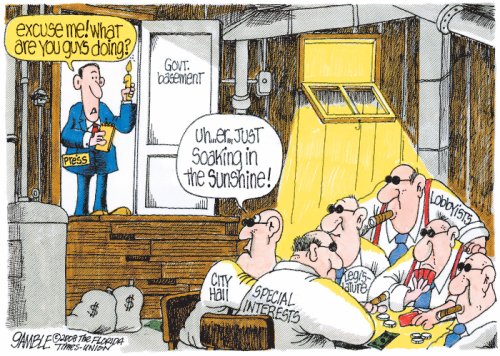
March 16-22 is Sunshine Week, the time to discuss and explore the concept of open government. The following column, provided by Sunshineweek.org, in one of a series Lake County News will offer this week as part of the important discussion of keeping government information available to the public.
Supreme Court Justice Louis Brandeis once remarked that “sunlight is the best disinfectant.” As the storm clouds cleared from Hurricanes Katrina and Rita, that sunlight illuminated many aspects of the failed federal government response to the storms and levee breaks.
A Freedom of Information Act request by CBS News uncovered the Federal Emergency Management Agency’s prior knowledge of toxic levels of formaldehyde in trailers provided to nearly 150,000 hurricane-affected families. An earlier FOIA request revealed how the Bush administration turned away a billion dollars of international assistance. Thousands of e-mails illustrating the federal bureaucracy’s incompetence in the days following the catastrophe only came to light after journalists engaged FOIA’s requirements.
But such FOIA requests are met far too infrequently. Flawed decision-making is too often shrouded by an apparent philosophy that “what the public doesn’t know can’t hurt us.”
On Oct. 5, 2005, Pulitzer Prize-winning journalist Mark Schleifstein of the New Orleans Times-Picayune filed a FOIA request with FEMA regarding its disaster response operations and planning. After a year of no response, the agency contacted him to ask if he was still interested. He replied with an emphatic “YES.”
Another year went by. Then, like a character in a monster movie asking “is it gone yet?” FEMA asked again whether the paper was still interested, and again it still was. That was this January. It is now late March, and FEMA has yet to act.
Mark is not alone in facing these delays. FEMA and the Department of Housing and Urban Development were due to give Congress a Disaster Housing Plan last July. Now they’ve promised April. The Army Corps of Engineers was to deliver a Category 5 hurricane protection plan in December. An interim document arrived this month, still without specific guidance on how the Corps intends to protect the coastal communities of Louisiana. The list of statutorily mandated reports either delayed or not delivered at all goes on and on.
In another journalism example, the Baton Rouge Advocate reported recently that it had filed a FOIA request in 2006 seeking documentation on FEMA’s contracting procedures and the decisions behind deploying travel trailers across the Gulf Coast. FEMA says it will release the information — for a fee. The going price for the truth is apparently $209,990, principally to defray copying costs. The agency said the documents are not available electronically and that the only hard copies are stored in its New Orleans field office. Meanwhile, on its Web site, FEMA itself advises that “if you plan ahead and copy what you have onto compact disks, you can be secure in knowing that they will not be lost in the future.”
As we this week mark national “Sunshine Week,” I am proud to report that Congress is making headway in attempts to assure greater government openness and transparency. On New Year’s Eve, the president signed into law the OPEN Government Act of 2007, which I co-sponsored with Senate Judiciary Committee Chairman Patrick Leahy (D-Vt.). The bill restores meaningful deadlines for agencies to respond to FOIA requests, and among other key reforms, sets up hotlines and an ombudsman’s office to aid requesters. In addition, we are working to pass legislation to shield journalists from undue prosecution for protecting whistleblowers, and I have introduced a bill to ensure local officials determine media credentialing in a disaster — not Washington bureaucrats.
Open government is a tenet of our democracy, and accountability is never more important than in times of crisis. Only by shining the light of public scrutiny on the government’s mistakes can we take steps to prevent them from repeating.
Today, after their hefty price tag was exposed on the Advocate’s front page, FEMA now appears to have opened the door a crack to cooperation. Let’s hope it swings wide — for the Advocate, Mark Schleifstein and others in pursuit of the truth. The catastrophic hurricanes and levee failures of 2005 left a lot of unanswered questions and lessons yet to be learned as we prepare for future disasters. These lessons are far too important to leave in the shadows.
Mary L. Landrieu represents Louisiana in the U.S. Senate.
{mos_sb_discuss:4}