
Opinion
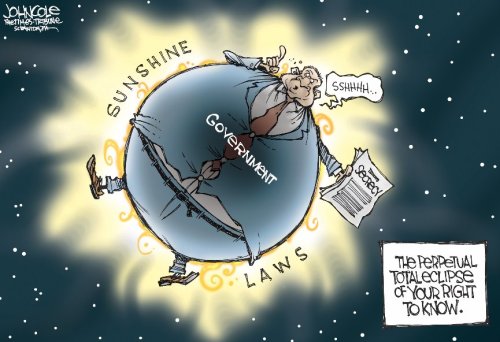
March 16-22 is Sunshine Week, the time to discuss and explore the concept of open government. The following column, provided by Sunshineweek.org, in one of a series Lake County News will offer this week as part of the important discussion of keeping government information available to the public.
This year’s Sunshine Week brings new rays of hope for the public’s right to know. The first reform to strengthen the Freedom of Information Act (FOIA) in more than a decade is newly on the books, and increasing government transparency is becoming a greater part of public debate and discussion.
With last year’s enactment of the bipartisan Leahy-Cornyn Openness Promotes Effectiveness in our National Government (“OPEN Government”) Act, Congress signaled an interest in seeking more openness and accountability in monitoring government’s activities.
The OPEN Government Act will help restore accountability in processing Americans’ FOIA requests, and it will help pull back the veil of secrecy that many feel has burdened our democracy for too long. This law will also protect the public’s right to know by ensuring that anyone who seeks information under FOIA, including freelance journalists and bloggers, can seek FOIA fee waivers.
But there are still challenges ahead. We were disappointed last month when the White House buried a provision in the Administration’s FY 2009 budget proposal that would move the functions of the new Office of Government Information Services (OGIS), which was created under the OPEN Government Act, from the independent National Archives and Records Administration to the Department of Justice. The President’s proposal is not only contrary to the express intent of the Congress, but it runs counter to the new law’s purpose — to ensure the timely and fair resolution of Americans’ FOIA requests.
The Office of Government Information Services was established to mediate FOIA disputes between federal agencies and FOIA requestors, review and evaluate agency FOIA compliance, and house the newly established FOIA ombudsman, among other things. When we drafted the OPEN Government Act, we intentionally anchored this vital office in the National Archives, so that OGIS would be free from the influence of the federal agency that litigates FOIA disputes — the Department of Justice. We also wanted OGIS to be set within the apolitical National Archives to nurture the new office’s independence, so that all Americans can be confident that their FOIA requests will be addressed openly and fairly.
Given the clear intent of Congress to establish OGIS as an independent office in the National Archives, the president’s budget proposal should not — and cannot — go unchallenged. In addition, given the Justice Department’s own record on FOIA compliance — a recent BNA article found that the Justice Department’s Office of Information Policy is burdened by increasing FOIA backlogs — it is difficult to justify entrusting the department with overseeing the processing of American’s FOIA requests.
When the Congress unanimously passed the OPEN Government Act just a few months ago, Democrats and Republicans alike joined together in promising the American people a more open and transparent government. We intend to work to ensure that that this was not an empty promise, but one that will be honored and fulfilled with a fully funded and operational Office of Government Information Services in the National Archives.
We also intend to build upon the important FOIA reform work that we began last year. Just in time for this year’s Sunshine Week, we have introduced new legislation to shed more light on the growing use of legislative exemptions to FOIA. The OPEN FOIA Act will require that when Congress provides for a statutory exemption to FOIA in new legislation, Congress must state its intention to do so explicitly and clearly in the bill. While we do not question the need to keep certain government information secret to ensure the public good, the excessive use of legislative exemptions to FOIA to withhold information from the public can harm our democracy. Our bill will ensure openness and clarity about how we treat one of our most important open government laws, by allowing more sunshine into the process of creating legislative exemptions to FOIA.
More that two centuries ago, Patrick Henry proclaimed that “[t]he liberties of a people never were, nor ever will be, secure, when the transactions of their rulers may be concealed from them.” These words remain as true today as they were 200 years ago. For more than four decades, FOIA has been perhaps the most important federal law to ensure the public’s right to know and to balance the government’s power with the need for government accountability.
As the recent legislative success with the OPEN Government Act shows us, open government is not a Democratic issue or a Republican issue. It is an American value and a virtue that all Americans can embrace. Sunshine Week gives us the chance to celebrate our successes, and evaluate the challenges that lie ahead as we work to further strengthen laws to protect the public’s right to know. To hold our government truly accountable, we must shine light on the decisions being made in the name of the American people. With the first major reforms to FOIA in more than a decade now under its belt, Congress must do everything within its power to continue to make sure that one of our most important open government laws is fully and faithfully enforced, so that we can let the sun shine on the most important actions of our government.
Sen. Patrick Leahy (D-Vt.) was installed in the Freedom of Information Act Hall of Fame in 1996. He is the author of the Electronic FOIA Amendments of 1996 and co-author of the OPEN Government Act, a comprehensive bill to improve FOIA’s implementation. Sen. John Cornyn (R-Texas) is the other co-author of the OPEN Government Act, and has long been a champion of open government. He has co-authored several open government bills in the Senate and supported numerous transparency measures. As Texas Attorney General, he also took ground-breaking measures to increase transparency.
{mos_sb_discuss:4}
- Details
- Written by: Sen. Patrick Leahy (D-Vt.) and Sen. John Cornyn (R-Texas)
Guest speakers at the Forum were Mimi Kennedy, Progressive Democrats of America National chairperson; Norman Solomon, author and syndicated columnist; Dan Smith, local public hospital consultant; Sara Rogers, from Sen. Kuehl’s office; Andrew McGuire, executive director of One Care Now; Mervis Reissig, PDA coordinator; and Stan Gold, health care activist.
PDA has been mobilizing support behind the Kuehl bill and also for HR 676, the national bill to create a universal single payer system which guarantees health care for all.
Both House Resolution 676 and State Senate Bill 840 are similar in their content and feasibility. They would provide health care for all Americans, with providers continuing as they are now in the private or community sector, but payment arranged by a single government entity similar to Medicare. Details can be found online at www.onecarenow.org.
Lake County was mentioned several times for having opened North Coast counties, cities and school organizations to the financial benefits the law will bring them when it passes. The forum discussed how just such an educational program is needed throughout the state.
PDA is establishing a Speakers Bureau and wants to encourage local organizations such as Lions Clubs and Veterans organizations to inform their communities about the savings everyone would see if SB 840 were in effect. An email between Kelly Cox, Lake County chief administrator, and Doug Willardson, Lake County Finance officer, dated 6/28/07 was quoted as saying, "Currently $3,209,936 is budgeted for health care ..." Following the formula proposed to fund the Universal Health Care Bill, this could be reduced to $1,546,111, a savings of more than half to the county.
Now other organizations are seeing the possibilities and are beginning to research their own health care costs: the Konocti Unified School District in Lake County, $500,000; Sonoma County Office of Education, $1.35 million; City of Petaluma, over $1.18 million; City of Rohnert Park, over $1.4 million.
Sen. Kuehl's universal, single payer health bill was first introduced in 2005 but earlier health care plans have been in the works since 1998. (SB 840 and essays concerning its development may be read at Sheila Kuehl's Site, http://dist23.casen.govoffice.com/index.asp?Type=B_BASIC&SEC=%7BE8682787-AE26-46B2-8252-E528F9D0145E%7D, or rather than type in that lengthy link, type Sheila Kuehl's name into Google and click directly on the SB 840 link.)
SB 840 passed both the Assembly and the State Senate in 2006 but was vetoed by Gov. Schwarzenegger. A Special Session of the Legislature was called by the governor to discuss the health care crisis, but he and the leaders of the Democratic Party in Sacramento could not reach agreement.
Since its re-introduction in 2007, SB 840 has again passed the State Senate but is now in committee, awaiting an Assembly vote. Advocates say they are trying to keep it from becoming a ballot initiative because of the huge amounts of money that the insurance companies would put up against it – and the majority of voters in California still do not understand its benefits.
The online group, www.onecarenow.org, is teaming up with PDA to relaunch their campaign. They have an action plan available on their website, www.onecarenow.org/index.html.
"We are only a few votes away from being able to override the governor's veto," Andrew McGuire pointed out. But the health insurance and pharmaceutical companies will not sit idly by.
"Insurance-industry profits have climbed from $20.8 billion in 2002 to $57.5 billion in 2006. During that same period, health care interests spent $2.2 billion on federal lobbying, more than did any other sector,” Norman Solomon told the forum. You can be sure they are not ignoring California's efforts.
Shirley Howland lives in Clearlake.
{mos_sb_discuss:4}
- Details
- Written by: Shirley Howland





 How to resolve AdBlock issue?