 How to resolve AdBlock issue?
Recreation
- Details
- Written by: California Department of Fish and Wildlife
The 2021 Pacific halibut quota for the California sport fishery is 39,260 pounds – approximately the same as the 2020 quota.
While the closing date of Nov. 15 is a new extension to the end of the season, the open dates are not guaranteed and the season could close early if it is determined that the quota has been taken.
In 2020, the season closed Aug. 11, when a very successful fishery resulted in the early attainment of the state’s limit.
Anglers participating in the Pacific halibut fishery and other recreational fisheries are reminded they may be met at fishing sites by CDFW staff collecting catch and fishing effort information. CDFW appreciates anglers’ cooperation and participation in these survey efforts.
In the case of Pacific halibut, staff will also be taking length measurements in a safe and physically distanced manner.
CDFW highly encourages all recreational anglers to assist with this length data collection effort, as the information will aid with quota tracking and in-season management.
State regulations for Pacific halibut automatically conform to federal regulations set by the National Oceanic and Atmospheric Administration’s National Marine Fisheries Service using the process described in the California Code of Regulations Title 14, Section 1.95.
Federal regulations for Pacific halibut were published in the Federal Register (86 FR 20638) on April 21 and took effect immediately.
Anglers are always advised to check for updated information when planning a Pacific halibut fishing trip, as a season closure announcement could come at any time.
Other regulatory information, including bag/possession limits and gear restrictions, can be found on CDFW’s Pacific halibut webpage.
Public notification of any in-season change to regulations is made through the NMFS Pacific halibut hotline at 800-662-9825 or CDFW’s Groundfish and Pacific halibut Regulations Hotline at 831-649-2801.
- Details
- Written by: Editor
LAKEPORT, Calif. – Saturday, April 24, was opening night at Lakeport Speedway under the new management, Furia Motorsports.
The night featured the Bandoleros, Jammer, Limited Modifieds, Bombers and Jalopies.
The grandstands were operating at 33-percent capacity and it was great to see people back supporting the local racetrack.
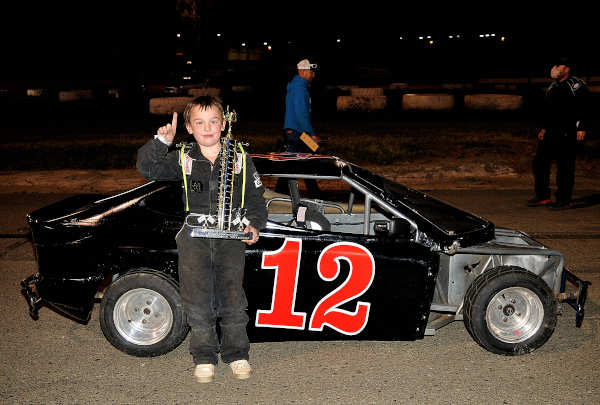
In the Bandolero division, four brand new drivers made their debuts.
Jordan Ray in the No. 88 drove his way to win the heat race with his brother No. 15 Kai Lovell in second, No. 11 Courtney Portlock in third and No. 12 Travis Powers in fourth.
In the main event, No. 12 Travis Powers took home the win after a hard wreck in the heat race. No. 15 Kai Lovell finished second, with No. 88 Jordan Ray in third and No. 11 Courtney Portlock in fourth.
All four drivers did a great job for their first time racing at Lakeport Speedway.
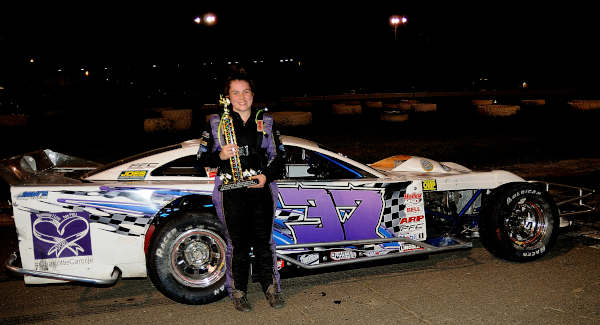
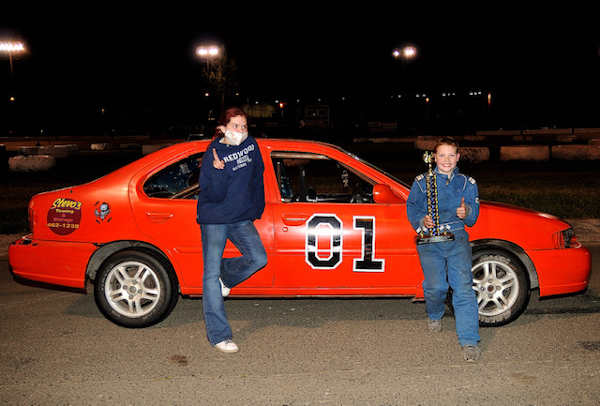
In the Jammer division, No. 01 TJ Sorrels won the Jr Jammer heat race and main event. Danney Helm Sr. in the No. 20 took home the heat race with No. 23 Christian Sanchez in second, No. 22 Dave Rogers in third, No. D4 Donovan Arreguin in fourth and No. 7 Isaiah Rojas in fifth. No. 31 Theresa French was sixth.
In the trophy dash, No. 22 Dave Rogers took home the win with No. 20 Danney Helm Sr. in second, No. D4 Donovan Arreguin in third and No. 23 Christian Sanchez in fourth.
In the main event, No. D4 Donovan Arreguin drove from fifth to first in seven laps to take home the win in front of No. 7 Isaish Rojas in second, No. 5 Jeff French in third, No. 22 Dave Rogers in fourth and No. 23 Christian Sanchez rounded out the top five.
In the Limited Modified division, No. 62 JR Roy Ingalls Jr. took home the trophy dash win after battling hard with No. 22 TJ Buzzard for four laps. No. 15 Richard Knight was third and No. 37 Sierra Furia was fourth.
In the heat race, No. 17 Brandon Powers jump out front early with No. 22 TJ Buzzard battling him on the outside groove. No. 15 Richard Knight and No. 37 Sierra Furia followed behind Buzzard until Knight was able to get around Powers on the last lap.
Knight took home the win with No. 17 Brandon Powers in second, No. 37 Sierra Furia in third, No. 22 TJ Buzzard in fourth and No. 62 JR Roy Ingalls Jr. rounded out the top 5. No. 27S Robert Schmidt was sixth, and No. 51 Bo Robertson was seventh.
In the main event, the front row was No. 67 Loren Powers Jr and No. 15 Richard Knight. Knight jumped out early with Furia following behind. Knight and Furia battled for 15 laps until Furia was able to get by Knight.
Furia took the lead and Knight settled into second. TJ Buzzard finished third, No. 37S Robert Schmidt finished fourth and No. 62 JR Roy Ingalls Jr. finished fifth. No. 17 Brandon Powers was sixth, No. 51 Bo Robertson was seventh and No. 67 Loren Powers Jr. was eighth.
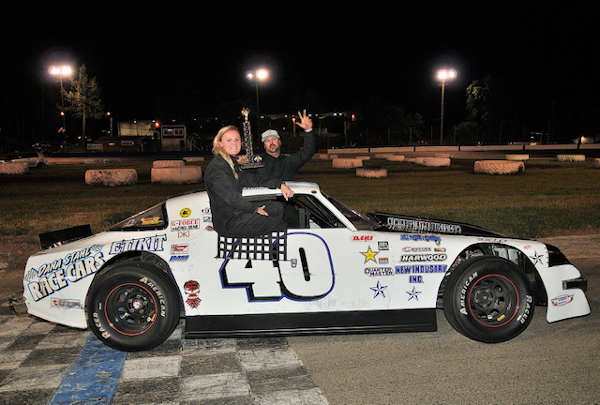
In the Bomber division, No. 79 Forrest Kuecker took home the win with No. 40 Charley Tour in second, No. 27 Loren Powers Jr. in third and No. 03 Wade Coleman in fourth.
In heat race 1, your front row was No. 63 David Jones and No. 96 Shelby Helm. Helm took the lead until lap three where there was a yellow for No. 01 Brenton Smith. Smith was towed to the pits with heavy damage.
At the restart, No. 79 Forrest Kuecker took over the lead with No. 27 Loren Powers Jr. following behind in second. Helm settled into third, with No. 63 David Jones in fourth, and No. 75B Audrey Portlock (B Bomber) in fifth. Smith did not get to finish the heat race.
In heat race 2, No. 77KC Kasey Horat and No. 12 Raymond Taylor Jr. were in the front row at the green flag. Taylor jumped to the lead until No. 03 Wade Coleman got around him to take over the lead. No. 40 Charley Tour raced with Coleman until lap nine when he was able to take
over the lead.
Tour took home the heat race win with No. 03 Wade Coleman in second, No. 02 Drew Smith in third, No. 12 Raymind Taylor Jr. in fourth and No. 77KC Kasey Horat in fifth.
In the main event, No. 96 Shelby Helm took the lead until lap 4 when No. 27 Loren Powers Jr. took over the lead. No. 79 Forrest Kuecker followed behind in second until No. 40 Charley Tour got by him on a mission to pass No. 27 Loren Powers.
On lap 28, Powers had a far ahead lead until he broke and had to be towed off. That gave Tour the opportunity to take over the lead with No. 02 Drew Smith taking over second, No. 79
Forrest Kuecker into third, No. 03 Wade Coleman in fourth, and No. 96 Shelby Helm in fifth.
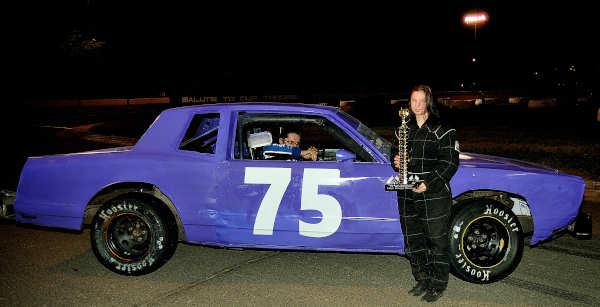
There were only two laps left for Smith to make any move on Tour at the restart. Tour was able to hold off No. 02 Drew Smith to take home the win. No. 79 Forrest Kuecker was third, No. 03 Wade Coleman was fourth, and No. 96 Shelby Helm rounded out the top 5. No. 12 Raymond Taylor was sixth, No. 27 Loren Powers Jr. was seventh, No. 77KC Kasey Horat was eighth, No. 63 David Jones was ninth and No. 75B Audrey Portlock was 10th.
Audrrey Portlock was the B Bomber main event winner.
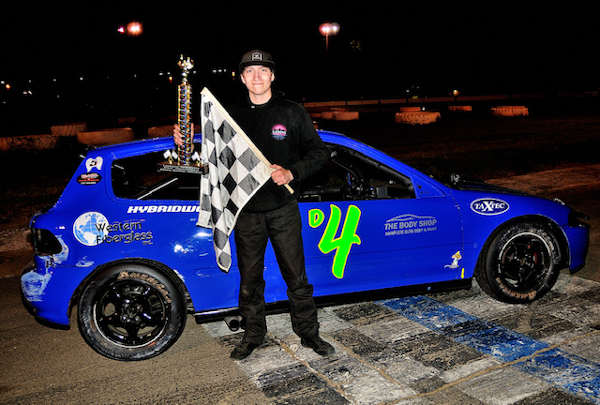
In the Jalopy division, No. 187 Chris Hunt took home the heat race win with No. 39 Jack Schleif in second, No. X2 Tia Everett in third, No. 96R Robert Portock in fourth and No. 55 Sorna Li in 5th.
In the main event, No. 96R Robert Portlock Jr. raced hard to take home the win with No. X2 Tia Everett in second, No. 187 Chris Hunt in third and No. 44 Sonra Li in fourth.
The next race is May 8 at Ukiah Speedway featuring the Limited Modifieds, Bombers, Jammers, Pro 4 Modifieds, Bandoleros and Open Modifieds.
The grandstands will be open at 33-percent capacity.
Ticket sales will be available online on the Ukiah Speedway website.
- Details
- Written by: CALIFORNIA DEPARTMENT OF FISH AND WILDLIFE
Monarch butterflies
Q: What is CDFW’s role in helping conserve monarch butterflies?
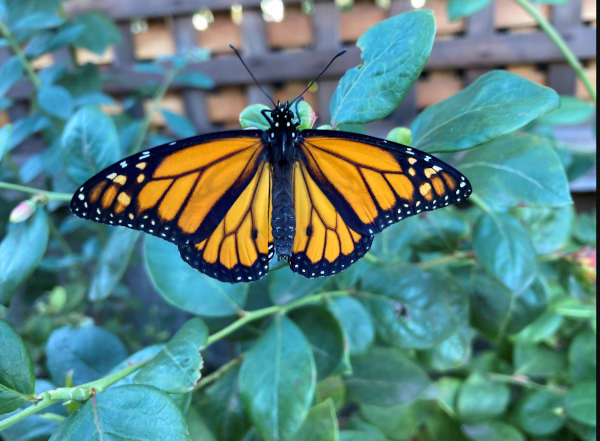
A: The Western population of migratory monarch butterflies has seen staggering declines over the past 20 years, from over 4 million in the 1980s to fewer than 2,000 individuals in the most recent census conducted in winter 2020-21. In California, monarchs are designated by CDFW as a terrestrial invertebrate of conservation concern and as a Species of Greatest Conservation Need.
To help kick-start recovery efforts, CDFW is enhancing over 1,700 acres of our properties throughout the state, with funding received to support the Governor’s Biodiversity Initiative as well as the Wildlife Conservation Board. Monarch caterpillars can only use milkweed as their host plant; therefore, we are focusing on creating breeding habitat by planting regionally appropriate milkweed species.
Western monarchs overwinter in groves of trees along the California coast, migrating to breeding sites throughout the west in the spring. CDFW is also adding flowering plants which provide the nectar that helps fuel this long-distance migration.
Because they are highly mobile, monarchs are widespread in the state: present in urban, natural and agricultural areas. We need an “all-hands-on-deck” approach to help save the species in the west. While it is prohibited to remove monarchs from the wild in California, there are many ways for the public to get involved in recovery efforts.
We encourage planting native milkweed species and native flowering plants, especially those that bloom in the early-spring or late fall. You can also contribute to community science projects Western Monarch Milkweed Mapper and the Western Monarch Count to help researchers gather data that can inform our conservation decisions.
Non-lead ammo waiver
Q: I’m a long-time hunter who has transitioned to using nonlead ammunition. In case anyone hasn’t noticed, there’s a nationwide shortage right now. I’m trying to find simple .30-06 nonlead ammo, and it doesn’t seem to be available anywhere. Someone told me that the Department of Fish and Wildlife’s director could waive the non-lead ammo requirement. Is that a possibility for the upcoming big game seasons? (Brad)
A: We share your frustration because yes, nonlead ammunition is difficult to find, especially right now. However, the director for California Department of Fish and Wildlife (CDFW) does not have the authority you are asking about.
California Fish and Game Code section 3004.5 (j)(1) authorizes CDFW’s director to temporarily suspend the nonlead requirement for a specific hunting season and caliber upon a finding by the director that nonlead ammunition of a specific caliber is not commercially available from any manufacturer because of federal prohibitions relating to armor-piercing ammunition pursuant to Chapter 44 (commencing with Section 921) of Title 18 of the United States Code.
When AB 711 was enacted, the law that required implementation of the nonlead ammunition requirement for hunting, there was concern that the ammunition met the definition of armor piercing due to its design. That concern turned out to be legally unfounded, but regardless, that provision of the law does not apply to your stated concern.
So where does that leave us as big game hunters? As the big game seasons approach, ammunition manufacturers tend to ramp up production of ammunition needed for hunting and there should be some available by that time.
However, you should continue to periodically check your local stores for it. Whenever and wherever you look for nonlead hunting ammunition and they don’t have it, we advise you to notify the staff of what you need to make sure it remains a priority for them.
For more information see CDFW’s Non-Lead Ammunition and Certified Non-Lead Ammunition webpages.
Sidearms while hunting
Q: My friends and I are planning a turkey and pig hunt in Madera County, D7. Can I carry a sidearm with lead ammo? Two of my friends won’t be hunting—can they carry sidearms?
A: As you may know, nonlead ammunition is required when taking any wildlife with a firearm anywhere in California. Prohibition on the use of lead ammunition for taking wildlife is covered in California Code of Regulations (CCR), Title 14, section 250.1(c).
The regulation does not prohibit the possession of concealable firearms containing lead ammunition provided the firearm is possessed for personal protection and is not used to take or assist in the take of wildlife.
It’s important to note that with the exception of ammunition for concealable firearms possessed for personal protection, hunters may not possess lead ammunition along with a firearm capable of firing that ammunition when nonlead ammunition is required. With regard to your friends, they may carry a sidearm as long as neither is a felon or otherwise prohibited from possessing firearms, per California Penal Code Section 29800.
Finally, note that this response only addresses CDFW laws specific to the hunting scenario you described. Be sure to familiarize yourself with general firearm laws related to concealed weapons, transportation, storage, etc.
- Details
- Written by: Elizabeth Larson
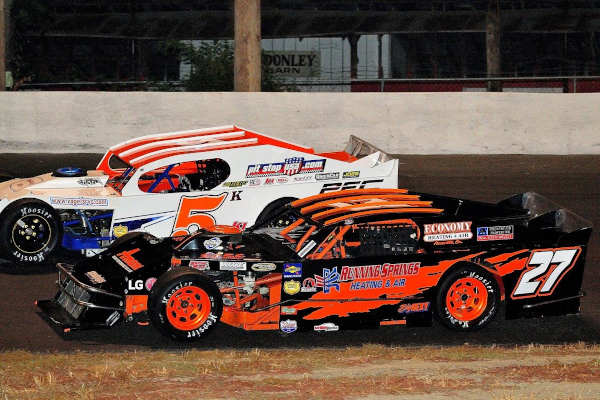
NORTHERN CALIFORNIA – The North State Modified Series, or NSMS, presented by Protect the Harvest, is proud to announce that its 2021 racing schedule will begin on April 17 at Shasta Speedway in Anderson.
The series will be joined by all the local Shasta Speedway classes and will feature the O’Reilly Auto Parts 60 lap feature event as well as the Lucas Oil Dash for Cash.
After Shasta the series ventures south to the Madera Speedway on May 8 to join the Madera Late Models and Jr. Late Models, the Madera Hobby Stocks, Toyota Sedans/MST, and Madera Mini Stocks. This is “Ladies Night’ where all ladies will get in free. As of now a limited number of spectators will be allowed in the grandstands.
At the second event in Madera on Aug. 7, track promoter Kenny Shepherd expects to be able to host more “fans in the stands.”
NSMS will then venture north to Redwood Acres Raceway in Eureka on June 5 for the first of two events.
Redwood Acres Raceway is a 3/8-mile paved oval, the largest track on the NSMS tour. The second race in Eureka, the “Dale Baldwin Challenge” will be the richest event in the history of the series with $5,000 going to the winner of the 60 lap event, presented by McMurray and Sons Roofing.
That race will take place on Sept. 25 in conjunction with a 150 lap open-comp late model race.
NSMS will be back at Shasta Speedway on June 19 to be a part of the Shasta County Fair celebration. Joining the race card that night will be the Nor-Cal Pro-4 Modifieds.
Only one race is on the 2021 schedule in the month of July and that will be at Stockton 99 Speedway for the 2nd annual Bob Lehman Classic.
This will be an all open-wheel event featuring the North State Modifieds, Gun Slinger Winged Sprint Cars, NCMA Non-Wing Sprint Cars, Winged Supermodifieds, BCRA Midgets, Vintage BCRA Midgets, and Nor Cal Pro 4 Modifieds. It will also be Stockton’s Tom Manning Memorial event.
The NSMS season concludes at Shasta Speedway on Oct. 9 for the sixth annual Lloyd Burton “Against the Wind” Modified Challenge, sponsored by Mort Houston and the Burton Family.
Protect the Harvest will once again be the title sponsor of the North State Modified Series. Lucas Oil will fund a tow-money program for the drivers to help with the high cost of travel.
Other sponsors of the series are Hoosier Tire West, Sunoco Race Fuels, Naake Suspension, Five Star Bodies, Racer Bling, Scribner Plastics, Franks Radios, O’Reilly Auto Parts, McMurray and Sons Roofing, and Mark and Sharon Baldwin.