 How to resolve AdBlock issue?
Recreation
- Details
- Written by: Lake County News Reports
The Calso Campgrounds will be open with 14 campsites available to the public on a first-come, first-served basis. No reservations are accepted.
There will be safeguards in place to protect the public and to stop the spread of COVID-19. Each of the 14 sites will be available for a single household not to exceed six people and a single-vehicle.
The group campsites at Ridge Camp, Horse Camp, and Crawler Camp will remain closed to camping and group gatherings.
The Calso Campground is a rustic setting with no running water with one vault and one pit style outhouse. Campers are required to provide their own water and personal hygiene items. There is no trash collection at Calso Camp so campers are asked to “Pack it out if you pack it in.”
Campers are encouraged to bring their own cleaning supplies to provide for a sanitary camp environment. Restrooms will be cleaned and restocked daily by forest staff members.
The Boggs Mountain Demonstration State Forest does allow for small trailers or recreational vehicles if they fit within an available campsite, however, there are no RV hook-ups and there is no dump station located on the property.
Campground rules:
– Self-register at the kiosk in the entrance parking lot before setting up camp.
– Camping is $25 per night.
– Clip your registration slip on the campsite marker.
– One household per campsite, no more than six people, one vehicle per campsite, outside
visitors are prohibited at campsites.
– Maintain 6 feet social distancing within the campsite and 25 feet from adjacent campsites.
– Campfires are restricted to fire rings.
– Pack out what you pack in. Do not leave trash behind
– Do not cut or deface any green trees.
– Quiet hours are 10 p.m. to 6 a.m.
– Fireworks are prohibited on the Boggs Mountain Demonstration State Forest.
- Details
- Written by: California Department of Fish and Wildlife
Please note that the regulation changes are currently awaiting approval from the Office of Administrative Law.
These regulations are in place because spring Chinook salmon are a candidate species under the California Endangered Species Act, or CESA, and currently under status review for potential CESA listing.
The spring Chinook salmon fishery on the lower Klamath River, downstream of the Highway 96 bridge at Weitchpec, and Trinity River, upstream of the confluence of the South Fork Trinity River, will open July 1 and run through Aug. 14 on the Klamath River and through Aug. 31 on the Trinity River.
The daily bag limit has been set to one Chinook salmon (no size restrictions), and the possession limit set at two Chinook salmon.
The fall Chinook salmon fishery in the Klamath River will open Aug. 15, and in the Trinity River, the fall Chinook salmon season begins Sept. 1.
The Klamath-Trinity basin in-river quota is 1,296 adult fall Chinook salmon for 2020.
Fall Chinook salmon regulations on length have changed since 2019, with the adult size now being greater than 23 inches total length (previously 22 inches).
Bag limits will remain the same as 2019, with a two-fish daily bag limit, with no more than one fish over 23 inches (such as one adult and one jack).
The possession limit remains the same at six fish, with no more than three fish over 23 inches (effectively three daily bag limits).
Additionally, the brown trout bag and possession limits have doubled; increased to 10 fish per day and 20 fish in possession throughout the basin.
The in-river recreational adult fall Chinook salmon quota is divided among four sectors in the Klamath River basin:
Klamath River
– 3,500 feet downstream of Iron Gate Dam downstream to the Highway 96 bridge: 220 fish.
– Highway 96 bridge downstream to the mouth of the Klamath River: 648 fish.
– There is a sub-area closure at the mouth of the Klamath River when 15 percent of the basin allocation has been harvested: 194 fish harvested below the Highway 101 bridge triggers this closure.
Trinity River
– Old Lewiston Bridge to Highway 299 West bridge at Cedar Flat: 214 fish.
– Denny Road bridge downstream to the confluence with Klamath River: 214 fish.
Please see the 2020-2021 California Freshwater Sportfishing Regulations and 2020-2021 California Supplement Sport Fishing Regulations for more information.
Additionally, anglers can obtain information on Klamath Basin regulations and fall Chinook salmon quota updates by calling the Klamath-Trinity fishing hotline at 800-564-6479.
- Details
- Written by: Lake County News Reports
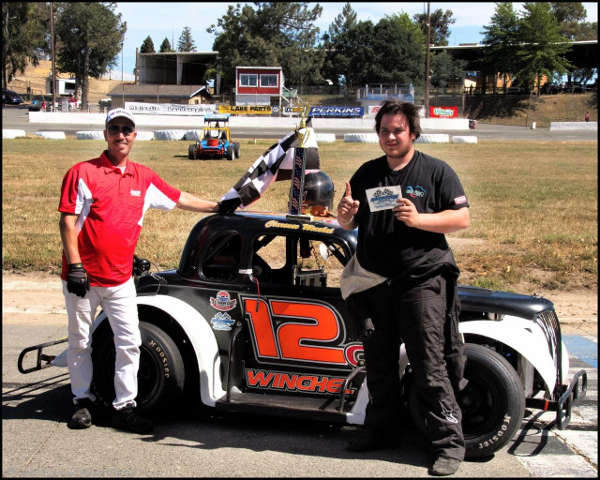
LAKEPORT, Calif. – Defending Lakeport Speedway Legends Cars champion Cody Winchel of Sebastopol joined the Legends of the Pacific on their first appearance at Lakeport Speedway in over two years on Saturday, and lead all but four laps of the “D&P Pools 35” lap feature event to capture the win over Aidan Daniels of Fort Bragg and Scott Sabol of Lakeport.
Richard Knight of Lakeport had a near clean sweep in the NCRA modified class winning the trophy dash, heat race and 30 lap main event. And Mikey Collins of Lakeport started on the pole and led wire to wire to capture the feature race in the Taco Bell Bomber class.
Once again the speedway had to race with no spectators as per the Public Health officer’s guidelines in Lake County. However, the event was live-streamed and shown on Facebook Live with more than 6,000 people reached.
Thirteen legends cars clocked in with Aidan Daniels fastest at 14.016 seconds. Winchel was second fastest at 14.0320 and Sabol turned a 14.109.
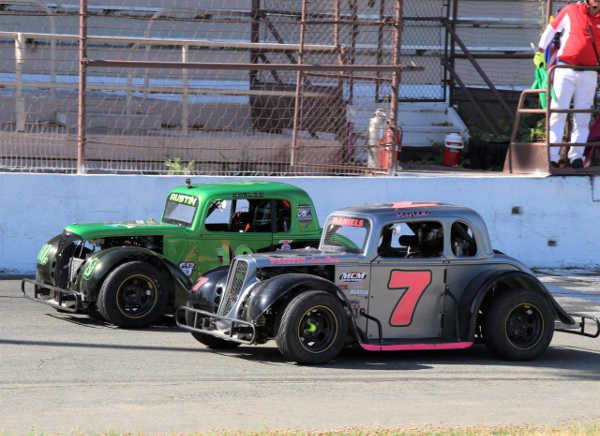
When David Winchel elected to drop to the back of the six-car inverted start, Kylie. Daniels, age 17, found herself starting on the pole of the feature next to Carlee Austin, also 17. The ladies ran side-by-side for two laps before Austin’s car dropped back allowing Cody Winchel to power into second. Winchel moved to the high side and drove past Kylie Daniels to take the lead on lap five.
The following round JK Kinney’s oil filter came loose and spilled oil on the track. The cars slipped through the oil with both Dylan Washburn and event sponsor Dave Allen slapping the wall to end their runs.
When racing resumed Winchel forged ahead again with Sabol ducking under Kylie Daniels for second. Both Keith Clement and Aidan Daniels were picking off cars and were up to third and fourth by lap eight. Aidan Daniels drove around Clement for third on the 10th circuit as Winchel and Sabol were driving away.
The race was slowed again on lap 18 when David Rank spun, and with nowhere to go, Blake Borchers slid into Rank. Both cars were able to restart and continue the race.
The restart saw Winchel jump out in front again, but this time Aidan Daniels drove under Sabol to assume second. Lap 21 saw Austin spin in turn four for another caution. The final yellow flag flew on lap 29 when Clement’s car broke loose and hit the turn two concrete.
The final six laps went without incident with Cody Winchel the winner followed by Aidan Daniels, Sabol, Kylie Daniels, Kevin Travels, Austin, Borcher and Rank.
Heat wins went to Borchers and Clement. Cody Winchel won the fast dash.
Lakeport Speedway held a special tribute to Sabol’s father, Chuck Sabol, a long-time great supporter of Lakeport Speedway prior to racing action.
The Legends of the Pacific are scheduled to return to Lakeport Speedway on July 25.
A short field of modifieds was on hand at the track as several of the regulars are still not ready to go.
Last week’s winner Mike Sullivan set the fast time of 12.900 seconds. Knight and Robert Schmidt started in the front row. The duo ran side-by-side the first part of lap one, but Schmidt drove his car into turn three so fast that it couldn’t make the pass stick, Schmidt lost control, the car spun and smacked the wall causing severe front end damage.
This left only three cars, Sullivan, Knight and Trevor Kollenborn, driving the Lauren Snider modified. Ten laps later Sullivan’s left front tire went flat and he stalled on the track. Sullivan pitted for a tire change and rejoined the pack.
Knight led the entire distance with Sullivan finishing second and Kollenborn third.
The Taco Bell Bomber 30 lapper saw several drivers electing to start in the rear leaving Collins and last week’s winner Donovan Cox in the front row. Both Simi Tour and Charlie Tour dove under Cox on the start with Trever Abella settling for fifth.
The lone yellow flag flew on lap 14 when Cox was attempting to put a lap down on Amber Portlock. Porlock’s car was running high but there wasn’t quite enough room for Cox to drive under. The two cars made contact with both ending up with flat tires. Cox pitted for the change, but Portlock’s run was over.
Two rounds later Abella retired his car to the pits, and at the checkered flag it was Collins, Charlie Tour, Simi Tour, Cox and Klinton Waite. Both the Tour brothers were considered “Fun-Run” cars due to tech issues and were not eligible for any awards.
Heat race wins went to Abella and Cox. Cox also won the trophy dash. Both RJ Randall and Raymond Taylor Jr. broke in hat laps and did not compete.
The North State Modified Series will be competing at the next scheduled event at Lakeport Speedway on July 18th. The July 3rd fireworks show was canceled.
NCRA races at Lakeport Speedway are presented by O’Reilly Auto Parts, Anderson Logging, Sullivan Const Masonry, Lake Parts, Bicoastal Media, Taco Bell, D&P Pools, Hillside Powersports, Clearlake Redi-Mix, Snap-On Tools, S&K Paving & Striping, Lucerne Roofing, S & K Automotive, Under the Sun Garden Supply, Perkins Septic Tanks, Lake County Tribal Health, Don Anderson Attorney At Law, Coleman’s Custom Vinyl, Lake County Welders, Steve Taylor Excavation, Dana Stahl Race Cars, Kelseyville Lions, Mike Sullivan Consulting, Lake Co. Waste Solutions, Gifford Backhoe Service and Majestic Landscaping.
For more information on the 2020 racing season, visit NCRA - Lakeport Speedway Facebook page.
- Details
- Written by: California Department of Fish and Wildlife
California Department of Fish and Wildlife
Question: Wolverines are thought to be extinct in California, is that correct? When I was younger my oldest brother and dad told me they spotted a wolverine at our cabin in the Sierra but that was over 10 years ago. I have also heard of sightings from neighbors. Is it possible there are wolverines still thriving in the Sierra? (Ryder)
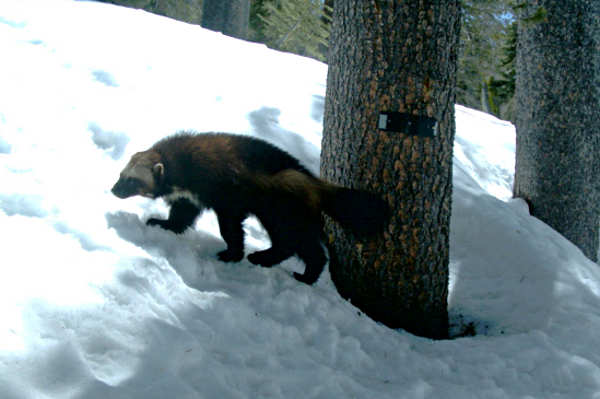
Answer: Scientists documented a single wolverine in California from 2008 to 2018. That wolverine was first discovered in February 2008 in the Truckee region of the Tahoe National Forest by a student who baited remote camera stations to monitor Pacific marten, another member of the weasel family.
Genetic research indicated the wolverine was male and came from a population in the Sawtooth Mountains of Idaho. Scientists aren't sure how the wolverine got here – but there have been other documented cases of wolverines traveling long distances.
The wolverine was monitored in the Truckee region using remote cameras and through collection of genetic samples. He was last detected in January 2018. We're not sure what happened to the wolverine, but a 10-year-old wolverine in the wild would be considered fairly old, so it's possible he lived out his life.
If your family's cabin was in the Truckee region (north of Highway 80 and west of Highway 89), they may have seen the wolverine that scientists were documenting. California Department of Fish and Wildlife (CDFW) Environmental Scientist Chris Stermer, who helped monitor the wolverine, recalls that several locals reported seeing it at the time.
In the past decade, multiple researchers have been surveying for other high alpine carnivores using baited camera stations. This additional camera work was largely due to the need to monitor the very small population of Sierra Nevada red fox in the Cascades and southern Sierra Nevada. These regions would be prime wolverine habitat, and scientists probably would have discovered a population if they were living there.
"I am fairly confident we will not find a breeding population of wolverines in California, but it is possible an occasional young male wolverine in search of a territory could make its way to California," said Stermer. "Fortunately, there is habitat for them to persist. Unfortunately, females do not travel as far, which limits their ability to mate."
Crayfish snares
Question: Would snares for crayfish similar to small crab snares be legal? Would the rules be the same? (Cal)
Answer: The rules for taking crayfish for sport are outlined in California Code of Regulations (CCR) Title 14, section 5.35. For the most part, you can take crayfish any time of year and there's no bag limit. There are restrictions on some bodies of water in Shasta County. These restrictions, outlined in CCR Title 14, section 5.35(d), were enacted to protect the endangered Shasta crayfish.
In bodies of water that aren't restricted, you can take crayfish by hand, hook and line, dip net or with traps not over three feet in length. There are differences between crayfish traps and crab snares which are relevant to your question. A crayfish trap is an elongated wire mesh trap with two open ends.
The crayfish is attracted to the bait and is then trapped by the cone-shaped opening. A crab snare is a loop snare that slips around the crab's leg and tightens when drawn up by the angler. CCR Title 14, section 5.35(d) does not provide for the take of crayfish by snare traps.
To lawfully take crayfish, you would have to catch them by hand, hook and line, dip net or trap less than three feet in length.
The taking of crayfish is legal in waters closed to trout and salmon fishing so long as you are using any of the above methods except hook and line.
How do wild turkey season limits work?
Question: I was hoping you could clear up some confusion regarding California's turkey hunting regulations. The regulations for the fall season state that I'm allowed one bird (either sex) per day and two per season. The regulations for the spring season state that I'm allowed one bearded bird per day and three per season, combined. I interpret this to mean that I can shoot up to two birds during the fall season and up to three during the spring season (which consists of the general, archery only and junior seasons combined) for a total of up to five birds per year. I have heard others interpret it to mean that I can shoot up to two birds in the fall and up to three in the spring but I can only shoot a combined total of up to three birds per year. Any clarification would be appreciated. (Tim)
Answer: Your initial interpretation of the regulations is correct. The fall and spring wild turkey seasons are completely separate seasons – and the season limits for each are treated separately as well. That means you can take up to two birds of either sex in the fall season. And it means you can take a combined total of three bearded birds over the course of the spring season, which includes the general season and the additional youth and archery only opportunities.
The confusion is related to possession limit. Since the seasons are separate seasons, the possession limits are separate too. Remember that you may not take more than one turkey per day during either season.
If you have a question for the California Department of Fish and Wildlife, email