 How to resolve AdBlock issue?
Recreation
- Details
- Written by: California Department of Fish and Wildlife
Access to ELER will be open to 100 hunters on a first-come, first-served basis on the following dates:
2019 hunts:
Saturday, Nov. 23: Check-in at 5 a.m.
Tuesday, Dec. 3: Check-in at 5 a.m.
Saturday, Dec. 7: Check-in at 5 a.m.
Thursday, Dec. 12: Check-in at 5 a.m.
Tuesday, Dec. 17: Check-in at 5 a.m.
Saturday, Dec. 21: Check-in at 5 a.m.
2020 hunts:
Saturday, Jan. 4: Check-in at 5:30 a.m.
Thursday, Jan. 9: Check-in at 5:30 a.m.
Saturday, Jan.18: Check-in at 5:30 a.m.
Thursday, Jan. 23: Check-in at 5:30 a.m.
"Eden Landing waterfowl hunts are unique in that there are no fees charged and hunting is offered on some Tuesdays and Thursdays when many public waterfowl hunting areas are closed," said ELER Manager John Krause. "These hunts produced a three-bird average last season, with northern shoveler and American wigeon being the most commonly taken."
Improvements have been made to ELER including a boat launch on Mount Eden Creek allowing access to tidal areas. Boaters are advised to consult local tide charts before launching as mud flats can subject vessels to hidden underwater hazards during low tides.
There is a 25-shell limit in the field and non-lead ammunition is required when taking wildlife anywhere in California. A small boat, canoe or other flotation device is highly recommended to access ponds and blinds. A hunting dog is recommended for retrieving birds. Hunters are responsible for avoiding closed areas.
To access ELER from Interstate 880: Exit at Alvarado Boulevard; continue west and turn right on Union City Boulevard; left on Bettencourt Road (look for Union Sanitary District sign); left on Whipple Road, right on Horner Street; right on Veasy Street. Enter at the yellow gate and proceed to the check station.
Adult hunters must have a valid California Hunting License, federal duck stamp, state duck stamp and Harvest Information Program validations. Junior hunters must have a junior license and, if 16 or older, also possess a federal duck stamp. Junior hunters must be accompanied by an adult 18 years or older (hunter or non-hunter).
Formal plans for public access opportunities at the reserve in addition to hunting are being developed as part of the South Bay Salt Ponds Restoration Project. More information is available at www.southbayrestoration.org.
- Details
- Written by: CALIFORNIA DEPARTMENT OF FISH AND WILDLIFE
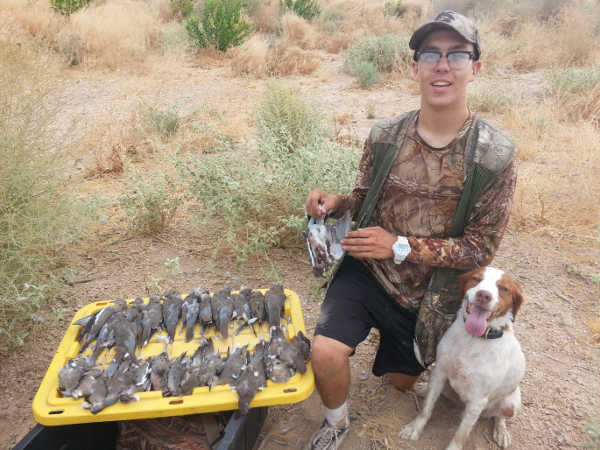
Do I need a HIP stamp to hunt dove?
Question: Is the Harvest Information Program (HIP) validation needed to hunt dove? I've heard that you don't need it if you're only buying a license to hunt ducks. (Paul)
Answer: Yes, you do need a HIP validation to hunt dove. It's required for any person hunting ducks, dove, gallinules, geese, band-tailed pigeon, black brant, coots or snipe. This validation is free to hunters who complete the HIP survey. The HIP validation is imprinted directly on your hunting license document after you answer the HIP survey questions.
The HIP survey provides wildlife biologists with data needed to make wildlife management decisions and formulate hunting seasons. You can learn more about it on the U.S. Fish and Wildlife Service website.
Fish plants on the North Fork of the Feather River?
Question: I have been a diehard freshwater fisherman in California for over 40 years and am frustrated over the lack of planting on my home water. Why is there a lack of trout planting on the North Fork Feather River at Belden? I just don't understand. (Mike E.)
Answer: The North Fork Feather River at Belden is a plant that CDFW conducts for PG&E as a requirement of their Federal Energy Regulatory Commission (FERC) license. CDFW grows and plants the fish and is reimbursed by PG&E.
The allotment of fish for the North Fork Feather River at Belden is based on that FERC license requirement, and it has been the same - 5,000 lbs. of catchable rainbow trout – for the last 25 years. We are not always able to meet that allotment, but that is the goal we are shooting to reach for that water every year. Last year, CDFW's North Central Region was short on fish, due in part to an unexpected disease outbreak, and the fact that Moccasin Creek Hatchery was damaged by flooding (other hatcheries picked up their planting allotments, which spread the resource more thin than usual).
So far in 2019, we are well on our way to meeting the 5,000 pound goal. In April we planted 1,520 fish, in June we planted 1,610 fish, and most recently on August 14 we planted 1,360 fish. That's a total of 4,490 catchable trout so far in 2019. There are more plants on the way this fall.
What's the difference between CDFW and the Commission?
Question: Can you explain the purpose of the California Fish and Game Commission? (Anonymous)
Answer: The California Fish and Game Commission was established by California's Constitution and is composed of five commissioners appointed by the governor and confirmed by the state Senate.
Many Californians are not fully aware of the identity, function or responsibilities of the commission, and believe it to be the same as, or part of, the California Department of Fish and Wildlife (CDFW). Actually, the commission is a separate entity from CDFW and does not oversee CDFW's day to day operations.
The commission has been involved in the management and wise use of California's fish and wildlife resources since 1870. Generally speaking, the commission's primary function is to promulgate regulations, in which it makes decisions involving topics such as seasons, bag limits, and methods of take for game animals and sport fish. CDFW then implements and enforces such regulations.
With the passage of the Marine Life Management Act (MLMA) in 1998, management authority for many commercial fisheries has been transferred from the State Legislature, and now resides with the commission.
Some have criticized the commission's regulatory actions as being nothing more than a rubber stamp for CDFW's recommendations. A review of the commission's actions on various CDFW recommendations indicates that this is not the case.
In many instances, the commission rejects or substantially modifies actions recommended by CDFW, but only where it is convinced that such action is in the best interest of the resource and truly reflects the wishes and needs of the people.
The commission often relies on CDFW's biological data and recommendations, since CDFW has the largest staff of experts for compiling data on California's wildlife.
You can learn more about the commission on its website. Meetings are held monthly and video coverage is both live-streamed and archived.
If you have a question for the California Department of Fish and Wildlife, email
- Details
- Written by: Redbud Audubon Society
- Details
- Written by: California Department of Fish and Wildlife
“They’re real. They’re not just a practical joke,” said Scott Gardner, the senior environmental scientist who leads CDFW’s Upland/Small Game Program, referencing the countless children who have been duped into mythical snipe hunts.
“Snipe are well-distributed throughout the state, but they’re a very challenging bird to harvest. Not only are they a difficult target to hit, but they often hang out with other shorebirds that you can’t take. So you really have to know your stuff when hunting snipe.”
A California hunting license, Harvest Information Program Validation and Upland Game Bird Validation are required to hunt snipe. Junior Hunting License holders do not need an Upland Game Bird Validation.
Wilson’s snipe are a plump brown-and-buff migratory shorebird with short, stocky legs and a long bill. They are the only shorebird legal to hunt in California. While they can be found throughout the state during California’s long snipe season, they are elusive and hard to spot on the ground, which means hunters need to be able to identify the birds quickly on the wing.
Snipe typically flush from the ground and fly away in a fast, twisting, zig-zag pattern. The word “sniper,” in fact, originally meant a hunter who was skilled at shooting the notoriously wily bird.
Snipe are frequently found probing muddy ground for earthworms and invertebrates. They prefer the muddy edges of ponds, damp fields and other wet, open habitats. Areas with low vegetation provide adequate camouflage and cover for snipe, but they can often be spotted by glassing the water’s edge with binoculars.
Because of their habitat and a hunting season that runs almost concurrently with California’s Balance of the State Zone waterfowl season, waterfowl hunters are most likely to encounter snipe in the field. Snipe, however, are best pursued with a light upland gun, an open choke and light loads such as #7 steel shot. Waterfowl hunters who take a poke at a fleeing snipe with their heavy guns, big loads and tighter chokes often find themselves punching holes in the air and risk damaging a snipe’s delicate, delicious meat with a shot that connects.
While snipe have a wide wingspan, they are smaller than quail and it may take several birds to make a single meal. They are often roasted or pan-fried whole or breasted out and cooked with butter or bacon. Hunters who enjoy eating dove or duck will likely love the taste of snipe.
Snipe have a small but devoted following among some California hunters.
The following tips and suggestions should inspire hunters to give snipe a try this season:
– Snipe hunting can be really good when the duck hunting is poor. Those warm, bluebird days in November make for a great opportunity to go snipe hunting.
– Snipe hunting is great for getting away from the crowds and enjoying some quiet time outdoors. So few people hunt snipe that snipe hunters often have all the boggy, upland fields to themselves.
– Snipe make for an exciting hunt. Snipe flush like a wild pheasant but can provide an abundance of shots and opportunities. A good snipe field can provide hunters with dozens of flushes.
– It helps to go on your first snipe hunt with someone who has hunted snipe before. You’ll be a lot more confident about your identification.
– If you miss a snipe you can often go after it again. A flushed bird will sometimes land again after a short flight.
– Snipe can be difficult and painstaking to pluck whole but it’s often worth the effort. The legs are especially delicious.
– You will almost never see a snipe on the ground before it flushes. Once you learn to identify snipe on the wing, however, it’s easy to distinguish snipe from other shorebirds. Snipe rarely fly in flocks. The vast majority of snipe flushes are single birds. Snipe often make a high-pitched call when they flush, sometimes described as a scaipe.
– Many snipe hunters don’t use hunting dogs. The low, erratic flight typical of a flushed snipe means a lot of low shots that can put a hunting dog in danger.
– Snipe are migratory birds and move. Snipe can be in one day in big numbers and gone the next. A good snipe field one day can be vacant of snipe the next.
– Snipe hunting regulations are available online at CDFW’s website within the 2019-20 bird hunting and public lands regulations booklet.
Please note that nonlead shot is now required when taking any wildlife with a firearm anywhere in California. Please plan accordingly. For more information, please see the CDFW nonlead ammunition webpage.