 How to resolve AdBlock issue?
Recreation
- Details
- Written by: California Department of Fish and Wildlife
California Department of Fish and Wildlife hatchery workers will open the gates in the ladder about 8 a.m. and will take more than 3 million spring-run eggs and 12 million fall-run eggs over the next two months in order to produce Chinook salmon for release next spring.
The hatchery is open from sunrise to sunset. Visitors can observe the salmon through the viewing windows and from the observation deck located at the base of the fish barrier dam.
At the main side of the hatchery, visitors can observe CDFW technicians performing the spawning process.
Thousands of schoolchildren tour the Feather River Hatchery each year. For more information about spawning schedules and educational opportunities at the Feather River Hatchery, please call 530-538-2222 or visit www.wildlife.ca.gov/fishing/hatcheries/feather-river .
For information about hatchery tours, please call 530-534-2306.
For more information about California’s fish hatcheries, please visit www.wildlife.ca.gov/fishing/hatcheries.
- Details
- Written by: California Department of Fish and Wildlife
The California Department of Fish and Wildlife wants to remind deer hunters to check for wildfire-related closures before heading to their favorite hunting spots for the general deer season, which is set to open in many parts of the state Saturday, Sept. 15.
Deer season is already underway in California's A and B4 zones along the coast and many coastal deer hunters have had to improvise and find new spots this season as a result of wildfire-related closures that upended hunting plans.
Please visit CDFW's forest fire related closure page for information and resources.
The majority of California's general deer hunting zones - B1, B2, B3, B5, B6, D6 and D7 - open Saturday, Sept. 15, along with premium hunting zones X9a and X9b in Mono and Inyo counties along the eastern Sierra. Several other general deer hunting zones - D3, D4, D5, D8, D9 and D10 open the following week, on Saturday, Sept. 22, as does premium hunting zone X8 in Alpine County.
"California has experienced several very large wildfires this summer, many of which are in popular deer hunting zones," said David Casady, an environmental scientist with CDFW's Deer Program. "Hunting will be challenging this year - particularly in the B zones and the northern parts of the A zone – but the range should respond positively and hunting should be productive in the next three to five years."
California's deer population is generally stable with small year-to-year fluctuations. Current estimates put the population at approximately 533,000 deer statewide. California hunters harvested 29,394 deer in 2017 with an overall hunter success rate of 16 percent.
Hunters are reminded that deer tag reporting is now mandatory - even for hunters who are unsuccessful or those who did not have a chance to hunt at all. CDFW has produced a video on how to properly complete, attach and report your deer tag.
California is phasing-in the use of nonlead ammunition for hunting which will be required for all wildlife harvest beginning July 1, 2019.
While nonlead ammunition is currently not required for hunting deer in California in 2018 outside of the California condor range, if you will be hunting on a CDFW wildlife area or ecological reserve, nonlead ammunition is required. For more information, please see CDFW's nonlead ammunition page.
Additional deer hunting information, including hunt zone descriptions, maps and special hunts, is available at CDFWs deer hunting page.
- Details
- Written by: BoatUS
ANNAPOLIS, Md. – The autumn boating season has arrived, and with it comes cooler water temperatures.
A fall overboard can get serious quickly, and wearing a life jacket could give you extra time to survive.
While many boaters have traditional floatation-filled life jackets, an increasing number have switched to more modern inflatable life jackets, which require a little preparation each year. If you haven’t inspected your inflatable life jacket and it’s gone through a summer’s worth of hard boating, now is a good time to take a close look at it.
Here’s a quick four-step prep for your inflatable life jacket from the BoatUS Foundation for Boating Safety and Clean Water:
– Open it up and look. Gently open the life jacket, usually by pulling apart any hook-and-loop tape covers or flaps and then unfolding. Pay close attention because repacking it is essentially the reverse of this process. Inside you will find a thin-walled bladder, which is what keeps your head above water when inflated, so take your time looking for any tears or abrasions. Are the waist strap and all buckles in working condition?
– Remove the cartridge. Unscrew the CO2 cartridge and ensure it hasn’t been discharged, sometimes indicated by a small puncture in the center of the threaded end. Some inflators will have a green ready-to-go indicator. Check the cartridge and inflation mechanism for corrosion. Some inflator mechanisms have a little “pill” or “bobbin” that dissolves in water allowing for automatic inflation. It should be in good shape. If not, purchase a rearming kit.
– Test for leaks. Using your mouth, blow up the life jacket using the manual-inflation tube found on the upper left front of the life jacket. This tube may also be used as a back up to fill the jacket with air in an emergency, so familiarize yourself with how it works. Leave the fully inflated life jacket alone for 24 hours to test for leaks.
– Repack. If, after the time is up and the life jacket still holds air, deflate it and repack according to the instructions, which usually can be found on an inside flap. Now you’re ready for fall boating season!
For more information on the care of life jackets, go to www.BoatUS.org/Life-Jackets/Care.
- Details
- Written by: California Department of Fish and Wildlife
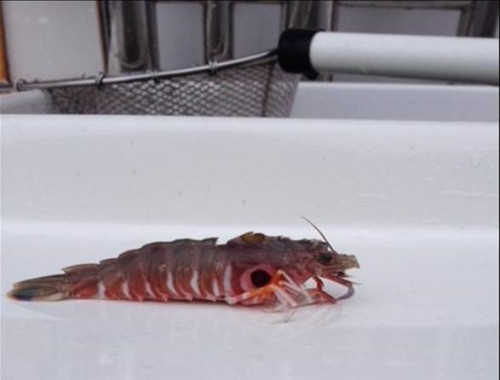
Can you identify this shrimp?
Question: In May of 2016, this shrimp drifted by our boat at night while we were fishing for squid on the south side of Catalina Island. I have been unable to identify it. Can you tell me what it is? (Kenny)
Answer: This is a target prawn (Sicyonia penicillata), also known as rock shrimp due to the rock-like hardness of the shell.
They are commonly found along the Gulf of California and on the western coast of the Baja California peninsula. You may take any type of ocean shrimp in California waters.
If you're interested in learning how to fish for these interesting shellfish, please check out the crustaceans section of the current Ocean Sport Fishing regulations for the regulations, legal gear, limits and other information you will need to know (California Code of Regulations Title 14, sections 29.05, 29.10 and 29.80).
Help with problem geese
Question: My neighbors and I have a major problem with Canada geese. We live on a street that parallels an irrigation canal. Approximately 25 to 35 geese invade our yards every day, three to five times a day.
They block the intersection and streets in all directions on their way, and they do a lot of damage to the grass and plants as well as inundate our yards, sidewalks and streets with feces.
Do you have any suggestions on what we can do to control the problem? We also get mallards, but in much smaller numbers and they do far less damage.
Is it possible to control the geese without scaring off the ducks? All we've managed to do is herd the geese from one yard to another, which is not a very good solution. (Bernie)
Answer: This is a very common human-wildlife conflict. These are likely molting geese and they're out searching for food along the canal. This time of year the grass dies back and the green grass they need becomes scarce, right when their normal need for food is multiplied due to the increased energy demand of re-growing feathers. Irrigated lawns and other landscaping plants are obvious attractants.
California Code of Regulations Title 14, section 251.1 forbids the harassment of animals (including birds), but makes an exception for landowners or tenants who are driving or herding birds or mammals for the purpose of preventing property damage.
In this case, you might be able to install a temporary fence that would keep the geese out. Or you could contact the maintenance division of the agency that maintains the canal, as they may have a solution too.
Other options include non-lethal methods of harassment such as dogs, laser pointers (green works best) and chasing them away so they are scared of humans.
CCR Title 14, section 503 speaks specifically to nuisance Canada geese, and the conditions under which you can obtain a permit to trap and relocate them.
Hunting with a companion dog
Question: I have a deer tag for X3B for 2018 season. My wife will come along with me, and since we have nobody to stay home to take care of the dog, we will need to bring the dog along for several days for our hunting trip too. We don't use the dog for deer hunting. Is it legal to have a non-hunting dog with me on a deer hunting trip? (Minh)
Answer: Congratulations on drawing a tag for X3B! That's a beautiful part of California. Yes, this is legal. Per the California Code of Regulations Title 14, section 265(c)(1), you are limited to one dog per licensed hunter during the general season only (sorry, no dogs are allowed during archery season!).
Be aware, if you happen to have a bear or bobcat tag in your possession as well, Fish and Game Code, section 3960 prohibits you from having a dog at all. Good luck with your hunt.
Why do I need a license in international waters?
Question: Why does a United States citizen (a resident of California) need a fishing license to fish international waters off the California coast? (Anonymous)
Answer: California waters extend from the shore (high tide line) out to three nautical miles, federal waters stretch from three nautical miles to 200 nautical miles and international waters begin at 200 nautical miles out. All waters out to 200 nautical miles are still patrolled and managed cooperatively with the federal government.
Any fish taken outside of 200 nautical miles must still meet all fishing regulations in order to be brought back into U.S. waters, and all fish landed at California ports must additionally meet all California regulations.
Fisheries in all state and federal waters have regulations and many have strict management guidelines to properly manage the take of various species to assure overfishing does not occur which could collapse those and related fisheries.
Regulations and limitations of fishing activities and take is imperative, especially in waters of a state populated by nearly 40 million people.
If you have a question for the California Department of Fish and Wildlife, email