 How to resolve AdBlock issue?
Recreation
- Details
- Written by: Editor
LOWER LAKE, Calif. – Anderson Marsh State Historic Park continues to hold monthly guided nature walks.
The next walk is scheduled for Saturday, March 14. Following the walk, a tour of the Historic Ranch House Museum will be offered.
Park docent and AMIA volunteer Roberta Lyons will lead a walk along the creek trail with an option to do the ridge trail.
Bring binoculars and meet in front of the Ranch House at 8:15 a.m. for time to experience the early morning wildlife to be found in the Ranch House and Barn complex yard. The walk will begin at 8:30 a.m.
Recent birds seen in the park include Western Bluebirds, tree swallows, acorn, Nuttal’s and Lewis’s woodpeckers, red-shafted flickers, cedar waxwings, spotted and California towhees, double-crested cormorants, white-tailed kites, red-tailed and red-shouldered hawks, great egrets and great blue herons, kingfishers, red-winged blackbirds and robins.
Heavy rain will cancel the walk which begins at 8:30 a.m. from the Ranch House parking lot.
There is no charge for those attending.
Anderson Marsh State Historic Park is located on Highway 53, between Lower Lake and Clearlake.
For more information about the walks, email
For more information about the park, visit http://www.parks.ca.gov/?page_id=483 .
- Details
- Written by: Editor
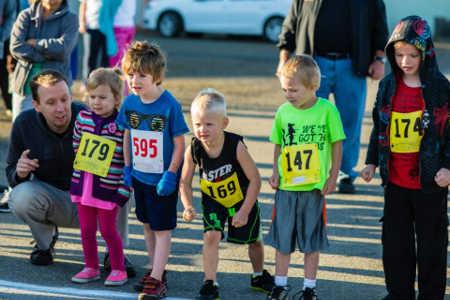
KELSEYVILLE, Calif. – The Lake County Milers are out to prove that you can mix fitness, fun and fundraising with their sixth annual Donut Run in Kelseyville on Saturday, April 11, at 8:30 a.m.
A large portion of the proceeds from the 5K run and walk, which starts and finishes at the Adobe Creek Packing facility on Loasa Road, will be donated to the Kelseyville High School Track and Cross County Teams.
“The Kelseyville Donut Run has become a great tradition for the young and old, walker and runner,” says Jeanine Burnett, event director for the Lake County Milers. “We are thrilled that the majority of our net proceeds this year will benefit the Kelseyville High School Track and Cross Country Teams.”
The sixth annual Donut Run/Walk returns to Kelseyville with donuts, coffee and juice after the race for all participants.
Race directors, Jim and Shirley Campbell, are excited about the addition of Chip Timing by NorCal Timing, Technical "wicking" shirts or tank option for the 5K and cotton t-shirts for the Kids Run all included in entry fees.
Medals will be awarded to the first-, second- and third-place male and female winners overall for the run and first through fifth place male and female winners overall for the walk, as well as to the top three winners in each age division for the run.
Medals will be awarded to the top three overall boys and girls in both kids events.
The registration fee is $30 for adults who register by April 4 and $35 thereafter and on race day.
The registration fee for youths ages 19 and under for 5k Run/Walk is $20 if registered by April 4 thereafter and on race day $25. Kids 1/2k (ages 4-5) and 1k (ages 10 and under) $10 through race day and does include a T-shirt.
For shirt guarantee (especially youth sizes) register by March 8. Event-day registration is from 7 to 7:45 a.m.; there is no guarantee on event shirts on race day registration.
For an entry form and other instructions visit the Milers Web site at www.lakecountymilers.com to print a registration form which can be mailed in along with the fee.
For a small additional convenience fee, participants can register online through www.runsignup.com/donutrun .
The Milers running and walking group meets at 9 a.m. every Saturday in two locations: Mountain High Coffee, Hartmann Road exit off Highway 29 in Hidden Valley Lake; and in Kelseyville in front of Woody’s Cafe & Pub, Kelseyville Lumber.
The public is warmly invited. Additionally, longer training runs are generally scheduled for Sundays.
To find out more about the Lake County Milers email
- Details
- Written by: Editor
MENDOCINO NATIONAL FOREST, Calif. – The California Department of Parks and Recreation and the Mendocino National Forest have maintained a successful partnership for over 30 years.
This partnership has provided funding assistance for the management of off-highway vehicle (OHV) recreation on National Forest System lands through the California State OHV Grants and Cooperative Agreements Program.
Current regulations mandated by the state of California require annual public participation in this fund allocation process.
The purpose of this notice is to share information and to solicit public input specific to the Mendocino National Forest’s upcoming grant application for the State’s 2014-2015 grant cycle.
These grants will support ongoing OHV management activities, with categories including Ground Operations (trail maintenance and facility operation and maintenance) and Law Enforcement.
“The Mendocino National Forest offers over 200 miles of designated OHV trails, providing exciting riding opportunities for a wide range of ability levels and vehicle types. In addition, over 1,300 miles of roughly graded roads are available for use by off-highway vehicle enthusiasts,” said Forest Engineer Shannon Pozas. “We appreciate your support and comments on our grant request. Your comments will help the State determine the level of funding to provide the Mendocino National Forest for ongoing trail maintenance, facility maintenance and law enforcement.”
In order to view and comment on the Mendocino National Forest’s Preliminary grant application, please visit the state of California Web site at www.ohv.parks.ca.gov then click the grants tab.
Additionally, a link to the state’s Web site may be found on the Mendocino National Forest Web site at www.fs.usda.gov/mendocino .
Comments may be provided between March 3 and April 6, 2015.
Instructions for providing comments can be found on the state of California Web site.
- Details
- Written by: Editor
The California Department of Fish and Wildlife (CDFW) is excited to announce the release of the Restoration Grant Program draft guidelines authorized and funded by Proposition 1 (Water Quality, Supply and Infrastructure Improvement Act of 2014), which was passed by California voters last November.
CDFW is now seeking public input on these guidelines via email, mail and a series of public meetings.
"This is an important opportunity to continue and expand upon the work we do across the state to restore habitat for fish and wildlife and protect important landscapes, while fostering partnerships and selecting the best projects through a competitive process," said CDFW Director Charlton H. Bonham.
For CDFW, this bond act provides, in total, $285 million for ecosystem restoration projects outside the Sacramento-San Joaquin Delta (Delta) and $87.5 million for projects that benefit the Delta.
Ecosystem restoration provides important benefits to water supply and sustainability as well as fish and wildlife habitat throughout California. Ecosystem restoration is also a climate change mitigation and adaptation strategy.
The public is encouraged to review and comment on the draft guidelines which can be found both at the CDFW Grants Web site, https://www.wildlife.ca.gov/Explore/Grant-Opportunities , and the Bond Accountability Web site, http://bondaccountability.resources.ca.gov/Guidelines.aspx?PropositionPK=48 .
Written comments should be emailed to the
CDFW will hold three public meetings in March and April 2015 for the purpose of receiving comments on the draft guidelines.
The meeting dates and locations will be posted on the CDFW Grants Web site when available.
The purpose of the guidelines is to establish the process, procedures and criteria through which CDFW will administer competitive grants for multi-benefit ecosystem and watershed protection and restoration projects in accordance with statewide priorities, including those in the California Water Action Plan.
To achieve this, CDFW is creating two new grant programs.
The Watershed Restoration Grant Program will focus on watershed restoration outside of the Delta and the Delta Water Quality and Ecosystem Restoration Grant Program will focus on water quality, ecosystem restoration and fish protection facilities that benefit the Delta.
- California Outdoors: A right to fish the oceans, scouting for abalone out of season, viewing wildlife with flashlights, treble hooks for halibut
- Fisheries agencies report positive outlook for 2015 ocean salmon fishing season
- North Coast anglers could be rewarded for returning fish tags in timely manner