How to resolve AdBlock issue?
Refresh this page
How to resolve AdBlock issue?
Refresh this page
Lake County News,California
  • Home
    • Registration Form
  • News
    • Community
      • Obituaries
      • Letters
      • Commentary
    • Education
    • Veterans
    • Police Logs
    • Business
    • Recreation
    • Health
    • Religion
    • Legals
    • Arts & Life
    • Regional
  • Calendar
  • Contact us
    • FAQs
    • Phones, E-Mail
    • Subscribe
  • Advertise Here
  • Login
How to resolve AdBlock issue?
Refresh this page
How to resolve AdBlock issue?
Refresh this page

News

Space News: The Hubble telescope has shifted into one-gyro mode after months of technical issues − an aerospace engineering expert explains


The Hubble Space Telescope is nearing its 35th birthday. NASA via AP

Imagine keeping a laser beam trained on a dime that’s 200 miles away. Now imagine doing that continuously for 24 hours, while riding a merry-go-round. Seem difficult? Well, that’s basically what the Hubble Space Telescope does.

After months of technical issues, NASA announced June 4 that Hubble would shift into one-gyroscope mode. This essentially means that the telescope will have to rely on just one of the several gyroscopes – devices that measure an object’s orientation in space – it normally uses to track and follow objects in space.

Named after astronomer Edwin Hubble, the Hubble telescope launched in 1990 into low Earth orbit. Here, it’s above Earth’s atmosphere, which interferes with the observations from Earth-based telescopes. During its three decades of operation, it has provided us with stunning pictures of distant galaxies and allowed scientists to look closer to the beginning of the universe.

Hubble takes clear, high-resolution pictures of stars billions of light years away. To collect enough photons – light “particles” – for a high-quality picture, it essentially acts as a very low-speed camera. It keeps its aperture – that is, the opening in the lens that lets light pass through – open for up to 24 hours to take a single picture.

Anyone who has taken a photo at a low shutter speed knows how difficult it is to avoid ending up with a blurry image. Hubble takes this to an extreme. It needs to stay pointed at the same distant point in space with an accuracy within a few milliarcseconds – where one milliarcsecond equals one 3,600,000th of a degree – for up to 24 hours. And it needs to keep this accuracy while orbiting the Earth at 17,000 miles per hour (27,000 kilometers per hour) through extreme heat and cold.

To keep track of its target and generate clear pictures, Hubble uses what aerospace engineers like me call attitude control systems. All spacecraft and aircraft have an attitude control system to help them point in the right direction.

What’s a gyro, anyway?

An attitude control system consists of a suite of sensors measuring the orientation of the spacecraft, a set of actuators – thrusters, reaction wheels or control moment gyroscopes – that move the spacecraft around, and a flight computer. The flight computer takes the measurements from the sensors and generates the commands for the actuators.

A diagram of the Hubble, showing three boxes labeled gyros, three labeled fine guidance sensors and two labeled reaction wheels in its interior.
The gyros work in tandem with fine guidance sensors and reaction wheels to control the telescope’s orientation in space. NASA/STSci

A gyroscope is a device that measures an object’s attitude, or orientation in space. In other words, it measures how much the object has rotated from some fixed point. For Hubble to know where it’s pointing to take a picture, it has to know where it is in space. It needs at least three gyros – one per axis.

Hubble initially had six gyros: three main ones and three more as extras. But after more than 30 years in orbit, four of the gyros have failed from complications related to aging.

From the two remaining gyros, NASA has reserved one as a backup, so Hubble is now operating with a single gyro. But if you need at least three gyros – one per axis – to know where you are, how can Hubble figure out where it is with only one gyro?

One of Hubble’s gyroscopes.

The clever answer that NASA engineers came up with is actually very simple. You can use other sensors on the telescope, such as magnetometers and star sensors, to make up for the lack of gyros.

Gyro stand-ins

Magnetometers measure Earth’s local magnetic field, which scientists understand pretty accurately. You can use the magnetometers to get a rough idea of the attitude with respect to the known magnetic field direction, pretty much the same way you use a compass. A three-axis magnetometer can take measurements of the strength and direction of the Earth’s magnetic field as the satellite moves along its orbit to find its orientation in space.

Or you can use star trackers or sun sensors, which are much more accurate than magnetometers. These sensors use a map of the sky and align what they see with what’s on the map to figure out where they are pointing.

By combining the star trackers, sun sensors, magnetometers and a single gyro, Hubble can maintain a pointing accuracy that is very close to the three-gyro configuration – although the one-gyro configuration will limit how fast Hubble can track objects in space.

Hubble has one of the most accurate pointing attitude control systems ever built, and it has provided people with stunning pictures of the early universe. But losing all but two gyros is just another reminder that Hubble’s days are numbered.

Hubble’s successor, the James Webb Space Telescope, launched on Dec. 25, 2021. It is stationed 1,000,000 miles (1,609,344 km) away from Earth at what is called the second Lagrange point (L2).

At this point, the telescope, the Earth and the Sun are always aligned, and the telescope’s protective sun shield blocks the Sun’s rays. This feature allows its infrared camera to operate at chilly temperatures to provide much better-quality pictures.

While the long-enduring Hubble’s discoveries opened the universe to astronomers, Webb will allow us to look deeper into the cosmos than ever before.The Conversation

Panagiotis Tsiotras, Professor of Aerospace Engineering, Georgia Institute of Technology

This article is republished from The Conversation under a Creative Commons license. Read the original article.
Details
Written by: Panagiotis Tsiotras, Georgia Institute of Technology
Published: 23 June 2024

State Parks signs agreement with Big Valley tribe for Clear Lake State Park use, collaboration

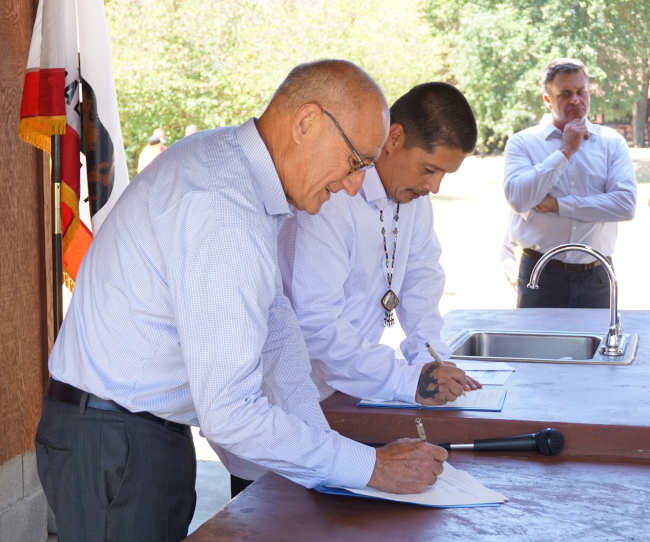
From right, State Parks Director Armando Quintero and Big Valley Tribal Chair Flaman McCloud Jr. sign a memorandum of understanding between State Parks and the tribe as Matt Teague, Northern Buttes District superintendent, looks on during a special event on Friday, June 21, 2024, at Clear Lake State Park in Kelseyville, California. Photo by Elizabeth Larson/Lake County News.

KELSEYVILLE, Calif. — California State Parks officials gathered with members of the Big Valley Band of Pomo Indians on Friday to celebrate a new collaborative agreement meant to support greater use of the park by the tribe, whose leaders said it is part of their original homeland.

The event at the park’s pavilion featured prayers by tribal elders and the signing of a memorandum of understanding, or MOU, which State Parks Director Armando Quintero said formalizes the relationship between the state and Big Valley.

The MOU State Parks signed with Big Valley on Friday is the 12th such agreement the state has entered into with a tribe. Quintero said the agreements vary from tribe to tribe.

The first tribal MOU was between State Parks and the Koi Nation of Northern California. That agreement, signed in April 2017, was for the purpose of collaboration and cooperation, and protecting cultural and natural resources in Anderson Marsh State Historic Park in Lower Lake.

That five-year MOU was renewed on Aug. 30 during a signing ceremony in which Lewis Ridge — reportedly named for Lewis’s woodpeckers that, in turn, are named after explorer Meriwether Lewis — was renamed Mxqawlay’ba Knowin Xyoykith Ridge, which translates to “the grandmothers/ancestors heal on this mountain,” in Southeastern Pomo.

At that time, McVicar Trail — named for a property donor — was renamed Dawa Qanoq’ana, which translates into “south way in front of me.”

Those renaming actions are part of the State Parks Reexamining our Past Initiative, which the agency said “seeks to remove derogatory and inaccurate names and materials from the State Park System while restoring native names and other significant aspects of California's cultural heritage.”

In the case of Clear Lake State Park, State Parks officials said the Big Valley tribe will contribute information on interpretation and resources, and will collaborate on actions around planning.

The MOU also will streamline communications and be a foundational document for care and stewardship.

The 590-acre park on the shore of Clear Lake was founded in 1949. It remains a popular and busy park year-round.

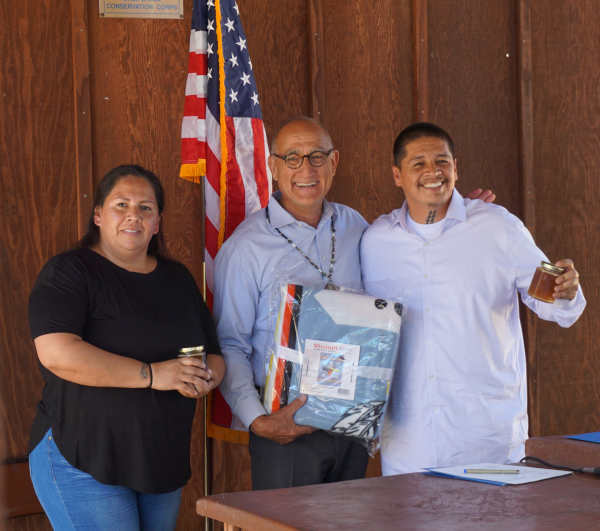
From left, Big Valley Tribal Secretary Vivian McCloud, State Parks Director Armando Quintero and Big Valley Tribal Chair Flaman McCloud Jr. celebrate during a signing ceremony for the agreement between California State Parks and Big Valley Band of Pomo Indians on Friday, June 21, 2024, at Clear Lake State Park in Kelseyville, California. Photo by Elizabeth Larson/Lake County News.

A momentous time for the tribe

Big Valley Tribal Chair Flaman McCloud Jr. offered a prayer at the start of the ceremony. He credited Philip Gomez, his predecessor as tribal chair, for helping start the process to establish the agreement with State Parks. Gomez died in February.

McCloud also welcomed a big group of runners taking part in the 500 Mile American Indian Spirit Marathon, who stop each year at the rancheria and decided to stop in at the ceremony.

“This is a momentous time for our tribe,” said McCloud, explaining their ancestral connection to the land. “This is where our people came from.”

He added, “The goal is to have this as ours,” not a part but the whole thing.

McCloud said they can talk about suffering, but they also have many blessings.

He thanked State Parks staff for working with the tribe to make the agreement happen.

Quintero, who along with McCloud signed the agreement at the event, recognized his own Indigenous heritage, tracing back to the Huichol people of central Mexico.

For Quintero, the event was particularly meaningful since it fell on the longest day of the year, which he said is a pause between the old year and the new one. “For me there is a sense of power and presence.”

He said it’s much more than an agreement. It allows for the tribe to practice ceremonies and gather plants and other materials for their use.

“These are your lands,” he told tribal members.

Tribal Secretary Vivian McCloud, Flaman McCloud’s sister, also credited the previous council — including Gomez — with starting the work that led to the agreement.

She said the tribe is looking forward to the future, and she thanked State Parks for sitting at the table with them.

“There’s so many things to be thankful for when it comes to Big Valley,” she said.

McCloud said she was humbled to be there. “It is an honorable place to be,” adding, “What a day in history, right?”

She said there are a lot of good things happening for the tribe, including the upcoming Tule Boat Festival in July.

The tribe, she said, is a good community partner that stands firm on tribal sovereignty. They have to speak for their ancestors and think about the seven generations to come when making decisions. “It’s not just about now.”

Brian Walsh, the State Parks archaeologist and district tribal liaison, said the agency received its first request from the tribe to work on an agreement in October 2021 and held the first meeting the following month.

After the ceremony, Quintero told Lake County News that the agreement gives full access to the park to tribal members for gathering of plants and minerals. They also will collaborate with State Parks in a full partnership to protect cultural sites.

The agreement also will facilitate the return of ceremonies within the park lands.

“Our charge is to protect cultural and natural history,” Quintero said.

He said it’s important to tell the truth about the history of the tribes.

Quintero referred to the changes at Sutter's Fort State Historic Park, where the master plan has been rewritten to represent the tribes. Now, no improvements at the site can involve putting materials into the ground because the fort was built on top of a village.

“It gives me a very powerful sense of pause,” Quintero said of including tribal history in the planning and understanding of park sites.

A lot of parks are doing fire planning with the tribes as part of safely managing the landscapes, he said.

In the newest state park, Dos Rios in Modesto, they also have included an area with plants for making basketry and other items. Quintero said it’s important to offer a safe place for plant gathering and growing, as most of the plants have been only available along roadsides. Indigenous women use their mouths to work on the materials, and as a result have the highest rate of mouth cancer, which he believes is a result of pollutants from the roadsides.

It’s expected Big Valley will be involved in the general plan update process for Clear Lake State Park that officials said is now getting underway.

Asked about statements made by tribal members about a desire to have the parklands back, Leslie Harzell, State Parks’ cultural resources division chief, department preservation officer and tribal liaison, said the agency doesn’t have statutory authority to return parklands.

Rather, they do consultation on access and capacity for co-management. In the case of the Yurok, in April 2022 the tribe — in partnership with State Parks, Parks California and Redwood National Park — opened the Stone Lagoon Visitor Center, the first tribally operated visitor center within the State Park system.

Hartzell said the California Natural Resources Agency has a grant program for tribes to explore a land back program through acquiring surplus state lands.

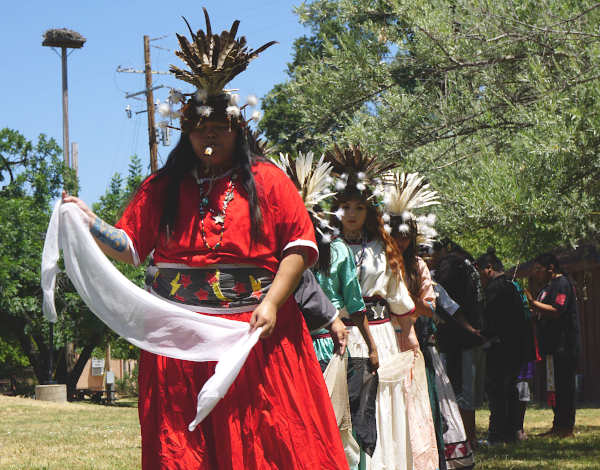
Pomo dancers perform following the signing ceremony for the agreement between California State Parks and Big Valley Band of Pomo Indians on Friday, June 21, 2024, at Clear Lake State Park in Kelseyville, California. Photo by Elizabeth Larson/Lake County News.

The park as resource

Tribal Secretary Vivian McCloud told Lake County News that she and her family didn’t grow up in Lake County but came back to live here between 10 and 15 years ago. They have ancestral ties through their grandmothers.

“The park has always been a resource” for medicine and materials like tules, she said.

They will gather tules at the park in July in preparation for the Tule Boat Festival, which takes place July 25 to 27 at Big Valley Rancheria.

The work to create the boats is a three-day process, from gathering to construction, she said.

McCloud said the MOU is creating new opportunities, such as allowing tribal members to visit and camp there without cost.

The agreement also is giving rise to new relationships and understanding. “It’s very healing to us,” she said.

During his comments at the start of the ceremony, Tribal Chair Flaman McCloud Jr. said he had envisioned “little feet” moving across the park, a reference to his ancestors.

On Friday, there were more little feet active in the park, but these weren’t from the past. Rather, they showed the shape of the tribe’s future — including the young dancers who swayed and twirled on the lawn near the pavilion.

There also were the tribe’s children, playing along the creek, sitting at the water’s edge, and catching and holding lizards.

Looking out across the park and the multicultural blend of people enjoying and using it, Quintero said, “The work here I think is going to go on well into the future.”

Email Elizabeth Larson at This email address is being protected from spambots. You need JavaScript enabled to view it.. Follow her on Twitter, @ERLarson, or Lake County News, @LakeCoNews.
Details
Written by: Elizabeth Larson
Published: 22 June 2024

Fires update: Region’s big fires held to no new acreage

LAKE COUNTY, Calif. — Work is continuing to put out the season's big wildland fires around the region.

The Sites fire, burning since Monday afternoon near Stonyford in Colusa County, was held to 19,195 acres on Friday, Cal Fire reported.

Containment rose to 30%, up from 20% the day before.

Cal Fire said approximately 2,205 personnel are assigned — up by more than 300 since the previous day — with 165 engines, 31 water tenders, 14 helicopters, 23 dozers and 64 hand crews.

In Sonoma County, the Point fire remains at 1,207 acres while containment with containment at 80%.

There are 400 personnel on the incident, with 21 engines, nine water tenders, eight dozers and 18 hand crews, Cal Fire said.

After an afternoon of temperatures approaching the 90-degree mark, Cal Fire anticipated that the marine layer would return overnight, “resulting in another night of excellent relative humidity recovery.

Cal Fire said crews continue to mop up and secure lines around the fire. Fire suppression repair also continues.

All evacuations have been lifted and damage inspections have been completed, Cal Fire said.

Email Elizabeth Larson at This email address is being protected from spambots. You need JavaScript enabled to view it.. Follow her on Twitter, @ERLarson, or Lake County News, @LakeCoNews.
Details
Written by: Elizabeth Larson
Published: 22 June 2024

Clearlake Animal Control: ‘Juliet,’ ‘Brennan’ and ‘Dale’

CLEARLAKE, Calif. — Clearlake Animal Control has many dogs awaiting their new families.

The Clearlake Animal Control website lists 41 adoptable dogs.

“Juliet.” Photo courtesy of Clearlake Animal Control.

The available dogs this week include “Juliet,” a female Labrador retriever mix with a chocolate and white coat. She has been spayed.

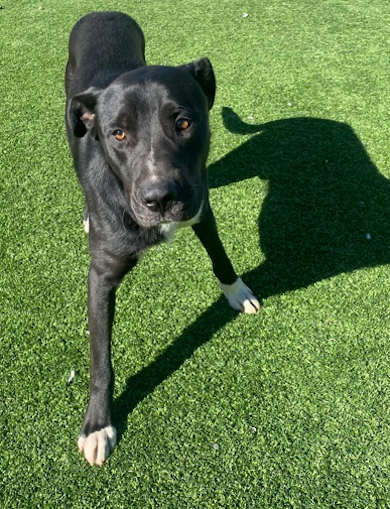
There is also “Brennan,” a male Labrador retriever mix with a black and white coat.

“Brennan.” Photo courtesy of Clearlake Animal Control.

Another adoptable dog is “Dale,” a male Doberman pinscher mix with a black and tan coat.

The shelter is located at 6820 Old Highway 53. It’s open from 9 a.m. to 6 p.m. Tuesday through Saturday.

“Dale.” Photo courtesy of Clearlake Animal Control.

For more information, call the shelter at 707-762-6227, email This email address is being protected from spambots. You need JavaScript enabled to view it., visit Clearlake Animal Control on Facebook or on the city’s website.

This week’s adoptable dogs are featured below.

Email Elizabeth Larson at This email address is being protected from spambots. You need JavaScript enabled to view it.. Follow her on Twitter, @ERLarson, or Lake County News, @LakeCoNews.

Details
Written by: Elizabeth Larson
Published: 22 June 2024
  1. Space News: Space radiation can damage satellites − my team discovered that a next-generation material could self-heal when exposed to cosmic rays
  2. City and county governments laud Supreme Court decision stopping ballot initiative
  3. Passenger killed in Thursday evening vehicle crash

Subcategories

Community

  • 633
  • 634
  • 635
  • 636
  • 637
  • 638
  • 639
  • 640
  • 641
  • 642
How to resolve AdBlock issue?
Refresh this page