How to resolve AdBlock issue?
Refresh this page
How to resolve AdBlock issue?
Refresh this page
Lake County News,California
  • Home
    • Registration Form
  • News
    • Community
      • Obituaries
      • Letters
      • Commentary
    • Education
    • Veterans
    • Police Logs
    • Business
    • Recreation
    • Health
    • Religion
    • Legals
    • Arts & Life
    • Regional
  • Calendar
  • Contact us
    • FAQs
    • Phones, E-Mail
    • Subscribe
  • Advertise Here
  • Login
How to resolve AdBlock issue?
Refresh this page
How to resolve AdBlock issue?
Refresh this page

News

Extreme heat can be dangerous for runners, cyclists and anyone spending time outdoors: 6 tips for staying safe


Think carefully before running or cycling in the heat of the day. Saul Loeb/AFP via Getty Images

When summer starts with a stifling heat wave, as many places are seeing in 2024, it can pose risks for just about anyone who spends time outside, whether they’re runners, people who walk or cycle to work, outdoor workers or kids playing sports.

Susan Yeargin, an expert on heat-related illnesses, explains what everyone should think about before spending time outside in a heat wave and how to keep yourself and vulnerable family members and friends safe.

What risks do people facing running, walking or working outside when it’s hot out?

The time of day matters if you’re going for a run, or if you’re walking or cycling to work during a heat wave. Early risers or evening runners face less of a risk – the Sun isn’t as hot and the air temperature is lower.

But if your normal routine is to go for a run midmorning or over lunch, you probably want to rethink exercising in the heat.

Pretty much everywhere in the U.S., the hottest part of the day is between 10 a.m. and 6 p.m. The body will gain heat from both the air temperature and solar radiation. The ground also heats up, so you’ll feel more heat rising up from the asphalt or grass.

Add humidity to the mix and that will also affect your body’s ability to dissipate heat through sweat.
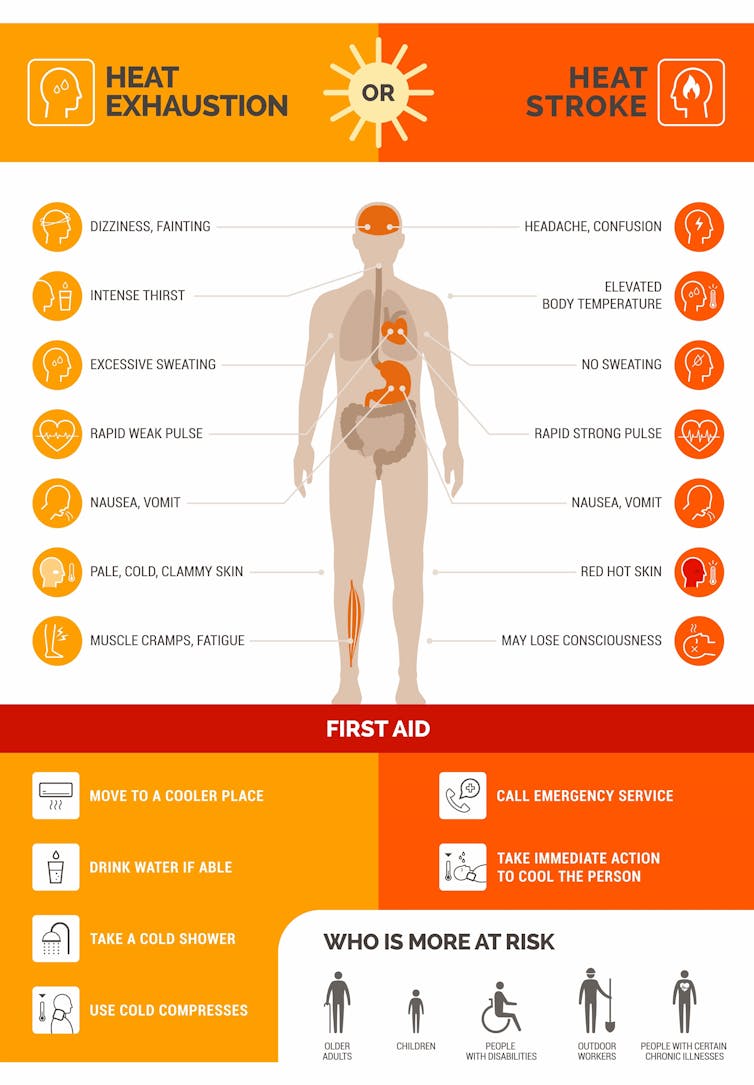
Symptoms of heat exhaustion and heat stroke
Signs of heat illness and what to do. Elenabs via Getty Images

Don’t forget that the body also generates internal heat when you’re active, whether you’re running or even mowing your lawn. When it’s warm to hot outside, you’re further increasing your heat gain through that exertion. The harder someone runs or cycles, the more heat they’re generating.

Outdoor workers on farms, construction sites or even walking dogs are often in the heat longer, with less flexibility for breaks.

Do our bodies eventually adapt to summer heat?

It takes about two weeks for the typical person to fully acclimatize to higher temperatures. Over that time, your body makes amazing adaptations to handle the heat.

Your sweat rate improves, dissipating heat more effectively. Your plasma volume expands so you have more blood pumping through your body, so the heart doesn’t have to work as hard. Because your cardiovascular system is more efficient, your body doesn’t heat up as much. You also retain salt a bit better, which helps you keep water in your body.

That doesn’t mean you’re ready for even higher temperatures or extreme heat, though. Even if you’re acclimatized to 80-degree weather, you might not be ready for a 95-degree heat wave. When we get early season heat waves and high humidity, that can reach a level people aren’t adapted to handle yet. And some combinations of heat and humidity are too much for anyone to safely spend much time in.

Are young children and older people at higher risk in the heat?

In older adults, the cardiovascular system isn’t as flexible and powerful as it used to be, so it doesn’t operate as efficiently, and sweating mechanisms decrease. That leaves older adults at greater risk for illnesses such as heat exhaustion or heat stroke.

Their thirst mechanism may also not function as well, leaving them more likely to become dehydrated. Some older adults are also less willing or able than younger people to seek out cooling centers.
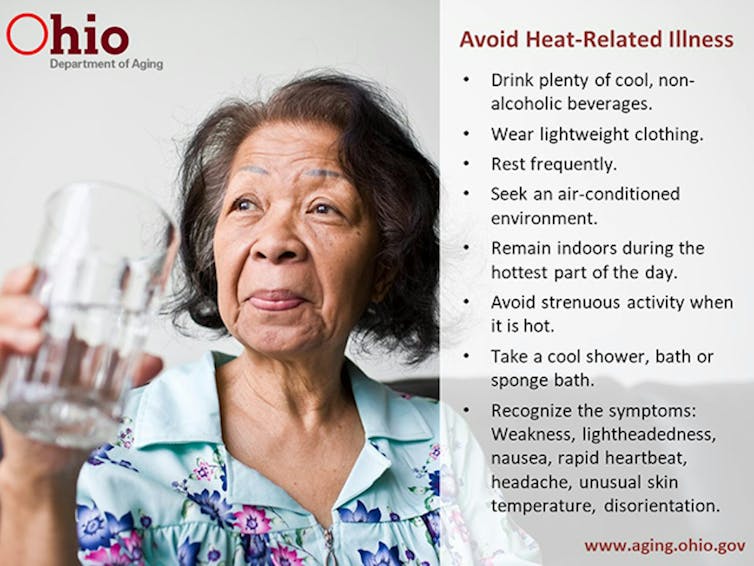
An older woman holds a glass of water next to a list of safety tips for older adults facing heat waves.
Tips for avoiding heat illness can save lives, but they can be difficult to follow, even in wealthy countries. Ohio Department of Aging.

Children might take a few more days to acclimatize than adults. They’re also more dependent on skin heat loss than sweating, which is why their skin can get red and flushed-looking.

Children are probably better about complaining about feeling too hot or not feeling well, though, so listen to them and help them seek out cooler areas. They might not realize that they can take a break during soccer practice, or that they should come in from the beach.

What are your top heat safety tips?

Be smart about the time of day you’re being active: People love their routines, but you need to get the workout and yard work and other outdoor activities done early in the day or late in the evening. Avoiding the hottest parts of the day is the smartest way to prevent heat illnesses. When outside and the Sun is up, seek places with shade.

Have good hydration habits: Don’t ignore thirst – it’s your body telling you something. Hydration keeps your plasma volume higher to help your heart work less and decreases your overall risk for heat illnesses. Your brain and muscles are also composed of water, so if your body senses that you don’t have enough water, it will start to sacrifice other things, including how much you’re sweating.

Listen to your body: When you do need to be outside to work or play, your body will give you cues regarding how it’s handling the heat. If you don’t feel well, feel hot or can’t seem to push harder, your body is telling you to slow down, add extra breaks or get out of the situation.

A man in a floppy hat and T-shirt pours water from a bottle into his mouth in front of a truck.
A worker wears a hat and cool clothes and tries to stay hydrated against the heat near St. Louis, Mo., on June 17, 2024. AP Photo/Jeff Roberson

Make smart clothing choices: Wear light-colored clothing, which absorbs less heat than dark clothes. Short-sleeved shirts and shorts can also avoid helping heat build up or impairing sweat evaporation.

Remember that helmets and sports equipment hold in heat: Construction workers often have to wear hard hats, but athletes don’t always need to practice with shoulder pads and helmets, especially in high heat. To help workers, there is a push for companies to follow health safety guidelines, such as providing cooling stations and hydration breaks.

Get a good night’s sleep: Heat exposure one day can affect your risk the following day. If you can sleep in air conditioning and get a good night’s sleep, that may help decrease the risk of heat illness.The Conversation

Susan Yeargin, Associate Professor of Athletic Training, University of South Carolina

This article is republished from The Conversation under a Creative Commons license. Read the original article.

Details
Written by: Susan Yeargin, University of South Carolina
Published: 24 June 2024

‘Meet me at the bell’: Lakeport Rotary partners with city to create new curfew bell monument

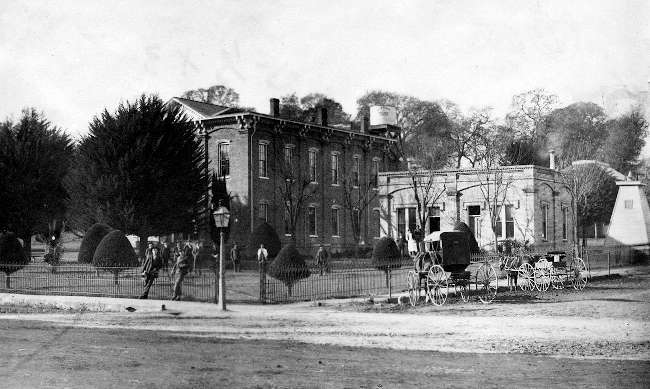
The Lakeport curfew bell also was used for emergencies. This image indicates the bell was located on Third Street and that the picture was from the time between 1896 and 1900. Photo courtesy of the Lakeport Rotary Club.

LAKEPORT, Calif. — Thanks to a partnership between the Lakeport Rotary and the city of Lakeport, an important piece of history is about to be added to the new Xabatin Park.

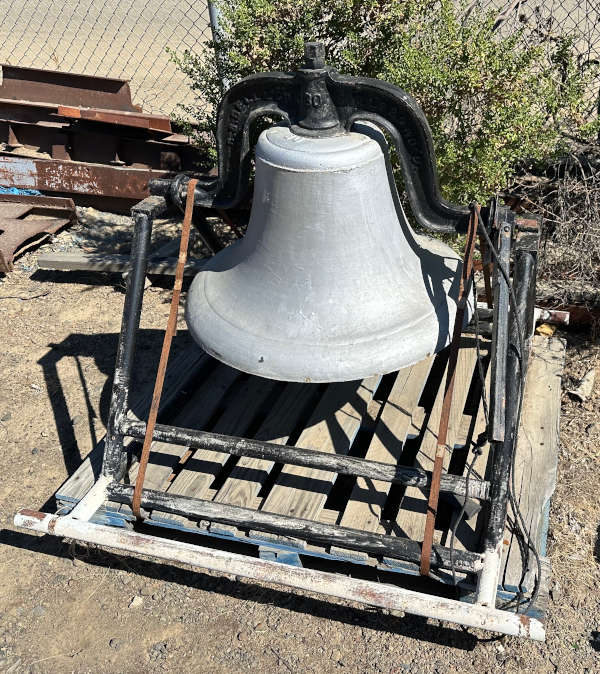
The historic Lakeport “curfew” — or “hooligan” — bell is slated to be the focus of a new monument at the park, which opened in October.

The Lakeport City Council gave its seal of approval to the project when it met on Tuesday.

Lakeport Public Works Director Ron Ladd said the curfew bell “is a fun project” they’ve been working on for over a year.

“The curfew bell has been a part of Lakeport history for a long time,” Ladd said.

His written report explained that Public Works “has collaborated closely” with the Lakeport Rotary Club to place the bell in the newly finished Xabatin Park. “The Rotary Club has generously agreed to fund the construction of a concrete pad and the installation of two benches at the designated location within the park.”

Ladd said in his report that the bell is “a treasured piece of local history dating back to the early 1900s. It rang every night at 10 p.m. to alert children that it was time to return home. This bell is a symbol of the community's past and a testament to Lakeport's rich heritage. Preserving and displaying the bell in Xabatin Park will allow current and future generations to connect with a tangible piece of the City’s history.”

Ladd credited Public Works Superintendent Jim Kennedy for finding the bell on the Lake County Fairgrounds property.

When the city was designing Xabatin Park, they thought it would be cool to incorporate the bell into the design, Ladd said.

However, due to facing a lot of budget challenges for the park, Ladd said the bell project was set aside.

Now, however, the situation has changed. “I’m really excited to see this project move forward,” Ladd said.

Mark Lipps, president of the Lakeport Rotary, explained the club’s efforts to preserve and showcase the bell.

“History is community,” said Lipps.

The historic Lakeport curfew — or “hooligan” — bell will soon have a new permanent home at the city’s Xabatin Park. Photo courtesy of the Lakeport Rotary Club.

He said the bell project is part of responding to an increased interest people have for walkable towns and embracing history. Young people particularly are interested in learning the history of places they visit.

Lipps said the Rotary wants to use history to help the downtown thrive. “We need to embrace it,” he said, adding he’s a historian at heart.

The bell, he suggested, was an early form of texting, and notified people that they were supposed to be off the street at 10 p.m. Some places rang their bells at 8 p.m.

The goal, Lipps said, is to use the bell to create a destination. Rotary ordered two benches, one of which will have the Lakeport Rotary logo. They were set to arrive on Friday.

“That’s a very exciting first step,” Lipps said.

The bell display and benches will be located near the parking lot and the bathrooms. Lipps said the benches will face the lake with the bell in the middle on a concrete platform and a plaque with historical elements. There also will be a plaque on the bell base with the names of the Rotary Club board members. Clearlake Redi-Mix is donating the concrete.

Lipps said he hopes people will say, “Meet me at the bell.”

He also hopes that it will encourage others to promote the city.

The total cost of the project — benches, plaque and construction — is around $25,000. Lipps said the Rotary is paying for the entire project.

Like Ladd, he credited Kennedy for saving the bell when the fair wanted to get rid of it. At that point, the bell was taken to the city’s Public Works yard for safe keeping.

He said Jonathan Bridges of Bridges Construction shared that his mother had, at one time, lived above the fire station, and was given free rent in exchange for ringing the curfew bell.

Lipps thanked everyone and said he’s looking forward to seeing them at the ribbon cutting, the date of which has not yet been set.

City Manager Kevin Ingram said he’s grateful to Rotary for the bell project, adding that the city was sorry to have to remove it from the original park plan.

Like Lipps, Ingram said he hopes the bell will become a place to meet.

Councilman Brandon Disney suggested the bell might be rung at night again. “That park is getting great use and that is a perfect spot for the bell.”

He moved to approve the bell’s placement and acknowledge Lakeport Rotary for its contribution, which Councilwoman Stacey Mattina seconded. The council unanimously approved Disney’s motion.

To support the project, donations can be sent to the Rotary Club of Lakeport, P.O. Box 937, Lakeport, CA 95453.

Email Elizabeth Larson at This email address is being protected from spambots. You need JavaScript enabled to view it.. Follow her on Twitter, @ERLarson, or Lake County News, @LakeCoNews.


The curfew bell at the original Lakeport Courthouse, on top of a pyramid-shaped monument at the far right of the image. Photo courtesy of the Lakeport Rotary Club.
Details
Written by: Elizabeth Larson
Published: 23 June 2024

Helping Paws: Puppies and older dogs

LAKE COUNTY, Calif. — Lake County Animal Care and Control has new young dogs and older dogs all waiting for homes this week.

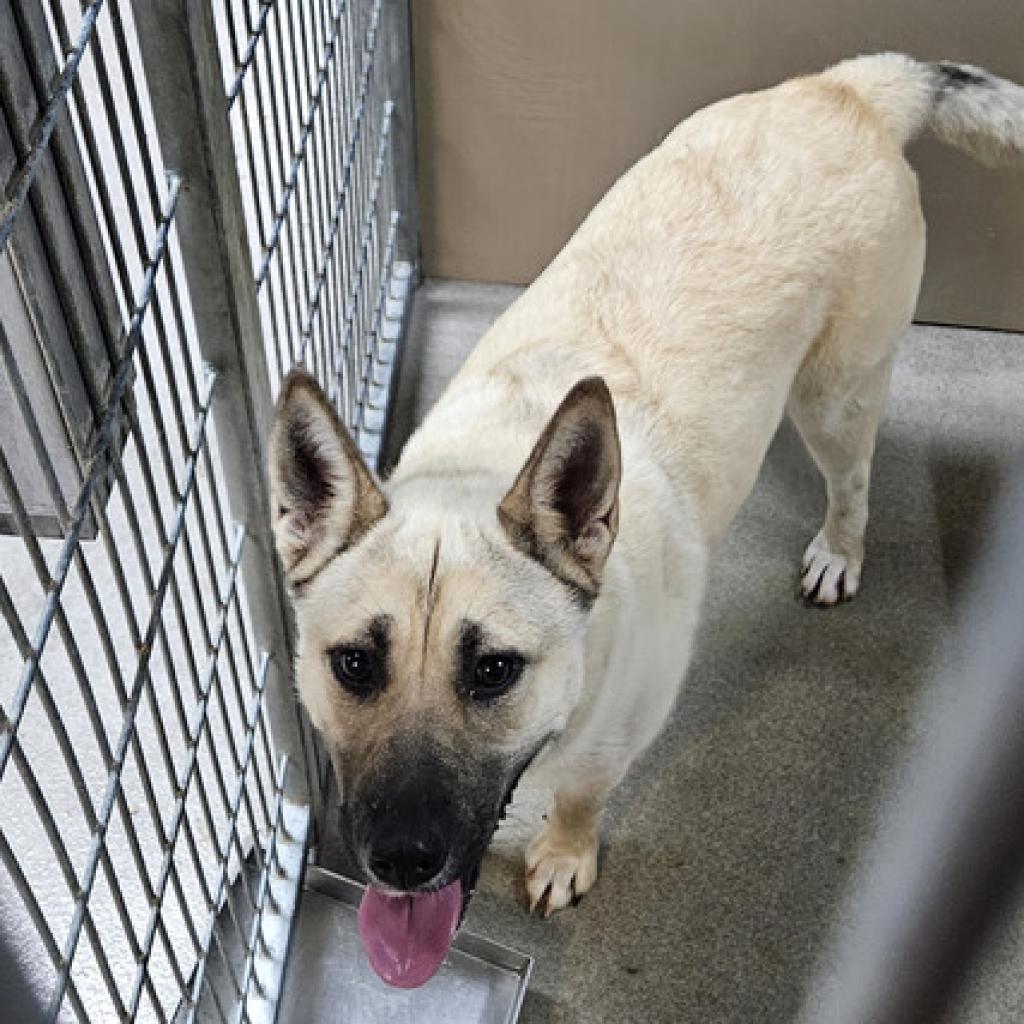
Dogs available for adoption this week include mixes of Australian cattle dog, bulldog, Chihuahua, dachshund, German shepherd, Labrador Retriever, mastiff, pit bull terrier, Rottweiler and terrier.

Dogs that are adopted from Lake County Animal Care and Control are either neutered or spayed, microchipped and, if old enough, given a rabies shot and county license before being released to their new owner. License fees do not apply to residents of the cities of Lakeport or Clearlake.

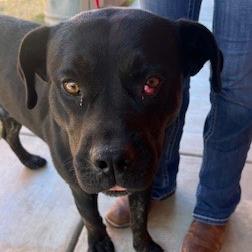
Those dogs and the others shown on this page at the Lake County Animal Care and Control shelter have been cleared for adoption.

Call Lake County Animal Care and Control at 707-263-0278 or visit the shelter online for information on visiting or adopting.

The shelter is located at 4949 Helbush in Lakeport.

Email Elizabeth Larson at This email address is being protected from spambots. You need JavaScript enabled to view it.. Follow her on Twitter, @ERLarson, or Lake County News, @LakeCoNews.


Foster#7134(Crusty)'s preview photo
Foster#7134(Crusty)

 
Kennel#2's preview photo
Kennel#2


Kennel#24(Rex)'s preview photo
Kennel#24(Rex)

Kennel#9's preview photo
Kennel#9

Kennel#10's preview photo
Kennel#10

Kennel#20(Piper)'s preview photo
Kennel#20(Piper)

 
Kennel#21(Coco)'s preview photo
Kennel#21(Coco)

Kennel#8's preview photo
Kennel#8

Kennel#29a's preview photo
Kennel#29a

Kennel#32's preview photo
Kennel#32

Kennel#29c's preview photo
Kennel#29c

Kennel#29d's preview photo
Kennel#29d

Kennel#33's preview photo
Kennel#33

Kennel#34's preview photo
Kennel#34

Kennel#25's preview photo
Kennel#25

Kennel#30's preview photo
Kennel#30

Kennel#12's preview photo
Kennel#12

Kennel#13's preview photo
Kennel#13

Kennel#19's preview photo
Kennel#19

Kennel#7's preview photo
Kennel#7


Kennel#31(Domino)'s preview photo
Kennel#31(Domino)
Kennel#15's preview photo
Kennel#15

Kennel#17's preview photo
Kennel#17

Kennel#18's preview photo
Kennel#18

Kennel#23's preview photo
Kennel#23

Kennel#4's preview photo
Kennel#4

 
Kennel#11(Luna)'s preview photo
Kennel#11(Luna)


Details
Written by: Elizabeth Larson
Published: 23 June 2024

California leaders announce 2024 state budget agreement

On Saturday, Gov. Gavin Newsom, Senate President pro Tempore Mike McGuire and Speaker of the Assembly Robert Rivas announced that they have reached an agreement on the 2024 state budget, which they said will support the state’s fiscal stability while preserving key programs that Californians depend on.

The agreement maintains the multi-year fiscal structure proposed by the governor in the May Revision to balance the budget in both 2024-25 and 2025-26, based on current revenue and spending projections.

It maintains what Newsom’s office called “the responsible budget approach that has benefitted California in recent years,” and also protects key safety net, housing, homelessness and classroom funding while preserving significant budget reserves to address future challenges.

Adding further fiscal protection, part of the agreement proposes additional legislation in August requiring the state to set aside a portion of anticipated surplus funds to be allocated in a subsequent budget act, so that the state does not commit certain amounts of future anticipated revenues until those revenues have been realized.

A 2026 constitutional amendment to grow the state’s Rainy Day Fund also will be pursued.

“This agreement sets the state on a path for long-term fiscal stability – addressing the current shortfall and strengthening budget resilience down the road,” said Newsom. “We’re making sure to preserve programs that serve millions of Californians, including key funding for education, health care, expanded behavioral health services, and combatting homelessness. I’m grateful for the partnership of our legislative leaders in meeting this challenge with balanced solutions that continue to make progress on California’s priorities.”

“Make no mistake: This is a tough budget year, but it also isn’t the budget situation we were originally fearing,” said McGuire. “Thanks to hard work, tough decisions, and early actions, we’ve been able to shrink the shortfall, protect our progress, and maintain responsible reserves. This balanced budget helps tackle some of our toughest challenges with resources to combat the homelessness crisis, investments in housing, and funding to fight wildfires and retail theft. And we’ve come together to lift up our kids and public schools with record funding, help the most vulnerable in our communities, and address the climate crisis. We owe a big thanks to our budget chairs, Speaker Rivas, Gov. Newsom and to the people of California for entrusting us with this incredible responsibility.”

“The Assembly fought hard to protect the public services that matter most to Californians, and we are delivering a budget that prioritizes affordability and long-term stability,” said Rivas. “We secured crucial investments to lower housing costs and keep people in their homes, and to sustain essential programs that help vulnerable families thrive. Students will grow and succeed because we kept classroom spending whole. And by balancing our budget this year and next, while preserving half the Rainy Day Fund, we are prepared for the future. Accountability was a cornerstone of this journey, which included 72 Assembly budget hearings and hundreds of hours of public feedback. None of this happens without the dedication of legislative staff, and I extend my deepest gratitude to them, along with my great appreciation for the Governor and Pro Tem. This is a strong budget that reflects our Caucus’ commitment to Californians’ priorities.”

Read an overview of the 2024 state budget agreement here.
Details
Written by: Lake County News reports
Published: 23 June 2024
  1. Space News: The Hubble telescope has shifted into one-gyro mode after months of technical issues − an aerospace engineering expert explains
  2. State Parks signs agreement with Big Valley tribe for Clear Lake State Park use, collaboration
  3. Fires update: Region’s big fires held to no new acreage

Subcategories

Community

  • 632
  • 633
  • 634
  • 635
  • 636
  • 637
  • 638
  • 639
  • 640
  • 641
How to resolve AdBlock issue?
Refresh this page