 How to resolve AdBlock issue?
News
Legislation advanced on Wednesday from Sen. Bill Dodd, D-Napa, that would help protect the finances of California public schools faced with the challenge of declining enrollment by extending the authority of local school boards to consider the fiscal impact of new charter school applications.
“When it comes to educating our children, locally elected school boards must decide how our precious resources are spent,” Sen. Dodd said. “They must have the tools to recover from financial setbacks due to declining enrollment and focus their funds where they will have the greatest benefit. I appreciate the committee support for my bill, which will help rebuild strong schools and ensure everyone has access to the best education possible.”
Enrollment in California public schools has declined over the past two decades because of several factors including a declining birth rate and migration from California.
Because school districts receive their funding based on the number of students they educate, the loss of students has serious financial effects, which require local leaders to make difficult budget choices, including the closing of schools.
Compounding financial stress and recovery is the establishment of new charter schools that operate independently from local districts and draw away their public education funds critical to their fiscal health and solvency.
In response, Sen. Dodd introduced Senate Bill 1380, which gives greater authority to local school district boards in considering charter school applications that would negatively impact their financial stability.
The bill would clarify that local school districts can deny applications for new charter schools where a campus was closed or when a district has made necessary budget decisions to protect against fiscal insolvency within the last five years due to declining enrollment.
Also, it would authorize county education boards to make a finding to deny charter school petitions that are substantially similar to petitions that were previously denied by a local school board.
Finally, the bill wouldn’t impact the continuation of existing charter schools nor require any charter school application from being denied.
SB 1380 is co-sponsored by the California School Boards Association, Napa Valley Unified and Vallejo City Unified school districts. It was approved today by the Senate Education committee.
“SB 1380 will provide school district and county boards of education with better tools to improve the charter authorization process and eliminate redundancy that undermines local control and jeopardizes the integrity of important charter agreements signed in recent years,” said CSBA President Albert Gonzalez. “This legislation protects the long-term fiscal stability of schools and local community input, which is essential for delivering high-quality educational opportunities to students. We applaud Sen. Dodd’s efforts to support our local governing boards, particularly those making difficult decisions to improve services for all students.”
“Protecting the district’s fiscal solvency is my top priority because, without resources, we cannot give our students the quality education they deserve nor support the staff who dedicate themselves to educating them,” said William Spalding, superintendent of Vallejo City Unified School District. “SB 1380 will ensure that the hard work the district has done to recover from bankruptcy will not be compromised. We appreciate Sen. Dodd’s leadership and his commitment to our students.”
“Two-thirds of California’s school districts are getting less funding due to declining enrollment, while operating costs continue to rise,” said Rosanna Mucetti, superintendent of Napa Valley Unified School District. “We’re thankful Sen. Dodd has introduced SB 1380, which will help ensure that adults confidently make fiscal decisions in the best interest of all students.”
Dodd represents the Third Senate District, which includes all or portions of Napa, Solano, Yolo, Sonoma, Contra Costa and Sacramento counties.
“When it comes to educating our children, locally elected school boards must decide how our precious resources are spent,” Sen. Dodd said. “They must have the tools to recover from financial setbacks due to declining enrollment and focus their funds where they will have the greatest benefit. I appreciate the committee support for my bill, which will help rebuild strong schools and ensure everyone has access to the best education possible.”
Enrollment in California public schools has declined over the past two decades because of several factors including a declining birth rate and migration from California.
Because school districts receive their funding based on the number of students they educate, the loss of students has serious financial effects, which require local leaders to make difficult budget choices, including the closing of schools.
Compounding financial stress and recovery is the establishment of new charter schools that operate independently from local districts and draw away their public education funds critical to their fiscal health and solvency.
In response, Sen. Dodd introduced Senate Bill 1380, which gives greater authority to local school district boards in considering charter school applications that would negatively impact their financial stability.
The bill would clarify that local school districts can deny applications for new charter schools where a campus was closed or when a district has made necessary budget decisions to protect against fiscal insolvency within the last five years due to declining enrollment.
Also, it would authorize county education boards to make a finding to deny charter school petitions that are substantially similar to petitions that were previously denied by a local school board.
Finally, the bill wouldn’t impact the continuation of existing charter schools nor require any charter school application from being denied.
SB 1380 is co-sponsored by the California School Boards Association, Napa Valley Unified and Vallejo City Unified school districts. It was approved today by the Senate Education committee.
“SB 1380 will provide school district and county boards of education with better tools to improve the charter authorization process and eliminate redundancy that undermines local control and jeopardizes the integrity of important charter agreements signed in recent years,” said CSBA President Albert Gonzalez. “This legislation protects the long-term fiscal stability of schools and local community input, which is essential for delivering high-quality educational opportunities to students. We applaud Sen. Dodd’s efforts to support our local governing boards, particularly those making difficult decisions to improve services for all students.”
“Protecting the district’s fiscal solvency is my top priority because, without resources, we cannot give our students the quality education they deserve nor support the staff who dedicate themselves to educating them,” said William Spalding, superintendent of Vallejo City Unified School District. “SB 1380 will ensure that the hard work the district has done to recover from bankruptcy will not be compromised. We appreciate Sen. Dodd’s leadership and his commitment to our students.”
“Two-thirds of California’s school districts are getting less funding due to declining enrollment, while operating costs continue to rise,” said Rosanna Mucetti, superintendent of Napa Valley Unified School District. “We’re thankful Sen. Dodd has introduced SB 1380, which will help ensure that adults confidently make fiscal decisions in the best interest of all students.”
Dodd represents the Third Senate District, which includes all or portions of Napa, Solano, Yolo, Sonoma, Contra Costa and Sacramento counties.
- Details
- Written by: Elizabeth Larson
LAKE COUNTY, Calif. — In celebration of National Poetry Month and Earth Day, come to the Lakeport Library on Saturday, April 20, at 3 p.m. to meet new Poet Laureate Brenda Marie Yeager.
Along with Yeager, other featured guests will include Lake County Poet Laureate Emerita Georgina Marie Guardado, Jennifer Mills Kerr, Mimi Whittaker and Roy Arthur Blodgett.
Following these speakers, attendees will have the opportunity to read their own poetry or a favorite poet’s work.
Invite the poets and poetry-enthusiasts in your life to come, enjoy the readings, and bring poetry to participate in the open mic.
For more information, visit the Lake County Poet Laureate Facebook Group or Instagram page, contact Brenda Marie Yeager atThis email address is being protected from spambots. You need JavaScript enabled to view it. , or contact Amy Patton by phone at the Lakeport Library at 707-263-8817.
Also in celebration of National Poetry Month, April 18 is “Poem in Your Pocket Day.”
Every April, the Academy of American Poets celebrates poetry by making short poems available to the public to share with others throughout the day at schools, bookstores, libraries, parks, workplaces and on social media.
The public is invited to pick up a #PocketPoem from any of the four Lake County Library branches and share it in any of the following ways:
• Post it or read it in a video on social media with the hashtag #PocketPoem;
• Read it to a loved one in person, on the phone, or via zoom;
• Tape it to the water cooler at work;
• Share your favorite poems with the Lake County Poet Laureate Facebook Group & Instagram page.
For more information, indicate your interest on the “Poem in Your Pocket Facebook Event” or contact Brenda Marie Yeager atThis email address is being protected from spambots. You need JavaScript enabled to view it. .
For information about other upcoming library events, contact the Lake County Library by phone at 707-263-8817 or online at https://library.lakecountyca.gov, on Facebook at
https://www.facebook.com/LakeCountyLibrary, X (formerly Twitter) @LakeCoLibrary, Instagram @lakecountylibrary, YouTube @lakecountycalibrary and TikTok @lakecountycalibrary.
Along with Yeager, other featured guests will include Lake County Poet Laureate Emerita Georgina Marie Guardado, Jennifer Mills Kerr, Mimi Whittaker and Roy Arthur Blodgett.
Following these speakers, attendees will have the opportunity to read their own poetry or a favorite poet’s work.
Invite the poets and poetry-enthusiasts in your life to come, enjoy the readings, and bring poetry to participate in the open mic.
For more information, visit the Lake County Poet Laureate Facebook Group or Instagram page, contact Brenda Marie Yeager at
Also in celebration of National Poetry Month, April 18 is “Poem in Your Pocket Day.”
Every April, the Academy of American Poets celebrates poetry by making short poems available to the public to share with others throughout the day at schools, bookstores, libraries, parks, workplaces and on social media.
The public is invited to pick up a #PocketPoem from any of the four Lake County Library branches and share it in any of the following ways:
• Post it or read it in a video on social media with the hashtag #PocketPoem;
• Read it to a loved one in person, on the phone, or via zoom;
• Tape it to the water cooler at work;
• Share your favorite poems with the Lake County Poet Laureate Facebook Group & Instagram page.
For more information, indicate your interest on the “Poem in Your Pocket Facebook Event” or contact Brenda Marie Yeager at
For information about other upcoming library events, contact the Lake County Library by phone at 707-263-8817 or online at https://library.lakecountyca.gov, on Facebook at
https://www.facebook.com/LakeCountyLibrary, X (formerly Twitter) @LakeCoLibrary, Instagram @lakecountylibrary, YouTube @lakecountycalibrary and TikTok @lakecountycalibrary.
- Details
- Written by: Lake County News reports
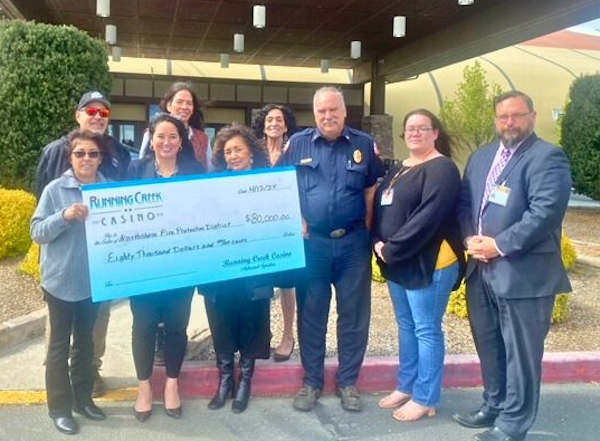
UPPER LAKE, Calif. — The Habematolel Pomo of Upper Lake Tribe continues to build on its support of Northshore Fire Protection District’s emergency response efforts with a donation of $80,000.
“Our tribe’s ongoing support for Northshore Fire Protection District is an effort to ensure they have the resources necessary to meet the public safety and emergency needs of our community to help keep everyone safe,” said Sherry Treppa, chairwoman for the Habematolel Pomo of Upper Lake. “We are pleased to continue our support for vital partners like the Northshore Fire Protection District who do so much to serve our community."
“The Habematolel Pomo of Upper Lake Tribe is a key member of our community and, most importantly, a trusted partner. We are grateful for their ongoing support for the Northshore Fire Protection District,” said Northshore Fire Protection District ChiefMike Ciancio. “The Habematolel Pomo of Upper Lake Tribe was also instrumental in helping us start the fuels crew, including funding the crew’s wages for the first year, and their support for this initiative and so many others has been vital to protecting our community.”
The contribution is a part of the Habematolel Pomo of Upper Lake’s ongoing commitment to local communities and residents in the region.
The Northshore Fire District said this latest round of support will assist with emergency response efforts and staff support.
The tribe’s contribution will assist with staffing and maintaining equipment to support firefighters when on duty.
- Details
- Written by: Lake County News reports
A bill creating a pilot program in the state Department of Justice granting three Northern California tribes at the epicenter of the state’s Missing and Murdered Indigenous People, or MMIP, cases was unanimously approved Wednesday by the Assembly Committee on Public Safety.
Assemblymember James C. Ramos (D-San Bernardino) introduced AB 2138 earlier this year as an additional means to battle the MMIP crisis in California.
“California ranks fifth in the nation for uninvestigated, unresolved MMIP cases,” Ramos said. “The devastating MMIP crisis has caused untold tragedy that continues into future generations robbing families of loved ones and too often leaving children without mothers or fathers. One contributing factor to this epidemic is the confusion over law enforcement jurisdiction caused by a 1953 federal law. We can reduce the number of unsolved cases by clarifying jurisdiction and permitting tribal police to pursue alleged perpetrators with the same authority as state peace officers if they meet California requirements.”
The participating tribes include Blue Lake Rancheria and the Yurok tribe, both from Humboldt County and Coyote Valley Band of Pomo Indians located in Mendocino County.
In December 2021, the Yuroks declared an emergency declaration because of a spate of missing persons and attempted human trafficking.
“It is our firm belief that this bill and pilot program will combat the crisis of MMIP by improving public safety in tribal communities,” said Yurok Tribal Chairman Joe James when asked about his tribe’s sponsorship of AB 2138. “Thank you to Assemblymember Ramos for his leadership on this important issue, and we look forward to the collaborative efforts with tribal communities to ensure our safety and wellbeing.”
In 1953, Congress approved Public Law 280, or PL 280, that transferred responsibility for law enforcement and criminal justice on tribal lands to six states, including California.
The law resulted in fewer resources for public safety and created jurisdictional confusion among federal, state and local law enforcement and less safety overall on reservations.
In late March, the Assembly Select Committee on Native American Affairs and the Public Safety Committee conducted an informational roundtable about the impact of the law in California and how it contributes to the MMIP crisis. The roundtable hearing featured tribal leaders and police, victims and University of California, Los Angeles author and distinguished research professor Carole Goldberg. Goldberg is a noted researcher and writer on PL 280.
Negative impacts of Public Law 280 (PL 280) include the absence of peace officer status for tribal police; the inability to arrest non-Native persons committing crimes on native lands, less support for funding and infrastructure, lack of equipment and training, and a greater mistrust of policing.
If AB 2138 is approved, the DOJ will monitor, evaluate and support the program and will not be construed to infringe on tribal sovereignty. A tribal officer designated as a peace officer would have authority on the tribal lands and also on any place in the state specified the bill such as:
• When an immediate danger to persons or property exists;
• When making an arrest where there is probable cause to believe a public offense has occurred on tribal land and with prior consent of police or sheriff;
• When an officer is in hot pursuit of a suspect in a crime committed on tribal land; and
• When delivering an apprehended person to the law enforcement authority or magistrate in the city or county where the offense occurred.
AB 2138 will be heard next in the Assembly Committee on Appropriations.
The Yurok Tribe and California Indian Legal Services are sponsors. Supporters include Blue Lake Rancheria, California Tribal Business Alliance, Habematolel Pomo of Upper Lake, Initiate Justice, Picayune Rancheria of the Chukchansi Indians, Strong Hearted Native Women’s Coalition, Inc. and Tejon Indian Tribe.
Assemblymember James C. Ramos (D-San Bernardino) introduced AB 2138 earlier this year as an additional means to battle the MMIP crisis in California.
“California ranks fifth in the nation for uninvestigated, unresolved MMIP cases,” Ramos said. “The devastating MMIP crisis has caused untold tragedy that continues into future generations robbing families of loved ones and too often leaving children without mothers or fathers. One contributing factor to this epidemic is the confusion over law enforcement jurisdiction caused by a 1953 federal law. We can reduce the number of unsolved cases by clarifying jurisdiction and permitting tribal police to pursue alleged perpetrators with the same authority as state peace officers if they meet California requirements.”
The participating tribes include Blue Lake Rancheria and the Yurok tribe, both from Humboldt County and Coyote Valley Band of Pomo Indians located in Mendocino County.
In December 2021, the Yuroks declared an emergency declaration because of a spate of missing persons and attempted human trafficking.
“It is our firm belief that this bill and pilot program will combat the crisis of MMIP by improving public safety in tribal communities,” said Yurok Tribal Chairman Joe James when asked about his tribe’s sponsorship of AB 2138. “Thank you to Assemblymember Ramos for his leadership on this important issue, and we look forward to the collaborative efforts with tribal communities to ensure our safety and wellbeing.”
In 1953, Congress approved Public Law 280, or PL 280, that transferred responsibility for law enforcement and criminal justice on tribal lands to six states, including California.
The law resulted in fewer resources for public safety and created jurisdictional confusion among federal, state and local law enforcement and less safety overall on reservations.
In late March, the Assembly Select Committee on Native American Affairs and the Public Safety Committee conducted an informational roundtable about the impact of the law in California and how it contributes to the MMIP crisis. The roundtable hearing featured tribal leaders and police, victims and University of California, Los Angeles author and distinguished research professor Carole Goldberg. Goldberg is a noted researcher and writer on PL 280.
Negative impacts of Public Law 280 (PL 280) include the absence of peace officer status for tribal police; the inability to arrest non-Native persons committing crimes on native lands, less support for funding and infrastructure, lack of equipment and training, and a greater mistrust of policing.
If AB 2138 is approved, the DOJ will monitor, evaluate and support the program and will not be construed to infringe on tribal sovereignty. A tribal officer designated as a peace officer would have authority on the tribal lands and also on any place in the state specified the bill such as:
• When an immediate danger to persons or property exists;
• When making an arrest where there is probable cause to believe a public offense has occurred on tribal land and with prior consent of police or sheriff;
• When an officer is in hot pursuit of a suspect in a crime committed on tribal land; and
• When delivering an apprehended person to the law enforcement authority or magistrate in the city or county where the offense occurred.
AB 2138 will be heard next in the Assembly Committee on Appropriations.
The Yurok Tribe and California Indian Legal Services are sponsors. Supporters include Blue Lake Rancheria, California Tribal Business Alliance, Habematolel Pomo of Upper Lake, Initiate Justice, Picayune Rancheria of the Chukchansi Indians, Strong Hearted Native Women’s Coalition, Inc. and Tejon Indian Tribe.
- Details
- Written by: Lake County News reports