How to resolve AdBlock issue?
Refresh this page
How to resolve AdBlock issue?
Refresh this page
Lake County News,California
  • Home
    • Registration Form
  • News
    • Community
      • Obituaries
      • Letters
      • Commentary
    • Education
    • Veterans
    • Police Logs
    • Business
    • Recreation
    • Health
    • Religion
    • Legals
    • Arts & Life
    • Regional
  • Calendar
  • Contact us
    • FAQs
    • Phones, E-Mail
    • Subscribe
  • Advertise Here
  • Login
How to resolve AdBlock issue?
Refresh this page
How to resolve AdBlock issue?
Refresh this page

News

Thompson votes to support supplemental package for key national security priorities

On Saturday, Rep. Mike Thompson (CA-04) reported that he voted to support the bipartisan supplemental package that appropriates over $95 billion in funding to protect national security priorities, support Ukraine, Israel and Taiwan and provide humanitarian aid to Palestine.

“Putin’s illegal invasion of Ukraine, the largest land war in Europe since World War II, is costing thousands of innocent lives, destroying the livelihood of Ukrainians and undermining our national security,” Thompson said.

“Our country is a global leader, and we have a responsibility to keep our commitment to democracy and help our allies defend themselves against attacks on democracy and freedom. Putin did not stop after invading Georgia and Crimea, and he will not stop his assault on Ukraine. He will continue with his goal to reconstruct the old Soviet Union. Once he crosses the border into a NATO country, we will become more than a financial supporter. We will be drawn into the war with our troops. Failure to respond to this illegal invasion will make America less safe. It is important to put a stop to his aggression and attack on our democratic allies,” Thompson continued.

“Israel is our strongest ally in the Middle East. This supplemental package will help Israel defend itself and its people from terrorism like we saw on Oct. 7 and the unprecedented drone and ballistic missile attack from Iran last week,” Thompson said. “The protection of civilian life is tantamount as the conflict in Israel and Gaza is creating a worsening humanitarian crisis. This supplemental provides $9.2 billion in humanitarian aid, including for Palestinian civilians in Gaza. It’s crucial to ensure that innocent civilians who have nothing to do with the conflict in the region can receive food, water, medicine and other essential humanitarian assistance. Additionally, I have called on the Biden Administration to ensure that Israel follows international law and takes steps to protect civilians and allow humanitarian aid into Gaza.”

The bill also provides security assistance for Taiwan, increases sanctions on Iran and addresses security threats from foreign adversaries like the Chinese Communist Party who use technology platforms to undermine the U.S.

Thompson represents California’s Fourth Congressional District, which includes all or part of Lake, Napa, Solano, Sonoma and Yolo counties.
Details
Written by: Lake County News reports
Published: 21 April 2024

Caring for older Americans’ teeth and gums is essential, but Medicare generally doesn’t cover that cost


C. Everett Koop, the avuncular doctor with a fluffy white beard who served as the U.S. surgeon general during the Reagan administration, was famous for his work as an innovative pediatric surgeon and the attention he paid to the HIV-AIDS crisis.

As dentistry scholars, we believe Koop also deserves credit for something else. To help make the medical profession pay more attention to the importance of healthy teeth and gums, he’d often say: “You are not healthy without good oral health.”

Yet, more than three decades after Koop’s surgeon general stint ended in 1989, millions of Americans don’t get even the most basic dental services, such as checkups, tooth cleanings and fillings.

Americans who rely on the traditional Medicare program for their health insurance get no help from that program with paying their dental bills aside from some narrow exceptions. This group includes some 24 million people over 65 – about half of all the people who rely on Medicare for their health insurance.

Photo of a man in a military-looking uniform, wearing a bushy gray goatee and large wire-rimmed glasses, with an American flag in the backgorund.
Surgeon General C. Everett Koop, seen in 1987 while serving in the Reagan administration. Wally McNamee/Corbis via Getty Images

‘Medically necessary’ exceptions

When the Medicare program was established in 1965, almost all dental services were excluded due to the expense and vigorous opposition from associations that represent dentists out of fear that reimbursement rates would be markedly low compared to traditional insurance plans or out-of-pocket payment.

However, interest in including dental benefits in Medicare is on the rise at the Centers for Medicare and Medicaid Services, the federal agency responsible for the Medicare program, as well as many organizations that seek to provide dental benefits to all members of society.

The Biden administration initially considered the addition of comprehensive Medicare dental coverage as part of its proposed Build Back Better legislation, a broad US$1.8 trillion legislative package designed to fix problems ranging from child care costs to climate change, but failed to get enough support in Congress.

Dental coverage was eliminated from the version of the bill the House passed in 2021, in part due to cost concerns and resistance from organized dentistry due to the low reimbursement rates for medical care for patients with Medicare benefits.

In 2022, after the broader package was blocked in the Senate, the federal government added coverage for dental treatment that was designated as “medically necessary” for people with Medicare.

The list of circumstances that would lead patients to be eligible is short. Some examples include patients scheduled for organ transplants or who have cancer treatment requiring radiation of their jaws.

But we believe that dental care is necessary for everyone, especially for older people.

Chew, speak, breathe

While many working Americans get limited dental coverage through their employers, those benefits are usually limited to as little as $1,000 per year. And once they retire, Americans almost always lose even that basic coverage.

Given the importance of oral health for your overall health and quality of life, and increasing scientific understanding of the role of poor oral health in a wide array of chronic diseases, we believe that Medicare should include basic dental services.

A healthy mouth is essential for chewing, speaking and breathing. Being able to flash a good smile boosts self-esteem and helps maintain a sense of well-being.

Left untreated, dental diseases often result in infections that can cause severe pain. Poor oral health can lead to hospitalization and even death. Yet, routine oral care is frequently unavailable to many Americans.

Rich Americans with Medicare coverage are almost three times more likely to receive dental care compared to those with low incomes. And almost 3 in 4 low-income people over 65 don’t see a dentist in a typical year.

Connected to many serious conditions

Numerous epidemiological studies have associated atherosclerosis, a serious condition colloquially known as clogged arteries, cardiovascular disease and stroke, with periodontal disease – chronic inflammation of the bone and gum tissues that support the teeth.

Having diabetes makes you three times as likely to develop gum disease because diabetes compromises the body’s response to inflammation and infection. At the same time, treating diabetes patients for gum disease can help control their blood sugar levels. Researchers have found that when people with diabetes get preventive dental and periodontal care, their diabetes is better controlled and health care costs decline.

Poor oral health can also increase the risk of contracting pneumonia, especially for patients in hospitals and nursing homes. When patients see a dentist before entering the hospital, they’re less likely to get pneumonia during their stay.

There is also evidence that untreated dental problems may contribute to rheumatoid arthritis as well as Alzheimer’s disease and other cognitive impairments.

Chemo can damage your teeth

Many cancer treatments can damage teeth, especially for older adults.

As a result, Medicare has started to reimburse for dental bills tied to tooth decay or other oral conditions after they get chemotherapy or radiation treatment.

The American Dental Association warns of the oral health problems that arise following chemotherapy and radiation treatment and offers tips on protecting your teeth during treatment.

More than nice to have

The history of U.S. health care helps explain why Medicare generally won’t cover the cost of dental and gum treatment.

Doctors and dentists are educated separately, and doctors learn very little about dental conditions and treatments when they’re in medical school.

Most dental electronic health records aren’t linked to medical systems, hindering comprehensive care and delivery of dental care to those in need.

At the same time, medical insurance and dental insurance have evolved to serve very different functions. Medical insurance was designed specifically to cover large, unpredictable expenses, while dental insurance was intended to mainly fund predictable and lower-cost preventive care.

While protection from catastrophic medical costs has always been perceived as a necessity, coverage of dental services was conceived as a benefit that’s mostly nice to have.

But that’s an outdated idea disconnected from a large body of scientific evidence.

Medicare Advantage plans

Until Medicare expands coverage to include preventive dental services for everyone, alternative plans such as Medicare Advantage, through which the federal government contracts with private insurers to provide Medicare benefits, serve as a stopgap.

In 2016, only 21% of beneficiaries in traditional Medicare had purchased a stand-alone dental plan, whereas roughly two-thirds of Medicare Advantage enrollees had at least some dental benefits through their coverage. However, these plans vary greatly in the procedures that they cover.

The costs of this hole in Medicare coverage is high: 1 in 5 Americans with Medicare – including many with little disposable income – are spending at least $1,000 a year on dental care.

It seems that Dr. Koop was onto something – you can’t be healthy without good oral health. Adding basic dental benefits to Medicare would likely help many older Americans to live happier and healthier lives, and at the same time potentially reduce overall health care costs.The Conversation

Frank Scannapieco, Professor and Chair of Oral Biology, University at Buffalo and Ira Lamster, Clinical Professor of Periodontics and Endodontics, Stony Brook University (The State University of New York)

This article is republished from The Conversation under a Creative Commons license. Read the original article.


Details
Written by: Frank Scannapieco, University at Buffalo and Ira Lamster, Stony Brook University (The State University of New York)
Published: 21 April 2024

Helping Paws: Shepherds, retrievers and mastiffs

LAKE COUNTY, Calif. — Lake County Animal Care and Control has many more new dogs in the shelter this week, waiting for homes.

Dogs available for adoption this week include mixes of Alaskan husky, American blue heeler, Anatolian shepherd, Australian shepherd, border collie, Chesapeake Bay retriever, Chihuahuas, German shepherd, hound, Labrador Retriever, mastiff, pit bull terrier and Rottweiler.

Dogs that are adopted from Lake County Animal Care and Control are either neutered or spayed, microchipped and, if old enough, given a rabies shot and county license before being released to their new owner. License fees do not apply to residents of the cities of Lakeport or Clearlake.

Those dogs and the others shown on this page at the Lake County Animal Care and Control shelter have been cleared for adoption.

Call Lake County Animal Care and Control at 707-263-0278 or visit the shelter online for information on visiting or adopting.

The shelter is located at 4949 Helbush in Lakeport.

Email Elizabeth Larson at This email address is being protected from spambots. You need JavaScript enabled to view it.. Follow her on Twitter, @ERLarson, or Lake County News, @LakeCoNews.


Kennel#14's preview photo
Kennel#14

Kennel#9's preview photo
Kennel#9

Kennel#30(Brian)'s preview photo
Kennel#30(Brian)

Kennel#15's preview photo
Kennel#15

Kennel#26's preview photo
Kennel#26

Kennel#20's preview photo
Kennel#20

Kennel#6's preview photo
Kennel#6

Kennel#19's preview photo
Kennel#19

Kennel#7's preview photo
Kennel#7

 
Kennel #13's preview photo
Kennel #13

Kennel#25's preview photo
Kennel#25

Kennel #18's preview photo
Kennel #18

Kennel#34's preview photo
Kennel#34

Kennel#4's preview photo
Kennel#4

Kennel#8's preview photo
Kennel#8

Kennel#24's preview photo
Kennel#24

 
Kennel#10's preview photo
Kennel#10

Kennel#12(b)'s preview photo
Kennel#12(b)

Kennel#27(a)'s preview photo
Kennel#27(a)

Kennel#32's preview photo
Kennel#32

Kennel#17's preview photo
Kennel#17

Kennel#23's preview photo
Kennel#23

Kennel#16's preview photo
Kennel#16

 
Kennel#2's preview photo
Kennel#2

Kennel#5's preview photo
Kennel#5

 
Kennel#22's preview photo
Kennel#22

Kennel#29's preview photo
Kennel#29

Kennel#31a's preview photo
Kennel#31a

Kennel#31b's preview photo
Kennel#31b

Kennel#31c's preview photo
Kennel#31c

Kennel#3's preview photo
Kennel#3


Details
Written by: Elizabeth Larson
Published: 21 April 2024

Space News: Exploding stars send out powerful bursts of energy − I’m leading a citizen scientist project to classify and learn about these bright flashes


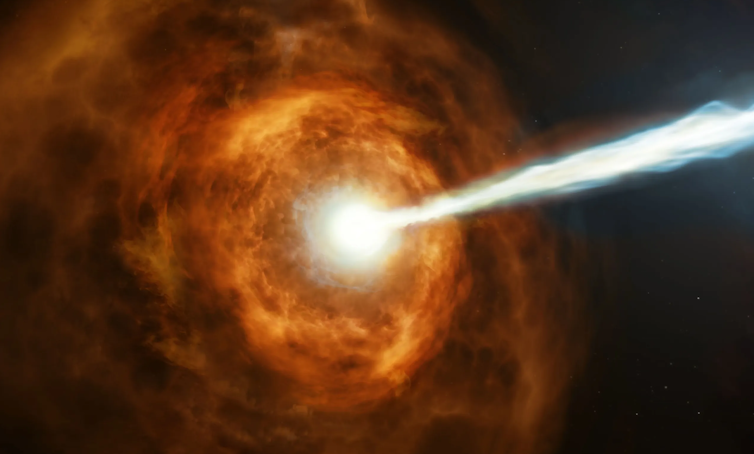
Gamma-ray bursts, as shown in this illustration, come from powerful astronomical events. NASA, ESA and M. Kornmesser

When faraway stars explode, they send out flashes of energy called gamma-ray bursts that are bright enough that telescopes back on Earth can detect them. Studying these pulses, which can also come from mergers of some exotic astronomical objects such as black holes and neutron stars, can help astronomers like me understand the history of the universe.

Space telescopes detect on average one gamma-ray burst per day, adding to thousands of bursts detected throughout the years, and a community of volunteers are making research into these bursts possible.

On Nov. 20, 2004, NASA launched the Neil Gehrels Swift Observatory, also known as Swift. Swift is a multiwavelength space telescope that scientists are using to find out more about these mysterious gamma-ray flashes from the universe.

Gamma-ray bursts usually last for only a very short time, from a few seconds to a few minutes, and the majority of their emission is in the form of gamma rays, which are part of the light spectrum that our eyes cannot see. Gamma rays contain a lot of energy and can damage human tissues and DNA.

Fortunately, Earth’s atmosphere blocks most gamma rays from space, but that also means the only way to observe gamma-ray bursts is through a space telescope like Swift. Throughout its 19 years of observations, Swift has observed over 1,600 gamma-ray bursts. The information it collects from these bursts helps astronomers back on the ground measure the distances to these objects.

A cylindrical spacecraft, with two flat solar panels, one on each side.
NASA’s Swift observatory, which detects gamma rays. NASA E/PO, Sonoma State University/Aurore Simonnet

Looking back in time

The data from Swift and other observatories has taught astronomers that gamma-ray bursts are one of the most powerful explosions in the universe. They’re so bright that space telescopes like Swift can detect them from across the entire universe.

In fact, gamma-ray bursts are among one of the farthest astrophysical objects observed by telescopes.

Because light travels at a finite speed, astronomers are effectively looking back in time as they look farther into the universe.

The farthest gamma-ray burst ever observed occurred so far away that its light took 13 billion years to reach Earth. So when telescopes took pictures of that gamma-ray burst, they observed the event as it looked 13 billion years ago.

Gamma-ray bursts allow astronomers to learn about the history of the universe, including how the birth rate and the mass of the stars change over time.

Types of gamma-ray bursts

Astronomers now know that there are basically two kinds of gamma-ray bursts – long and short. They are classified by how long their pulses last. The long gamma-ray bursts have pulses longer than two seconds, and at least some of these events are related to supernovae – exploding stars.

When a massive star, or a star that is at least eight times more massive than our Sun, runs out of fuel, it will explode as a supernova and collapse into either a neutron star or a black hole.

Both neutron stars and black holes are extremely compact. If you shrank the entire Sun into a diameter of about 12 miles, or the size of Manhattan, it would be as dense as a neutron star.

Some particularly massive stars can also launch jets of light when they explode. These jets are concentrated beams of light powered by structured magnetic fields and charged particles. When these jets are pointed toward Earth, telescopes like Swift will detect a gamma-ray burst.

Gamma-ray burst emission.

On the other hand, short gamma-ray bursts have pulses shorter than two seconds. Astronomers suspect that most of these short bursts happen when either two neutron stars or a neutron star and a black hole merge.

When a neutron star gets too close to another neutron star or a black hole, the two objects will orbit around each other, creeping closer and closer as they lose some of their energy through gravitational waves.

These objects eventually merge and emit short jets. When the short jets are pointed toward Earth, space telescopes can detect them as short gamma-ray bursts.

Neutron star mergers emit gamma-ray bursts.

Classifying gamma-ray bursts

Classifying bursts as short or long isn’t always that simple. In the past few years, astronomers have discovered some peculiar short gamma-ray bursts associated with supernovae instead of the expected mergers. And they’ve found some long gamma-ray bursts related to mergers instead of supernovae.

These confusing cases show that astronomers do not fully understand how gamma-ray bursts are created. They suggest that astronomers need a better understanding of gamma-ray pulse shapes to better connect the pulses to their origins.

But it’s hard to classify pulse shape, which is different than pulse duration, systematically. Pulse shapes can be extremely diverse and complex. So far, even machine learning algorithms haven’t been able to correctly recognize all the detailed pulse structures that astronomers are interested in.

Community science

My colleagues and I have enlisted the help of volunteers through NASA to identify pulse structures. Volunteers learn to identify the pulse structures, then they look at images on their own computers and classify them.

Our preliminary results suggest that these volunteers – also referred to as citizen scientists – can quickly learn and recognize gamma-ray pulses’ complex structures. Analyzing this data will help astronomers better understand how these mysterious bursts are created.

Our team hopes to learn about whether more gamma-ray bursts in the sample challenge the previous short and long classification. We’ll use the data to more accurately probe the history of the universe through gamma-ray burst observations.

This citizen science project, called Burst Chaser, has grown since our preliminary results, and we’re actively recruiting new volunteers to join our quest to study the mysterious origins behind these bursts.The Conversation

Amy Lien, Assistant Professor of Physics, University of Tampa

This article is republished from The Conversation under a Creative Commons license. Read the original article.

Details
Written by: Amy Lien, University of Tampa
Published: 21 April 2024
  1. Authorities investigate discovery of body in Clear Lake
  2. Lakeport City Council recognizes Sexual Assault Awareness Month
  3. Clearlake Animal Control: Meet ‘Turbo’ and the dogs; update on shelter population

Subcategories

Community

  • 700
  • 701
  • 702
  • 703
  • 704
  • 705
  • 706
  • 707
  • 708
  • 709
How to resolve AdBlock issue?
Refresh this page
Copyright © 2026 Lake County News,California. All Rights Reserved.