 How to resolve AdBlock issue?
News
- Details
- Written by: Clayton Buck, George M. Hayward and Lydia R. Anderson
About 6.7 million people or 3.3% of adults age 30 and over lived with their grandchildren in 2021, according to a recently released U.S. Census Bureau report on the characteristics and geography of grandparents living with grandchildren under the age of 18 in the United States.
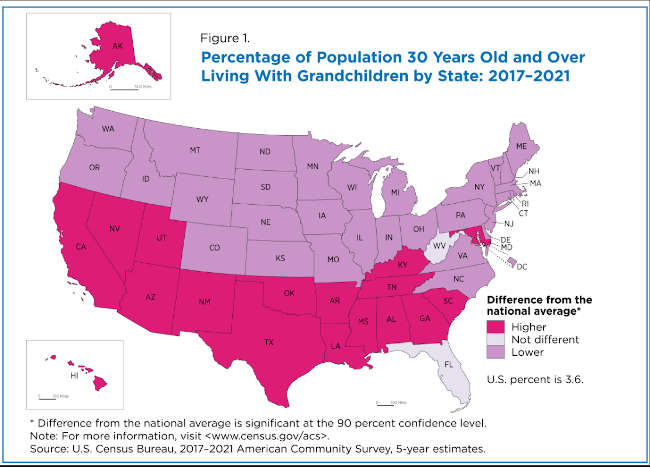
Alaska, Hawaii and states in the Southeast and Southwest had a higher share of grandparent-grandchildren households than the national average while states in the Northeast, Midwest and Pacific Northwest had lower shares.
Grandparents have long served critical roles in U.S. families that are shaped by changing demographic trends, such as increasing life expectancy, which allows grandparents more years to develop relationships with grandchildren.
Cultural expectations of the role of grandparents also contribute to differences in living arrangements.
States with highest share of grandparents living with grandchildren
Using 2017-2021 American Community Survey, 5-year estimates, Figure 1 shows the percentage of the population age 30 and over who lived with grandchildren under the age of 18 and whether the estimate for each state differed significantly from the national average.
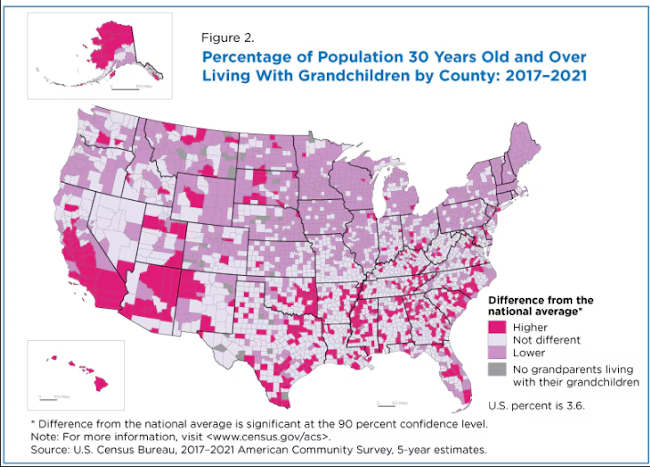
The county-level map (Figure 2) offers an even more granular look at how these estimates vary. Some states, such as Connecticut, Iowa, Maine, Massachusetts, New Hampshire, Oregon, Rhode Island and Vermont had zero counties with percentages higher than the national average.
The geographic patterns reflect the demographics and cultural characteristics of people who live in those areas.
The South, for example, has a higher percentage of Black or African American populations in the region who have a relatively high rate of living with grandchildren.
Lower percentages in the Northeast and Midwest could reflect higher percentages of non-Hispanic White populations, who have among the lowest percentage of grandparents living with grandchildren.
The high percentages of grandparents living with grandchildren throughout Alaska and Hawaii reflect the higher percentages of American Indian and Alaska Native (AIAN) and Native Hawaiian and Other Pacific Islander (NHPI) populations, respectively. Both groups (AIAN and NHPI) have among the highest percentages living with grandchildren.
Grandparents caring for grandchildren
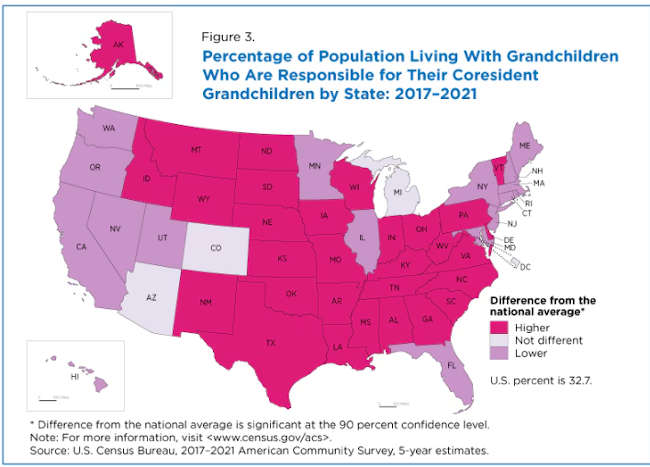
Nationally, roughly 32.7% of grandparents living with their grandchildren under the age of 18 were responsible for their care (Figure 3).
With the exception of the District of Columbia, Florida and Maryland, states in the South had higher percentages than the national average while states on the West Coast tended to have lower percentages. Alaska was higher and Hawaii was lower than the national average.
Arizona, Colorado, the District of Columbia and Michigan were the only states or state equivalents with estimates that were not significantly different from the national average.
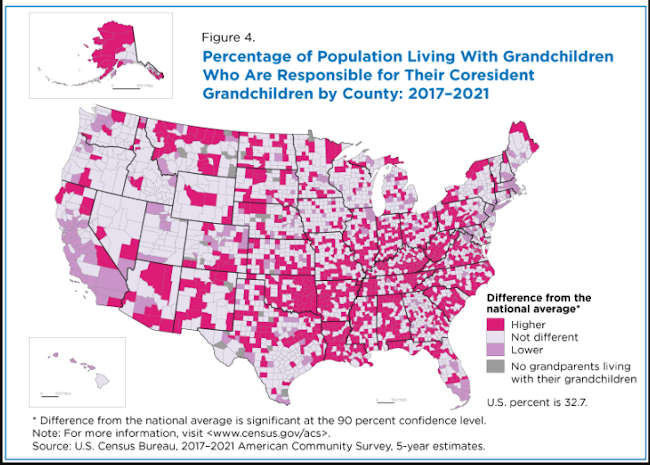
Figure 4 shows county-level geographic variation. Some states, such as Hawaii, New Jersey, Rhode Island and Utah, had zero counties with percentages higher than the national average. On the other end of the spectrum, Arkansas, Delaware, Kentucky, Louisiana, New Mexico, Oklahoma, South Carolina and Wyoming did not have a single county lower than the national average.
Several states had a higher share of the population 30 years and over living with grandchildren (Figure 1) than the national average but a lower share of those living with grandchildren who were responsible for their grandchildren (Figure 3).
For example, the share of grandparents living with grandchildren exceeded the national average in California, Hawaii, Maryland, Nevada and Utah (Figure 1), but the share of those responsible for their grandchildren’s care was lower than the national average in those states (Figure 3).
The opposite was true in 16 states: Idaho, Indiana, Iowa, Kansas, Missouri, Montana, Nebraska, North Carolina, North Dakota, Ohio, Pennsylvania, South Dakota, Vermont, Virginia, Wisconsin and Wyoming. In those states, the percentage of grandparents living with grandchildren was lower than the nation as a whole but the share of those responsible for the care of their grandchildren was higher.
Clayton Buck and Lydia R. Anderson are family demographers in the U.S. Census Bureau’s Social, Economic, and Housing Statistics Division’s Fertility and Family Statistics Branch. George M. Hayward is a family demographer in the Census Bureau’s Population Division’s Population Estimates Branch.
- Details
- Written by: James Morton Turner, Wellesley College
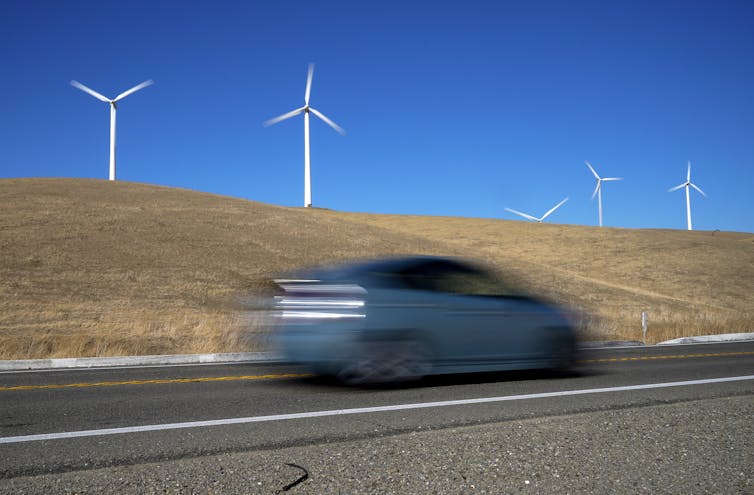
Panasonic’s new US$4 billion battery factory in De Soto, Kansas, is designed to be a model of sustainability – it’s an all-electric factory with no need for a smokestack. When finished, it will cover the size of 48 football fields, employ 4,000 people and produce enough advanced batteries to supply half a million electric cars per year.
But there’s a catch, and it’s a big one.
While the factory will run on wind and solar power much of the time, renewables supplied only 34% of the local utility Evergy’s electricity in 2023.
In much of the U.S., fossil fuels still play a key role in meeting power demand. In fact, Evergy has asked permission to extend the life of an old coal-fired power plant to meet growing demand, including from the battery factory.
With my students at Wellesley College, I’ve been tracking the boom in investments in clean energy manufacturing and how those projects – including battery, solar panel and wind turbine manufacturing and their supply chains – map onto the nation’s electricity grid.
The Kansas battery plant highlights the challenges ahead as the U.S. scales up production of clean energy technologies and weans itself off fossil fuels. It also illustrates the potential for this industry to accelerate the transition to renewable energy nationwide.
The clean tech manufacturing boom
Let’s start with some good news.
In the battery sector alone, companies have announced plans to build 44 major factories with the potential to produce enough battery cells to supply more than 10 million electric vehicles per year in 2030.
That is the scale of commitment needed if the U.S. is going to tackle climate change and meet its new auto emissions standards announced in March 2024.
The challenge: These battery factories, and the electric vehicles they equip, are going to require a lot of electricity.
Producing enough battery cells to store 1 kilowatt-hour (kWh) of electricity – enough for 2 to 4 miles of range in an EV – requires about 30 kWh of manufacturing energy, according to a recent study.
Combining that estimate and our tracking, we project that in 2030, battery manufacturing in the U.S. would require about 30 billion kWh of electricity per year, assuming the factories run on electricity, like the one in Kansas. That equates to about 2% of all U.S. industrial electricity used in 2022.
Battery belt’s huge solar potential
A large number of these plants are planned in a region of the U.S. South dubbed the “battery belt.” Solar energy potential is high in much of the region, but the power grid makes little use of it.
Our tracking found that three-fourths of the battery manufacturing capacity is locating in states with lower-than-average renewable electricity generation today. And in almost all of those places, more demand will drive higher marginal emissions, because that extra power almost always comes from fossil fuels.
However, we have also been tracking which battery companies are committing to powering their manufacturing operations with renewable electricity, and the data points to a cleaner future.
By our count, half of the batteries will be manufactured at factories that have committed to sourcing at least 50% of their electricity demand from renewables by 2030. Even better, these commitments are concentrated in regions of the U.S. where investments have lagged.
Some companies are already taking action. Tesla is building the world’s largest solar array on the roof of its Texas factory. LG has committed to sourcing 100% renewable solar and hydroelectricity for its new cathode factory in Tennessee. And Panasonic is taking steps to reach net-zero emissions for all of its factories, including the new one in Kansas, by 2030.
More corporate commitments can help strengthen demand for the deployment of wind and solar across the emerging battery belt.
What that means for US electricity demand
Manufacturing all of these batteries and charging all of these electric vehicles is going to put a lot more demand on the power grid. But that isn’t an argument against EVs. Anything that plugs into the grid, whether it is an EV or the factory that manufacturers its batteries, gets cleaner as more renewable energy sources come online.
This transition is already happening. Although natural gas dominates electricity generation, in 2023 renewables supplied more electricity than coal for the first time in U.S. history. The government forecasts that in 2024, 96% of new electricity generating capacity added to the grid would be fossil fuel-free, including batteries. These trends are accelerating, thanks to the incentives for clean energy deployment included in the 2022 Inflation Reduction Act.
Looking ahead
The big lesson here is that the challenge in Kansas is not the battery factory – it is the increasingly antiquated electricity grid.
As investments in a clean energy future accelerate, America will need to reengineer much of its power grid to run on more and more renewables and, simultaneously, electrify everything from cars to factories to homes.
That means investing in modernizing, expanding and decarbonizing the electric grid is as important as building new factories or shifting to electric cars.
Investments in clean energy manufacturing will play a key role in enabling that transition: Some of the new advanced batteries will be used on the grid, providing backup energy storage for times when renewable energy generation slows or electricity demand is especially high.
In January, Hawaii replaced its last coal-fired power plant with an advanced battery system. It won’t be long before that starts to happen in Tennessee, Texas and Kansas, too.
James Morton Turner, Professor of Environmental Studies, Wellesley College
This article is republished from The Conversation under a Creative Commons license. Read the original article.
- Details
- Written by: Lake County News reports
April is National Earthquake Preparedness Month, and this month state officials are sharing multilingual resources and calling on Californians to sign up for alerts through the state’s first-in-the-nation Earthquake Early Warning System to prepare for the next big one.
The MyShake App is now available in English, Spanish, Chinese (traditional), Vietnamese, Korean and Filipino.
Earthquake Warning California is the country’s first publicly available, statewide warning system giving California residents crucial seconds to Drop, Cover, and Hold On.
Sign up to get alerts to your phone as soon as shaking is detected by ground motion monitoring:
• MyShake App: Free smartphone app that provides iPhone and Android users with audio and visual warnings.
• Local alerts.
• Wireless Emergency Alerts (WEAs): No-cost text messages for emergency situations.
An earthquake safety guide is available here.
Individuals, businesses and communities can take steps today to protect life and property when a serious earthquake strikes.
Know your risks:
• Visit myhazards.caloes.ca.gov to learn about local risks.
• Prepare your home by securing furniture, appliances, home fuel systems and more.
Make a plan:
• Create a customized emergency plan for your specific needs
• Build an emergency contact list
• Build an emergency supply kit with copies of important documents
Know how to protect yourself during an earthquake:
• DROP to the ground, COVER your head with your arms, and HOLD ON to your neck until shaking stops.
• Remain vigilant for aftershocks.
Check in on family and friends after shaking stops:
• Reach out to your emergency contacts.
• Check in with those in your community who may need additional assistance.
• Listen to local authorities and official resources.
The Listos California campaign, which works to expand access to lifesaving emergency preparedness information, offers earthquake preparedness resources in several languages:
• Listos California Social Toolkit.
• Listos California Stay Safe Flyer.
• Listos California Quick Guide.
• Listos California Disaster Ready Guide.
- Details
- Written by: Frank J. Infurna, Arizona State University
Middle-aged Americans are lonelier than their European counterparts. That’s the key finding of my team’s recent study, published in American Psychologist.
Our study identified a trend that has been evolving for multiple generations, and affects both baby boomers and Gen Xers. Middle-aged adults in England and Mediterranean Europe are not that far behind the U.S. In contrast, middle-aged adults in continental and Nordic Europe reported the lowest levels of loneliness and stability over time.
We used survey data drawn from over 53,000 middle-aged adults from the U.S. and 13 European nations from 2002 to 2020. We tracked their reported changes in loneliness every two years across the midlife years of 45 to 65. This span provided us data from the so-called silent generation of people born between 1937 and 1945; baby boomers, born between 1946 and 1964; and members of Generation X, born between 1965 and 1974.
Our study makes clear that middle-aged Americans today are experiencing more loneliness than their peers in European nations. This coincides with existing evidence that mortality rates are rising for working-age adults in the U.S.
We focused on middle-aged adults for several reasons. Middle-aged adults form the backbone of society by constituting a majority of the workforce. But they also face increasing challenges today, notably greater demands for support from both their aging parents and their children.
Following the Great Recession from late 2007 to 2009, middle-aged adults in the U.S. reported poorer mental and physical health compared to same-aged peers in the 1990s. Compared to several European nations, U.S. middle-aged adults currently report more depressive symptoms and higher rates of chronic illness, pain and disability.
Why it matters
The desire to belong is an innate and fundamental need. When this is lacking, it can have downstream consequences.
Loneliness is bad for your health. Researchers have found that loneliness is as dangerous as smoking. Loneliness increases one’s vulnerability to sickness, depression, chronic illness and premature death.
Loneliness is considered a global public health issue. The U.S. surgeon general released an advisory report in 2023 documenting an epidemic of loneliness and a pressing need to increase social connection. Other nations, such as the U.K. and Japan, have appointed ministers of loneliness to ensure relationships and loneliness are considered in policymaking.
What still isn’t known
Why are middle-aged Americans exceptional when it comes to loneliness and poorer overall mental and physical health?
We did not directly test this in our study, but in the future we hope to zero in on the factors driving these trends. We think that the loneliness Americans are reporting compared to peer nations comes down to limited social safety nets and to cultural norms that prioritize individualism over community.
Individualization carries psychological costs, such as reductions in social connections and support structures, which are correlates of loneliness. Relative to the other nations in our study, Americans have a higher tendency to relocate, which is associated with weak social and community ties.
One of the reasons why we chose countries from across Europe is that they differ dramatically from the U.S. when it comes to social and economic opportunities and social safety nets. Social and economic inequalities likely increase one’s loneliness through undermining one’s ability to meet basic needs. Generous family and work policies likely lessen midlife loneliness through reducing financial pressures and work-family conflict, as well as addressing health and gender inequities.
Our findings on loneliness in conjunction with previous studies on life expectancy, health, well-being and cognition suggest that being middle-aged in America is a risk factor for poor mental and physical health outcomes.
The Research Brief is a short take on interesting academic work.
Frank J. Infurna, Associate Professor of Psychology, Arizona State University
This article is republished from The Conversation under a Creative Commons license. Read the original article.





