 How to resolve AdBlock issue?
News
- Details
- Written by: Elizabeth Larson
The action by the Board of Supervisors came a week after Congressman Mike Thompson led a bipartisan letter to CPUC President Alice Bushing Reynolds urging the CPUC to reject AT&T’s petition to end access to landline services, as Lake County News has reported.
AT&T filed a document with the CPUC in December seeking relief from its “carrier of last resort,” or COLR, obligations across the state. It’s seeking an expedited process in its request.
The CPUC website for the proceeding explains a carrier of last resort as “a telecommunications service provider that stands ready to provide basic telephone service, commonly landline telephone service, to any customer requesting such service within a specified area. At least one telephone company in a specified area is legally required to provide access to telephone service to anyone in its service territory who requests it. This is known as the Carrier of Last Resort (COLR) obligation, which ensures that everyone in California has access to safe, reliable, and affordable telephone service. AT&T is the designated COLR in many parts of the state and is the largest COLR in California. Where AT&T is the default landline telephone service provider means that the company must provide traditional landline telephone service to any potential customer in that service territory. AT&T is proposing to withdraw as the COLR in your area without a new carrier being designated as a COLR.”
Deputy County Administrative Officer Matthew Rothstein presented the draft letter to the board on Tuesday afternoon.
He explained that AT&T’s proposed withdrawal as carrier of law resort would impact much of Lake County.
The letter notes that in rural areas where population density is low, “the market frequently leaves residents with few quality, affordable telecommunications options. For numerous Lake County residents and rural Californians, Plain Old Telephone Service (POTS) is a critical lifeline, and the most reliable means to access 911 and 211 services.”
The letter raises the “considerable dangers” AT&T’s proposal creates for communities in high fire areas that don’t have “reliably continuous alternative services.”
It continues, “Plainly, COLR relief should not be considered without meaningfully addressing the vulnerabilities it would create. Winter storms of recent years have likewise left communities with damaged landlines and without cell service for periods of time. Thousands of Lake County residents living in rural communities rely on telecommunications to manage medical and other critical needs.”
The letter notes that AT&T says it will maintain service for landline customers “during a transition period to newer technologies,” but not providing “meaningful assurance service will be continually available in the future. Natural disasters and other events frequently damage communications equipment and infrastructure, and there is no guarantee of timely repair. While emerging technologies may be promising, availability and adoption in rural communities typically significantly lags more population-dense areas.”
Following that statement, the letter asks for the CPUC’s “engagement and commonsense regulation is essential to ensuring no California communities are left with zero telecommunications options.”
Another concern the letter raises is that AT&T fails “to adequately consider the relative difficulty vulnerable customers (such as those of advanced age, medically vulnerable and economically disadvantaged individuals) may have in accessing alternative services.”
The board’s letter asks that the CPUC reject AT&T’s application and insist that more adequate measures are undertaken first when it comes to planning for vulnerable communities.
“Taking away a tool that meaningfully promotes public safety without first replacing its functionality is clearly wrong, and antithetical to the State’s interest in well serving ALL residents,” the letter said, concluding with asking the CPUC to put vulnerable Californians first and reject the proposal.
Supervisor Jessica Pyska moved to approve the letter, with Supervisor Michael Greene seconding and the board approving it 5-0.
Email Elizabeth Larson at
- Details
- Written by: Lake County News reports
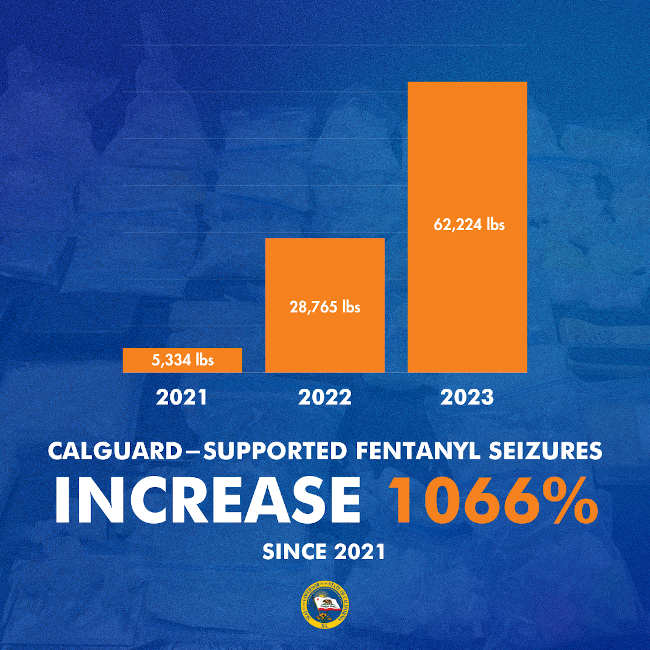
Gov. Gavin Newsom on Tuesday announced that the California National Guard supported counter-drug operations in 2023 that led to the record seizure of 62,224 pounds of fentanyl in California and the state’s ports of entry.
Since 2021, fentanyl seizures supported by CalGuard have increased by 1066%.
“Fentanyl is a poison, and it does not belong in our communities. California is cracking down — increasing seizures, expanding access to substance abuse treatment, and holding drug traffickers accountable to combat the immeasurable harm opioids have caused our communities,” said Gov. Newsom.
“The California National Guard is committed to combating the scourge of fentanyl,” said Major General Matthew P. Beevers, adjutant general of the California National Guard. “These extraordinary seizure statistics are a direct reflection of the tireless efforts of the highly trained CalGuard Service Members supporting law enforcement agencies statewide.”
Total fentanyl seized has risen dramatically each year, from 5,334 pounds, valued at $64.1 million in 2021, to 28,765 pounds valued at $230 million in 2022 and 62,224 pounds valued at $649 million in 2023.
Cracking down on illegal drugs being smuggled into California, Governor Newsom last year increased the number of CalGuard service members deployed to interdict drugs at U.S. ports of entry along the border by approximately 50%.
CalGaurd’s coordinated drug interdiction efforts in the state are funded in part by California’s $30 million investment in 2022 to expand CalGuard’s work to prevent drug-trafficking transnational criminal organizations.
The amount of fentanyl seized in California in 2023 is enough to potentially kill the global population nearly twice over. According to the Drug Enforcement Administration, a lethal dose of fentanyl is 2 mg.
Since Gov. Newsom took office in 2019, California has invested over $1 billion to crack down on opioid trafficking and enforce the law, combat overdoses, support those with opioid use disorder, and raise awareness about the dangers of opioids.
The Governor’s Master Plan for Tackling the Fentanyl and Opioid Crisis provides a comprehensive framework to deepen the impact of these investments — including through a CalRx effort where California will allocate $30 million to support partners in developing, manufacturing, procuring, and/or distributing a naloxone nasal product under the CalRx label and through new legislation to address the next wave of the overdose crisis.
- Details
- Written by: Elizabeth Larson
The council will meet at 3:30 p.m. Thursday, Feb. 29, in the council chambers at Clearlake City Hall, 14050 Olympic Drive.
The meeting will be broadcast live on the city's YouTube channel or the Lake County PEGTV YouTube Channel.
Community members also can participate via Zoom. The webinar ID is 848 0574 7044, passcode is 524710. The meeting can be accessed through one-tap mobile at +16694449171,,84805747044#.
The agenda can be found here.
On the agenda is consideration of a resolution approving an application for funding and the execution of a grant agreement from the 2023-2024 CDBG Mitigation Resilient Planning
and Public Serviced Program in the Amount of $1.5 million for code enforcement services.
The council also will consider a resolution approving an application for funding and the execution of a grant agreement from the 2023-2024 CDBG Mitigation Resilient Planning and
Public Services Program in the amount of $400,000 for water infrastructure planning.
Email Elizabeth Larson at
- Details
- Written by: Lake County News reports
The Forest Service said the initial comment period for the Northwest Forest Plan concluded Feb. 2.
Of note, forests in California included in the Northwest Forest Plan planning are Klamath National Forest and Butte Valley National Grassland, Lassen National Forest, Mendocino National Forest, Modoc National Forest, Six Rivers National Forest and Shasta-Trinity National Forest.
The Forest Service had been accepting comments on a notice of intent that the agency will prepare an environmental impact statement to evaluate the effects of proposed amendments to the Northwest Forest Plan.
More than 9,000 comments were received from the public which are now being analyzed to refine the proposed action, identify initial concerns, and explore potential alternatives and environmental impacts.
Using that information, a draft environmental impact statement will be drafted, posted, and available for public review and additional comments in the coming months.
In addition to public comments, the Forest Service has been actively engaging tribes, state and local leaders, community-based organizations, and other interested publics.
“The goal of this process is to contribute to sustainable, climate-adapted, wildfire-resilient landscapes designed to protect threatened and endangered species while also contributing to social and economic sustainability in the region,” said Jacque Buchanan, regional forester for the Pacific Northwest Region. “To achieve that goal, we need to hear the voices, insights and concerns of the people who value these public lands and live, work, and recreate within the Northwest Forest Plan landscape."
The proposed amendment will affect the land management plans of 17 national forest and grasslands across 24.5 million acres of federally managed lands in western Oregon and Washington, and northwestern California.
The Northwest Forest Plan was established in 1994 to address threats to threatened and endangered species while also contributing to social and economic sustainability in the region.
After nearly 30 years, the Northwest Forest Plan needs to be updated to accommodate changed ecological and social conditions.
Updates on the process of amending the Northwest Forest Plan can be found on the Northwest Forest Plan webpage and also on the and also on the USDA Forest Service, Region 6 website.




