 How to resolve AdBlock issue?
News
- Details
- Written by: Elizabeth Larson
The board will meet beginning at 9 a.m. Tuesday, Feb. 27, in the board chambers on the first floor of the Lake County Courthouse, 255 N. Forbes St., Lakeport.
The meeting can be watched live on Channel 8, online at https://countyoflake.legistar.com/Calendar.aspx and on the county’s Facebook page. Accompanying board documents, the agenda and archived board meeting videos also are available at that link.
To participate in real-time, join the Zoom meeting by clicking this link.
The meeting ID is 893 7696 3983, pass code 750003. The meeting also can be accessed via one tap mobile at +16699006833,,89376963983#,,,,*750003#.
In an untimed item, the board will consider proposed structural changes to the Water Resources Department.
At 11 a.m., the board will hold a public hearing to discuss the purchase agreement for property at 16540 State Highway 175 in Cobb, which is slated to be a new county park.
The 13-acre site’s purchase amount is $300,000.
In an untimed item, the board will consider a letter asking the California Public Utilities Commission to Reject AT&T California’s request to be relieved of carrier of last resort obligations.
The full agenda follows.
CONSENT AGENDA
5.1: Adopt proclamation thanking Senate President Pro Tempore Mike McGuire and the California State Legislature for their support of Lake County’s tree mortality emergency.
5.2: Adopt proclamation celebrating First 5 Lake County’s 25 years of service in Lake County.
5.3: Adopt resolution amending Resolution No. 2023-117 establishing position allocations for Fiscal Year 2023-2024, Budget Unit No. 8107, Water Resources and reestablishing the Water Resources director as a county classification.
5.4: Adopt Resolution to Establish Fund 427 – Kelseyville Seniors Inc. (KSI) Trust .
5.5: Adopt resolution approving Agreement No. 22-1694-0019-SF with the State of California, Department of Food and Agriculture for Insect Trapping for FY 23-24 for $41,224.
5.6: Adopt resolution approving Agreement No. 23-SD17 with California Department of Food and Agriculture for compliance with the Seed Services program for the period July 1, 2023, through June 30, 2024.
5.7: Approve travel exceeding 1,500 miles for Behavioral Health staff to attend the annual Behavioral Health Management Summit in Las Vegas, Nevada, from March 25 to 26, 2024.
5.8: Adopt resolution of the Lake County Board of Supervisors Authorizing the Lake County Behavioral Health Services director to sign the subcontractor agreement for the Behavioral Health Bridge Housing Program.
5.9: Approve memorandum of understanding between Partnership HealthPlan of California and Lake County Behavioral Health Services and authorize the Behavioral Health director to sign.
5.10: Approve the bylaws of the Maternal Child Adolescent Health Advisory Board.
5.11: Approve fourth amendment to agreement between county of Lake and Jones Towing for abandoned vehicle towing and disposal services, for an increase of $40,000, total amount not to exceed $90,000, for a term from July 31, 2023 through June 30, 2024; and authorize the chair to sign.
5.12: Adopt resolution authorizing application for, and receipt of, Local Government Planning Support Grant Program Funds (Amending RES 2020-65, to Update CAO Name to Susan Parker for Ongoing Project Activity with the LEAP Grant).
5.13: (a) Rescind Resolution 2024-08; and (b) adopt new resolution to submit the CDBG MIT - PPS Grant Application; and (c) authorize county administrative officer or her designee to submit the grant application.
5.14: Approve first amendment to agreement between county of Lake and Leonard’s Hauling and Tractor, for nuisance abatement services, for an increase of $45,000, total amount not to exceed $75,000, for a term from July 31, 2023 through June 30, 2024; and authorize the chair to sign.
5.15: Ratify year two (2024) compensation adjustment for the agreement for medical services in Lake County Detention Facility with California Forensic Medical Group (CFMG).
5.16: Adopt resolution approving the Department of Health Services’ Application to the California Department of Public Health, Childhood Lead Poisoning Prevention Branch (CLPPB) Grant Program for Fiscal Years 2023/2024 through 2025/2026 and Authorize the director of Health Services to sign said application and grant in the amount of $93,043.
5.17: Approve Accela subscription annual license renewal from March 1, 2024 through Feb. 28, 2025, in the amount of $36,033.06, and authorize the board chair to sign.
5.18: Approve request to apply for and accept PATH CITED funding in the amount of $552,334.59 and authorize the department head to sign grant application and acceptance documentation.
5.19: Ratify California Home Visitation State General Fund Evidence-Based Home Visiting (CHVP SGF EBHV) Funding in the Amount of $470,413 Annually for Fiscal Years 23-24 Through 27-28.
5.20: Approve contract for services agreement for continued funding in the amount of $85,000 and authorize the department head to sign contract agreement documentation with Public Health Institute.
5.21: Approve request to close the Probation Department on Thursday, March 14, from 8:45 a.m. to 11:30 a.m for all-staff training.
5.22: Approve the qualified list from the request for qualifications for capital project management services.
5.23: Approve the qualified list from the request for qualifications for energy consulting services.
5.24: a) Approve the general services agreement between the county of Lake and SHN Engineers & Geologists, Inc. for Landfill Environmental Services and authorize chair to sign; and (b) approve supplemental services agreement number one for the 2024 Monitoring and Reporting Program and authorize chair to sign.
5.25: (a) Approve the contract with Timekeeping Systems Inc in the amount not to exceed $25,000 and (b) authorize the chairman of the board to sign the agreement.
5.26: Sitting as the Lake County Sanitation District, Board of Directors, adopt resolution revising the Fiscal Year 2023-2024 Adopted Budget of the County of Lake by canceling reserves in Fund 254 SE Regional Sewer System Capital Improvement Reserve Designation, in the amount of $350,000 to make appropriations in the Budget Unit 8354, Object Code 783.61-60 for the Odor Control Improvement Project on Lift Station #1 and Lift Station #2.
5.27: Approve contract between county of Lake and Backroad Hauling for hauling services, in the amount of $49,000 Per Fiscal Year from July 1, 2023 to June 30, 2024, and authorize the chair to sign.
5.28: a) Waive the competitive bidding pursuant to Section 38.2 due to the unique nature of service; and, b) approve memorandum of understanding between Social Services and Behavioral Health Services for CalWORKs mental health and substance abuse services in an amount that shall not exceed the California Department of Social Services (CDSS) Allocation, from July 1, 2024 to June 30, 2027, and authorize the chair to sign.
5.29: Approve eighth amendment to contract between county of Lake and Ewing and Associates for the Child Welfare Services Parking Lot Located on South Forbes Street in Lakeport, for the Amount of $4,800 from July 1, 2024 to June 30, 2025, and authorize the chair to sign.
5.30: Sitting as Lake County Board of Directors Watershed Protection District, adopt resolution authorizing the county of Lake Water Resources Director to accept funds from California Department of Water Resources (DWR) Flood System Repair Project (FSRP) for much-needed repairs to levee maintenance areas within the Upper Lake levee system.
5.31: Sitting as Lake County Board of Directors Watershed Protection District, (a) waive the formal bidding process, pursuant to Lake County Code Section 2-38.4, Cooperative Purchases, and (b) approve the agreement between the county of Lake Watershed Protection District and 360 Junk Removal & Hauling in an amount not to exceed $150,000 and authorize the chair to sign the agreement.
TIMED ITEMS
6.2, 9:03 a.m.: Pet of the Week.
6.3, 9:04 a.m.: Presentation of proclamation thanking Senate President Pro Tempore Mike McGuire and the California State Legislature for their support of Lake County’s tree mortality emergency response.
6.4, 9:06 a.m.: Presentation of proclamation celebrating First 5 Lake County’s 25 years of service in Lake County.
6.5, 9:10 a.m.: Consideration of (a) waiving the formal bidding process, per Purchasing Code 2-38.1, as this is an annual contract for services that have not increased more than the consumer price index and 2-38.2 as it is not in the public interest due to the unique nature of goods or services; and (b) Aa five year lease of 26 Automated License Plate Reader Cameras from Flock Group Inc., 1170 Howell Mill Rd NW Suite 210, Atlanta, GA 30318 in an amount not to exceed $68,500/year or $342,500/5 year agreement and (c) authorizing the Chairman of the Board of Supervisors to sign.
6.6, 9:15 a.m.: Consideration of presentation of Lake County Graduates from the 2023 NACo Leadership Academy.
6.7, 9:20 a.m.: Consideration of the Dec. 31, 2023 report of Lake County Pooled Investments.
6.8, 9:30 a.m.: Presentation of Report of Summary Abatement Action Taken at 6439 Fifteenth Avenue, Lucerne (APN#034-212-10); Property Owner: Rhonda Morril.
6.9, 9:40 a.m.: Presentation of report of summary abatement action taken for a removal of one recreational vehicle on Highway 20, Clearlake Oaks (Registered Owner: Brett Hill, Jr.).
6.10, 9:50 a.m.: Consideration of (a) presentation of annual update from the Lake County Fire Safe Council; and (b) letter of support for the Lake County Fire Safe Council to apply for the County Coordinator Grant Program.
6.11, 11 a.m.: Public hearing, a) consideration of agreement for the purchase of real property located at 16540 State Highway 175 in Cobb; and b) consideration of resolution accepting and consenting to recordation of a grant deed.
6.12, 11:30 a.m.: Consideration of update from the Lake County Community Risk Reduction Authority on grant funding from the California Governor's Office of Planning and Research.
6.13, 1 p.m.: Continued from Feb. 6), public hearing – consideration of an ordinance amending the purchasing ordinance: Article X of Chapter Two of the Lake County Code to include increased purchasing limits, additional definitions, modify requirements for exemptions from competitive bidding and additional procedures for informal and formal bidding.
6.14, 1:02 p.m.: Consideration of Lake County Fish and Wildlife Advisory Committee's recommendation to allocate $8,000 from the Fish and Game Fund to support the 2024 Clearlake Science Symposium.
6.15, 1:15 p.m.: (a) Consideration of letter requesting support from State Department of Water Resources; (b) approval of resolution authorizing the grant application, acceptance, and execution for the Potter Valley Project Decommissioning - Lake County Water Supply Impact and Technical Assessment, authorizing the chair to sign.
6.16, 1:30 p.m.: (a) Consideration of a Brief Update from Trane US, Inc. (Trane) on the N. Lakeport Firemain Linked Auxiliary Supply/Hydraulic Energy Storage (FLASHES) Projects (Poe Mountain Upper Lake and Hartley Projects); (b) Consideration of a Resolution Authorizing Trane to Develop and Submit Two Microgrid Incentive Program (MIP) Grant Applications, at No Direct Cost to the County (c) Consideration of Agreements for MIP Application Preparation Services.
UNTIMED ITEMS
7.2: Consideration of letter of support for Clearlake’s grant application for the Dam Road roundabout.
7.3: Consideration of a letter of support for California Coastal Conservancy LiDAR Derivatives funding.
7.4: Consideration of Resolution Amending Resolution No. 2023-117 Establishing Position Allocations for Fiscal Year 2023-2024, Budget Unit No. 2111 Public Defender and establishing the Deputy Public Defender I/II/III/Sr. and Public Defender I/II as County classification.
7.5: Consideration of a letter asking the California Public Utilities Commission to Reject AT&T California’s request to be relieved of carrier of last resort obligations.
7.6: Consideration of (a) resolution authorizing Lake County Behavioral Health Services Department to Serve as the Administrative Entity for the Lake County Continuum of Care; and (b) Memorandum of Understanding Between Lake County Behavioral Health Services and Lake County Continuum of Care for collaborative applicant and lead agency services.
7.7: Consideration of Amendment Number 2 to the Agreement Between the County of Lake - Lake County Behavioral Health Services as Lead Administrative Entity for the Lake County Continuum of Care and Adventist Health Clear Lake Hospital, Inc. in the Amount of $443,000 for Fiscal Years 2021-2024 and authorize the board chair to sign.
7.8: Consideration of Resolution of the Lake County Board of Supervisors authorizing the Lake County Behavioral Health Services Director to Sign the Drug Medi-Cal Organized Delivery System (ODS) Implementation Plan.
7.9: Consideration of Amendment No. 1 to the agreement between the county of Lake and Community Behavioral Health for Specialty Mental Health Services in the aAmount of $3,200,000 for Fiscal Years 2023-24, 2024-25, and 2025-26 and authorize the board chair to sign.
7.10: Consideration of agreement between county of Lake and Adventist Health St. Helena and Vallejo for acute inpatient psychiatric hospital services and professional services associated with acute inpatient psychiatric hospitalization in the amount of $300,000 for fiscal years 2023-26.
7.11: Consideration of appointments to the Lake County Building Board of Appeals.
7.12: Consideration of appointment to the southern Lake County Seat of the Cannabis Ordinance Task Force.
7.13: Consideration of appointments to the General Plan Advisory Committee.
7.14: Consideration of first amendment to agreement between county of Lake and PlaceWorks for planning services to prepare the Lake County Climate Adaptation Plan (CAP), for an increase of $186,000, for a total amount not to exceed $2,074,954.
7.15: Consideration of updated Rule 1503 Sick Leave Policy.
7.16: Consideration of Rule 1513 Reproductive Loss Leave Policy.
7.17: Consideration of updated hiring incentive policy.
7.18: Consideration of the Lake County Library Collection Development Policy.
7.19: Consideration of Workplan for the Public Defender’s Office.
7.20: Consideration of resolution authorizing the chair of the board to approve and direct the tax collector to sell, at public auction via internet, tax defaulted property which is subject to the power to sell in accordance with Chapter 7 of part 6 of Division 1, of the California Revenue and Taxation Code and approving sales below minimum price in specified cases.
7.21: Consideration of the Award of Bid No. 23-32 to Rege Construction Inc., for the Eastlake Sanitary Landfill Phase One Cell Construction Project in the amount of $5,161,663.
7.22: Consideration of presentation on discharge of accountability — property tax.
CLOSED SESSION
8.1: Public employee evaluation: Special Districts administrator.
8.2: Public employee evaluation: Community Development director.
8.3: Public employee evaluation: Behavioral Health director .
8.4: Conference with legal counsel: Significant exposure to litigation pursuant to Gov. Code section 54956.9(d)(2), (e)(1) – One potential case.
8.5: Conference with legal counsel: Existing litigation pursuant to Government Code section 54956.9 (d)(1): Earthways Foundation, Inc. v. County of Lake, et al.
Email Elizabeth Larson at
- Details
- Written by: Lake County Association of Realtors
Over the month of January 2024, a total of 51 single family homes were sold through the multiple listing service, compared to 54 in December and 52 sold a year ago during the month of January 2023. These include traditionally built “stick-built” houses as well as manufactured homes on land.
There were five sales of mobile homes in parks in January, compared to six sold in December and compared to six sold in January last year.
For bare land (lots and acreage) 16 were sold in January, the same as in December, compared to 19 that time the previous year in January 2023.
There are 343 “stick built” and manufactured homes on the market right now. If the rate of sales stays the same at 51 homes sold per month, there are currently 6.7 months of inventory on the market. That means that if no new homes are brought to the market for sale, in 6.7 months, all of these homes would be sold and there would be no homes available for sale.
Less than 6 months of inventory is generally considered to be a “sellers’ market” while more than 6 months of inventory is often called a “buyers’ market.”
January’s inventory was slightly higher than December 2023, when there were 6.4 months of inventory available. Agents are currently reporting an uptick in offers being written.
The total percentage of homes bought for all cash in January:
• 33% (compared to 35% for December and 15% for a year ago in January 2023);
• 27% were financed by Fannie Mae or Freddie Mac (“conventional loans”) compared to 37% for December and 35% for January 2023;
• 25% were financed by FHA (compared to 20% in December and 21% in January 2023);
• 2% were financed by the VA or CalVet (compared to 1% in December and 15% for January 2023);
• 10% had other financing such as private loans, USDA, or seller financed notes (compared to 4% in December, and compared to 6% for January 2023). None of the closed sales in January were reported as assumable loans that were assumed by the buyer.
The homes in January sold at an average of 93.1% of the asking price at the time the property went under contract, but an average of 86.1% when compared to the original asking price when the property first came on the market.
This means that the asking home prices had been reduced from their original list prices before an offer was accepted.
In December, homes sold for 94.6% of the asking price at the time the property went under contract, and 88% of the original asking price.
A year ago in January, homes were selling at 94.2% of the asking price at the time the property went under contract and at 86.9% when compared to the original asking price.
The median time on the market for residential properties in January was 92 days, compared to 62 days in December and 48 days a year ago in January 2023.
The median sale price of a single family home in Lake County in January was $292,000, which is lower than the $305,000 median sale price for December and also lower than the median sale price a year ago of $300,000 during January 2023.
This would indicate that last month, the lower priced homes were selling in greater numbers to bring the median sale price down compared to December 2023 and January 2023.
The median asking price of homes on the market right now is $369,500, compared to December’s $360,000.
In January, 41% of homes sold had seller concessions for an average concession of $11,767; the rate and amount of concessions is higher compared to December 2023’s numbers, when 37% of homes sold had seller concessions with an average concession of $7,679.
In January 2023, 52% of homes sold had an average seller concession of $9,148. This past month in January 2024, the average seller concession was highest for the largest cash transaction, which was a sale for $1,760,000 with a seller concession of $40,000.
FHA loans were next, with an average seller concession of $12,330; conventional loans had an average concession of $10,445. The only VA loan had a seller concession of $7,900.
- Details
- Written by: Chase Sawyer and Joey Marshall
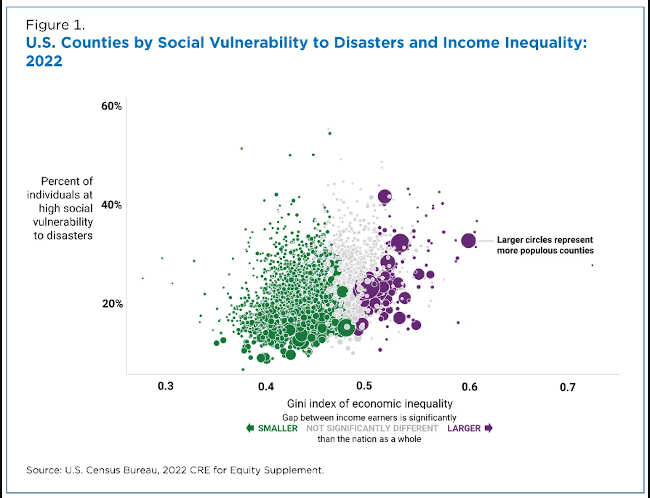
The share of residents socially vulnerable to disasters is higher in counties where income inequality is the same as or greater than the national average, according to a U.S. Census Bureau analysis.
The analysis of the Census Bureau’s Community Resilience Estimates, or CRE, Equity Supplement linked social vulnerability and income inequality.
Nationally, 20.6% of people were found to be highly vulnerable to disasters in 2022. But in counties where income inequality was at or above the national average, 23.4% were highly vulnerable. In counties with income inequality below the national average, 19.2% of residents were deemed highly vulnerable.
Figure 1 shows the relationship between the share of the vulnerable population and the income inequality in each U.S. county. Each circle represents one of the nation’s 3,144 counties, with larger circles representing more populous counties.
Counties with higher levels of income inequality — farther to the right — tended to have a higher share of individuals more socially vulnerable to disasters — closer to the top.
For example, the large purple circle on the far right is a populous county (New York County) with high income inequality (0.5980) and high social vulnerability (33.1%).
Gauging social vulnerability to disasters can help community planners, government entities and stakeholders to prepare for a disaster and plan response and recovery efforts.
The CRE provides an easily understood metric for how socially vulnerable every neighborhood in the United States is to disasters, including wildfires, flooding, hurricanes and pandemics such as COVID-19.
Modeled estimates are based on 10 components of social vulnerability including income, and access to transportation and the internet. Current estimates use Census data and provide the number and percentage of residents in the nation, states, counties and census tracts in three groups, people with zero, one or two, and three or more vulnerabilities.
CRE for equity
This analysis used the 2022 CRE Equity Supplement, also known as the CRE for Equity, which pairs data from the 2022 CRE with stats from the 2018-2022 ACS; 2020 Census; and the Census Bureau’s Planning Database. The findings are the most recent measures of social vulnerability and equity in one source.
There are several new data points in the newest version of the CRE for Equity. Key indicators are available for major race and ethnic groups from the ACS, though it wasn’t used in the analysis in this article.
Users can review area level statistics and explore how these characteristics differ based on race and ethnicity. These data include information on topics such as income, age, unemployment, and health insurance status that play a role in measuring equity.
What the CRE shows
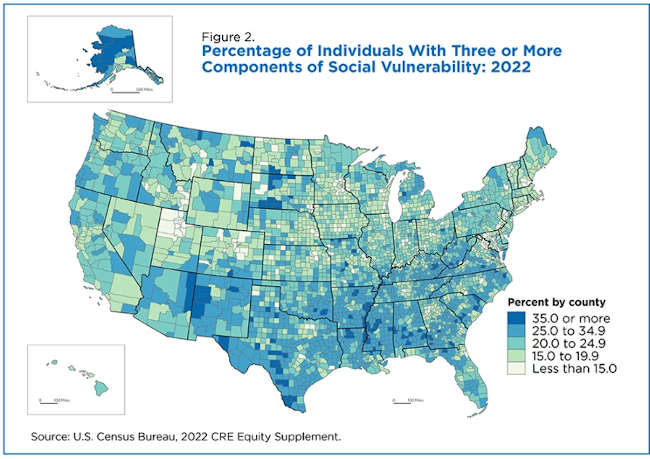
The CRE shows the number and percentage of residents living with zero, one-to-two, or three-plus components of social vulnerability. Those with three or more components are considered to be the most socially vulnerable group and more susceptible to a disaster (Figure 2).
Social vulnerability to disasters is not distributed uniformly. Rather, a swath of counties from the Southwest to the South Atlantic tended to have a greater share of individuals with three or more vulnerabilities.
How income inequality is calculated
The ACS provides a variety of income measures, including the Gini index, a widely used measure of income inequality.
The Gini index measures income inequality ranging from zero to one, reflecting the amount that any two incomes differ, on average, relative to mean income. It is an indicator of how “spread out” incomes are from one another.
Values closer to zero represent a more equitable distribution of income. For instance, if every income earner in a county made exactly $10,000 per year, the Gini index would equal zero. But if one income earner made $10,000 and all other people earned $0, the Gini index would equal one and, therefore, be less equitable.
Income inequality increased in the United States from 2007 until 2022 when it dipped mainly due to income declines among middle and top income earners.
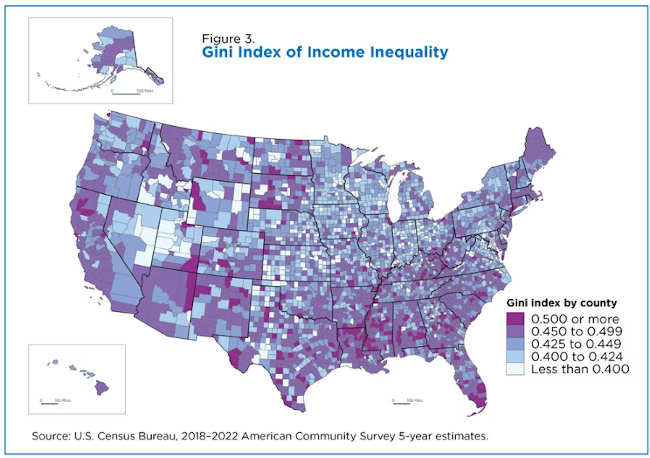
The national average of the Gini index is 0.4829 but income inequality varied widely across the country. Some counties had an estimated Gini index of 0.35 or less (Figure 3). Others had Gini index estimates greater than 0.55, which was higher than most of the world’s countries for which data were available.
Income inequality tends to be concentrated in the Southeast, roughly mirroring the pattern found for social vulnerability to disasters.
For this analysis, we compared the national estimate of inequality to that of each county to determine if there was a statistical difference. We then calculated the number of people with three or more components of social vulnerability in each type of area and found that areas with lower inequality were less socially vulnerable.
These results are consistent with prior research on the impact of income inequality on key well-being measures such as mental health, physical health and longevity.
Chase Sawyer is the technical lead for Modeled Data Product Development, Small Area and Longitudinal Estimates in the Census Bureau’s Social, Economic, and Housing Statistics Division. Joey Marshall is a data scientist in the Census Bureau’s Small Area and Longitudinal Estimates Area.
- Details
- Written by: Dennis M. Gorman, Texas A&M University

Early in the COVID-19 pandemic, researchers flooded journals with studies about the then-novel coronavirus. Many publications streamlined the peer-review process for COVID-19 papers while keeping acceptance rates relatively high. The assumption was that policymakers and the public would be able to identify valid and useful research among a very large volume of rapidly disseminated information.
However, in my review of 74 COVID-19 papers published in 2020 in the top 15 generalist public health journals listed in Google Scholar, I found that many of these studies used poor quality methods. Several other reviews of studies published in medical journals have also shown that much early COVID-19 research used poor research methods.
Some of these papers have been cited many times. For example, the most highly cited public health publication listed on Google Scholar used data from a sample of 1,120 people, primarily well-educated young women, mostly recruited from social media over three days. Findings based on a small, self-selected convenience sample cannot be generalized to a broader population. And since the researchers ran more than 500 analyses of the data, many of the statistically significant results are likely chance occurrences. However, this study has been cited over 11,000 times.
A highly cited paper means a lot of people have mentioned it in their own work. But a high number of citations is not strongly linked to research quality, since researchers and journals can game and manipulate these metrics. High citation of low-quality research increases the chance that poor evidence is being used to inform policies, further eroding public confidence in science.
Methodology matters
I am a public health researcher with a long-standing interest in research quality and integrity. This interest lies in a belief that science has helped solve important social and public health problems. Unlike the anti-science movement spreading misinformation about such successful public health measures as vaccines, I believe rational criticism is fundamental to science.
The quality and integrity of research depends to a considerable extent on its methods. Each type of study design needs to have certain features in order for it to provide valid and useful information.
For example, researchers have known for decades that for studies evaluating the effectiveness of an intervention, a control group is needed to know whether any observed effects can be attributed to the intervention.
Systematic reviews pulling together data from existing studies should describe how the researchers identified which studies to include, assessed their quality, extracted the data and preregistered their protocols. These features are necessary to ensure the review will cover all the available evidence and tell a reader which is worth attending to and which is not.
Certain types of studies, such as one-time surveys of convenience samples that aren’t representative of the target population, collect and analyze data in a way that does not allow researchers to determine whether one variable caused a particular outcome.
All study designs have standards that researchers can consult. But adhering to standards slows research down. Having a control group doubles the amount of data that needs to be collected, and identifying and thoroughly reviewing every study on a topic takes more time than superficially reviewing some. Representative samples are harder to generate than convenience samples, and collecting data at two points in time is more work than collecting them all at the same time.
Studies comparing COVID-19 papers with non-COVID-19 papers published in the same journals found that COVID-19 papers tended to have lower quality methods and were less likely to adhere to reporting standards than non-COVID-19 papers. COVID-19 papers rarely had predetermined hypotheses and plans for how they would report their findings or analyze their data. This meant there were no safeguards against dredging the data to find “statistically significant” results that could be selectively reported.
Such methodological problems were likely overlooked in the considerably shortened peer-review process for COVID-19 papers. One study estimated the average time from submission to acceptance of 686 papers on COVID-19 to be 13 days, compared with 110 days in 539 pre-pandemic papers from the same journals. In my study, I found that two online journals that published a very high volume of methodologically weak COVID-19 papers had a peer-review process of about three weeks.
Publish-or-perish culture
These quality control issues were present before the COVID-19 pandemic. The pandemic simply pushed them into overdrive.
Journals tend to favor positive, “novel” findings: that is, results that show a statistical association between variables and supposedly identify something previously unknown. Since the pandemic was in many ways novel, it provided an opportunity for some researchers to make bold claims about how COVID-19 would spread, what its effects on mental health would be, how it could be prevented and how it might be treated.

Academics have worked in a publish-or-perish incentive system for decades, where the number of papers they publish is part of the metrics used to evaluate employment, promotion and tenure. The flood of mixed-quality COVID-19 information afforded an opportunity to increase their publication counts and boost citation metrics as journals sought and rapidly reviewed COVID-19 papers, which were more likely to be cited than non-COVID papers.
Online publishing has also contributed to the deterioration in research quality. Traditional academic publishing was limited in the quantity of articles it could generate because journals were packaged in a printed, physical document usually produced only once a month. In contrast, some of today’s online mega-journals publish thousands of papers a month. Low-quality studies rejected by reputable journals can still find an outlet happy to publish it for a fee.
Healthy criticism
Criticizing the quality of published research is fraught with risk. It can be misinterpreted as throwing fuel on the raging fire of anti-science. My response is that a critical and rational approach to the production of knowledge is, in fact, fundamental to the very practice of science and to the functioning of an open society capable of solving complex problems such as a worldwide pandemic.
Publishing a large volume of misinformation disguised as science during a pandemic obscures true and useful knowledge. At worst, this can lead to bad public health practice and policy.
Science done properly produces information that allows researchers and policymakers to better understand the world and test ideas about how to improve it. This involves critically examining the quality of a study’s designs, statistical methods, reproducibility and transparency, not the number of times it has been cited or tweeted about.
Science depends on a slow, thoughtful and meticulous approach to data collection, analysis and presentation, especially if it intends to provide information to enact effective public health policies. Likewise, thoughtful and meticulous peer review is unlikely with papers that appear in print only three weeks after they were first submitted for review. Disciplines that reward quantity of research over quality are also less likely to protect scientific integrity during crises.
Public health heavily draws upon disciplines that are experiencing replication crises, such as psychology, biomedical science and biology. It is similar to these disciplines in terms of its incentive structure, study designs and analytic methods, and its inattention to transparent methods and replication. Much public health research on COVID-19 shows that it suffers from similar poor-quality methods.
Reexamining how the discipline rewards its scholars and assesses their scholarship can help it better prepare for the next public health crisis.
Dennis M. Gorman, Professor of Epidemiology and Biostatistics, Texas A&M University
This article is republished from The Conversation under a Creative Commons license. Read the original article.




