 How to resolve AdBlock issue?
News
- Details
- Written by: LAKE COUNTY NEWS REPORTS
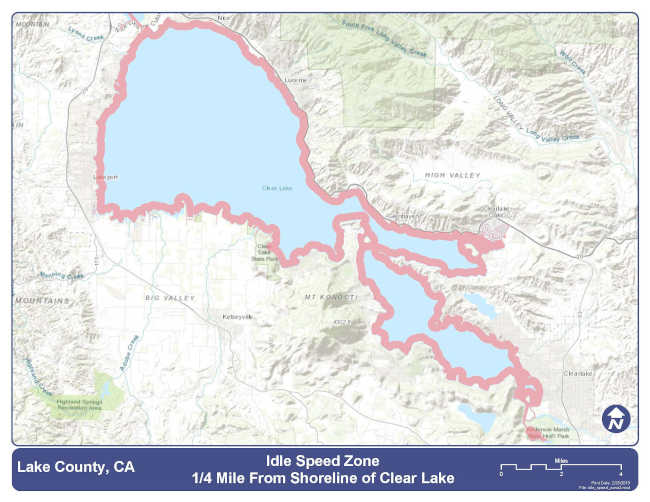
LAKE COUNTY, Calif. — Due to increasing lake levels in Clear Lake, motorboat users are reminded of local recreation Ordinance 3065, which requires idle speed when boating within one-quarter mile or less from the shore of Clear Lake.
“Idle speed” means operating a motorboat at a speed that does not produce a wake, protecting shoreline property and infrastructure from harmful wave action.
This Ordinance goes into effect when the lake reaches 8.0 feet or higher on the Rumsey scale for a 24-hour period.
Clear Lake passed the “full” mark of 7.56 feet Rumsey, the special measure for the lake, since Monday.
As of early Thursday morning, it was at 8.38 feet Rumsey.
The requirements are lifted when Clear Lake drops to 7.9 feet Rumsey, or lower, for a 24 hour period.
Violating this Ordinance constitutes a misdemeanor and may result in a fine not to exceed $500, or up to six months imprisonment in the County Jail.
Please continue to exercise caution due to floating and submerged debris
Additionally, all boaters are advised to use extra caution when operating motorboats throughout Clear Lake due to floating and submerged debris hazards resulting from the ongoing atmospheric river storm events that have occurred in late January and February.
Floating and submerged debris such as trees, branches, full or partial floating docks, abandoned or detached boats, trash, and other objects can cause significant damage, particularly when coming into contact with boats operating at normal to significant speed.
Boaters should remain vigilant and aware of their surroundings and maintain a safe, slower speed when boating throughout all of Clear Lake this time of year.
For questions regarding this topic, or to report in-lake hazards such as debris, floating docks, or missing or found hazard buoys, please contact the Water Resources Department at 707-263-2344 or email at
- Details
- Written by: Lake County News reports
The forecasted allocation is now 15% of requested supplies, up from the 10% initial allocation announced in December. This translates to about 200,000 acre-feet of additional water for the 29 public water agencies that serve 27 million Californians.
This assessment does not include the results of any of the storms that hit California earlier this month. The State Water Project will review conditions and may revise the forecasted allocation in mid-March.
The February allocation forecast update takes into account snow survey measurements and data up until Feb. 1 and spring runoff forecasts outlined in the first Bulletin 120 of the season.
While California has seen a series of winter storms the past two months, those storms have been warmer and brought historic rainfall to Southern California. Northern California, the headwaters of the State Water Project, has seen less of a benefit from these storms and precipitation for that region was below average.
The State Water Project has been able to take advantage of these storms, increasing storage at both Lake Oroville and San Luis Reservoir. Lake Oroville has increased 460,000 acre-feet and San Luis Reservoir has increased 85,000 acre-feet since January 1.
“We will continue to assess our State Water Project allocation forecast as more storms materialize in February and March,” said DWR Director Karla Nemeth. “This season is an important reminder of our extreme conditions and shift to bigger, flashier storms and the need to continue increasing the state’s ability to capture and store stormwater when it comes as rain instead of snow.”
As of Wednesday, the statewide snowpack is 86% of average for this date, and 69% of its April 1 average, which is considered the peak snowpack for the season.
“January’s storms allowed the state to increase, though slightly, its storage and delivery of much-needed water supplies from the SWP. The storms California has experienced so far have brought historic rainfall to Southern California, while Northern California — where the SWP and its infrastructure begins — has seen less precipitation,” said Jennifer Pierre, general manager of the State Water Contractors.
“With several weeks left in this year’s wet season, we hope more rain and snow can drive this allocation even higher. SWP reservoirs remain above average for this time of year, and following last year’s historic storms, both Lake Oroville and San Luis Reservoir’s storage have increased since the first of the year. And had the Delta Conveyance Project been in place, we could have moved an additional 314,000 acre-feet of water, which would have resulted in a higher allocation,” Pierre said.
Pierre added, “California’s climate extremes — characterized by larger, more unpredictable storms followed by prolonged dry periods — show how critical it is for our water managers to have the ability to make real-time water management decisions based on forecasting and current hydrology, capture as much water as possible when it’s available, and protect water supplies and deliveries for the 27 million Californians who rely on the SWP.”
State Water Project reservoirs remain above average for this time of year, as the state continues to benefit from last winter’s historic snowpack and efforts to capture and store as much water as possible. Lake Oroville, the State Water Project’s largest reservoir, is at 134 percent of average for this date.
With recent storms bringing more rain than snow, DWR continues to work with local water agencies to capture and store as much stormwater as possible. DWR is also supporting efforts statewide to capture stormwater and use it to recharge critical groundwater basins.
Each year, DWR provides the initial State Water Project allocation by Dec. 1 based on available water storage, projected water supply, and water demands.
Allocations are updated monthly as snowpack, rainfall, and runoff information is assessed, with a final allocation typically determined in May or June.
- Details
- Written by: Lake County News reports
The brief, “Commuting in the United States: 2022,” explores recent commuting trends using estimates from the 2022 ACS, one-year dataset, with comparisons to 2019 and 2021.
The analysis shows changes in the way people travel to work since the onset of the COVID-19 pandemic along with several key commuting characteristics, including means of transportation to work, travel time to work, and time of departure from home to go to work.
Highlights include the following.
• Almost 140 million people in the United States routinely commuted to work in 2022, and more than 20 million worked from home.
• Among U.S. workers, 15.2% worked from home in 2022, down from almost 17.9% in 2021 but still far higher than the 5.7% that worked from home before the onset of the COVID-19 pandemic in 2019. Among workers in Puerto Rico, 5.9% worked from home in 2022, down from 7.4% in 2021 but more than twice the 2019 share of 2.4%.
• The share of U.S. workers driving alone to work was 68.7% in 2022, about 7 percentage points less than the 75.9% in 2019. In Puerto Rico, 82.7% of workers drove alone to their place of work in 2022, compared to 84.3% in 2019, a decline of less than 2 percentage points.
• Public transportation commuting in the United States remained well below the 2019 share of 5.0% of workers at 3.1% in 2022. This represented an increase from the 2.5% of workers commuting by public transportation in 2021. In Puerto Rico, less than 1% of workers commuted by public transportation in 2021 and 2022, compared to 1.2% in 2019.
• In each of seven U.S. metropolitan areas with the most public transportation commuters, more workers commuted by public transportation in 2022 compared to 2021. However, public transportation commuting did not rebound to 2019 levels in any of these seven metro areas. In the New York metro, there were roughly 700,000 fewer transit commuters in 2022 than in 2019.
• Average one-way commuting time among those who traveled to a workplace increased by almost 1 minute from 25.6 minutes in 2021 to 26.4 minutes in 2022, still well short of its historic high of 27.6 minutes in 2019.
• With more than 20 million people working from home in 2022, about 9 million fewer commuters departed their homes for the workplace during the core commuting hours of 6 a.m. to 8:59 a.m. in 2022 than in 2019.
The American Community Survey provides a wide range of statistics about the nation’s people and housing, such as language spoken at home, education, commuting, employment, mortgage status and rent, income, poverty, and health insurance coverage. It is the only source of local estimates for most of the 40-plus topics it covers.
- Details
- Written by: Lake County News reports
“AT&T’s application to cease landline service in our communities threatens public safety in an area plagued by earthquakes, severe storms, floods, and fires and that has a geography that often disrupts cellular service for days, if not weeks, at a time,” Thompson and 14 other members of Congress wrote. “During these times, residents are only able to contact emergency services and obtain emergency updates via their landlines. In fact, many of these areas do not have reliable cellular service on a good weather day, at best. If AT&T’s petition is granted, we think an exception for residents who live in areas with unreliable cellular service, where they are prone to fires, earthquakes, flooding, and landslides is warranted.
“As the CPUC considers AT&T’s proposal to discontinue lifesaving services, we think a clear-eyed analysis of the limitations of the cellular service in good conditions, and in the hilly and mountainous areas where disasters can cause prolonged power outages is necessary. We encourage you to fully and fairly consider the concerns from constituents in our districts about the impact the loss of land lines would have on the safety of our community,” the members closed.
AT&T filed a document with the CPUC in December seeking relief from its “carrier of last resort” obligations across the state.
In Lake County, one of the five counties Thompson represents, AT&T wants to end its carrier of last resort obligations to 15 different communities: Clearlake Oaks, Clearlake Riviera, the city of Clearlake and surrounding areas, Cobb, Hidden Valley Lake, Kelseyville, the city of Lakeport city and surrounding areas, Lower Lake, Lucerne, Middletown, Nice, north Lakeport, Soda Bay, Spring Valley and Upper Lake.
Thompson was joined by 14 members of the California delegation in signing the letter.
The members of Congress signing the letter include Rep. Lou Correa, Rep. Mark DeSaulnier, Rep. Anna Eshoo, Rep. John Garamendi, Rep. Jared Huffman, Rep. Ro Khanna, Rep. Doug LaMalfa, Rep. Barbara Lee, Rep. Mike Levin, Rep. Kevin Mullin, Rep. Jimmy Panetta, Rep. Katie Porter, Rep. Adam Schiff and Rep. Mark Takano.
Information on the process and how to comment can be found here.
The full letter can be read below.
Dear Ms. Reynolds:
On behalf of the constituents of the California Delegation, we raise serious concerns with AT&T’s applications to be relieved of its Carrier of Last Resort (COLR) obligations and to remove its Eligible Telecommunications Carrier (ETC) designation in areas of California. AT&T’s application to cease landline service in our communities threatens public safety in an area plagued by earthquakes, severe storms, floods, and fires and that has a geography that often disrupts cellular service for days, if not weeks, at a time. During these times, residents are only able to contact emergency services and obtain emergency updates via their landlines. In fact, many of these areas do not have reliable cellular service on a good weather day, at best. If AT&T’s petition is granted, we think an exception for residents who live in areas with unreliable cellular service, where they are prone to fires, earthquakes, flooding, and landslides is warranted.
Congress has repeatedly passed legislation seeking to address the worsening severity of natural disasters and their impact on our constituents. For example, in the Bipartisan Infrastructure Law Congress provided $500 million for hazardous fuels mitigation; $500 million for prescribed fires; $500 million for communities to implement a community wildfire defense plan; $5 billion for utilities to underground power lines, install fire-resistant technologies, and expand the use of microgrids; and $3.5 billion for weatherization assistance to help homeowners make energy-efficient improvements that help fireproof their homes. Ensuring residents are able to communicate and reach emergency services during these natural disasters addresses the Congressional concern with mitigating the loss of life and property during these natural disasters that often require federal funds for remediation for the loss of property. There is no remediation possible for the loss of life.
CPUC’s stated mission is to ensure Californians have safe, reliable utility services. We do not believe that removing access to landlines is compatible with this mission. When catastrophic earthquakes, destructive fires, cataclysmic landslides, or ravaging floods happen residents are left without the electricity or working cellular towers necessary for cellular phone usage for days and weeks at a time. These disasters are not figurative or future possibilities. They happen regularly in this area of the country.
For example, this year already hundreds of thousands of Californians who were without power due to the Pineapple Express weather system storms, floods, and landslides. The earthquake of 2022 left Californians without power for such an extended period of time, people were unable to charge their cellular phones. The only way to call for emergency services and stay in touch with the outside world was via neighbors that had landlines. What will happen if these landlines are removed? How will people call for emergency service in a disaster or in areas with poor cellular reception?
As of the morning of February 7, 2024, you had over 3,000 comments asking you to deny the petition. We think these comments are worth consideration when determining whether to deny AT&T’s petition or to create an exception for residents who live in areas with unreliable cellular service, where they are prone to fires, earthquakes, flooding, and landslides.
As the CPUC considers AT&T's proposal to discontinue lifesaving services, we think a clear-eyed analysis of the limitations of the cellular service in good conditions, and in the hilly and mountainous areas where disasters can cause prolonged power outages is necessary. We encourage you to fully and fairly consider the concerns from constituents in our districts about the impact the loss of land lines would have on the safety of our community.




