 How to resolve AdBlock issue?
News
- Details
- Written by: Lake County News reports
LAKE COUNTY, Calif. — Do you ever wonder how much rainfall you received from a recent thunderstorm? How about snowfall during a winter storm?
If so, an important volunteer weather observing program needs your help.
The Community Collaborative Rain, Hail and Snow network, or CoCoRaHS, is looking for new volunteers across northwest California.
This grassroots effort is part of a growing national network of home-based and amateur rain spotters with a goal of providing a high density precipitation network that will supplement existing observations.
CoCoRaHS came about as a result of a devastating flash flood that hit Fort Collins, Colorado, in July 1997.
A local severe thunderstorm dumped over a foot of rain in several hours while other portions of the city had only modest rainfall.
The ensuing flood caught many by surprise and caused $200 million in damages. CoCoRaHS was born in 1998 with the intent of doing a better job of mapping and reporting intense storms.
As more volunteers participated, rain, hail, and snow maps were produced for every storm showing fascinating local patterns that were of great interest to scientists and the public.
Recently, drought reporting has also become an important observation within the CoCoRaHS program across the nation. In fact, drought observations from CoCoRaHS are now being included in the National Integrated Drought Information System.
How does one become a CoCoRaHS observer? Go to the CoCoRaHS website above and click on the “Join CoCoRaHS” emblem on the upper right side of the main website. After registering, take the simple online training, order your 4-inch rain gauge and start reporting.
To obtain a rain gauge, volunteers can order through the CoCoRaHS website for about $35 plus shipping. They have a limited number of rain gauges to give out if you are able to be a regular
observer and there is a limited number of observers currently in your area.
Observations are available on maps and reports for the public to view within five minutes of submitting them.
The process takes only five minutes a day, but the impact to the community is tenfold: By providing high quality, accurate measurements, the observers are able to supplement existing
networks and provide useful results to scientists, resource managers, decision makers and other users.
If you have any questions, including how to apply for a free rain gauge, email Matthew Kidwell at the National Weather Service in Eureka at
- Details
- Written by: Lake County News reports
The event will take place on Saturday, March 30, from 9 a.m. to 2 p.m., in the public parking lot located north of the Fifth Street boat ramp in downtown Lakeport.
Residents and business owners of the city of Lakeport are invited to participate in this effort to enhance our environment and beautify our city.
This event is limited to city of Lakeport residents and business owners; anyone dropping off trash and solid waste will be required to provide photo identification and a copy of a current city of Lakeport utility bill.
Participants are asked to follow these guidelines:
• Stay in vehicle while Lakeport Disposal staff unloads materials
• Two visits maximum per each address
ACCEPTED MATERIALS: Household trash; televisions; appliances (stoves, washers, dryers, dishwashers and water heaters); electronic waste; mattresses; household furniture; unusable clothes, blankets, towels; and similar materials.
NOT ACCEPTED: Refrigerators, hot tubs/spas, air conditioners, construction debris, used tires and Household Hazardous Waste.
For more details, please see the city’s website or Facebook page, or contact Lakeport Disposal at 707-263-6080.
- Details
- Written by: Lake County News reports
This year, Edison International donated $50,000 to California ReLeaf for California Arbor Week Grants — a community-led, tree-planting grant program offered by California ReLeaf with support from Cal Fire and the U.S. Forest Service.
This grant funding will go directly to supporting community urban forestry programs across the state.
“We are thrilled and grateful to work with so many partners to celebrate Arbor Week,” said Cindy Blain, executive director of California ReLeaf. “Arbor Week is a great reminder of the powerful role trees have in building climate resilience, community connection, and improving public health.”
Arbor Week has the ongoing support of the Forest Service and Cal Fire. Both agencies support ongoing community tree planting in urban areas of California through grant funding, education and technical expertise.
“Last year, the Forest Service announced the award of $43.2 million to the state of California and $102.87 million to cities, counties, nonprofits and schools to support our urban and community forests and people — funding made possible by the Inflation Reduction Act," said Miranda Hutten, Urban and Community Forestry Program Manager for the Pacific Southwest Region of the Forest Service.
“This historic investment recognizes the value of urban forests to build equity, support public health, increase climate resilience, and connect communities. This Arbor Week celebration we want to acknowledge the partners who support this vision and the people greening our neighborhoods across the region,” Hutten said.
- Details
- Written by: Jared McDonald, University of Mary Washington
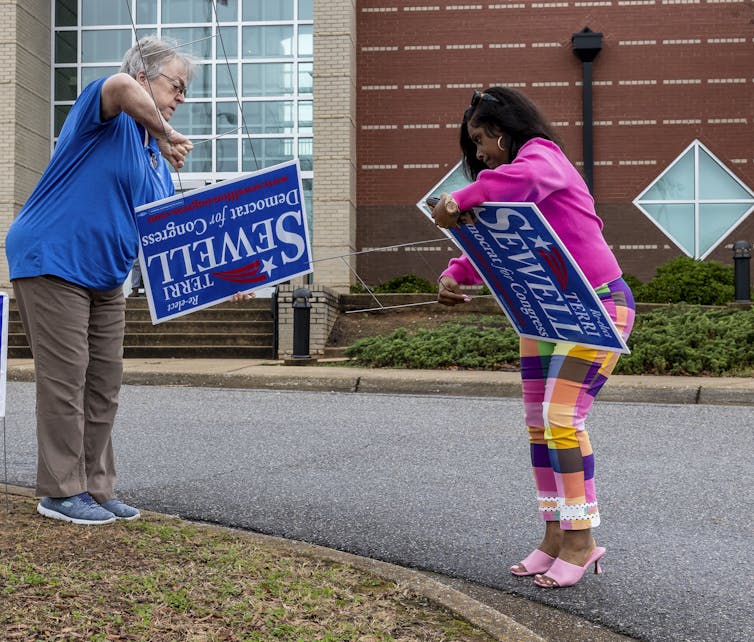
Now that Super Tuesday is over and the Democratic and Republican nominees are all but officially chosen, as everyone expected, voters can turn the page to the general election.
But they’re not excited about it, and they haven’t been for months.
A September 2023 Monmouth University poll showed no more than 40% of Americans said they were “enthusiastic” for either Biden or Trump to run again. That same month, the Pew Research Center found that 65% of Americans were exhausted with the current state of American politics. In February 2024, The New York Times said Democrats in particular were burned out by the seemingly endless avalanche of political crises.
You can listen to more articles from The Conversation, narrated by Noa.
It is not surprising that a rematch of the 2020 election is failing to inspire excitement in the American people. Yet, as a political scientist who studies citizen engagement and the public’s feelings toward the candidates, I find these trends disturbing. It’s not just polarization that’s driving voters’ malaise – it’s something else, which carries a stark warning for the health of American democracy.
There is another divide in politics
Most discussions of the current state of the American electorate have understandably focused on political polarization. Democrats and Republicans often express disdain for each other, even when they don’t actually disagree on specific policies for the nation to pursue.
Some of this disdain is rooted in identity. For example, people who hold unfavorable attitudes toward African Americans, feminists and other groups associated with the Democratic Party tend to identify more strongly with the Republican Party. People with unfavorable attitudes toward stereotypically Republican groups such as evangelicals and gun owners tend to be stronger Democrats.
From this perspective, Democrats and Republicans are pack animals motivated to protect their group and their group’s interests.
Often overlooked, however, is how the vitriol of modern American politics fuels what political scientists Yanna Krupnikov and John Barry Ryan call “The Other Divide.” This is the divide between people who engage in politics and those who don’t.
In short, a significant number of Americans don’t talk about politics, whether because they are not interested in politics or are turned off by the negativity. It’s a gradual trend dating back to the 1980s and 1990s that has continued for decades now. This weakens the fabric of democracy, because the only voices that are heard online and in the media are from those who are most willing to speak up. They tend to be the most dissonant and extreme views.
The public discussion about the country’s past, present and future therefore leaves out a wide range of people’s voices. What they might say is hard to know, specifically because they don’t engage in political discussions.
Young voter disengagement
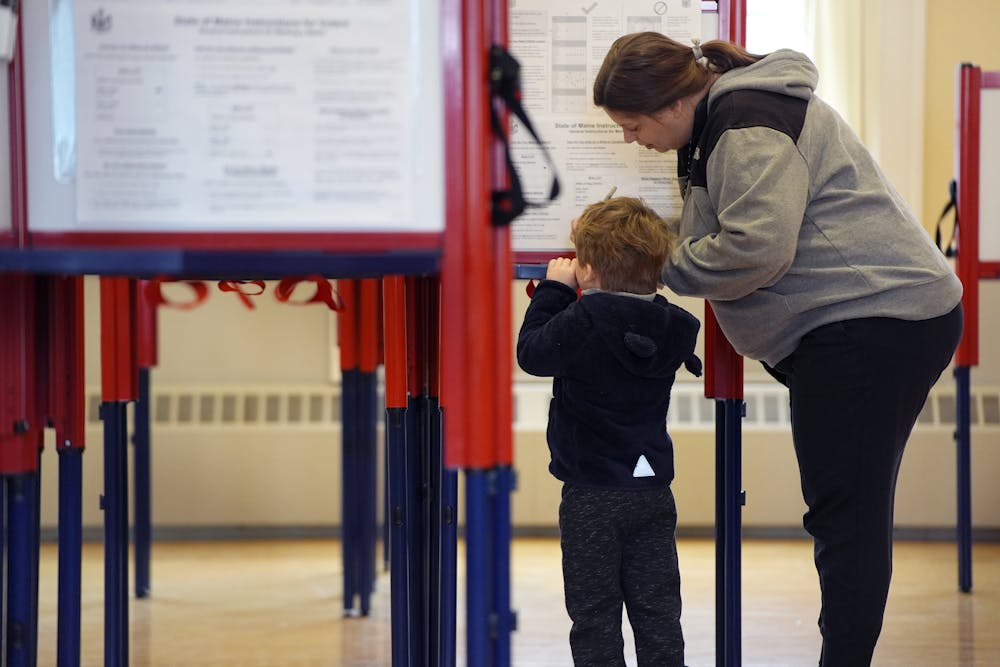
Especially troubling to me is the political disillusionment expressed by young people, who are the most likely group in the country to avoid identifying themselves as members of one party or the other. People who identify themselves as independents – especially if they don’t lean toward one party or the other – are also likely to lack interest in voting.
Having come of age during an era of high polarization, younger people are less likely to idealize politics and the right to vote. In prior research, my colleagues and I found that younger people worldwide were just as interested in politics as older citizens but were less likely to view voting as a civic duty. Protesting or joining an organization offers social benefits to young people – an opportunity to feel like they are part of something bigger. Voting, by contrast, is perceived as a more solitary act.
If younger American voters aren’t excited about the choices on the ballot, they may be more likely not to vote at all.
In a recent survey I conducted in collaboration with IGNITE National, an organization seeking to bolster young women’s engagement in the political process, we asked Gen Z Americans, adults born after 1996, what drove their disillusionment with American politics. Consistently, Gen Z respondents noted that the candidates appearing on the ballot did not look like them, contributing to their feeling of detachment from the political process.
Barack Obama’s race made 2008 a historic election. Hillary Clinton’s gender made 2016 a historic contest as well. By contrast, 2024 features the two oldest white men to ever seek the presidency, vying for second terms in office.
Burnout’s effects on democracy
Americans have many demands on their time. Between work, family and other activities, many struggle to watch or read the news, fact check what they see on social media or engage in productive political discussions. As a result, most of the American public is largely unaware of key aspects of important issues, and does not pay attention to the parties’ stances on those issues.
This lack of engagement is dangerous for democracy. Voters who cannot evaluate the merits of contrasting policy positions, or who cannot accurately assign blame and give credit for the state of the American economy, will ultimately fall back on cheap cues such as partisanship to make their choices.
Or they may abstain from politics altogether.
The campaign season offers an opportunity for voters who may be open to persuasion to engage in the political process for a short period of time, become sufficiently informed and make their voices heard. Though there are flaws in the many processes of political campaigning, media coverage and community involvement, the bottom line is simple: Deliberative democracy requires an American public that is willing to deliberate.
If Americans are too burned out to engage enthusiastically and provide feedback to political leaders, then there is little hope that any government could truly reflect the will of the people.
Jared McDonald, Assistant Professor of Political Science and International Affairs, University of Mary Washington
This article is republished from The Conversation under a Creative Commons license. Read the original article.