 How to resolve AdBlock issue?
News
- Details
- Written by: Elizabeth Larson

LAKEPORT, Calif. — The Lakeport Unified School Board on Wednesday night voted to begin notifying several employees of the potential for layoff as part of district leadership’s plan to address a budget shortfall.
The decision came at the end of a special three and a half-hour meeting called for Wednesday evening at the district office, where dozens of people crowded into the boardroom, with the audience spilling into the lobby.
At the start of the meeting, Superintendent Matt Bullard gave a brief statement on the proposal to cut both certificated and classified staff — including key union representatives — and blamed the situation on the state’s dropping revenues.
The proposal in its original form included cutting 16 employees, as well as the district’s long-running day care and after school program.
Among the employees facing layoff is Rachel Paarsch, director of supplemental support. Several people spoke in support of Paarsch and her work to advance and expand the district’s alternative education program.
“Cutting Rachel’s position would be a very big mistake,” said parent Krystal Pasalo, explaining how Paarsch has helped her son, who has learning disabilities.
On the classified side, the plan included eliminating the head groundskeeper and skilled maintenance worker positions and creating two head custodians with less pay, for a savings of only about $12,000 a year.
While the final vote included Paarsch’s layoff, the groundskeeper and maintenance positions, along with the after school coordinator and day care assistant were spared in the end.
Certificated staff found out about the proposal on Feb. 20, but classified staff said it was only on Monday that they found out what was proposed.
Wednesday’s action is what Bullard and board members said is a “first step” in attempting to meet the district’s budget shortfall in the coming months. Layoff notices for educators must be made by March 15.
Bullard said the proposal was the best option in his opinion. He went on to explain that the district wants to have competitive wages and benefits to attract employees to the district and, once they’re here, to retain them. The goal is to pay a minimum of $20 per hour for hourly employees and $60,000 per year for salaried employees.
“Budget reductions, reducing expenditures, is not an easy task,” said Bullard, who noted that all positions in the district deliver value to students and faculty.
“The decisions that are going to be made in the next three months as the budgeting unfolds are incredibly difficult to make,” Bullard said.
After nearly an hour and a half hearing input from alarmed staff, parents and students, the board went into a closed session in Bullard’s office, where they stayed behind closed doors for just under two hours before emerging to announce their decision.
Need for reducing expenditures
In response to questions asked during the meeting by Lake County News, Bullard said the proposed staff cuts were aiming to reduce expenditures by $1.3 million.
He said the district is deficit spending by $1.6 million this year and if costs aren’t reduced, Lakeport Unified could be facing significant financial issues in the coming school year.
Staff and their supporters argued that, particularly when it came to maintenance and grounds staff, the cuts would impact campus safety.
Darren Wells, the skilled maintenance worker whose job was on the list for elimination, said he’s saved the district tens of thousands of dollars with his work across the campus. He said safety should be a top priority, adding he didn’t think Bullard was willing to take a cut in pay.
Wells also is the classified union president, a factor which several people Lake County News spoke to during and after the meeting raised as an issue that led them to conclude that Wells was potentially being targeted.
Additionally, the school board and administration faced heavy criticism from one of its own during the meeting.
Lynn Andre, a retired district employee and former board member, said she didn’t understand why they are cutting the day care program, which was making money for the district not just by revenue but by attracting students.
“Your district has a problem with declining enrollment and to cut services, I can guarantee, will continue that decline,” said Andre, who noted that in the 15 years she had managed the day care program, it never faced a reduction.
“So if it’s in the red now you’re doing something wrong. You’re doing something wrong,” she said.
One of the things the district is doing wrong, Andre suggested, is that it hasn’t raised the rates for the program. During the rest of the meeting, there were parents who said they would gladly pay more for the program’s services.
Dave Norris, who worked for Lakeport Unified for 38 years and is its former head of maintenance, bolstered the safety argument by pointing out that the district is spending very little money on maintenance and grounds when considering the vast amount of responsibility.
He explained the variety of needs, from keeping playing fields in safe and acceptable shape — including removing gophers from the football field — to maintaining the bleachers in the gym and on the fields.
Dan Camacho, who now is the head of maintenance, said the district needs to have a serious conversation about the money saved and safety.
Camacho then changed gears, saying he thought it was sad that teachers and coaches wanted to put things on Facebook about the situation, adding he wished they would get the facts first. He singled out longtime football coach Milo Meyer, who was standing in the foyer, and who had posted his concerns about the district’s planned cuts.
In response to Camacho, Meyer went to the podium and began to give his take on the situation, explaining that students bring money to the district. “We have declining enrollment. End of story.”
Meyer said there have been about a dozen quality teachers who have left for other districts because of Lakeport Unified’s situation.
He said they’ve lost students, a tennis court and a swimming pool, and are losing other space on the campus as well, pointing to a large number of containers behind the gym.
Meyer said he didn’t know what the answer was, but that, “We need to look at ourselves.” He also raised issues with the rapid turnover of administrators, a matter others referenced as well.
Paarsch, now in her 10th year as an administrator in the district — where she herself attended school and worked as a fledgling teacher — said alternative education has flourished over the past five years, under her leadership.
Alternative education is trending and is bringing in students, she added.
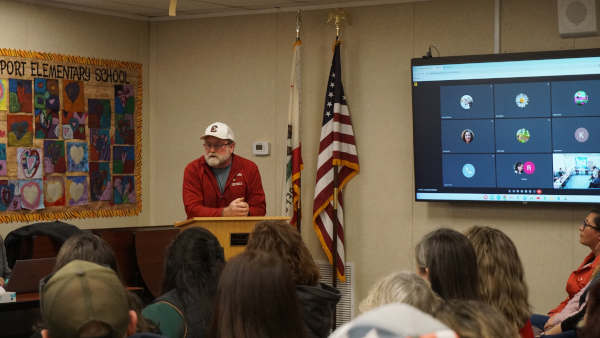
Waiting for a decision
The school board went into closed session in Bullard’s office just before 7:30 p.m. About 20 people — parents, students and staff — stayed on and waited for the board to come out and announce its decision.
During that wait, Phillip Sparkes, a senior at Clear Lake High School who had spoken to the board about his concerns about the proposed cuts, told Lake County News that he thought that getting rid of the permanent substitute counselors is ridiculous.
That means the main counselor is trying to cover too much, and she has less time for seniors. “They’ve stretched her too far,” Sparkes said.
When the board finally emerged after two hours, Board President Jennifer Williams-Richardson was visibly emotional. She came into the boardroom and took a tissue and began to dab her eyes. The rest of the board looked somber.
Their first order of business was to report action including unanimously approving taking the required steps to terminate a number of temporary employees as they must do at the end of each year. Those employees can be added back in the next school year, Bullard said.
They then took action to release Paarsch. That vote was 3-0, with two abstentions, reported Board member Phil Kirby, who also is Paarsch’s father.
The board then took up the first of the two resolutions regarding staff layoffs.
That resolution, for certificated staff, called for laying off nine full-time positions: three instructional coaches, three permanent substitutes, one permanent substitute counselor, one school psychologist and Paarsch’s position, director of supplemental support. The vote for that unchanged resolution was 3-0, with Kirby and Carly Alvord recusing themselves.
When it came to the classified layoffs, however, the board amended the proposed resolution. One bus monitor and two paraprofessionals will be laid off, but the head groundskeeper, the after school coordinator, Wells’ skilled maintenance worker position and the day care assistant were spared for now in a unanimous board vote.
“Obviously, these decisions are extremely difficult,” said Bullard, who thanked everyone for attending the meeting.
Bullard emphasized that they have not eliminated the positions but that what the board did was complete its ability to continue the process.
“This was just simply the first step” to provide employees the notice required by the education code and potentially eliminate the positions this spring, he said.
“This is the first step in this process, a process that we don’t want to do,” said Board member Dan Buffalo, adding that people could tell due to the emotions.
He said they have very little control over their revenues and they are trying to create space in their budget in order to give the best compensation packages for staff. The board has committed to an additional $1 million in its budget next year to do that while also right-sizing the district.
“It’s been a difficult night so maybe we’ll leave it at that,” Buffalo said.
Alvord said all of the board members have had really productive conversations over the past couple of days, although it doesn’t always feel that way when sitting in the boardroom.
“We really, truly sit here because we want what’s best for kids and we want what’s best for the district,” Alvord said.
Email Elizabeth Larson at

- Details
- Written by: Elizabeth Larson
Lauren Berlinn, spokesperson for the Lake County Sheriff’s Office, identified the crash victim as Gregory Allen Van Gundy, 58.
The California Highway Patrol’s Clear Lake Area office said Van Gundy was driving eastbound on Highway 20 east of Blue Lakes Road just before 1 p.m. on Sunday when he lost control in a curve and crossed into the opposing lane of traffic, hitting another vehicle head-on.
The CHP said Van Gundy died of his injuries at the scene. Two people in the car with which he collided had minor injuries.
The crash remains under investigation, the CHP said.
Email Elizabeth Larson at
- Details
- Written by: Lake County News reports
CLEARLAKE, Calif. — The Clearlake Police Department is working to find a 65-year-old man who was reported missing.
Police are seeking Kenneth Nicholson, 65.
His last known location was near the Travelodge in Clearlake.
Nicholson is described as a white male adult, 5 feet 9 inches tall, 165 pounds, with blond hair and blue eyes.
If you have any information regarding his whereabouts please contact the Clearlake Police Department at 707-994-8251, Extension 1 for dispatch.
- Details
- Written by: Elizabeth Larson
National Groundwater Awareness Week is next week, and in the spirit of promoting groundwater knowledge, the Department of Water Resources announceD that its innovative groundwater mapping project is complete and will provide critical information about our underground water supply.
The Statewide Airborne Electromagnetic, or AEM, Survey Project has now completed surveys in all high-and-medium-priority groundwater basins in California.
AEM surveys use state-of-the-art helicopter-based technology to scan the earth’s subsurface to depths of up to 1,000 feet, like taking an MRI of the earth, to visualize the aquifer structures beneath our feet.
You can see the AEM equipment in action in this DWR video: DWR's Airborne Electromagnetic (AEM) Surveys: The AEM Method (youtube.com).
DWR collected nearly 16,000 miles of AEM data within 95 groundwater basins across California between December 2021 and November 2023.
This data, which is now publicly accessible, is invaluable for identifying the most suitable locations to implement groundwater recharge projects that can capture water from winter rain and runoff events to store underground for use during dry periods.
The replenishment of depleted groundwater basins is a key action that local agencies are implementing under the Sustainable Groundwater Management Act, or SGMA, and is an essential part of California’s long-term water resilience and drought mitigation efforts, as seen in Governor Gavin Newsom’s strategy document, “California’s Water Supply Strategy, Adapting to a Hotter, Drier Future.”
“AEM data helps GSAs move more expediently towards development of projects in areas previously deemed as non-suitable for groundwater recharge,” said Kassy Chauhan, Executive Officer, North Kings Groundwater Sustainability Agency. “AEM has helped to navigate below ground to find the small pockets where the soil conditions are prime for groundwater recharge to occur. The picture of the sub-surface geology helps with project siting and ensures available financial resources are going towards feasible projects which will help get water into the underground helping the North Kings GSA reach its sustainability goals.”
California’s high- and medium-priority groundwater basins provide a major source of water supply for more than 15 million people, especially during dry years when surface water supplies are lacking. As California adapts to a hotter, drier future, groundwater supplies are becoming a more vital resource for communities, households, businesses, agriculture, and the environment that all depend on this critical water source.
“The state continues to make investments in the latest technology, like AEM, to ensure we are prepared for the weather extremes that are playing out in the new climate reality,” said Paul Gosselin, deputy director of sustainable groundwater management. “Data from these initial statewide AEM surveys are already being used by local groundwater agencies, and we are excited to move into the next phase, expanding data collection efforts and providing new tools for understanding and managing California's groundwater on a local, regional, and statewide level.”
As the 10-year anniversary of California’s landmark SGMA nears, DWR continues to build on the state’s long history of investigating California’s groundwater basins as part of California’s Groundwater (Bulletin 118). DWR is now moving into the next phase of this work, called Basin Characterization, where new and existing information, including AEM data, will be used to help identify and better understand underground aquifer structures and conditions more clearly than ever before.
DWR is assembling a broad team of experts and coordinating with local agencies to form a workgroup to support this effort to ensure that cutting-edge practices are employed, and results advance local groundwater management. The Basin Characterization Workgroup will aide in coordination and collaboration with local, state, and federal agencies, as well as academia and the private sector.
To support data access equity and allow all Californians to view and analyze this data, DWR developed online AEM Data Viewers. These viewers are revolutionary in the space of viewing complex geologic data as they allow data to be viewed online, without having to purchase specialized software. These tools will enable both the public and technical users to interact with the data in a three-dimensional space, providing a more immersive and informative experience.
DWR’s Basin Characterization efforts will be ongoing as tools and technology improve, in order to increase understanding of California’s groundwater basins and aquifer structures.
In May, DWR will release the next Semi-Annual Groundwater Conditions Update, which will contain the most current statewide groundwater data and information, including Annual Report data submitted by local groundwater sustainability agencies. This data will help provide a clearer picture of the amounts of managed and natural groundwater recharge that occurred during water year 2023.
All of this work is helping local groundwater managers better understand and manage their basins to address both drought and flood response and achieve long-term groundwater sustainability.