 How to resolve AdBlock issue?
News
- Details
- Written by: European Southern Observatory

Using the European Southern Observatory’s Very Large Telescope, or VLT, astronomers have characterized a bright quasar, finding it to be not only the brightest of its kind, but also the most luminous object ever observed.
Quasars are the bright cores of distant galaxies and they are powered by supermassive black holes. The black hole in this record-breaking quasar is growing in mass by the equivalent of one Sun per day, making it the fastest-growing black hole to date.
The black holes powering quasars collect matter from their surroundings in a process so energetic that it emits vast amounts of light. So much so that quasars are some of the brightest objects in our sky, meaning even distant ones are visible from Earth. As a general rule, the most luminous quasars indicate the fastest-growing supermassive black holes.
“We have discovered the fastest-growing black hole known to date. It has a mass of 17 billion Suns, and eats just over a Sun per day. This makes it the most luminous object in the known Universe,” said Christian Wolf, an astronomer at the Australian National University, or ANU, and lead author of the study published today in Nature Astronomy. The quasar, called J0529-4351, is so far away from Earth that its light took over 12 billion years to reach us.
The matter being pulled in toward this black hole, in the form of a disc, emits so much energy that J0529-4351 is over 500 trillion times more luminous than the Sun.
“All this light comes from a hot accretion disc that measures seven light-years in diameter — this must be the largest accretion disc in the Universe," said ANU PhD student and co-author Samuel Lai. Seven light-years is about 15 000 times the distance from the Sun to the orbit of Neptune.
And, remarkably, this record-breaking quasar was hiding in plain sight. “It is a surprise that it has remained unknown until today, when we already know about a million less impressive quasars. It has literally been staring us in the face until now,” said co-author Christopher Onken, an astronomer at ANU. He added that this object showed up in images from the European Southern Observatory Schmidt Southern Sky Survey dating back to 1980, but it was not recognised as a quasar until decades later.
Finding quasars requires precise observational data from large areas of the sky. The resulting datasets are so large, researchers often use machine-learning models to analyse them and tell quasars apart from other celestial objects.
However, these models are trained on existing data, which limits the potential candidates to objects similar to those already known. If a new quasar is more luminous than any other previously observed, the programme might reject it and classify it instead as a star not too distant from Earth.
An automated analysis of data from the European Space Agency’s Gaia satellite passed over J0529-4351 for being too bright to be a quasar, suggesting it to be a star instead. The researchers identified it as a distant quasar last year using observations from the ANU 2.3-metre telescope at the Siding Spring Observatory in Australia.
Discovering that it was the most luminous quasar ever observed, however, required a larger telescope and measurements from a more precise instrument. The X-shooter spectrograph on ESO’s VLT in the Chilean Atacama Desert provided the crucial data.
The fastest-growing black hole ever observed will also be a perfect target for the GRAVITY+ upgrade on ESO’s VLT Interferometer, or VLTI, which is designed to accurately measure the mass of black holes, including those far away from Earth.
Additionally, ESO’s Extremely Large Telescope, or ELT, a 39-meter telescope under construction in the Chilean Atacama Desert, will make identifying and characterizing such elusive objects even more feasible.
Finding and studying distant supermassive black holes could shed light on some of the mysteries of the early Universe, including how they and their host galaxies formed and evolved. But that’s not the only reason why Wolf searches for them.
“Personally, I simply like the chase,” he said. “For a few minutes a day, I get to feel like a child again, playing treasure hunt, and now I bring everything to the table that I have learned since.”
- Details
- Written by: Brenda Yeager
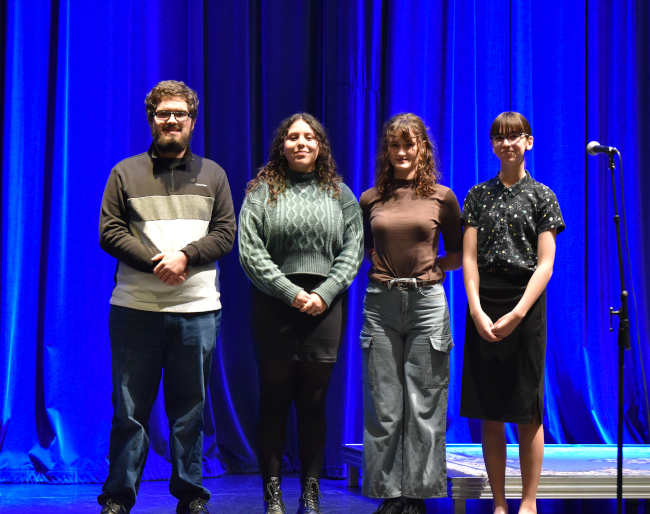
LAKEPORT, Calif. — On a bright Sunday in the last days of January, the students of Lake County shared their voices through the beauty and power of poetry.
The Soper-Reese Theatre resonated with dynamic recitations by the finalists of Lake County’s annual Poetry Out Loud competition, a national arts program that encourages the study of poetry and culminates in a live, juried recitation event.
The competition was created by the National Endowment for the Arts and The Poetry Foundation and has been proudly hosted for over a decade by the Lake County Arts Council in partnership supported by a grant from the California Arts Council.
This year, four students represented the best of the best from their high schools: Madelin Muniz-Espinoza, Clear Lake High School; David Wilkes, Kelseyville High School; Jocelyn Knapp, Lower Lake High School; and Lily Morita, Middletown High School.
Each of these amazing students had already competed and won first place in the competition at their individual school levels and came to the county level finals with two full length poems memorized for performance.
They had spent weeks studying, memorizing and rehearsing each piece with adult performance coaches Tim Barnes (Clear Lake High School), John Tomlinson (Kelseyville and Lower Lake High Schools) and Michele Krueger (Middletown High School).
The students read in rounds, each presenting one poem per round.
The audience, judges and the Master of Ceremonies Laura McAndrews Sammel, treasurer and a member of the Board of Directors of the Lake County Arts Council, were often moved to tears by the depth of passion and understanding in the students’ poetic delivery.
Jordan O’Halloran was the coordinator of this year’s Poetry Out Loud competition and also had the daunting task of tallying the scores of the tight competition.
She gathered a group of local poets and educators to serve as judges: Lake County Poet Laureate Emeritus Richard Schmidt, artist, writer and teacher Diana Liebe Schmidt, poet and retired educator Pamela Bordisso, political poet and theatrical artist Beulah Vega and poet Brenda Yeager.
In between the students’ recitations, as O’Halloran was tallying the scores, the poet judges read a stunning and diverse array of their original work.
Then, the performances culminated with an exquisite reading by Georgina Marie Guardado, the current Lake County Poet Laureate, who spoke of how moved she was by the caliber of student performances. She honored the students and audience with a reading of her own original work and a poem by the current National Poet Laureate, Ada Limon.
After a tight competition of deeply inspiring recitations, Lily Morita of Middletown High School took first place with her soulful and insightful performances of “Listening In Deep Space,” by Diane Thiel and “Backdrop Addresses Cowboy,” by Margaret Atwood. She will move on to the next level of Poetry Out Loud’s California State final competition in Sacramento.
David Wilkes of Kelseyville High School took second place and will be the backup competitor at Sacramento if Morita should find herself unable to attend.
Madelin Muniz-Espinoza of Clear Lake High School won third place and Jocelyn Knapp of Lower Lake High School was the runner up.
Congratulations and best of luck in Sacramento (and beyond!) to Lily Morita and to all of the student competitors who have moved us with their stunning performances to understand how truly poetry can help us find beauty “when we find each other.”
- Details
- Written by: Sarah Stonbely, Northwestern University
Is local news readily available in your town? Do reporters still cover your school board and other municipal meetings?
If you answered yes, you are likely wealthier than the average American, and you live in or near a metro area.
The State of Local News Project at Northwestern University documents the changing local news landscape across the country. Our latest report shows that where you live and how much money you make affect whether you live in a news desert or a news oasis. This divide is related to other factors affecting the health of our democracy, as analysis of our data by the nonprofit Rebuild Local News showed.
For more than a decade, I have worked in organizations that study and support local journalism, and I’m intimately familiar with both the challenges and the solutions for the local journalism landscape.
Inequity in local news
One of the most vexing problems, as our report shows, is the persistence of inequity between communities that are local journalism haves and have-nots.
The have-nots are news deserts with few, if any, journalists to do the daily newsgathering and reporting that people require to participate meaningfully in their local communities and democratic institutions.
The main challenge for news outlets in have-not communities is the migration of advertising money from the printed page – where it made up roughly 80% of news organizations’ income – to the screen, where it now makes up less than 20%. This decline in ad revenue, a trend for the last decade-plus, has forced many outlets to rely on audience funding, philanthropy, cost-cutting or some combination of the three.
In communities with little disposable income to put toward news subscriptions or donations and no local philanthropies, cost-cutting becomes the only option. This creates a self-reinforcing spiral of lower quality and declining readership and, ultimately, closure.
In 2023, the country lost more than 130 print newspapers, which continue to be the newsrooms most likely to produce original local content that other outlets circulate.
Since 2005, the U.S. has lost almost 2,900 papers.
New digital outlets are not being created fast enough to fill that huge void. The number of digital outlets has held steady at roughly 550 in recent years, with about 20 new outlets opening each year – and roughly the same number closing.
All told, 1,558 of the nation’s 3,143 counties have only one news outlet, while 203 are news deserts with zero, meaning there are likely thousands of communities that simply do not have access to local news.
For example, both Texas and Tennessee had four counties lose their only remaining newspaper last year. All eight papers were independently owned.
What it takes to thrive
Wealthier communities do better sustaining local news organizations.
Our data shows that counties with an average household income over US$80,000 can support a robust local journalism ecosystem – meaning 10 or more outlets. Those with an average household income of $54,000 or less are more likely to be news deserts. By the same token, the percentage of the population below the poverty line in news deserts averages more than 16%, versus 12% in counties with robust markets. This finding aligns with other research, including a previous study I did of local news in New Jersey.
In addition to household income, population density correlates to the number of outlets serving a local community. In our data, counties with 10 or more outlets are overwhelmingly urban or dense suburbia, while news deserts are usually rural – though news deserts also occur in low-income pockets of metro areas. Densely populated communities tend to include higher-income households and have network effects that come from the ability of businesses to reach a larger number of people in a relatively small footprint.
This phenomenon leads to the third factor related to number of outlets in a county: gross domestic product per capita. In any town, city or country, the GDP represents the amount of money netted from sales of services and merchandise, divided by population. For the news oases in our study, the average GDP per capita is $75,140. For the news deserts, it is just $8,964. This difference reflects the retail and services base, and the number of businesses that could buy advertising in their local news outlet, or create jobs that would allow residents to donate to one.
An example that highlights the importance of this factor is the newspaper Moab Sun News, which is thriving in the rural rocky highlands of Utah, thanks in part to a robust tourism industry and retail base. Though it serves a relatively small permanent population of 5,321, the Moab Sun News has built a sustainable business model through strong advertising revenue, a user-friendly website that welcomes subscriptions and donations, and creative collaborations with other community organizations in town.
The final factor that contributes to a community being a journalism have or have-not is access to high-quality broadband. Emerging metrics show that this near-necessity of contemporary life is not yet reliably available to rural Americans.
What’s working
Despite these seemingly intractable problems, solutions to local journalism inequality are becoming clearer.
One is collaboration. For example, in Colorado, the national nonprofit news outlet The Daily Yonder has hired a reporter based in a rural community to write stories about life there and share them out with both local and national organizations.
Another is philanthropy. The new Press Forward initiative has begun local chapters across the country, with at least one planning to serve rural communities. Organizations like the National Trust for Local News have been buying outlets that would likely otherwise be sold to hedge funds, and turning them into nonprofits that will continue to serve their communities.
Public policy should also play a role. At the state level, policies to support local news have seen success in New Jersey, California and elsewhere, and more bills are working their way through state legislatures. People seem to be realizing that having quality local news is just as vital as having public education and access to health care. With any luck, every community will have the opportunity to be a journalism “have.”
Sarah Stonbely, Director, State of Local News Project, Northwestern University
This article is republished from The Conversation under a Creative Commons license. Read the original article.
- Details
- Written by: Elizabeth Larson

CLEARLAKE, Calif. — Clearlake Animal Control has dozens of dogs needing new homes this week.
The Clearlake Animal Control website lists 57 adoptable dogs.
This week’s dogs include “Emily,” a 1-year-old female Doberman pinscher with a red and copper coat. She has been spayed.

There also is “Turbo,” a male Belgian malinois mix with a black and brown coat. He has been neutered.
The shelter is located at 6820 Old Highway 53. It’s open from 9 a.m. to 6 p.m. Tuesday through Saturday.
For more information, call the shelter at 707-762-6227, email
This week’s adoptable dogs are featured below.
Email Elizabeth Larson at