How to resolve AdBlock issue?
Refresh this page
How to resolve AdBlock issue?
Refresh this page
Lake County News,California
  • Home
    • Registration Form
  • News
    • Education
    • Veterans
    • Community
      • Obituaries
      • Letters
      • Commentary
    • Police Logs
    • Business
    • Recreation
    • Health
    • Religion
    • Legals
    • Arts & Life
    • Regional
  • Calendar
  • Contact us
    • FAQs
    • Phones, E-Mail
    • Subscribe
  • Advertise Here
  • Login
How to resolve AdBlock issue?
Refresh this page

News

Supervisors add $60,000 for hunger relief amid surging demand for food

Details
Written by: Lingzi Chen
Published: 21 November 2025

LAKE COUNTY, Calif. — The Board of Supervisors on Tuesday approved an additional $60,000 for three more weeks of hunger relief as food insecurity continues to strain Lake County, despite the end of the federal shutdown and the disbursement of delayed benefits.

The amount adds to the previously approved $80,000 on Nov. 4, which provided two weeks of food support for local residents in need while the federal shutdown froze the Supplemental Nutrition Assistance Program, or SNAP — the federal program that funds CalFresh, which a quarter of Lake County’s population relies on for food.

The funding allowed the county to bolster local pantries and food banks, which saw “never-before-seen lengths” of food distribution lines over the past two weeks, Lake County Social Services Director Racheal Dillman Parsons reported at Tuesday’s meeting.

Even with boosted supply, “Unfortunately, not all families could be served,” she said.

The federal shutdown ended on Nov. 12 with a continuing resolution opening the government through Jan. 31, 2026. Litigation against the federal government withholding November SNAP funds have been dropped. 

Dillman Parsons said that the delayed November CalFresh benefits have been issued and December benefits “will be issued as usual.” 

However, food insecurity continues to linger in Lake County and food banks are continuing to see increased demands.

Part of that strain predates the shutdown and is compounded with unemployment and consumer prices, Dillman Parsons said. “The cost of food in particular, went up 3.1% over the last year,” she added. 

The longest federal shutdown in history has worsened the situation with its “residual effect,” as Dilman Parsons called it, continuing to impact the vulnerable residents who rely on food aid and live on fixed incomes. 

She noted that finances have been disrupted for many families, and children who depend on free school meals will lose access during the November and December holidays, which total about three weeks. 

In Lake County, individuals qualified for full CalFresh benefits receive just $292 a month. 

“So could you imagine feeding yourself on $292 a month? It's not very much,” Dillman Parsons said. “So between the food banks and what everybody's experienced, I think that there is a lot of food insecurity happening, and I think that this just kind of pushed it over the edge for people.”

She shared the experience of an individual living on a fixed income who has spent “hours over years” waiting in food bank lines.

“When I have to rely on more coming out of my pocket that means not turning on the heater so that I don't have to pay for heating,” a passage from her presentation slide read. “It means not picking up as many prescriptions so that I don't have to pay a copay. It means trying to spend more on credit cards for food.”

With Supervisor Eddie Crandell absent, the remaining four supervisors voted unanimously to approve another $20,000 per week for the next three weeks through Dec. 9, continuing the support for local food distributions. 

Dillman Parsons noted that the request for additional funds would be temporary, no longer than Dec. 31, “because the county doesn’t have unlimited funding.”

“But doing a little extra for the community during the holidays would be nice, if you have the ability to do it,” she added. “There’s certainly a need within our community.”

Local food distribution sites reported unprecedented demand for food

Soon after the Board of Supervisors approved the initial $80,000 and formed the ad hoc workgroup to administer the funds, the county entered into an agreement with Redwood Empire Food Bank. 

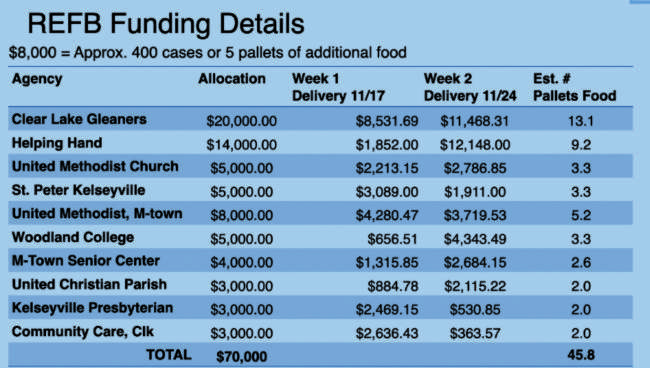
Over the past two weeks, the partnership provided $70,000 worth of food to 10 local feeding partners, including Clear Lake Gleaners and other nonprofit and faith-based organizations.

The workgroup spent another $9,500 ordering five pallets of “Meals Ready to Eat,” or MREs, to be distributed among eight sites around the county including all Peers Support Centers, Behavioral Health in Lucerne, and Social Services in Lower Lake, at approximately 250 MREs per site.

However, shipping has been delayed several times and the MREs had not yet arrived by Tuesday, Dillman Parsons said. 

The remaining $500 was used to purchase 50 10-punch bus passes to help individuals without transportation reach food distribution sites. 

So far, food distributors say they have seen “unprecedented demand” and “never-before-seen length” of food lines, according to Dillman Parson’s presentation. 

Just last week, Clear Lake Gleaners and its sub-contracted sites reported serving a total of 1,753 meals around their nine sites. 

“I’m surprised at the Finley numbers,” Supervisor Helen Owen said of the 793 individuals served at the site.

Dillman Parsons said it’s their main site so “people from everywhere will come there.”

Still, the overwhelming demand for food was not completely fulfilled. 

“We talked to them to serve about 600 on that day, and had to scramble to get the other 193 bags together…and still have to turn people away,” said Social Services Program Manager Tera Gandolfo of the Finley situation. 

It was estimated that 20 individuals were left unserved at the site, although Dillman Parsons said the Gleaners did not have a mechanism to track exactly how many families were turned away.

Gandolfo recalled the day directing traffic for the site on Thursday, Nov. 6, when the federal government was still in shutdown and CalFresh benefits had not rolled out. 

“Thank everybody for their time, for being out there in the cold and potential rain," Gandolfo said. “Also they came two plus hours earlier than they normally do, because they knew it was going to be a heavier request from everybody.”

She continued: “And the line didn't stop, and it went all the way down their street and around the corner, and it just didn't stop.”

Find most updated food distribution information and Thanksgiving community meals on the Social Services Department’s Facebook page. 

Food insecurity lingers into future uncertainties

While the federal government reopens and food benefit distribution has resumed, concerns over long-term food insecurity still persist, along with other complications. 

During public comment, Margaux Kambara noted the additional challenges faced by immigrants in need of food. 

“It would be helpful for the ad hoc committee to remind partners that some neighbors with immigration issues do not feel safe picking up food supplies; measures that partners can take to keep neighbors safe are appreciated,” she said. “Measures such as identifying private or employee only spaces at food distribution sites would go a long way.”

Supervisor Bruno Sabatier noted that even though SNAP benefits are currently budgeted through September of next year, that doesn’t guarantee there won’t be problems over food benefits again if another shutdown begins on Jan. 31, when “some more politics is being played.” 

“So I just think we need to be prepared, because we know Jan. 31 it's probably going to happen again,” he said. 

Lingzi Chen is a staff reporter at Lake County News and a 2024-2026 California Local News Fellow. Email her at This email address is being protected from spambots. You need JavaScript enabled to view it.. 

Thompson leads 34 members of Congress to demand reversal of cancellation of bike and pedestrian infrastructure grants

Details
Written by: LAKE COUNTY NEWS REPORTS
Published: 21 November 2025

On Monday, Congressman Mike Thompson (CA-04) led a group of 34 members of Congress demanding the U.S. Department of Transportation Secretary Sean Duffy reverse the department’s cancellation of bike and pedestrian infrastructure projects across the country. 

The group demanded the department honor existing grant agreements and reaffirm its commitment to building safer, more connected communities.

“Communities across America have spent years planning bike lanes, trails, and pedestrian infrastructure that save lives and strengthen local economies,” said Thompson, whose district includes Lake County. “The Department’s decision to revoke these grants undermines local priorities and ignores Congress’s clear directive to support non-vehicular transportation. We’re calling on Secretary Duffy to reverse course and uphold the commitments made to our communities.”

Reports in recent weeks have detailed a wave of cancellations affecting projects in states such as Alabama, Illinois, New Mexico, and Connecticut. 

Each project had been awarded discretionary federal funding through programs such as BUILD, Safe Streets and Roads for All, and Reconnecting Communities — initiatives explicitly designed to improve road safety and accessibility for all users, not just drivers.

The members highlight examples of canceled grants for important projects such as:

• An $11.7 million bike lane project in Fairfield, Alabama.
• A $675,000 trail improvement grant in McLean County, Illinois.
• An $11.5 million rail trail in Albuquerque, New Mexico.
• A $5.7 million greenway project in Connecticut.

The lawmakers point out that many local governments have already incurred planning and design costs based on signed federal agreements. 

The lawmakers stress that cancelling these grants deprives communities of resources promised to make travel safer and spur local economic growth.

“Congress funded these programs to make streets safer, support healthy communities, and reduce congestion,” wrote the lawmakers. “Cancelling them is not in the best interest of the Department, the communities we represent, or the quality of life of the American people.”

Thompson and his colleagues are urging Secretary Duffy to reinstate the cancelled projects and ensure future funding continues for non-vehicular transportation initiatives.

A full copy of the letter can be viewed below.


November 17, 2025

The Honorable Sean Duffy, Secretary
United States Department of Transportation
1200 New Jersey Avenue, SE
Washington, DC 20590

Dear Secretary Duffy:

As congressional supporters of bike infrastructure funding, we write with serious concerns over the Department of Transportation ignoring Congressional and local priorities through its cancellation of numerous bike and pedestrian projects. Congress supports investments in making bicycling safer through several funding mechanisms because we see the returns in stronger local economies, healthier residents, and safer roads.

Reports indicate that DOT cancelled discretionary grants because they were awarded to bicycling-related projects. For example:

Reporting indicates an $11.7 million project to add bike lanes in Fairfield, Alabama, was cancelled because it ran “counter to DOT’s priority of preserving or increasing roadway capacity for motor vehicles.”

A news report about a cancelled BUILD grant worth $675,000 in McLean County,
Illinois notes that “the Transportation Department told the county that the grant no longer aligned with its priorities.”

In Albuquerque, New Mexico, local reporting on a cancelled $11.5 million BUILD grant to construct a seven-mile rail trail indicates, “DOT’s withdrawal letter provided little justification beyond stating the department is focusing on car-based projects rather than people-based projects like the Rail Trail, according to the city.” The article states the trail “is estimated to generate $1 million to $3.2 million in annual economic impact and increase property values in the area.”

And in Connecticut, the cancellation of a $5.725 million grant for a greenway was
explained as not aligning with the department’s priorities to improve the quality of life of the American people. If that is a priority for transportation grants, then, numerous studies have shown shared trails contribute greatly to improved quality of life.

These congressionally funded discretionary grant programs were specifically authorized and  funded to support multimodal and bicycling projects. In the case of BUILD, Safe Streets and Roads for All, the Reconnecting Communities Program, and others, these programs reflect the will of Congress to support local communities’ road safety needs and the will of local communities who sought these grants.

We understand that these discretionary grants have been signed and agreed upon by both parties, including your agency, and they reflect valuable work and resources invested by local communities. Grantees have often already incurred costs upon the expectation of their grant agreement being executed, and so far grantees have yet to be offered a recourse to appeal their cancellation.

Cancelling these grants is not in the best interest of the U.S. Department of Transportation, the communities we represent, or the quality of life of the American people. Communities should be able to rely on an agreement signed by the federal government to build safer roads and trails for everyone.

These are common sense improvements in American communities, chosen as priorities by
American communities. Bike infrastructure investments generate economic activity and save vulnerable road users’ lives.

We ask that the U.S. Department of Transportation reconsider its cancellation of the funding  agreements it signed with communities regarding non-vehicular modes of transportation, and  continue to sign agreements for future projects related to bicycling and walking infrastructure.

Thank you for your full and fair consideration of this matter, consistent with applicable statute  and agency guidelines. We look forward to an update on these grant agreements in the near  future and how you plan to support bike infrastructure projects.

I treat menopause and its symptoms, and hormone replacement therapy can help – here’s the science behind the FDA’s decision to remove warnings

Details
Written by: Genevieve Hofmann, University of Colorado Anschutz Medical Campus
Published: 21 November 2025

Reanalyses of earlier research have shown that hormone therapy is safe and effective for many women going through menopause. monkeybusinessimages/iStock via Getty Images Plus

For more than 20 years, hormone therapy for menopause has carried a warning label from the Food and Drug Administration describing the medication’s risk of serious harms – namely, cancer, cardiovascular disease and possibly dementia.

On Nov. 10, 2025, the FDA announced that drugmakers should remove these “black box” safety warnings.

The Conversation U.S. asked Genevieve Hofmann, a women’s health nurse practitioner at the University of Colorado Anschutz Medical Campus, to explain how the decision will affect health care for people going through menopause or postmenopause.

How did the FDA’s decision come about?

When people think of hormone therapy for menopause, they generally think of systemic estrogen and progestogens – for example, pills or patches that deliver hormones throughout the body.

Health care providers prescribed hormone therapy to manage symptoms of menopause such as hot flashes, night sweats and brain fog much more widely in the 1980s and 1990s than they do today. That’s because in the early 2000s, researchers analyzed data from a study called the Women’s Health Initiative and reported that hormone therapy increased the risk of breast cancer, heart disease, blood clots and stroke, as well as cognitive decline after menopause.

After this research was first published in 2002, the use of hormone therapy fell by 46% within six months – both because clinicians were reluctant to prescribe it and patients were fearful of taking it. In 2003, the FDA added black box warnings – the most serious warnings, indicating a risk of serious harm or death – to all estrogen-containing hormone products for menopause.

The FDA announced on Nov. 10, 2025, that it will ask drug companies to remove ‘black box’ warnings from hormone therapy for menopause.

But researchers soon pointed out methodological flaws in the analysis. And over the past two decades, careful reanalyses of data from that study, as well as newer studies, have shown that systemic hormone therapy is very safe for most women, though there are nuances surrounding its use.

Meanwhile, women’s health experts have been increasingly vocal in the past five years in calling to remove the black box warnings from a form of hormone menopause therapy that’s applied locally, not systemically. Topical localized estrogen is applied directly to the vagina and surrounding areas, usually in the form of a cream or vaginal insert. It’s used to treat the genitourinary syndrome of menopause, which manifests as genital and urinary symptoms.

Even though topical estrogen products are extremely safe and were not evaluated in the Women’s Health Initiative study, the FDA warnings were added to them, too.

In July 2025, the FDA held an expert panel to discuss what’s currently known about the risks and benefits of hormone therapy for menopause. At the meeting, most experts urged the agency to remove the warning labels on topical vaginal estrogen products.

The Nov. 10 announcement was the outcome of that discussion, and it included both systemic and topical hormone therapy.

Why is systemic estrogen no longer considered unsafe?

Researchers are now finding that the balance of risks and benefits of systemic hormone therapy for menopause seems to depend strongly on when someone starts hormones, as well as the type, dose and length of use.

For women under 60 or within 10 years of their final period, the therapy is much safer than it is for older women. A 2017 follow-up of Women’s Health Initiative participants showed that overall deaths from any causes actually decreased in this younger cohort of menopausal women taking hormones.

For women who are more than 10 years from their final menstrual period, starting hormone therapy may increase their risk of cardiovascular disease. Researchers now refer to this as the timing hypothesis. Newer studies also support this idea.

Also, some ways of delivering hormones to the body turned out to be safer than others. Taking estrogen orally, as pills or tablets, carries a higher risk of blood clots. Those risks go away when it’s delivered through the skin using a patch, gel or spray. Many more options for hormone therapy exist today than in the early 2000s.

Additionally, it’s well established that hormone therapy improves bone health by preventing bone loss. Some studies suggest that in younger menopausal women, it may actually protect against cardiovascular disease, though this link is not yet proven and needs more study.

Unfortunately, many people missed out on the timing window. In my practice, I see patients who went through menopause 10 or 15 years ago and either didn’t get hormone therapy at the time or stopped taking it when the initial Women’s Health Initiative results came out. Now, they are hearing about the benefits, and many want to try it. But their higher cardiovascular risk may overshadow the benefit.

What about topical estrogen?

Genitourinary syndrome of menopause is ubiquitous – it affects every person with ovaries who goes through menopause, and the symptoms tend to worsen with age.

They include vaginal dryness, painful sex and urinary issues such as an increase in urgency or frequency, along with incontinence. Urinary tract infections often tend to get more frequent with menopause, particularly in older women. Treating them can require multiple courses of antibiotics.

Tissues in the genitourinary area are loaded with estrogen receptors – proteins in cells that bind the hormone. So adding some estrogen back to these areas can help restore the quality and thickness of these tissues, and possibly even promote the growth of healthy bacteria around the vagina and the urinary tract. The treatment can greatly improve quality of life and promote better health and longevity.

Despite topical estrogen’s safety and effectiveness, the FDA did not distinguish between it and systemic estrogen when adding the black box warnings in 2003. For this reason, many providers whose patients have symptoms relating to the genitourinary syndrome of menopause have been reluctant to prescribe it. Often, providers simply don’t know that it has a different safety profile than systemic estrogen.

How will removing the black box warnings affect patients?

Overall, I see this as a big win for women and their ability to manage the symptoms of menopause. I think this will make clinicians and patients far less anxious about prescribing and taking this medication.

Clinicians like me who specialize in women’s health and menopause – and who have been following the research – have been safely prescribing hormone therapy all along. But many general practitioners who often lacked either menopause-specific training or the time and resources to stay on top of the latest findings have been more reluctant to do so.

Safety concerns that led to the black box warnings, especially in regard to local vaginal estrogen, have turned out to be overblown. While clinicians still need to consider who is a good candidate for systemic hormone use, the evidence shows that for most people, it is a safe option.

Even more important, patients who were previously convinced that hormone therapy was unsafe may feel more comfortable discussing it with their provider and considering it. And if they do receive a prescription for hormone therapy, I hope that the likelihood of them starting this effective treatment is no longer hindered by reading a scary package insert that was based on outdated evidence.

While this medication is not a silver bullet that reverses aging, starting hormones at the right time can safely improve symptoms that diminish people’s quality of life. So if you’re having symptoms that are bothersome, consider asking your provider about menopause hormone therapy to help manage them.The Conversation

Genevieve Hofmann, Assistant Professor of Nursing and Women's Health, University of Colorado Anschutz Medical Campus

This article is republished from The Conversation under a Creative Commons license. Read the original article.

Clearlake Animal Control: ‘Spot’ and the dogs

Details
Written by: Elizabeth Larson
Published: 21 November 2025
“Spot.” Photo courtesy of Clearlake Animal Control.

CLEARLAKE, Calif. — Clearlake Animal Control continues to have new additions to its lineup of dogs waiting for new homes.

The shelter has 49 adoptable dogs listed on its website.

This week’s dogs include “Spot,” a 2-year-old male pit bull mix with a brown and white coat.

Shelter staff said Spot has a lot of energy, loves to run and play with toys. “Spot walks well on leash and is very friendly and would love a home of his own,” shelter staff said.
 
The shelter is located at 6820 Old Highway 53. It’s open from 9 a.m. to 6 p.m. Tuesday through Saturday. 

For more information, call the shelter at 707-762-6227, emailThis email address is being protected from spambots. You need JavaScript enabled to view it. or visit Clearlake’s adoptable dogs here.

This week’s adoptable dogs are featured below.

Email Elizabeth Larson at This email address is being protected from spambots. You need JavaScript enabled to view it.. Follow her on Twitter, @ERLarson, and on Bluesky, @erlarson.bsky.social. Find Lake County News on the following platforms: Facebook, @LakeCoNews; X, @LakeCoNews; Threads, @lakeconews, and on Bluesky, @lakeconews.bsky.social. 

  1. Lake County Rotary clubs partner with Polly Klaas Foundation to stop the sex-trafficking and exploitation of children
  2. Lakeport Library closes temporarily for construction
  3. Lakeport Police make arrest following hit and run
  • 153
  • 154
  • 155
  • 156
  • 157
  • 158
  • 159
  • 160
  • 161
  • 162
How to resolve AdBlock issue?
Refresh this page