How to resolve AdBlock issue?
Refresh this page
How to resolve AdBlock issue?
Refresh this page
Lake County News,California
  • Home
    • Registration Form
  • News
    • Education
    • Veterans
    • Community
      • Obituaries
      • Letters
      • Commentary
    • Police Logs
    • Business
    • Recreation
    • Health
    • Religion
    • Legals
    • Arts & Life
    • Regional
  • Calendar
  • Contact us
    • FAQs
    • Phones, E-Mail
    • Subscribe
  • Advertise Here
  • Login
How to resolve AdBlock issue?
Refresh this page

News

Space News: NASA goes on an ESCAPADE – twin small, low-cost orbiters will examine Mars’ atmosphere

Details
Written by: Christopher Carr, Georgia Institute of Technology and Glenn Lightsey, Georgia Institute of Technology
Published: 16 November 2025

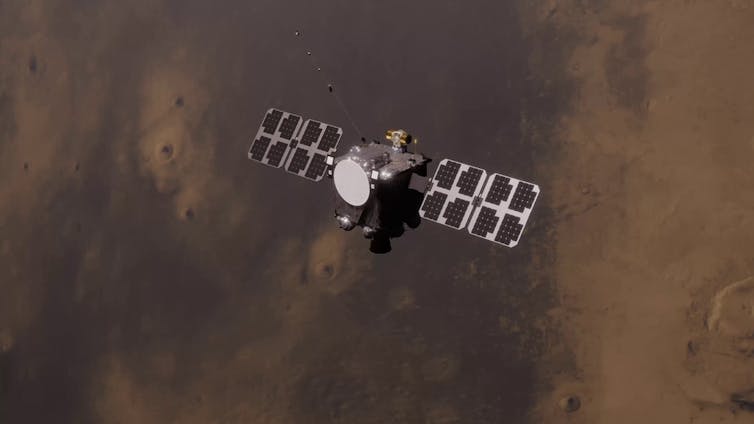
This close-up illustration shows what one of the twin ESCAPADE spacecraft will look like conducting its science operations. James Rattray/Rocket Lab USA/Goddard Space Flight Center

Envision a time when hundreds of spacecraft are exploring the solar system and beyond. That’s the future that NASA’s ESCAPADE, or Escape and Plasma Acceleration and Dynamics Explorers, mission will help unleash: one where small, low-cost spacecraft enable researchers to learn rapidly, iterate, and advance technology and science.

The ESCAPADE mission launched on Nov. 13, 2025 on a Blue Origin New Glenn rocket, sending two small orbiters to Mars to study its atmosphere. As aerospace engineers, we’re excited about this mission because not only will it do great science while advancing the deep space capabilities of small spacecraft, but it also will travel to the red planet on an innovative new trajectory.

The ESCAPADE mission is actually two spacecraft instead of one. Two identical spacecraft will take simultaneous measurements, resulting in better science. These spacecraft are smaller than those used in the past, each about the size of a copy machine, partly enabled by an ongoing miniaturization trend in the space industry. Doing more with less is very important for space exploration, because it typically takes most of the mass of a spacecraft simply to transport it where you want it to go.

A patch with a drawing of two spacecraft, one behind the other, on a red background and the ESCAPADE mission title.
The ESCAPADE mission logo shows the twin orbiters. TRAX International/Kristen Perrin

Having two spacecraft also acts as an insurance policy in case one of them doesn’t work as planned. Even if one completely fails, researchers can still do science with a single working spacecraft. This redundancy enables each spacecraft to be built more affordably than in the past, because the copies allow for more acceptance of risk.

Studying Mars’ history

Long before the ESCAPADE twin spacecraft Blue and Gold were ready to go to space – billions of years ago, to be more precise – Mars had a much thicker atmosphere than it does now. This atmosphere would have enabled liquids to flow on its surface, creating the channels and gullies that scientists can still observe today.

But where did the bulk of this atmosphere go? Its loss turned Mars into the cold and dry world it is today, with a surface air pressure less than 1% of Earth’s.

Mars also once had a magnetic field, like Earth’s, that helped to shield its atmosphere. That atmosphere and magnetic field would have been critical to any life that might have existed on early Mars.

A view of Mars' crater-flecked surface from above.
Today, Mars’ atmosphere is very thin. Billions of years ago, it was much thicker. ©UAESA/MBRSC/HopeMarsMission/EXI/AndreaLuck, CC BY-ND

ESCAPADE will measure remnants of this magnetic field that have been preserved by ancient rock and study the flow and energy of Mars’ atmosphere and how it interacts with the solar wind, the stream of particles that the sun emits along with light. These measurements will help to reveal where the atmosphere went and how quickly Mars is still losing it today.

Weathering space on a budget

Space is not a friendly place. Most of it is a vacuum – that is, mostly empty, without the gas molecules that create pressure and allow you to breathe or transfer heat. These molecules keep things from getting too hot or too cold. In space, with no pressure, a spacecraft can easily get too hot or too cold, depending on whether it is in sunlight or in shadow.

In addition, the Sun and other, farther astronomical objects emit radiation that living things do not experience on Earth. Earth’s magnetic field protects you from the worst of this radiation. So when humans or our robotic representatives leave the Earth, our spacecraft must survive in this extreme environment not present on Earth.

ESCAPADE will overcome these challenges with a shoestring budget totaling US$80 million. That is a lot of money, but for a mission to another planet it is inexpensive. It has kept costs low by leveraging commercial technologies for deep space exploration, which is now possible because of prior investments in fundamental research.

For example, the GRAIL mission, launched in 2011, previously used two spacecraft, Ebb and Flow, to map the Moon’s gravity fields. ESCAPADE takes this concept to another world, Mars, and costs a fraction as much as GRAIL.

Led by Rob Lillis of UC Berkeley’s Space Sciences Laboratory, this collaboration between spacecraft builders Rocket Lab, trajectory specialists Advanced Space LLC and launch provider Blue Origin – all commercial partners funded by NASA – aims to show that deep space exploration is now faster, more agile and more affordable than ever before.

NASA’s ESCAPADE represents a partnership between a university, commercial companies and the government.

How will ESCAPADE get to Mars?

ESCAPADE will also use a new trajectory to get to Mars. Imagine being an archer in the Olympics. To hit a bull’s-eye, you have to shoot an arrow through a 15-inch – 40-centimeter – circle from a distance of 300 feet, or 90 meters. Now imagine the bull’s-eye represents Mars. To hit it from Earth, you would have to shoot an arrow through the same 15-inch bull’s-eye at a distance of over 13 miles, or 22 kilometers. You would also have to shoot the arrow in a curved path so that it goes around the Sun.

Not only that, but Mars won’t be at the bull’s-eye at the time you shoot the arrow. You must shoot for the spot that Mars will be in 10 months from now. This is the problem that the ESCAPADE mission designers faced. What is amazing is that the physical laws and forces of nature are so predictable that this was not even the hardest problem to solve for the ESCAPADE mission.

It takes energy to get from one place to another. To go from Earth to Mars, a spacecraft has to carry the energy it needs, in the form of rocket fuel, much like gasoline in a car. As a result, a high percentage of the total launch mass has to be fuel for the trip.

When going to Mars orbit from Earth orbit, as much as 80% to 85% of the spacecraft mass has to be propellant, which means not much mass is dedicated to the part of the spacecraft that does all the experiments. This issue makes it important to pack as much capability into the rest of the spacecraft as possible. For ESCAPADE, the propellant is only about 65% of the spacecraft’s mass.

ESCAPADE’s route is particularly fuel-efficient. First, Blue and Gold will go to the L2 Lagrange point, one of five places where gravitational forces of the Sun and Earth cancel out. Then, after about a year, during which they will collect data monitoring the Sun, they will fly by the Earth, using its gravitational field to get a boost. This way, they will arrive at Mars in about 10 more months.

This new approach has another advantage beyond needing to carry less fuel: Trips from Earth to Mars are typically favorable to save fuel about every 26 months due to the two planets’ relative positions. However, this new trajectory makes the departure time more flexible. Future cargo and human missions could use a similar trajectory to have more frequent and less time-constrained trips to Mars.

ESCAPADE is a testament to a new era in spaceflight. For a new generation of scientists and engineers, ESCAPADE is not just a mission – it is a blueprint for a new collaborative era of exploration and discovery.

This article was updated on Nov. 13, 2025 to reflect the ESCAPADE launch’s date and success.The Conversation

Christopher Carr, Assistant Professor of Aerospace Engineering, Georgia Institute of Technology and Glenn Lightsey, Professor of Space Systems Technology, Georgia Institute of Technology

This article is republished from The Conversation under a Creative Commons license. Read the original article.


Modesto man dies in solo vehicle Highway 20 crash

Details
Written by: Elizabeth Larson
Published: 15 November 2025

LAKE COUNTY, Calif. — A solo vehicle crash on Highway 20 Friday morning led to the death of a passenger.

The Lake County Sheriff’s Office identified Gabriel Guarchaj-Ajtzalam, 30, of Modesto as the man who died as a result of the wreck.

The crash was first reported at about 9 a.m. Friday on Highway 20 east of Clearlake Oaks. 

Radio reports from the scene indicated a vehicle had gone down the embankment, one person had been ejected and had major injuries, with four others with less severe injuries. 

Sgt. Joel Skeen of the California Highway Patrol’s Clear Lake Area office said the vehicle involved, a white 2003 Chevy Express van, was traveling westbound on State Route 20, east of New Long Valley Road near mile post marker 41.3 when the crash occurred.

“Due to reasons still under investigation, the driver of the van lost control in a downhill curve and went over a steep embankment on the north side of the roadway,” Skeen said.

Skeen said the van overturned multiple times as it travelled down the embankment, ejecting the right front passenger — Guarchaj-Ajtzalam — who later succumbed to his injuries. 

Radio reports stated that a REACH helicopter was dispatched to the scene to transport Guarchaj-Ajtzalam to a trauma center in Vacaville. He died a short time later, with a coroner called at around 11 a.m., based on the CHP’s online logs. 

“The driver and front middle passenger were uninjured,” Skeen said. “There were two occupants in the rear of the van unrestrained and suffered moderate injuries.”

He said neither drugs nor alcohol were suspected to be factors in the crash. 

One-way traffic near the wreck site was in place until shortly before 11 a.m. while the investigation and vehicle removal took place, the CHP reported.

Email Elizabeth Larson at This email address is being protected from spambots. You need JavaScript enabled to view it.. Follow her on Twitter, @ERLarson, and on Bluesky, @erlarson.bsky.social. Find Lake County News on the following platforms: Facebook, @LakeCoNews; X, @LakeCoNews; Threads, @lakeconews, and on Bluesky, @lakeconews.bsky.social. 

Anglers didn’t disappoint in first day of Bass Angler Magazine's Super 60 Championship

Details
Written by: Craig Nelson
Published: 15 November 2025
Mason McAbee, left, with 27.40 pounds and Randy McAbee, right, with 22.81 pounds. Photo by Craig Nelson.

LAKE COUNTY, Calif. — Beginning at 6:50 a.m. Friday — considered “safe light” — the Bass Angler Magazine, or BAM, Super 60 Championship was underway.

Bassmaster Elite Tour angler Bryant Smith’s first stop was an undisclosed spot on the north end of the lake.

After two passes and rotating through four different reaction baits, the Bassmaster Elite Tour angler was without a bite. 

Asked if he was focusing on bringing five bass to the scale or capitalizing on advancing with the hybrid keeper count, which is 14 inches. 

“I’m focused on five big bites but if the keeper count format is in play, I will take it,” Smith said.

At midday, the wind ramped up to 6 miles per hour from the southeast, which makes fishing tough on Clear Lake. 

A local saying is that when the wind blows from the southeast the fish bite the least, and when the wind blows from the northwest they bite the best.

Bass Angler Magazine's Super 60 Championship day one Leader Austin Bonjour with 29.75 pounds. Photo by Craig Nelson.


After checking TourneyX before midday it was clear the anglers did most of their damage in the morning.

The weigh-in started at 3:20 p.m. and what an exciting and well coordinated show Mark Lassagne and his staff put on. From the TV show production and entertaining commentary, day one of the BAM Super 60 Championship was a huge success.

The day one leader was Austin Bonjour with 29.75 pounds and eight keepers.

The rest of the top 10 in order are: 

• Robert Riehl, 17.04 pounds, 13 keepers; 
• Mason McAbee, 27.40 pounds, nine keepers;
• Luke Johns, 20.12 pounds, 11 keepers; 
• Ty Manterola, 27.11 pounds, nine keepers;
• Colby Pearson, 27.12 pounds, eight keepers; 
• Randy McAbee, 22.81 pounds, five keepers;
• Bryant Smith, 14.0 pounds, seven keepers; 
• Jason Crone, 19.68 pounds, five keepers; 
• Tyler Madden, 12.70 pounds, seven keepers.
   
Craig Nelson is a former professional golfer who fell in love with tournament bass fishing 20 years ago. He found Lake County after fishing an FLW Stren Series event and never left. He’s the back-to-back winner of the Konocti Classic and runner up in the inaugural WON Bass Clear Lake Open.
 

Colby Pearson brought in 27.11 pounds during the first day of the Bass Angler Magazine's Super 60 Championship on Friday, Nov. 14, 2025. Photo by Craig Nelson.


What’s a ‘black box’ warning? A pharmacologist explains how these labels protect patients

Details
Written by: C. Michael White, University of Connecticut
Published: 15 November 2025

Black box warnings can influence whether or not clinicians decide to prescribe a drug. SDI Productions/E+ via Getty Images

A “black box” warning on a health product sounds pretty scary – maybe even more so when it’s suddenly being taken off the packaging.

Americans were reminded of this type of public health messaging on Nov. 10, 2025, when the Food and Drug Administration announced it is removing the “black box” warning from hormone replacement therapy for menopause.

But what are these warnings, anyway? What’s their history, and how do they affect a drug’s use?

I am a clinical pharmacologist and pharmacist studying drug prescribing, safety and effectiveness for over 25 years.

Black box warnings – or as the FDA officially calls them, boxed warnings – are a tool for alerting pharmacists and clinicians that the medication may have serious risks. These health care professionals are then expected to communicate those risks to consumers.

An official source of drug information

Black box warnings for particular medications appear on the product package inserts that the FDA requires pharmaceutical companies to create for each prescription drug.

Product package inserts provide official information about the drug to health care professionals. These pamphlets are attached to bulk containers of drugs purchased by pharmacies so that the pharmacist has the most updated official information on the product. The package inserts are also published in textbooks such as the Physician’s Desk Reference and on websites maintained by drug manufacturers.

The requirement for product package inserts came out of a consumer protection law passed in 1966, called the Fair Packaging and Labeling Act, which aimed to prevent unfair or deceptive packaging in products used by consumers.

The package insert carries a set of official information about the drug, provided by the manufacturer and regulated by the FDA. The insert must include who the drug is approved for, proper dosing and administration, and a description of the key clinical trial results that showed it was effective and safe.

It must also disclose any health risks that the drug poses – such as a boxed warning.

Flagging safety risks

The FDA has two categories for the health risks that medications could pose: precautions and warnings. Both are listed on the package insert.

Precautions warn clinicians of possible harm that could result in minor or moderate injury to patients. Warnings, on the other hand, alert them to the potential risk of dangerous adverse events that could result in serious injury or death. The most serious warnings for a drug are called boxed warnings. The text of those warnings is enclosed by a black box on the insert so they will not be missed by clinicians.

According to a 2022 study, more than 400 medications currently carry black box warnings.

The FDA announced it was removing the black box warning from hormone therapy for menopause.

Antidepressants are one example. While such drugs can lessen the severity of depression symptoms, researchers have found that during the first few weeks of taking them, patients have an increased risk of suicide – particularly children and young adults. The FDA first issued a black box warning about the drugs’ use in children and adolescents in 2004 and expanded the warning to young adults in 2007.

Another example is clozapine, a drug used to suppress delusions experienced by people with schizophrenia. Although the drug is very effective, the FDA first gave it a black box warning when it was reintroduced to the market in 1989 because it can stop the production of white blood cells, potentially leading to life-threatening infections.

Hormone replacement therapy for menopause got its black box warning in 2003 after a clinical trial called the Women’s Health Initiative pointed to an increased risk of breast cancer without a reduced risk of heart disease in women who used it.

In subsequent years, reanalyses of the Women’s Health Initiative results, as well as data from other studies, have shown that the therapy is safe in women ages 50 to 60. Newer, safer formulations of estrogen and progestin have also emerged. These factors prompted the FDA to remove the warnings in November 2025, saying the therapy doesn’t pose significant risks.

Medical and legal realities

Black box warnings can influence clinicians’ choice of whether or not to prescribe a particular drug. For example, since other drugs for schizophrenia do not carry the serious risks that clozapine does, clinicians usually reserve that medicine for people who could not use those other drugs.

The black box warnings can also play a role in malpractice cases. In some states, package inserts and any warnings they contain can be used to establish a standard of care, leaving clinicians who deviate from them liable for damages. In other states, the warnings they list can be used to support findings of negligence.

For instance, the black box warning on the insert of the drug thalidomide states it can cause birth defects. It instructs clinicians to obtain a a negative pregnancy test before use and ensure the patient is not able to get pregnant or is taking precautions to avoid pregnancy before prescribing. Failure to do so could make the clinician liable if the person taking the drug bears a child with birth defects.

Product package inserts are living documents. As new information becomes available, the FDA may find a medication’s risk is untenable and request the drug be removed from the market. Or it may decide to remove the boxed warning from the drug if new data shows the drug is less dangerous than previously thought.The Conversation

C. Michael White, Distinguished Professor of Pharmacy Practice, University of Connecticut

This article is republished from The Conversation under a Creative Commons license. Read the original article.

  1. City of Lakeport seeks Business Walk surveys
  2. Space News: Space debris struck a Chinese spacecraft – how the incident could be a wake-up call for international collaboration
  3. Multistate infant botulism outbreak results in baby formula recall; county health officials monitor situation
  • 159
  • 160
  • 161
  • 162
  • 163
  • 164
  • 165
  • 166
  • 167
  • 168
How to resolve AdBlock issue?
Refresh this page