How to resolve AdBlock issue?
News
- Details
- Written by: Lake County News reports
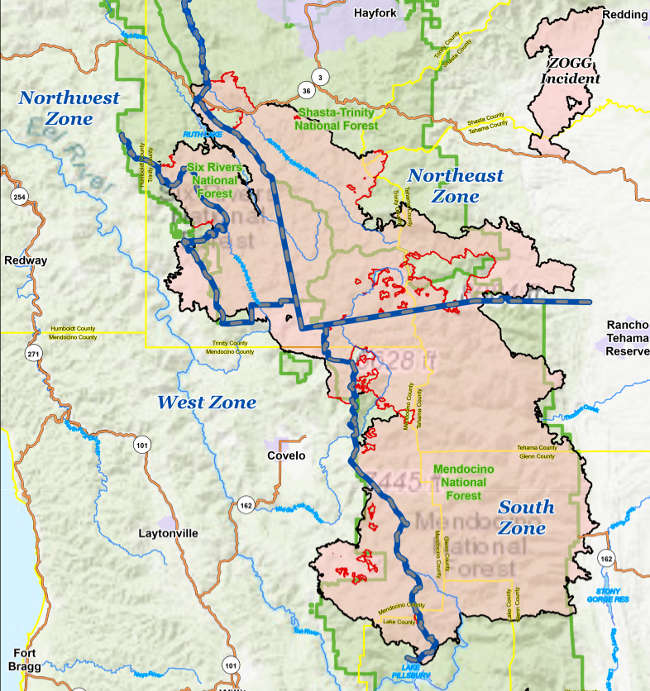
The US Forest Service said the lightning-caused complex, burning since Aug. 17, was up to 1,032,264 acres and 86 percent containment on Sunday night.
It’s burning on the Mendocino, Shasta-Trinity and Six Rivers National Forests.
As containment has risen on the complex, firefighter numbers have been rolled back. By Sunday night, officials said 2,508 personnel remained assigned to all four zones.
The Forest Service said firefighters have completed the remaining line in the Eel River Canyon while helicopters were used to drop water on isolated areas of heat near the river.
Suppression repair activities, including constructing waterbars, removing dozer berms, spreading slash piles outside of dozer line where possible, using woody material that is 2 inches or less in diameter to cover line, and covering 50 percent of bare soil area with woody material are ongoing along the western side of the South Zone, officials said.
On Saturday, the Forest Service said firefighters completed one mile of handline and one and a half miles of dozer line repair in the southwest portion of the fire.
A closure order remains in effect for the fire area on the Mendocino National Forest.
Private properties accessed via a Forest System road may require a permit from the USDA Forest Service. Contact the Mendocino National Forest at 530-934-3316 for more information.
Hunting and recreation are prohibited within the August Complex South Zone Fire Area Closure area. Safety hazards in the area include unstable trees that may fall, loose rocks and boulders, burning stumps and deep ash pits.
- Details
- Written by: Lake County News reports
The data cover 408,740 positions and a total of nearly $20.39 billion in 2019 wages.
Users of the site can view compensation levels on maps and search by region; narrow results by name of the entity or by job title; and export raw data or custom reports.
The newly published data were reported by 11 UC institutions (312,118 employees and $17.16 billion in wages) and 44 CCC districts (96,622 employees and $3.23 billion in wages).
The breakdown for the 11 UC institutions is as follows:
– University of California, Los Angeles: 67,632 employees; wages, $4,029,790,028; health and retirement contributions, $626,895,228.
– University of California, San Francisco: 34,167 employees; wages, $3,296,751,282; health and retirement contributions, $474,795,731.
– University of California, San Diego; 47,070 employees; wages, $2,636,228,727; health and retirement contributions, $453,059,955.
– University of California, Davis: 45,488 employees; wages, $2,519,966,364; health and retirement contributions, $462,541,591.
– University of California, Irvine: 30,326 employees; wages, $1,535,713,385; health and retirement contributions, $265,682,656.
– University of California, Berkeley: 35,449 employees; wages, $1,339,276,525; health and retirement contributions, $208,655,181.
– University of California, Santa Barbara: 17,974 employees; wages, $554,105,922; health and retirement contributions, $98,187,793.
– University of California, Riverside: 13,635 employees; wages, $476,546,526; health and retirement contributions, $80,352,057.
– University of California, Santa Cruz: 12,981 employees; wages, $387,730,007; health and retirement contributions, $74,367,492.
– University of California, Office of the President: 2,242 employees; wages, $221,726,496; health and retirement contributions, $37,013,038.
– University of California, Merced: 5,154 employees; wages, $157,879,575; health and retirement contributions, $30,105,228.
The top 10 largest community college districts are as follows:
– Los Rios Community College District: 8,466 employees; wages, $253,396,098; health and retirement contributions, $78,103,820.
– San Diego Community College District: 6,416 employees; wages, $228,228,139; health and retirement contributions, $72,442,239.
– Foothill-De Anza Community College District: employees, 4,114; wages, $152,567,755; health and retirement contributions, $37,605,641.
– South Orange County Community College District : employees, 3,777; wages, $150,165,096; health and retirement contributions, $47,570,830.
– Contra Costa Community College District: employees, 4,976; wages, $144,575,038; health and retirement contributions, $43,237,040.
– San Francisco Community College District : employees, 2,604; wages, $140,928,567; health and retirement contributions, $36,910,906.
– Rancho Santiago Community College District: employees, 3,801; wages, $140,184,249; health and retirement contributions, $40,625,717.
– Ventura County Community College District: employees, 2,964; wages, $114,429,965; health and retirement contributions, $38,492,132.
– Sonoma County Junior College District: employees, 3,163; wages, $101,164,568; health and retirement contributions, $28,428,741.
– Peralta Community College District 3: employees, 173; wages, $99,905,820; health and retirement contributions, $30,398,491.
Yuba Community College District, one of the two districts serving Lake County, is listed No. 31 of the 44 districts that have filed. It has 1,644 employees, $40,416,807 in wages and $6,388,814 in health and retirement contributions.
The Mendocino-Lake Community College District did not file.
California law requires cities, counties and special districts to annually report compensation data to the state controller. The state controller also maintains and publishes state and California State University salary data.
No such statutory requirement exists for UC, CCC, superior courts, fairs and expositions, First 5 commissions, or K-12 education providers; their reporting is voluntary.
A list of entities that did not file or filed incomplete reports is available here.
Since the website launched in 2010, it has registered more than 12 million pageviews. The site contains pay and benefits information on more than two million government jobs in California, as reported annually by each entity.
As the chief fiscal officer of California, Controller Yee is responsible for accountability and disbursement of the state’s financial resources. The controller has independent auditing authority over government agencies that spend state funds.
- Details
- Written by: Lake County News reports
The event will be held from 9 a.m. to 1 p.m. as a drive-thru drop off on the west side of the police station at 2025 S. Main St.
Physical distancing and face masks will be required. Persons arriving at the event are directed to remain in their vehicles until directed by police staff.
The department said it will accept all over-the-counter or prescription medication in pill, tablet or capsule form including schedule II-V controlled and noncontrolled substances.
Pills need to be emptied out of their containers and placed in a plastic bag, not paper, so they can easily see the contents to make sure there is nothing in the bag they can't take.
They also will collect vape pens or other e-cigarette devices from individual consumers only after the batteries are removed from the devices. They stressed that they will not be responsible for removing the batteries from the devices.
Items that won’t be accepted are illegal drugs, needles, inhalers and aerosol cans.
“Since we started participating with the prescription Take Back Program in January of 2019, our agency has collected 557 pounds of prescription drugs, many of which were dangerous narcotics including opioids. This protects our community by keeping these drugs from being diverted to illegal use and keeps it out of our environment and water,” the department said in a report on the event.
- Details
- Written by: Lake County News reports
NORTHERN CALIFORNIA – Dramatic fire-retardant drops and massive water douses from helicopters are often the images shown of fighting wildfires like the August Complex.
And while those firefighting tactics are indeed a critical part of getting containment around flames, there’s also the gritty, marathon-like work going on at basecamps and on fire lines that most people don’t get to see.
“Yeah 16-hour days. We wake up at the crack of dawn, before that even,” said Gabrielle Falaschi.
She’s one of hundreds of Corpsmembers in the California Conservation Corps who are either fighting fires or working the basecamps that deliver the support firefighters need to keep going.
“As soon as I finished orientation (at CCC’s Delta Center in Stockton, California) we were out here. This is about our third week here. It’s really great, working refir,” she said.
Refir is short for the task of storing and distributing everything needing refrigeration at basecamp, whether it’s food or first aid.
From sunup to beyond sundown, the CCC Corpsmembers are handling “refir,” chow lines, installing signage and fencing, and issuing firefighting gear like chainsaws, fire pants, hose nozzles – whatever it takes to get the firefighters rested, refueled and back to the fire lines.
“Which means sometimes we have people here that go to town to Walmarts and Rite Aids, to buy special stuff and things left at home”, said Corpsmember Angel Campos from Compton, California.
He joined the CCC nearly a year ago. The program enrolls 18- to 25-year-olds to gain work experience through responding to state emergencies, but mainly through working on environmentally focused projects like building hiking trails and restoring natural habitats.
Corpsmembers are paid a monthly stipend of $1,905 and can earn up to $8,000 in scholarships each year they are enrolled.
Some Corpsmembers enroll specifically to fight wildland fires. They train alongside Cal Fire and U.S Forest Service – responding to the front lines, including the August Complex fire where they hand-dig fire breaks and put out hot spots.
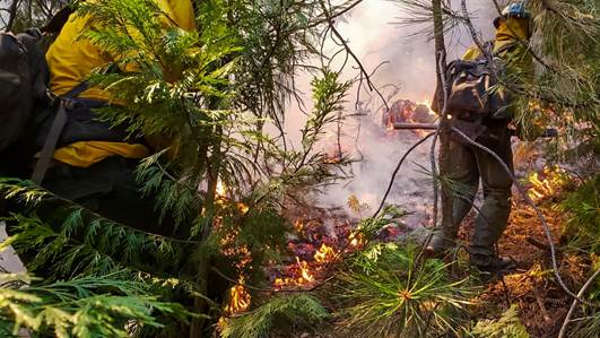
“It’s seriously tough work,” said CCC Conservationist Cedar Long.
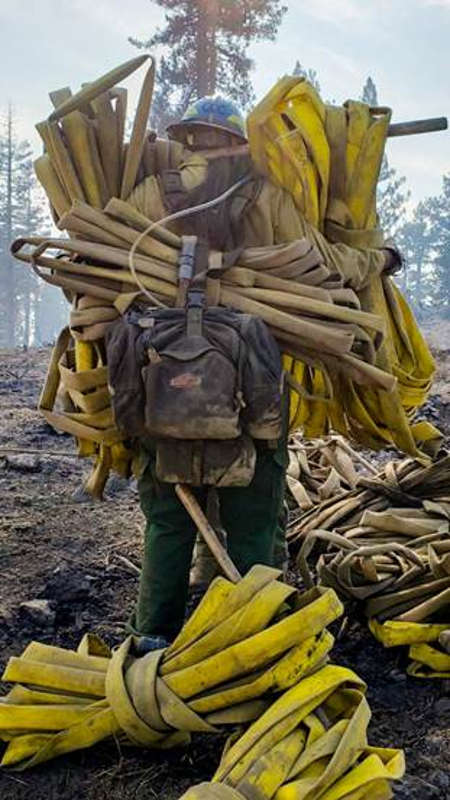
She led her crew of 14 Corpsmembers from the CCC Ukiah Center in doing the grueling task of hiking out – on foot – miles of fire hose used by USFS crews as flames surged south of Highway 36 between Red Bluff and Dinsmore.
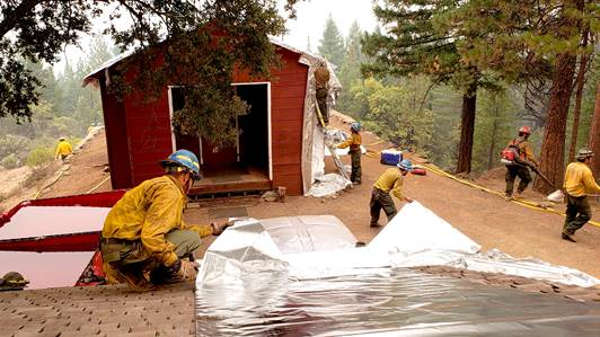
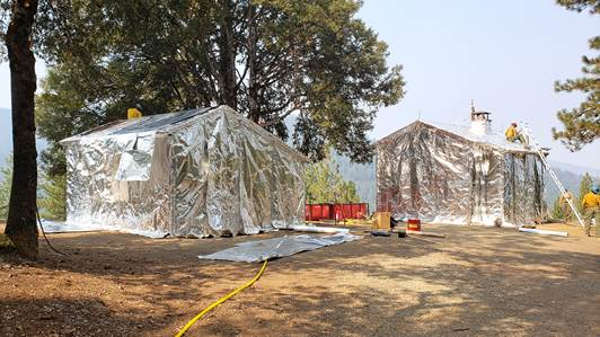
Her crew was also tasked with preserving the historic Post Creek Guard Station lookout cabin by doing what’s called a structure wrap – literally wrapping the building from baseboard to chimney in foil.
“These are 18- to 25-year-olds doing this work. It’s on-the-job training for the Corpsmembers and experience they will remember forever,” Long said, and experience that can lead to a career.
She added it’s work that doesn’t necessarily make the evening news but does make a huge impact on both the young Corpsmembers and local communities.
Back at the August Complex basecamp, Falaschi took a breather from her 16-hour day that she finds comfort in knowing it’s helping the fight against flames consuming wildland, property and sadly, lives.
“You’re doing it for yourself. You’re doing it for the firefighters. You’re doing it for the community. You’re doing it for California. We live here, you gotta make it a great place to be,” she said.