How to resolve AdBlock issue?
News
- Details
- Written by: Lake County News reports
Despite the number of people affected and the broad availability of programs and services to assist those in need, widespread misunderstanding and stigma surround mental illness.
Oct. 4 to 10 is Mental Health Awareness Week, and the National Alliance on Mental Illness, or NAMI, is striving to raise public awareness of the many effects of mental illness.
“Many don’t seek out treatment in early phases, because they don’t recognize the signs and symptoms,” said Todd Metcalf, director of Lake County Behavioral Health Services.
Mental Health America, or MHA, recently developed free online screening tools for seven major mental health conditions, now available at www.MHAscreening.org.
These brief screenings lend insight into whether you or someone you care about may be experiencing clinical anxiety, bipolar disorder, psychosis, an eating disorder, depression, post-traumatic stress syndrome, or a substance use disorder.
While a screening is not a diagnosis, it can be the gateway to initiating a discussion with a loved one or mental health professional.
These unprecedented times have highlighted the critical role effective diagnosis and management of mental conditions plays in households and communities.
MHA’s online screening tools and resources from NAMI can be conversation starters that prompt lifesaving and transformative change.
Lake County Behavioral Health Services aims to support county residents’ mental health and well-being. They invite community members to join them in the effort of sharing information about good mental health.
“We want to replace stigma with hope – during Mental Illness Awareness Week and throughout the year,” said Metcalf.
For more information, please contact Lake County Behavioral Health Services at 707-274-9101 or 707-994-7090.
- Details
- Written by: Elizabeth Larson
LAKE COUNTY, Calif. – Authorities have issued evacuation warnings for two areas south of Middletown due to the Glass fire getting closer to Lake County.
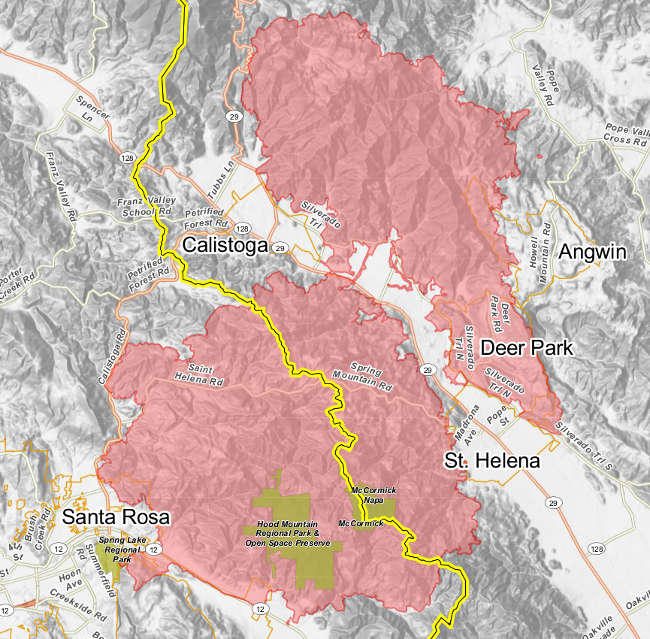
The Glass fire, which has been burning since last Sunday, grew by about 400 acres overnight for a total of 63,885 acres and 17-percent containment by Sunday morning, Cal Fire reported.
The Lake County Sheriff’s Office issued the evacuation warnings just after 3 p.m. for areas south of Rancheria Rancheria Road, east of the Lake-Sonoma County Line, north of the Lake-Napa County Line and west of Highway 29, and for South Mirable Road, east of Highway 29, north of the Lake-Napa County line and west of McGuire and Three Peaks ridgeline.
A map showing the evacuation warning areas is below.
“These Evacuation Warnings are due to the Glass Fire moving closer to the Lake County Line. We are asking everyone to take preparations in the event that a mandatory evacuation order is issued,” the sheriff’s office said in its alert.
Should evacuation orders be issued and shelter is needed, evacuees you will be directed to a temporary evacuation point, the sheriff’s office said.
Cal Fire said Highway 29 remains closed to vehicle traffic in both directions between Tubbs
Lane and the Lake County line.
Email Elizabeth Larson at
- Details
- Written by: ESTHER OERTEL
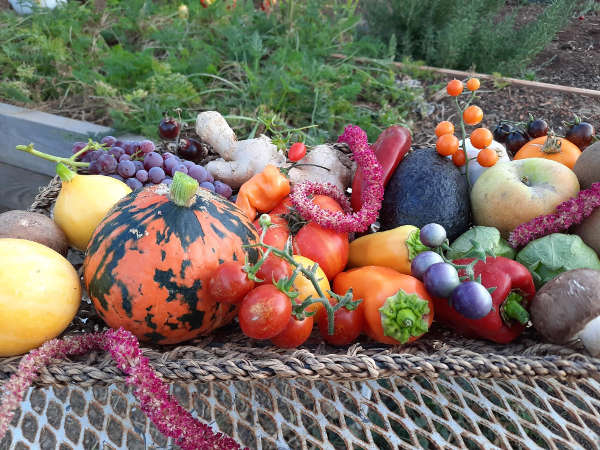
LAKE COUNTY, Calif. – In honor of this month’s holiday, Halloween, today’s column will celebrate the odd, the eerie, and the out of the ordinary when it comes to fruits and vegetables.
I traipsed to a local supermarket today, phone in hand, hoping to take photos of a few exotic offerings in the produce department. I didn’t have much luck, as what was there was pretty commonplace, at least from our point of view.
But when I began to view the veggies and fruits through the camera’s eye, it dawned on me that ordinary is really just a matter of perspective. The colorful fresh fare that lines the shelves of the average supermarket produce aisle is anything but ordinary.
The array of colors is amazing, not to mention the varying shapes, sizes and textures of each farm-produced item. It boggles the mind to think that such diversity sprang from the ground … or the branch … or the vine.
Take the avocado, for example. Its hard outer coating is so bumpy and rough that it’s also known as an alligator pear. The skin that hides the rich flesh within is anything but appetizing.
How about the artichoke? Who would’ve thought that we’d consider this bud from a thistle plant such a delicacy, and who had the nerve to eat the first one?
Fuzzy kiwi look like cute little alien creatures, not unlike short-haired versions of the “Tribbles” of Star Trek fame. (Can’t you just imagine them purring?)
Gnarled rhizomes of ginger look more like tree roots than food, and pineapples remind me of hand grenades with wild hair-dos on steroids.
Let’s not forget mushrooms, the “fungus among us” which is harvested from light-deprived growing caves.
You may think I’m easily amused, and perhaps I am, but I think of produce as art from a very creative mind. And the best part is that we’re privileged to eat it.
The truth is that many of the fruits and vegetables we now take for granted were once considered rare and exotic. Hot peppers, kiwi fruit and mangoes all fall into this category.
What follows is a fun look at some unique fruits and vegetables from around the world and close to home. They may seem exotic now, but who knows? One day they may be commonplace fare in our local market.
What better plant to celebrate autumn than the pumpkin tree? These branches with mini pumpkin-like fruit are sold for decorative purposes this time of year. As much as it looks like a pumpkin, the fruit is actually an ornamental eggplant, which is used in Asia in stir-fry dishes.
The dragon fruit’s official name is pitaya. Common in Asia, as well as in Central and South America, it sports a hot pink outer rind, out of which emerge neon green leaves that are reminiscent of tropical fish fins. Its bright white black-flecked flesh is sour, juicy and refreshing.
Chinese artichokes, also known as crosnes, look like grubs or caterpillars. They have a rich, artichoke-like flavor and are eaten sautéed, pickled or as a garnish.
The grapefruit-sized cherimoya looks almost reptilian, with tight green scales on the outside. Inside is white flesh that’s soft and super sweet. It’s described as having a flavor that’s similar to a combination of banana, strawberry, and pineapple.
Durians are popular across Southeast Asia. Green, football shaped, and spiny, they’re known for their strong, unpleasant odor and are banned from being eaten in public in some locations. Despite the smell, their silky, sweet fruit is used in desserts, or sometimes eaten raw in segments.
The black radish looks nothing like its small, red, rotund counterpart that we’re used to seeing. Rather, it looks more like a chubby, black-skinned carrot. A more common variety is round and about the size of a tangerine. It has a pungent flavor and is used often as a supplement.
Fiddleheads are a short-lived delicacy, being available for only a few weeks in the spring. These curly fronds from young ferns are native to Canada and New England and taste somewhat like asparagus. One note of caution, though: When eaten raw, they’ve been linked to food poisoning, so it’s best to steam them before eating.
Lychee fruit has long been seen as a dessert on a Chinese menu, but have you ever seen them in their natural state? This fruit native to Asia looks more like a sea creature than a fruit. Green tentacles grow out of bright pink skin which surrounds the sweet, juicy, white flesh inside.
Morel mushrooms, native to woodsy areas in the U.S. and Europe, have a honeycombed head, making them look like elongated brains on a stick. Be careful if you hunt them in the wild as some varieties are poisonous.
Star fruit, also known as carambola, have five fin-like segments along their elongated body, so when cut a star shape appears. This tropical yellow fruit tastes a bit like plums or pears.
When sliced, the lotus root has a beautiful, almost snowflake-like, design in its flesh. It’s crunchy like water chestnuts or jicama, but has a more delicate flavor than either of these.
Ramps, also known as wild leeks, are becoming increasingly popular with chefs. This member of the onion family has a scallion-like bulb and flat, broad leaves. Native to North America, it’s typically available for only a few weeks each year.
That’s my exotic green grocer’s dozen. Can you think of any I missed?
As to today’s recipe, below are instructions for making a tasty baked pumpkin stuffed with cornbread and autumn greens. We have a plethora of pumpkins growing in our home garden now, both large and small. The bright spots of orange that peek through the tangle of green vines reminded me of this delightful and somewhat out of the ordinary treat for your fall dinner table.
The recipe below is a vegetarian version of this dish but, if you prefer, cooked sausage or sauteed ground meat can be added. Enjoy!
Baked Stuffed Pumpkin
Ingredients
1 medium pumpkin, about 10 inches in diameter
1 recipe cornbread, baked, cooled, and chopped into 1-inch cubes
4 tablespoons olive oil or butter
1 medium yellow onion, chopped
2 garlic cloves, minced
6 cups fresh autumn greens, such as kale, collards, turnip greens, beet greens, or chard (or a combination), washed and coarsely chopped
1/2 cup walnuts, chopped
1 egg
3 tablespoons chopped mixed fresh herbs of your choice, such as sage, thyme or parsley (Note: 3 teaspoons dried herbs can be substituted)
Salt and freshly-ground black pepper, to taste
Vegetable broth to moisten
Procedure
1. Preheat oven to 350 degrees F. Cut the lid off the pumpkin and scoop out seeds and fibers. Place cleaned pumpkin on a lightly-oiled baking sheet and bake for around 45 minutes, then remove from oven and keep warm.
2. In a large skillet, heat olive oil or butter over medium-high heat and add onion and garlic, stirring to coat with oil. Cook, stirring occasionally, until vegetables are slightly softened and golden, about 5 minutes.
3. Add greens and fresh herbs. Cook, stirring, until greens are wilted and coated with oil.
4. In a large mixing bowl, place cornbread cubes, wilted greens, walnuts, egg, salt, and pepper, stirring to combine. Add enough broth to moisten.
5. Place stuffing in pumpkin and cover with foil. Replace pumpkin in preheated oven and bake for 35 or more minutes, until stuffing is cooked and pumpkin is tender.
6. Transfer pumpkin to a pretty platter and remove foil. Serve warm, being sure to scoop bits of cooked pumpkin on to everyone’s plate along with the stuffing.
Serves 6.
Esther Oertel is a writer and passionate home cook from a family of chefs. She grew up in a restaurant, where she began creating recipes from a young age. She’s taught culinary classes in a variety of venues in Lake County and previously wrote “The Veggie Girl” column for Lake County News. Most recently she’s taught culinary classes at Sur La Table in Santa Rosa. She lives in Middletown.
- Details
- Written by: Elizabeth Larson
Dry, hot weather conditions have continued to drive the Glass fire, but firefighters kept its growth to 1,090 acres during the course of the day on Saturday, for a total of 63,450 acres by nightfall, with containment rising to 15 percent, Cal Fire said.
The fire has been burning for a week in Napa and Sonoma counties.
At 6 p.m. Sunday, Cal Fire will host a virtual community meeting to give an update on the Glass fire. The meeting will be live-streamed on the Cal Fire Sonoma-Lake-Napa Unit Facebook page.
Cal Fire said there are 2,773 firefighting personnel assigned to the incident, along with 408 engines, 49 water tenders, 23 helicopters, 27 hand crews, 66 dozers and nine masticators.
So far, no injuries to firefighters have been reported.
Critically low fuel moisture,very warm and dry weather conditions are contributing to very active fire behavior, Cal Fire said.
Aggressive mop up and tactical patrol continues in areas where the fire’s forward progress has stopped. Crews are working aggressively to construct and reinforce existing control lines, officials said.
Cal Fire said it is threatening 21,613 structures, down by several thousand since Saturday morning.
The fire has so far destroyed a total of 826 buildings, 561 in Napa, 265 in Sonoma. Another 163 buildings – 91 in Sonoma, 72 in Napa – have been damaged.
Sonoma County has now posted a damage assessment map.
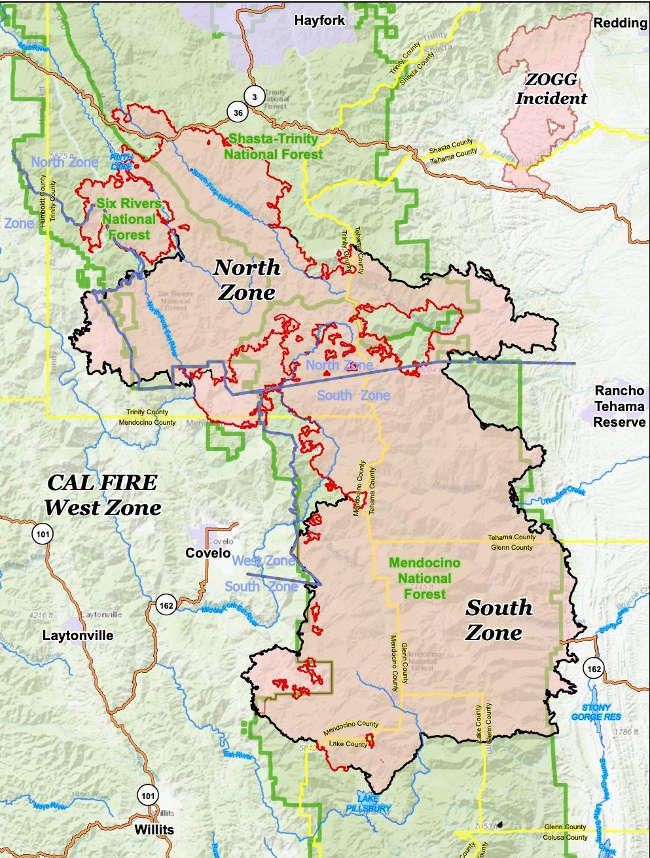
The August Complex – burning since Aug. 17 – grew by nearly 15,000 acres since Friday, reaching 984,804 acres and 51-percent containment by Saturday evening, officials reported.
On the complex’s South Zone, which includes the Mendocino National Forest in northern Lake County, the US Forest Service said that hard work on Friday in the Lake Pillsbury region resulted in high confidence in the integrity of the containment lines built to protect property and resources.
All hose, fixtures, pumps and other fire apparatus have been pulled and reset for potential use in the northwestern corner of the August Complex. Patrol status has been achieved at Lake Pillsbury, Rice Creek and adjacent areas, officials said.
The Forest Service said Sunday will be a transitional day, with Pacific Northwest Team 2 migrating resources and strategy to the northwestern corner of the August Complex. In upcoming shifts, the team will further join forces with Cal Fire and the Alaska IMT1.
Along with that movement, task forces consisting of multiple fire engines and water tenders will continue patrolling the long containment lines from Lake Pillsbury to the west up to Eel River, and east and north to Paskenta, officials said.
Email Elizabeth Larson at