 How to resolve AdBlock issue?
News
- Details
- Written by: Lake County News reports

LAKE COUNTY, Calif. – When the governor of California issued the statewide shelter in place order in mid-March, and nearly all of the state’s public schools dismissed their students for the remainder of the school year, child care providers were placed in a difficult situation.
Considered essential businesses, they were allowed to remain open as long as they followed social distancing precautions and increased cleaning procedures.
The concern was that essential workers in other industries would still need care for their children in order to continue their jobs to support this health crisis.
But it hasn’t been easy for Lake County’s early learning teachers, providers and staff.
Many local facilities watched their enrollment dwindle as working parents lost jobs or were furloughed, and no longer had the need or finances to send their children to child care.
Some parents kept their children at home because they were concerned that their child would contract the virus in a group setting.
More stringent cleaning protocols required implementation, yet owners encountered difficulties in getting basic goods to run their businesses, such as cleaning products and food.
Many facilities had to close.
Carla Ritz, executive director of First 5 Lake, explains, “When COVID-19 social distancing precautions were ordered, 30 out of 31 child care centers in the county closed their doors along with 21 out of 70 licensed family child care homes.”
Support was available in Lake County through a partnership of local agencies dedicated to increasing the quality of child care providers in Lake County.
The Lake County Child Care Planning Council, or LPC, a consortium of agencies and nonprofits, works to build partnerships with individuals and organizations in our community to help meet the child care needs of our communities.
Angela Cuellar-Marroquin of the Lake County Office of Education is the coordinator of the LPC. “We truly are all in this together. Multiple local agencies are working hand-in-hand together during this health crisis.”
Carla Ritz, executive director of First 5 Lake, explained, “First 5 California invests in California's child care system by funding the IMPACT (Improve and Maximize Programs so All Children Thrive) approach to quality improvement throughout the state.”
Ritz added, “In Lake County, First 5 Lake has served as the lead agency overseeing the use of the $853,110 in IMPACT funding that has been invested in Lake County over the past five years, and Lake County Office of Education staff have implemented the program.”
The Lake County Office of Education typically uses IMPACT dollars to fund Quality Rating and Improvement System, otherwise known as QRIS, also headed by Cuellar-Marroquin.
But during this health crisis, QRIS was allowed to repurpose their IMPACT grant funding. This includes incentive stipends for providers remaining open to serve essential workers, materials for programs that are serving new age groups, and materials for sites to distribute to parents to use with children while sheltering in place.
“I think some of the most heart-warming things I’ve seen in this pandemic are those providers who have had to close, yet they are still taking care of their students from a distance,” said Cuellar-Marroquin. “The providers might be closed, yet every week, and sometimes every day, they are on Zoom with their children, or doing circle times via Facebook Live. I’ve even had providers who are closed reaching out to us for take-home materials, because they know their students at home are in need of supplies to keep on track with their early childhood learning.”
The reality though is that providers are still grappling with getting the basic supplies they need to follow protocols.
"Providers in Lake County have been diligent in following all Community Care Licensing rules and regulations related to social distancing and cleaning procedures to best protect the children and themselves. They are finding it difficult to secure cleaning materials, sometimes specific food items and other essential items for their operations," said Jamie Castaldo, resource & referral manager, Rural Communities Child Care, A program of North Coast Opportunities.
Ritz says, “Help is on the way!”
She explains that recently, the First 5 California Commission held an emergency meeting and authorized funding to contract with www.SupplyBank.org to provide relief to providers in need of essential supplies for babies and young children, such as diapers, wipes and gloves, in addition to much-needed sanitation items.
Lake County is expecting multiple shipments from SupplyBank over the next 60 days to meet that need locally.
Quality child care is now becoming an important issue in the reopening of the economy.
In Gov. Newsom’s April 28, 2020 press conference, he said, “Child care is foundational to getting people back to work. If they cannot get the kind of quality child care that they deserve they are less likely to get back to work and jump-start this economy."
Brock Falkenberg, Lake County superintendent of schools and a commissioner on the First 5 Lake Board said, “We know that quality child care is more important than ever now, and organizations such as First 5 Lake, North Coast Opportunities, and the Lake County Office of Education will continue committing time and energy towards helping our parents get back to work, by making quality child care available here in Lake County.”
There are open local child care slots available. Lake County families seeking child care can call the referral message line at North Coast Opportunities at 707-467-3211. Calls are returned within 24 hours.
For families who need financial assistance to help pay for child care, there are a limited number of subsidized child care slots available for essential workers. To find out if you qualify, visit ncoinc.org and complete the waitlist application.
For child care providers interested in becoming a part of QRIS, please contact Angela Cuellar at

- Details
- Written by: Elizabeth Larson
The board will meet virtually beginning at 9 a.m. Tuesday, May 5, in the board chambers on the first floor of the Lake County Courthouse, 255 N. Forbes St., Lakeport.
The meeting can be watched live on Channel 8 and online at https://countyoflake.legistar.com/Calendar.aspx . Accompanying board documents, the agenda and archived board meeting videos also are available at that link.
Because the meeting will be held virtually, members of the public are asked to submit comments on items to
At 9:01 a.m., Lake County Public Health Officer Dr. Gary Pace will present his weekly update on the COVID-19 situation.
At 10 a.m., the board will discuss and consider the next steps for COVID-19 local control.
In a memo on the item, Supervisor Bruno Sabatier is suggesting adding more jurisdictions to a letter submitted on April 21 from the board to the governor that requested local control in reopening the economy while following public health benchmarks.
“This agenda item provides us with the ability to discuss what our next move is with our previous letter and future correspondence as we try to find ways to move forward and loosen the restrictions that are currently in place and obtain local control where we can make the best decisions for us rather than a one size fits all 4 phase action plan that covers all of the state of California,” Sabatier wrote.
In untimed COVID-19-related items, the board will consider a letter to state leaders advocating for county funding needs due to disaster response and lost revenue, a continued discussion of a proposed urgency ordinance that would require members of the public to wear masks at public facilities, and staff reports on disaster response expenses and revenue concerns for the future due to the pandemic.
At 11 a.m., the board will host a discussion, at the request of Supervisor EJ Crandell, regarding AB 626, a law to allow microenterprise home kitchen operations.
The full agenda follows.
CONSENT AGENDA
5.1: Approve leave of absence from 4/13/2020 to 6/12/2020 for Department of Social Services employee David Perata and authorize the chair to sign.
5.2: (a) Waive the formal bidding process, pursuant to Lake County Code Section 38.2, as it is not in the public interest due to the unique nature of goods or services; and (b) approve the agreement between the county of Lake and Adventist Health St. Helena and Adventist Health Vallejo for the fiscal year 2019-20 for a contract maximum of $150,000 and authorize the board chair to sign the agreement for psychiatric inpatient hospital services and professional services associated with acute inpatient psychiatric hospitalizations to clients referred by Lake County Behavioral Health Services.
5.3: Approve corrected late travel claim for crisis supervisor in the amount of $763.63 and authorize the auditor-controller to process payment.
5.4: Adopt proclamation designating the month of May 2020 as Maternal Mental Health Awareness Month in Lake County.
5.5: Adopt proclamation designating the week of May 3-9, 2020 as Law Enforcement Officers Week.
TIMED ITEMS
6.1, 9:01 a.m.: Consideration of update on COVID-19.
6.2, 10 a.m.: Discussion and consideration of next steps for COVID-19 local control.
6.4, 10:35 a.m.: (a) Presentation of proclamation designating the week of May 3-9, 2020, as Law Enforcement Officers Week; and (b) presentation of proclamation designating the month of May 2020 as Maternal Mental Health Awareness Month in Lake County.
6.5, 11 a.m.: Discussion and consideration of AB 626, Eduardo Garcia. California Retail Food Code: microenterprise home kitchen operations.
UNTIMED ITEMS
7.2: Consideration of Letters to Gov. Newsom, to Sen. McGuire and to Assemblymember Aguiar-Curry to advocate for our funding needs for disaster response and revenue loss resulting from the COVID-19 crisis.
7.3: Consideration of an Ordinance Amending Chapter 21, Article 27 of the Lake County Code pertaining to commercial cannabis cultivation.
7.4: Continued from April 28: Consideration of an urgency ordinance establishing temporary safety protocols upon the reopening of county facilities to the public during the ongoing COVID-19 state of emergency.
7.5: Consideration of staff reports on (a) COVID-19 disaster response expenses to date and (b) revenue and expense concerns for the future, resulting from coronavirus pandemic impacts.
Email Elizabeth Larson at
- Details
- Written by: Elizabeth Larson
The meeting will take place via webinar beginning at 6 p.m. Tuesday, May 5.
To speak on an agenda item, access the meeting remotely here or join by phone by calling 415-930-5229 or toll-free, 877-309-2074. The access code is 620-529-293; the audio pin will be shown after joining the webinar. Those phoning in without using the web link will be in “listen mode” only and will not be able to participate or comment.
Comments can be submitted by email to
Please indicate in the email subject line "for public comment" and list the item number of the agenda item that is the topic of the comment. Comments that read to the council will be subject to the three minute time limitation (approximately 350 words). Written comments that are only to be provided to the council and not read at the meeting will be distributed to the council prior to the meeting.
On Tuesday, the council is scheduled to get a presentation from Public Health Officer Dr. Gary Pace on the current progress in containing the COVID-19 outbreak in Lake County. Pace had been set to speak to the council at its last meeting in April but had a time conflict.
In council business, City Manager Margaret Silveira is asking the council to review the application for the July 18 Rhythm & Brews event and other similar events using public areas in light of shelter in place orders.
“Staff is seeking direction in processing and scheduling events using public areas in Lakeport in the upcoming months. Since March 18, Shelter-in-Place orders have been instituted in Lake County to help stop the spread of COVID-19. It is likely that some type of order will continue through the summer months, making it difficult to respond to public requests for events and the subsequent street closures,” Silveira wrote in her report to the council.
Options for the council to consider include denying the Rhythm & Brews event, approving it with staff recommendations, or directing staff to cancel all events scheduled for May through September.
In other business, the council will consider the proposed resolution adopting the Eleventh Street Corridor Multimodal Engineered Feasibility Study and make a recommendation that the Lake Area Planning Council also adopt the proposed Study.
Staff also will ask the council to proceed with the preparation of a Community Development Block Grant application for $70,681 in aid through the federal Coronavirus Aid, Relief, and Economic Security, or CARES, Act.
On the consent agenda – items considered noncontroversial and usually accepted as a slate on one vote – are ordinances; minutes of the regular council meeting on April 21 and the special council meeting on April 24; confirmation of the continuing existence of a local emergency for the Mendocino Complex fire; confirmation of the continuing existence of a local emergency for the February 2019 storms; confirmation of the continuing existence of a local emergency for the October 2019 public safety power shutoff; confirmation of the continuing existence of a local emergency for the COVID-19 public health emergency; and receipt and filing of the draft minutes of the regular meeting on April 22 of the Measure Z Advisory Committee.
Email Elizabeth Larson at
- Details
- Written by: Robert Sanders
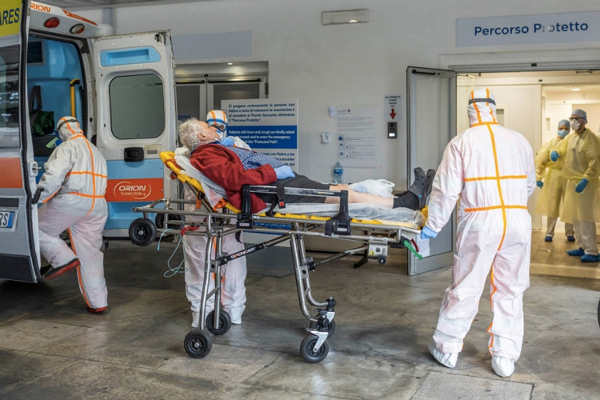
A comparison of daily deaths in Italy since January 2020 with those over the previous five years there indicates that the fatality rate in that country for those infected with the new coronavirus is at least 0.8 percent, far higher than that of the seasonal flu and higher than some recent estimates.
Extrapolating from the Italian data, University of California, Berkeley, and Lawrence Berkeley National Laboratory data scientists estimate that the fatality rate in New York City and Santa Clara County in California can be no less than 0.5 percent, or one of every 200 people infected.
These conclusions contrast with those of a study posted in April by Stanford University epidemiologists, who pegged the fatality rate at between 0.1 percent and 0.2 percent. An affiliated team from the University of Southern California later in April reported a similar fatality rate in Los Angeles.
“Their final number is much lower than our estimate,” said senior author Uros Seljak, a UC Berkeley professor of physics, faculty scientist at Berkeley Lab and member of the Berkeley Institute for Data Science. He also is co-director of the Berkeley Center for Cosmological Physics, or BCCP.
Seljak says that getting COVID-19 doubles your chance of dying this year.
“If you want to know what are the chances of dying from COVID-19 if you get infected, we observed that a very simple answer seems to fit a lot of data: It is the same as the chance of you dying over the next 12 months from normal causes,” said Seljak.
Current uncertainties can push this number down to 10 months or up to 20 months, he added. His team discovered that this simple relation holds not only for the overall fatality rate, but also for the age-stratified fatality rate, and it agrees with the data both in Italy and in the U.S.
“Our observation suggests COVID-19 kills the weakest segments of the population,” Seljak said.
The paper was posted online last week on MedRxiv in advance of peer review and submission to a journal.
Italy’s deaths twice the official count
The study by Seljak and his colleagues predicts that the true number of deaths in Italy from COVID-19 is more than twice the official figure: around 50,000 people, as of April 18. The country’s official statistics listed more than 150,000 confirmed cases, as of that date, and more than 20,000 attributed deaths.
The difference, the researchers say, is likely due to many deaths among older people that have not been counted in the official Italian statistics. The team found a much higher fatality rate for those over 70 years of age: In Lombardy, a region hit hard by the pandemic, those between 70 and 79 had a 2.3 percent infection fatality rate, while those 80 to 89 had an almost 6 percent fatality rate. Nearly 13 percent of those over 90 died.
In comparison, those 40 to 49 had a 0.04 percent fatality rate.
These differing fatality rates can explain the observed higher number of deaths among younger people in New York City. Because the population there is younger that in Italy, more deaths among young people are expected, despite their lower fatality rate. The researchers predict that about 26 percent of all deaths from COVID-19 in New York City will be among those younger than 65.
The population of Italy, on the other hand, is older, yielding a higher overall fatality rate for the country’s population: 0.8 percent, versus 0.5 percent for New York. Only 10 percent of Italian deaths will be younger than 65.
The team also estimated, based on the predicted fatality rate for those infected with the new coronavirus and the positivity rate for those tested for COVID-19 in New York City, that about one-quarter of that city’s population has been infected with the virus. This agrees with the recent announcement by New York Gov. Andrew Cuomo of 21 percent infection.
The team’s predicted infection rate for Santa Clara is around 1 percent, while that for Los Angeles is around 2 percent, based on current mortality rates.
Given known infection and fatality rates on the Diamond Princess cruise ship, the team also calculated an upper limit on the fatality rate for those infected: about twice the lower limit, or 1 percent, for New York City and Santa Clara County.
Uncertainty fueled by lack of diagnostic tests
Uncertainty about the fatality rate for those infected by the new virus, dubbed SARS-CoV-2, resulted from delays in testing, due to a shortage of test kits and testing labs. This left public health officials in the dark about the true rate of infection in the general population, which is needed to calculate what percentage of infected people die.
The Stanford study estimated an infection rate in Santa Clara County of between 2.5 percent and 4.2 percent of residents, whereas the USC study estimated an infection rate in Los Angeles between 2.8 percent and 5.6 percent. Both are much higher than previous estimates, which means the number of confirmed COVID-positive deaths relative to those infected dropped to a low of 0.2 percent.
Based on these studies, some of the Stanford authors have argued that COVID-19 is little worse than the seasonal flu, casting doubt on decisions to mandate shelter-in-place and the closing of many businesses.
“Of course, it (the infection fatality rate) matters, for policy decisions,” Seljak said. “Is this just a bad case of flu, as they would like to claim, or is it something much more serious?”
To answer that question, Seljak and his colleagues mined a previously untapped source of data: the daily death rate for 1,688 towns in Italy between Jan. 1 and April 4 for the years 2015 through 2020, provided by the Italian Institute of Statistics. The excess deaths between January and April of this year, presumably due to COVID-19, can be used to calculate a lower limit for the death rate from the virus.
“The dataset is a treasure trove for statistical analysis of COVID-19 mortality,” Seljak said. “For example, it can give mortality rate as a function of age better than any other data out there, a sad consequence of tens of thousands of deaths from COVID-19 in Italy. With this data, we established that if one gets infected and is above 90 years of age, the probability of dying is at least 10 percent, because that is the fraction of the entire population of Bergamo province in this age group that died. In contrast, the corresponding number for ages 40 to 49 is 0.04 percent, far lower than previous estimates.”
The Lombardy region of Italy, for example, was a viral hotspot, with the province of Bergamo hardest hit: The infection spread to so many people in Bergamo — likely two-thirds of the population, if not the entire population — that it is possible that so-called herd immunity has set in, Seljak said. That means that enough people are immune, at least temporarily, to stanch the spread of the virus among the uninfected.
With essentially everyone in Bergamo infected, and the known deaths since January — predicted to be more than 6,000 out of a population of 1 million — it was easy to calculate the lowest possible infected fatality rate: 0.56 percent.
For Lombardy, the researchers estimated that the lowest possible fatality rate was even higher: about 0.84 percent. They also estimated that 23 percent of the population of Lombardy was infected, as of April 18 — on average, 35 times the number of positive tests in the province.
The team conducted an analysis for all Italian towns that reported daily death data and for all age groups, using a counterfactual analysis: estimating the expected number of deaths daily between January and April 2020, based on the previous five years, and comparing those numbers with reported deaths. The excess is assumed to be due to COVID-19. The researchers employed statistical methods often used in analyzing large sets of data: the Conditional Mean with a Gaussian process (CGP) and a Synthetic Control Method (SCM).
In nearly all towns, the excess deaths in early 2020 exceeded the official count attributed to COVID-19.
The numbers the team came up with are lower limits, the researchers emphasize, since deaths in many Italian towns are not fully up to date.
“Some of my colleagues think that we have been overly conservative, which might be true,” Seljak said. “We have just accounted for the people who have died up until today, but people are still dying.”
The first author of the paper is Chirag Modi, a physics graduate student in BCCP. Other co-authors are postdoctoral fellows Vanessa Böhm and George Stein and research scientist Simone Ferraro of Berkeley Lab and the BCCP, and former Miller Fellow at UC Berkeley.
Robert Sanders writes for the UC Berkeley News Center.