 How to resolve AdBlock issue?
News
- Details
- Written by: Lake County News reports
“We’re grateful to partner with Lake and Mendocino counties on this critical coronavirus telephone town Hall,” McGuire said.
“We’ll have the latest, most accurate information from the medical professionals on the front lines on the virus response, stay-at-home orders and what a safe and strategic opening of our local economy would look like. We hope folks can join us for this informative community event,” McGuire said.
McGuire will host the public health officers from Lake and Mendocino counties, the superintendents of schools for the two counties and a University of California physician focused on infectious diseases.
To attend, dial 844-721-7241, enter code 6666128 and follow the prompts. You will be connected to the live town hall via telephone and you will be able to listen to the doctors providing critical updates. The town hall will be limited to the first 1,000 participants.
Email your questions and comments in advance and in real-time during the telephone town hall to
- Details
- Written by: Mark Abkowitz, Vanderbilt University

The tornadoes that swept across the Southeast this spring were a warning to communities nationwide: Disasters can happen at any time, and the coronavirus pandemic is making them more difficult to manage and potentially more dangerous.
The next six months could be especially challenging. Forecasts show widespread flooding is likely again this spring from the northern Plains through the Gulf of Mexico. The western U.S. expects significant droughts this summer, a recipe for wildfires. The U.S. is also facing a high-risk Atlantic hurricane season.
Each type of disaster could leave thousands of people homeless and many in need of rescue and emergency care.
Dealing with response and recovery from a disaster in the midst of the coronavirus pandemic raises new and unsettling questions. Who is available to respond? What medical assistance can be provided if hospitals are treating COVID-19 patients and there is already a shortage of supplies? Where do we shelter and house evacuees, given the need to keep large numbers of evacuees socially distant from one another? Moreover, the time frame for dealing with this dual challenge may not be measured in days or even weeks, but rather months and possibly years.
As a civil engineer specializing in risk management, I work with governments and businesses to assess enterprise risks, including extreme weather. There are no silver bullets to solving these dilemmas, but there are simple concepts and questions that planners should be addressing right now.
Planning is crucial
With the coronavirus pandemic adding a new layer of challenges and risks, community leaders should be planning in a structured way for how they will deal with worst-case scenarios.
That means asking: What can go wrong? How likely is it? What are the consequences? And what resources do we need to mitigate the risk?
Before this year, few communities seriously considered the need to deal with a pandemic on top of a natural disaster. Their playbooks for responding to a tornado or a hurricane likely didn’t include the need to consider social distancing in emergency shelters or how to get help from other states when a widespread health crisis is underway.
Officials should be asking the key questions again, casting the net wide enough to consider any plausible scenario. Importantly, they should be addressing where personnel, equipment, facilities and supplies can be found and how those resources should be allocated.
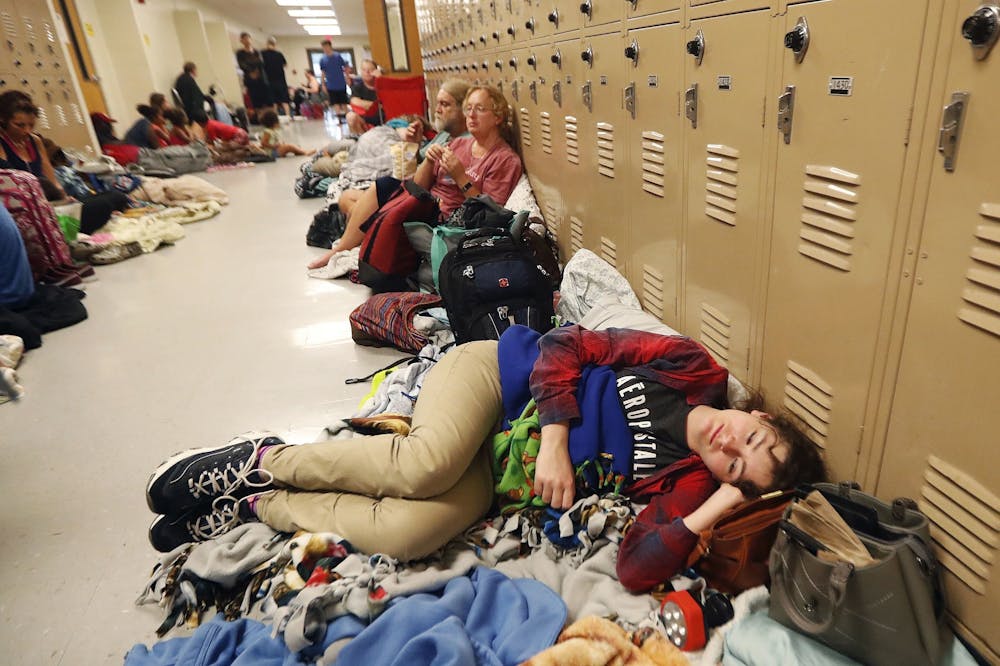
With the likelihood that resources normally available from federal agencies and mutual aid agreements won’t be accessible this year, some local communities have started banding together to fill the void.
In New Orleans, Evacuteer, a nonprofit normally focused on helping residents evacuate during a hurricane, has shifted its operations to stockpiling food and supplies, recognizing that the pandemic response has depleted many of these resources.
The Mississippi River Cities and Towns Initiative, a coalition of mayors and leaders, is procuring personal protective equipment for distribution to wherever severe flooding may occur.
Vacant hotel rooms and college dormitories are becoming important sheltering options. When tornadoes hit the Southeast in April, the Red Cross turned to a revised playbook and responded with social distancing in mind. Instead of opening shelters, where the coronavirus could easily spread, it worked with hotels to put hundreds of storm victims into rooms. Its volunteers, normally on the scene after disasters, jumped into emergency response coordination work from home.
The logistics challenge and federal leadership
Without careful, coordinated planning, desperately needed resources can be sent to the wrong locations, leaving the areas most in need of assistance without lifesaving capabilities.
The shortages of testing, face masks and ventilators in areas hit hard by the coronavirus pandemic show how logistical failures can threaten the quality of health care and the susceptibility of hospital workers to harm.
Ideally, disaster logistics management should be a federal role. The federal government has greater access to supplies and the authority to marshal resources. The most effective approach is centralized control of the supply chain and a unified command structure, much in the way the Defense Logistics Agency supports military operations. It requires total awareness of where to get supplies and where they are needed, and the ability to alter traditional supply chains when necessary.
Many case studies illustrate the success of this approach, and the risks of not using it. During the 2001 terrorist attack on the Pentagon, the Arlington County Fire Department quickly established a unified command with other agencies. The emergency crews on the scene knew who was in charge and could coordinate effectively. Conversely, the disorganized response to Hurricane Katrina in 2005 left tens of thousands of people without basic supplies.
Changing how businesses operate
Inventory management is perhaps the most difficult challenge. In our global economy, companies have been overwhelmingly focused on cutting costs to remain competitive.
Businesses respond by keeping inventory as low as possible, relying on the supply chain to make just-in-time deliveries to meet production and service needs. There is little to no adaptive capacity in the system – the excess resources they could draw upon when a disaster strikes.
Creating this adaptive capacity will require a sea change in how businesses operate, with the strategy of cutting costs to the max replaced with a more reasoned approach of being cost-conscious while maintaining a sufficient inventory to meet societal needs.
Now is the time to recognize how to become resilient when confronting multiple disasters simultaneously. There is a famous oil filter commercial in which an auto mechanic, discussing the cost of replacing an oil filter as opposed to the cost of engine repair by deferring that decision, declares: “You can pay me now….or you can pay me later.” Later is no longer an option.
[You need to understand the coronavirus pandemic, and we can help. Read The Conversation’s newsletter.]
Mark Abkowitz, Professor of Civil and Environmental Engineering and Director of the Vanderbilt Center for Environmental Management Studies, Vanderbilt University
This article is republished from The Conversation under a Creative Commons license. Read the original article.
- Details
- Written by: Lake County News reports
City officials said providing essential services in a safe manner to citizens has been the priority and they continue to do so by putting new procedures in place to do business at City Hall.
A new plexiglass barrier has been installed at the City Hall public counter, as well as floor markers allowing a maximum of three citizens within the lobby area to assist in maintaining social distancing, and regular sanitization of surfaces.
The Clearlake Police Department lobby area is also open during regular business hours for a maximum of two citizens at a time.
City officials apologized for any wait times community members may encounter and appreciate their understanding and patience as the city navigates “these uncharted times.”
The city said larger group meetings, including city council and planning commission meetings will continue to be held virtually via Zoom with opportunities for public participation through Open Town Hall and email.
The city continues to provide normal business through phone calls, email and video conferencing by appointment.
Please call 707-994-8201 for questions or accommodations in conducting city business.
- Details
- Written by: Elizabeth Larson
Public Health Officer Dr. Gary Pace confirmed to Lake County News that the inmate is Lake County’s eighth COVID-19 case.
Sheriff Brian Martin said his agency got the inmate’s test results on Monday morning.
Lt. Corey Paulich said the specimen that identified the infected inmate was collected on Tuesday, April 19.
Paulich said the inmate is not displaying any symptoms of illness. When the positive test result was received the inmate was placed in isolation to avoid spreading the virus.
The sheriff’s office would not provide further information, citing medical privacy laws.
That includes not releasing information in response to questions from Lake County News about how long the inmate has been in custody and whether that individual came in sick or was infected while in the jail.
Paulich said the sheriff’s office is working with Public Health to determine the source of the infection.
One of Lake County’s previous seven confirmed COVID-19 cases was in a former state prison inmate released back to the county early in April, as Lake County News has reported.
Paulich said the test of the COVID-19 positive inmate was part of a 100-test survey conducted in the jail to determine if the virus could be detected in the inmate population or sheriff’s office staff.
He said all participants were asymptomatic so lab testing was not prioritized, causing the delay in receiving the results.
As of Monday, Paulich said the results of 91 tests have been received and this is the only positive case. Four test results are still pending.
Paulich said the sheriff's office has identified all inmates and staff who may have come into close contact with this inmate.
Following the guidelines of the Centers for Disease Control and Prevention and in consultation with the Lake County Public Health officer, 17 inmates who had direct contact with the infected inmate are currently in medical isolation, Paulich said.
On March 12, the sheriff's office instituted enhanced measures to prevent the spread of coronavirus in the jail.
Those measures include suspending jail programs and visitation, screening all staff prior to entry to the facility, placing inmates who are in custody for minor offenses on home detention, enhanced medical screening at booking, wearing of face masks by staff, designating bed spaces for isolation and quarantine, among others, Paulich said.
Paulich said the jail continues to undergo comprehensive regular cleaning and disinfecting.
Due to Judicial Council of California rules issued in April that put in place a no-bail rule statewide for misdemeanors and lower-level felonies during the COVID-19 pandemic – which it said was meant to “safely reduce jail populations” – the jail census has dropped.
The jail is licensed for 286 inmates and currently has about 172 inmates, which Paulich said changes daily.
Paulich said the sheriff’s office has implemented safeguards to improve the health and well-being of inmates and employees.
Officials are providing comprehensive education to the jail population and staff on how to reduce chances of exposure and infection, he said.
“We have implemented social distancing, virtual meetings, working from home, as well as paused non-essential meetings, travel and training. We have hand sanitizers, cleaning wipes, face masks and disposable gloves readily available to employees,” Paulich said.
“This is a developing situation and we will provide updates as information becomes available,” Paulich said.
To learn more about all the steps being taken to keep everyone in custody safe and healthy, visit www.lakesheriff.com and explore the Coronavirus2019 response plan at http://www.lakesheriff.com/Assets/Sheriff+Site/coronavirus.pd .
Email Elizabeth Larson at