How to resolve AdBlock issue?
Refresh this page
Lake County News,California
  • Home
    • Registration Form
  • News
    • Education
    • Veterans
    • Community
      • Obituaries
      • Letters
      • Commentary
    • Police Logs
    • Business
    • Recreation
    • Health
    • Religion
    • Legals
    • Arts & Life
    • Regional
  • Calendar
  • Contact us
    • FAQs
    • Phones, E-Mail
    • Subscribe
  • Advertise Here
  • Login
How to resolve AdBlock issue?
Refresh this page

News

Smoky air to result in unhealthy conditions over the weekend

LAKE COUNTY, Calif. — The Lake County Air Quality Management District is urging community members to be aware of air conditions through Sunday that could be unhealthy for sensitive groups due to a fire in Napa County.

Current air monitor readings throughout Lake County range from “good” to “unhealthy for sensitive groups,” the district reported.

The Pickett fire in Napa County East of Calistoga currently is causing the regional smoke impacts throughout Lake County. 

All areas of Lake County may experience “moderate” to “unhealthy for sensitive groups” air quality through the weekend, the district reported.

Areas at higher elevations may experience more severe smoke impacts. The district said to expect fluctuating periods of poorer air quality as the occasional wind gust pushes smoke into Lake County. This smoke forecast is based on the latest weather, monitoring, fire activity information and will be updated as necessary. 

The district is actively monitoring the smoke impacts throughout the county. Additionally, go to www.lcaqmd.net and follow the Quick Links for Air Monitoring for current smoke and air quality conditions.

Concentrations of smoke may vary depending upon location, weather, elevation and time of day. 

Smoke from wildfires and structure fires contain harmful chemicals that can affect your health. Smoke can cause eye and throat irritation, coughing, and difficulty breathing. People who are at greatest risk of experiencing symptoms due to smoke include: those with respiratory disease (such as asthma), those with heart disease, young children and older adults.

These sensitive populations should stay indoors and avoid prolonged activity. All others should limit prolonged or heavy activity and time spent outdoors. Even healthy adults can be affected by smoke. Seek medical help if you have symptoms that worsen or become severe.

Follow these general precautions to protect your health during a smoke event:

• Minimize or stop outdoor activities, especially exercise.
• Stay indoors with windows and doors closed as much as possible.
• Do not run fans that bring smoky outdoor air inside – examples include swamp coolers, whole-house fans, and fresh air ventilation systems.
• Run your air-conditioner only if it does not bring smoke in from the outdoors.  
• Change the standard air conditioner filter to a medium or high efficiency filter. If available, use the “re-circulate” or “recycle” setting on the unit.
• Do not smoke, fry food or do other things that will create indoor air pollution.

If you have lung disease (including asthma) or heart disease, closely monitor your health and contact your doctor if you have symptoms that worsen.

Consider leaving the area until smoke conditions improve if you have repeated coughing, shortness of breath, difficulty breathing, wheezing, chest tightness or pain, palpitations, nausea, unusual fatigue, lightheadedness.

Localized areas of unhealthy air quality are possible throughout this fire season. Take appropriate measures whenever smoke is present.

Tit-for-tat gerrymandering wars won’t end soon – what happens in Texas and California doesn’t stay there


Congressional redistricting – the process of drawing electoral districts to account for population changes – was conceived by the Founding Fathers as a once-per-decade redrawing of district lines following the decennial U.S. census. Today it has devolved into a near-constant feature of American politics – often in response to litigation, and frequently with the intent of maintaining or gaining partisan advantage.

Polls show widespread public disapproval of manipulating political boundaries to favor certain groups, a process known as gerrymandering. However, we currently see little hope of preventing a race to the bottom, where numerous states redraw their maps to benefit one party in response to other states drawing their maps to benefit another party.

The most recent round of tit-for-tat gerrymandering began in Texas. After drawing their post-census congressional maps in 2021, Republicans in the Texas Legislature, at President Donald Trump’s behest, are advancing a new set of maps designed to increase the number of Republican congressional seats in their state. The goal is to help Republicans retain control of the U.S. House of Representatives in the 2026 midterm elections by converting five Democratic seats to ones that will likely result in a Republican victory.

In response, California Democratic Gov. Gavin Newsom is pushing to redraw his state’s map. Under Newsom’s plan, Democrats could gain five House seats in California, offsetting Republican gains in Texas. The California Legislature approved the new maps on Aug. 21 and Gov. Newsom signed the bills that day. Next, the maps will be presented to California voters on the November 2025 ballot for approval.

Newsom vows that he isn’t trying to disband the independent redistricting process that California enacted in 2021. Rather, he proposes to shift to these partisan gerrymandered maps temporarily, then return to independent, nonpartisan redistricting in 2031.

Democrats in Illinois and New York, and Republicans in Indiana, Missouri and South Carolina, have signaled that they may follow Texas and California’s leads. Based on our research on politics and elections, we don’t expect that the wave will stop there.

Gerrymandering dates back to struggles over U.S. foreign policy in the early 1800s and is named for a signer of the Declaration of Independence, Elbridge Gerry.

Rules for mapmakers

Redistricting has always been an inherently political process. But the advent of widespread, easily accessible computer technology, increasingly predictable voting patterns and tight partisan margins in Congress have turbocharged the process.

There are ways to tweak this gerrymandering run amok and perhaps block a bad map or two. But none of these approaches are likely to stop partisan actors entirely from drawing maps to benefit themselves and their parties.

The most obvious strategy would be to create guardrails for the legislators and commissions who draw the maps. Such guidelines often specify the types of data that could be used to draw the maps – for example, limiting partisan data.

Anti-gerrymandering rules could also limit the number of political boundaries, such as city or county lines, that would be split by new districts. And they could prioritize compactness, rather than allowing bizarrely-shaped districts that link far-flung communities.

These proposals certainly won’t do any harm, and might even move the process in a more positive direction, but they are unlikely to end gerrymandering.

For example, North Carolina had an explicit limitation on using partisan data in its 2021 mapmaking process, as well as a requirement that lawmakers could only draw maps in the North Carolina State Legislative Building. It was later revealed that a legislator had used “concept maps” drawn by an aide outside of the normal mapmaking process.

In a world where anyone with an internet connection can log onto free websites like Dave’s Redistricting to draw maps using partisan data, it’s hard to prevent states from incorporating nonofficial proposals into their maps.

Courts and commissions

A second way to police gerrymandering is to use the courts aggressively to combat unfair or discriminatory maps. Some courts, particularly at the state level, have reined in egregious gerrymanders like Pennsylvania’s 2011 map, which was overturned in 2018.

At the national level, however, the U.S. Supreme Court ruled in Rucho v. Common Cause in 2019 that partisan gerrymandering claims presented “political questions beyond the reach of the federal courts” and ultimately were better suited to state courts. There are still likely to be claims in federal courts about racial dilution and other Voting Rights Act violations in gerrymanders, but the door to the federal courthouse for partisanship claims appears to be closed for the time being.

A third option is for states to hand map-drawing power to an independent body. Recent studies show that independent redistricting commissions produce maps that are more competitive and fairer. For example, a nonpartisan scholarly review of the 2021-2022 congressional and state legislative maps found that commissions “generally produce less biased and more competitive plans than when one party controls the process.”

Commissions are popular with the public. In a 2024 study with political scientists Seth McKee and Scott Huffmon, we found that both Democrats and Republicans in South Carolina preferred to assign redistricting to an independent commission rather than the state Legislature, which has been in Republican control since 2000.

Studies using national polling data have also found evidence that redistricting commissions are popular, and that people who live in states that use commissions view the redistricting process more positively than residents of states where legislators draw congressional lines.

A national solution or bust

While redistricting commissions are popular and effective in states that have adopted them, current actions in California show that this strategy can fail if it is embraced by some states but not others.

Unfortunately, there is no simple solution for tit-for-tat gerrymandering. Litigation can help at the margins, and independent redistricting can make a difference, but even the best intentions can fail under political pressure.

The only wholesale solution is national reform. But even here, we are not optimistic.

A proportional representation system, in which seats are divided by the portion of the vote that goes to each party, could solve the problem. However, removing single-member districts and successfully implementing proportional representation in the United States is about as likely as finding a hockey puck on Mars.

A national ban on gerrymandering might be more politically palatable. Even here, though, the odds of success are fairly low. After all, the people who benefit from the current system would have to vote to change it, and the filibuster rule in the Senate requires not just majority but supermajority support.

So, brace for what’s about to come. As James Madison famously observed, forming factions – groups of people united by a common interest that threatens the rights of others – is “sown in the nature of man.”

Gerrymandering helps factions acquire and retain power. If U.S. leaders aren’t willing to consider a national solution, it won’t disappear anytime soon.The Conversation

Gibbs Knotts, Professor of Political Science, Coastal Carolina University and Christopher A. Cooper, Professor of Political Science & Public Affairs, Western Carolina University

This article is republished from The Conversation under a Creative Commons license. Read the original article.
Space News: Double detonation — new image shows remains of star destroyed by pair of explosions

For the first time, astronomers have obtained visual evidence that a star met its end by detonating twice. 

By studying the centuries-old remains of supernova SNR 0509-67.5 with the European Southern Observatory’s Very Large Telescope, they have found patterns that confirm its star suffered a pair of explosive blasts. 

This discovery shows some of the most important explosions in the Universe in a new light.

Most supernovae are the explosive deaths of massive stars, but one important variety comes from an unassuming source. White dwarfs, the small, inactive cores left over after stars like our Sun burn out their nuclear fuel, can produce what astronomers call a Type Ia supernova.

"The explosions of white dwarfs play a crucial role in astronomy,” said Priyam Das, a PhD student at the University of New South Wales Canberra, Australia, who led the study on SNR 0509-67.5 published in Nature Astronomy. 

Much of our knowledge of how the Universe expands rests on Type Ia supernovae, and they are also the primary source of iron on our planet, including the iron in our blood. “Yet, despite their importance, the long-standing puzzle of the exact mechanism triggering their explosion remains unsolved," he adds.

All models that explain Type Ia supernovae begin with a white dwarf in a pair of stars. If it orbits close enough to the other star in this pair, the dwarf can steal material from its partner. In the most established theory behind Type Ia supernovae, the white dwarf accumulates matter from its companion until it reaches a critical mass, at which point it undergoes a single explosion. 

However, recent studies have hinted that at least some Type Ia supernovae could be better explained by a double explosion triggered before the star reached this critical mass.

Now, astronomers have captured a new image that proves their hunch was right: at least some Type Ia supernovae explode through a ‘double-detonation’ mechanism instead. In this alternative model, the white dwarf forms a blanket of stolen helium around itself, which can become unstable and ignite.

This first explosion generates a shockwave that travels around the white dwarf and inwards, triggering a second detonation in the core of the star — ultimately creating the supernova.

Until now, there had been no clear, visual evidence of a white dwarf undergoing a double detonation. Recently, astronomers have predicted that this process would create a distinctive pattern or fingerprint in the supernova’s still-glowing remains, visible long after the initial explosion. Research suggests that remnants of such a supernova would contain two separate shells of calcium.  

Astronomers have now found this fingerprint in a supernova’s remains. Ivo Seitenzahl, who led the observations and was at Germany’s Heidelberg Institute for Theoretical Studies when the study was conducted, says these results show “a clear indication that white dwarfs can explode well before they reach the famous Chandrasekhar mass limit, and that the ‘double-detonation’ mechanism does indeed occur in nature.” 

The team were able to detect these calcium layers (in blue in the image) in the supernova remnant SNR 0509-67.5 by observing it with the Multi Unit Spectroscopic Explorer, or MUSE, on the European Southern Observatory’s Very Large Telescope. This provides strong evidence that a Type Ia supernova can occur before its parent white dwarf reaches a critical mass.

Type Ia supernovae are key to our understanding of the Universe. They behave in very consistent ways, and their predictable brightness — no matter how far away they are — helps astronomers to measure distances in space. 

Using them as a cosmic measuring tape, astronomers discovered the accelerating expansion of the Universe, a discovery that won the Physics Nobel Prize in 2011. Studying how they explode helps us to understand why they have such a predictable brightness.

Das also has another motivation to study these explosions. “This tangible evidence of a double-detonation not only contributes towards solving a long-standing mystery, but also offers a visual spectacle,” he says, describing the “beautifully layered structure” that a supernova creates. For him, “revealing the inner workings of such a spectacular cosmic explosion is incredibly rewarding.”

First day of AgVenture 2025 Program showcases pear harvest  

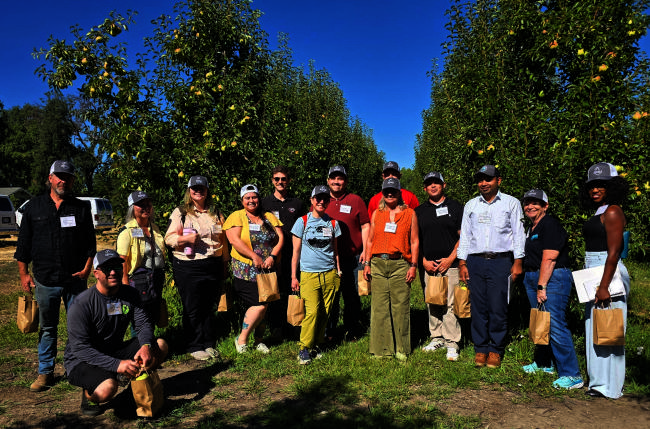
From left to right, Noah Cornell, Max Stockton, Margaux Kambara, Jessi Edmiston, Angela De Palma-Dow, Drew Jacoby, Haerah Baird, Luca Moretti, Stephanie Holdenried, Anthony Arton, Mathew Barnes, Pawan Upadhyay, Becky Salato and Angela Frazier. Courtesy photo.


LAKE COUNTY, Calif. — On Aug. 15, 14 community leaders participating in this year’s AgVenture class dug into the pear industry with special presentations, a visit to Panella Orchards during harvest, and a tour of Scully Packing Company in Finley. 

The “Next Generation” is the theme for farming families in this year’s program. Diane Henderson, who is the fourth-generation of her family to farm pears in Kelseyville, ran through the history of her family’s orchard with its 134-year-old trees.

She turned over the podium to her nephew Greg Panella, a fourth generation farmer himself, whose family is the current steward of the former Henderson Ranch, now known as Panella Orchards. 

Panella took the class to one of his orchards that was being skillfully picked by workers and forklifted by his 12-year-old daughter, Audrey, for transport to the packing shed. 

At Scully Packing Co., founders Phil and Toni Scully, sons Pat and Andy, both co-owners and company managers, and granddaughter Hanna, the newest addition to their sales team, welcomed the group for an in-depth tour of their shed in full operation. 

For most in the group, it was their first time seeing the start to end cycle of the pears from packing to palletizing and into the cold storage before being shipped to stores and markets across North America.  

Each family member spoke, highlighting their specialty within the company, covering history of the pear industry to date, current marketing conditions and challenges, and labor, including the shed’s innovative program that allows them to hire 16- to 18-year-old high school students. 

Deputy Lake County Agricultural Commissioner Sam Upton began the afternoon presentations highlighting his office’s regulatory functions and ways they partner with and help farmers.

Pear and wine grape farmer Myron Holdenried (fifth generation farmer), and his grandson, Carson Holdenried (seventh generation farmer), gave an historical overview of how agriculture developed in Lake County and how programs like 4-H and FFA enhance youth learning and prepare them for working in agriculture. 

He added his personal insights into ranching with family seven days a week.

Broc Zoller, PhD, aka The Pear Doctor, highlighted his agricultural research and integrated pest management (IPM) in pears. Son Zach Zoller also spoke on solar farms and aiming towards becoming a full-time farmer. 

Recurring themes with the next generation were sustainability, food safety, worker safety, regulatory issues, and the difficulty of farming pears.

Class members appreciated getting a full scope of the pear market and the many impacts on it, from the pests in the field to the vagaries of market forces influencing wholesale prices which in turn affect what the farmer receives at the end of harvest. The shed tour and the many intricacies of managing it was a highlight. 

Class participant Margaux Kambara summed up the day with, “I liked getting the big picture of why pears are so unique, and I can see that the families involved make it special.”

Launched in 2010, AgVenture is an innovative educational program presented by the Lake County Chapter of California Women for Agriculture. It is for non-farming community members and others who wish to understand the vital contributions of agriculture to Lake County’s quality of life and economy. The program’s steering committee includes Katy Evans, Rebecca Harper, Colleen Rentsch, Toni Scully, Bonnie Sears, Katherine VanDerWall, and Sharron Zoller.

AgVenture is made possible with funding from individual donors and program sponsors like Bella Vista Farming Company, who provides van transport for program tours.

The next AgVenture seminar will be in September focusing on Lake County’s wine grape industry.

Mendocino National Forest activates fire restrictions due to conditions

MENDOCINO NATIONAL FOREST, Calif. — Mendocino National Forest officials are issuing fire restrictions due to increased risk of fire starts. 

The combination of dry fuels, low humidity and high temperatures create conditions that elevate risk of ignition and rapid fire spread.

Fire restrictions go into effect now through the end of the 2025 fire season. 

Fire restrictions prohibit the following activities:

• Building, maintaining, attending or using a fire, campfire, or stove fire.
• Smoking, except within an enclosed vehicle or building, or within the designated recreation sites shown in Exhibit A of the forest order.
• Operating an internal combustion engine, except on National Forest System roads or trails.
• Welding, or operating an acetylene or other torch with an open flame.
• Using an explosive.
• Possessing, discharging or using any kind of firework or other pyrotechnic device.

With a valid California Campfire Permit, visitors may use portable stoves or lanterns using gas, jellied petroleum, or pressurized liquid fuel.  

Additionally, visitors with a valid California Campfire Permit may enjoy a campfire or stove fire in the Designated Fire Safe Recreation Sites (see Exhibit A), as well as in federally designated Wilderness Areas (see Exhibit B).

Forest Service officials stated that more than 90% of all fires are human-caused. Visitors to national forests can help prevent wildfires with just a bit of planning and common sense.

• Campfires: Attend your campfire at all times. Ensure your fire is completely extinguished — drown with water (NOT dirt), stir with your shovel, drown again and feel for any heat using the back of your hand. Continue this process until no heat remains.
• Stoves: If using pressurized or bottled liquid fuel stoves, lanterns, or heating devices, use in barren areas with at least 3 feet of clearance from grasses and other debris that may catch fire. Prevent stoves from tipping.
• Vehicles: When traveling, ensure your chains are properly connected. The hot underside of the vehicle and dragging chains can start a fire. Stick to driving on designated roads and trails and be careful to not park your car or OHV in tall, dry vegetation, including grass.
• Spark Arrestors: Ensure that all internal or external combustion engines have a spark arresting device properly installed, maintained and in effective working order.
• Smoking: Extinguish all smoking materials dead out on bare soil. Pack out all cigarette butts and filters.
• Fireworks: Fireworks are prohibited on all national forests year-round, leave them and all other pyrotechnic devices at home.  

Similar restrictions are also in effect on neighboring public lands. Because restrictions can vary by jurisdiction, visitors should contact the area they plan to visit for specific fire restrictions and conditions.

California campfire permits are available online at https://permit.preventwildfiresca.org/. 

The fire restrictions and list of designated firesafe campgrounds are available on the Mendocino National Forest website. 

Visitors can check the latest alerts, orders and recreation information at https://www.fs.usda.gov/r05/mendocino. 

Gov. Newsom signs ‘Election Rigging Response Act’ legislative package

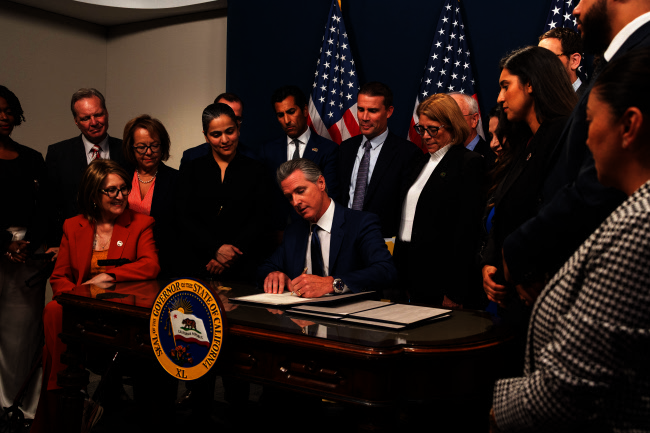
Gov. Gavin Newsom signs the “Election Rigging Response Act” legislative package on Thursday, August 21, 2025, in Sacramento, California. Lake County’s senator, Mike McGuire, also the Senate pro tempore, is standing just behind and to the right of Newsom, while Assemblymember Cecilia Aguiar-Curry, is just to the right of Newsom. Photo courtesy of the Governor’s Office.


On Thursday, Gov. Gavin Newsom, alongside Speaker Robert Rivas and Senate pro Tempore Mike McGuire, signed the “Election Rigging Response Act” legislative package.

Newsom’s office said the package will give Californians an opportunity this November to push back against President Trump’s power grab in Texas and other Republican-led states.

In doing so, Proposition 50 — named for the 50 United States — would allow Californians an opportunity to bring some much-needed accountability to the Trump Administration. 

“Californians have been uniquely targeted by the Trump Administration, and thanks to the hard work of the California legislature, they will have a choice to fight back — and bring much needed accountability to Trump’s efforts to undermine the democratic process,” said Newsom.

About the legislative package

Assembly Constitutional Amendment 8 (Rivas, McGuire): allows Californians the ability to adopt a new, temporary Congressional map, in response to the congressional redistricting in Texas, that neutralizes Trump’s power grab.

Senate Bill 280 (Cervantes, Pellerin): establishes timelines and procedures to conduct a statewide special election for Proposition 50, and provides the funding for the special election, set to take place on November 4, 2025.

Assembly Bill 604 (Aguiar-Curry, Gonzalez): establishes the temporary Congressional District Maps that would take effect if the people vote to pass ACA 8 on November 4.

This bill package implements Governor Newsom’s framework announced last week in Los Angeles at the Democracy Center, alongside leaders from across the Golden State like Planned Parenthood, labor unions, community organizations and educators, as well as key elected officials at the federal, state, and local level. 

“California will not be a bystander to Trump’s power grab,” said Speaker Robert Rivas (D-Salinas). “We are acting to defend our state from his attacks, by taking it directly to the voters. Californians believe in democracy and freedom, and we will not stand by while the House is hijacked by authoritarianism. Today, we gave every Californian the opportunity to stop Trump by saying yes to our people, to our state, and to American democracy.”

"The Election Rigging Response Act legislation allows voters the chance to stop Trump and Republican attempts to blatantly steal our election," said pro Tempore Mike McGuire (D-North Coast). "This legislation is temporary, and it's all about fairness. And, today's action means we're fighting back for our democracy and our future — not with fire — but with the power of the voters and millions of folks across the Golden State."

Gov. Newsom also issued a proclamation calling the special election for Nov. 4, 2025. 

  • 164
  • 165
  • 166
  • 167
  • 168
  • 169
  • 170
  • 171
  • 172
  • 173

Community

  • Sheriff’s Activities League and Clearlake Bassmasters offer youth fishing clinic

  • City Nature Challenge takes place April 24 to 27

Public Safety

  • Lakeport Police logs: Wednesday, Feb. 11

  • Lakeport Police logs: Tuesday, Feb. 10

Education

  • Ramos measure requiring school officer training in use of anti-opioid drug moves forward

  • Lake County Chapter of CWA announces annual scholarships 

Health

  • California ranks 24th in America’s Health Rankings Annual Report from United Health Foundation

  • Healthy blood donors especially vital during active flu season

Business

  • Employment law summit takes place March 9

  • Two Lake County Mediacom employees earn company’s top service awards

Obituaries

  • Terry Knight

  • Ellen Thomas

Opinion & Letters

  • Who should pay for AI’s power? Not California ratepayers

  • Crandell: Supporting nephew for reelection in supervisorial race

Veterans

  • State honors fallen chief warrant officer killed in conflict in Iran

  • CalVet and CSU Long Beach team up to improve data collection related to veteran suicides

Recreation

  • April Audubon program will show how volunteers can help monitor local osprey nests

  • First guided nature walk of spring at Anderson Marsh State Historic Park April 11

  • Second Saturday guided nature walks continue at Anderson Marsh State Historic Park

  • Wet weather trail closure in effect on Upper Lake Ranger District

Religion

  • Kelseyville Presbyterian Church plans Easter service

  • Easter ‘Sonrise’ Service returns to Xabatin Community Park

Arts & Life

  • ‘CIA’ delves into the shadowy world of an espionage thriller

  • ‘War Machine’ shifts the battlefield into uncharted territory

Government & Politics

  • Lake County Democratic Central Committee endorses Falkenberg

  • Crandell launches reelection campaign plans March 15 event

Legals

  • April 23 hearing on Lake Coco Farms Major Use Permit

  • NOTICE OF 30-DAY PUBLIC COMMENT PERIOD & NOTICE OF PUBLIC HEARING

How to resolve AdBlock issue?
Refresh this page