How to resolve AdBlock issue?
Refresh this page
Lake County News,California
  • Home
    • Registration Form
  • News
    • Education
    • Veterans
    • Community
      • Obituaries
      • Letters
      • Commentary
    • Police Logs
    • Business
    • Recreation
    • Health
    • Religion
    • Legals
    • Arts & Life
    • Regional
  • Calendar
  • Contact us
    • FAQs
    • Phones, E-Mail
    • Subscribe
  • Advertise Here
  • Login
How to resolve AdBlock issue?
Refresh this page

News

Data that taxpayers have paid for and rely on is disappearing – here’s how it’s happening and what you can do about it

Many U.S. government agencies collect data and make it publicly available. Anna Moneymaker/Getty Images

People rely on data from federal agencies every day – often without realizing it.

Rural residents use groundwater level data from the U.S. geological survey’s National Water Information System to decide where to dig wells. High school coaches turn to weather apps supported by data from the National Weather Service to decide when to move practice inside to avoid life-threatening heat. Emergency managers use data from the Census Bureau’s American Community Survey to ensure that residents without vehicles have seats on evacuation buses during local emergencies.

On Jan. 31, 2025, websites and datasets from across the federal government began to disappear. As that happened, archivists and researchers from around the world sprang into action, grabbing what they could before it was gone.

Trust in the federal statistical system took another hit when Bureau of Labor Statistics Commissioner Erika McEntarfer was fired on the heels of a dismal Aug. 1, 2025, employment report.

And reduced data collection at the bureau was already causing concern before her dismissal. The bureau has ceased collection of critical inputs to the Consumer Price Index, likely reducing that inflation indicator’s accuracy, especially at the level of specific locations and products.

As researchers of economics and epidemiology at the University of Michigan, we have spent years working with data, often from the federal government. When data and information began to disappear, we were spurred into action to preserve these important public goods.

The Inter-university Consortium for Political and Social Research, where we work – commonly known as ICPSR – has been making data from governments and researchers available for more than 60 years. We are stewards of this data, preserving it and ensuring that it is accessible in a safe and responsible manner.

Unfortunately, government data is now at risk of becoming less available or disappearing. But there are steps that researchers – and the public – can take to reduce that risk.

Data at risk

Some 8,000 pages were removed from federal websites within a few days of Jan. 31, 2025. Though many were soon restored following substantial outcry and some court orders, it’s still unclear how the restored webpages and datasets may have been changed.

Webpage showing a search bar, several categories of data, and a mission statement about open government data
Data.gov, launched in 2009, lists many datasets available from the government, providing pointers back to the agency where the data resides. Congress codified this data transparency in the Open Government Data Act in 2019. Screenshot by The Conversation, CC BY-SA

In one preliminary examination, researchers found that 49% of the 232 datasets they reviewed had been substantially altered, including the replacement of the word “gender” with “sex.” This alteration can obscure nonbinary gender identities. Only 13% of the changes the researchers found were documented by the government.

U.S. government data has also become less accessible because of mass firings of federal workers and the dismantling of entire agencies.

Important efforts like the Data Rescue Project and the Internet Archive have been able to preserve a great deal of knowledge and data, but they are mostly limited to publicly available data and information.

No one left to vet data

Many important government data resources contain sensitive or identifying information. This means officials must vet requests before they grant access to data rescue efforts. But many agencies have had their ability to conduct vetting and manage access severely curtailed and, in some cases, eliminated altogether.

Take the Pregnancy Risk Assessment Monitoring System, which provides key data on maternal and child health from around the United States. The Centers for Disease Control and Prevention integrates data collected at state and local levels and adds population information to come up with estimates. While some of this data is publicly available, access to most data from 2016 and later requires a request to the CDC and a signed data use agreement.

At the start of 2025, multiple researchers reported to our team at the Inter-university Consortium for Political and Social Research that the CDC had stopped processing these requests. In February, researchers discovered that the Pregnancy Risk Assessment Monitoring System would be discontinued.

The CDC suggested that data collection would restart at some point. But on April 1, the entire Pregnancy Risk Assessment Monitoring System team was laid off. This made one of the most valuable sources of data on the health of mothers and babies largely inaccessible, and put plans for its future in limbo.

Similar situations have played out at other agencies, including the dismantled U.S. Agency for International Development and the National Center for Education Statistics. Data collected, cleaned and harmonized using taxpayer dollars is now languishing on inaccessible servers.

Inaccessible data

The portal that researchers use to apply for access to restricted federal statistical data now includes a list of data that researchers can no longer access.
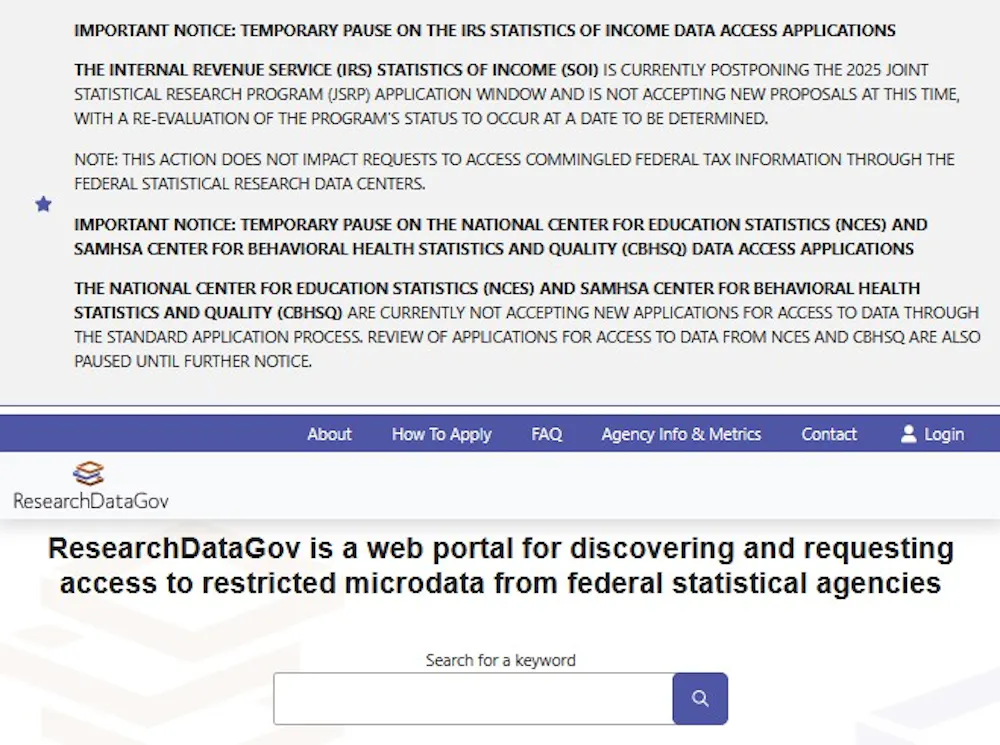
Screenshot of the dataset search bar with a notice above listing datasets that are not available
The portal that researchers use to apply for access to restricted datasets from 16 agencies has added a list of several large datasets that are no longer available. The Conversation, CC BY-ND

Some organizations are leading efforts to restore access to particular datasets. The Inter-university Consortium for Political and Social Research, for instance, has an agreement with USAID to preserve and provide access to USAID’s education data. Unfortunately, these efforts barely scratch the surface. With very few staff left, there isn’t a clear estimate of which other USAID resources remain inaccessible.

According to our count, 354 restricted datasets from the federal statistical system’s Standard Application Portal have become unavailable due to firings, layoffs and funding cuts.

Data is critical for people and the state and local governments that represent them to make good decisions. Federal data is also used for oversight, so that researchers can verify that the government is doing what it’s supposed to in accordance with its congressionally mandated missions. Government efficiency requires accountability.

And accountability requires high-quality and timely data on operations.

The mass firings of federal employees means that those tasked with ensuring this accountability are doing so while struggling to obtain necessary data.

So where do we go from here?

While the pace of intentional government data removal appears to have slowed, it hasn’t stopped. New datasets under threat of disappearing are being rescued daily. Restructured federal agencies and related changes to – or neglect of – official websites can make data difficult or impossible to find.

What you can do

If you identify data that is at risk, perhaps because its collection has been discontinued or it covers a controversial topic, you can report your observations to the Data Rescue Project, a grassroots effort of archivists, librarians and other concerned people.

The Data Rescue Project has been working for months to identify data and preserve government data, including in the Inter-university Consortium for Political and Social Research’s DataLumos open-access archive.

Similarly, the Public Environmental Data Partners, a coalition of nonprofits, archivists and researchers, are preserving federal environmental data and have a nomination form.

Efforts to identify restored data that has been altered are also gaining steam.

Dataindex tracks Federal Register notices that describe proposed changes to 24 widely used datasets from across the federal government, including the American Community Survey from the Census Bureau, the National Crime Victimization Survey from the Bureau of Justice Statistics, and the National Health Interview Survey from the CDC. The website also facilitates comment on proposed alterations.

You can help researchers understand the scale of data alterations that have been, and continue to be, made. If you notice changes in public datasets, you can share that information with the American Statistical Association’s FedStatMonitoring project.

The Inter-university Consortium for Political and Social Research is continuing our efforts to ensure the preservation of, and access to, existing data, including from the Bureau of Labor Statistics and the Consumer Financial Protection Bureau.

At the same time, we and other groups are planning future efforts in data collection to avoid gaps in our knowledge.

The federal statistical system is both large and complex, including hundreds of thousands of datasets that people depend on in many ways, from weather forecasts to local economic indicators. If the federal government continues to step back from its role as a provider of high-quality, trusted data, others – including state and local governments, academia, nonprofits and companies – may need to fill the gap by stepping up to collect it.The Conversation

Margaret Levenstein, Research Professor at the Institute for Social Research, University of Michigan and John Kubale, Research Assistant Professor at the Institute for Social Research, University of Michigan

This article is republished from The Conversation under a Creative Commons license. Read the original article.


Supervisors to discuss budget changes, rent stabilization ordinance and CEO-style government

LAKE COUNTY, Calif. — The Board of Supervisors this week will revisit budget adjustments for the new fiscal year, discuss a proposed mobile home rent stabilization ordinance, and consider a report from a governance workshop exploring a shift to a “chief executive officer” model for county government. 

The‌ ‌board will meet beginning ‌at‌ ‌9‌ ‌a.m. Tuesday, Aug. 19, in the board chambers on the first floor of the Lake County Courthouse, 255 N. Forbes St., Lakeport.

The‌ ‌meeting‌ ‌can‌ ‌be‌ ‌watched‌ ‌live‌ ‌on‌ ‌Channel‌ ‌8, ‌online‌ ‌at‌ ‌https://countyoflake.legistar.com/Calendar.aspx‌‌ and‌ ‌on‌ ‌the‌ ‌county’s‌ ‌Facebook‌ ‌page. ‌Accompanying‌ ‌board‌ ‌documents, ‌the‌ ‌agenda‌ ‌and‌ ‌archived‌ ‌board‌ ‌meeting‌ ‌videos‌ ‌also‌ ‌are‌ ‌available‌ ‌at‌ ‌that‌ ‌link. ‌ ‌

To‌ ‌participate‌ ‌in‌ ‌real-time, ‌join‌ ‌the‌ ‌Zoom‌ ‌meeting‌ ‌by‌ ‌clicking‌ ‌this‌ ‌link‌. ‌ ‌

The‌ ‌meeting‌ ‌ID‌ ‌is‌ 865 3354 4962, ‌pass code 726865.‌ ‌The meeting also can be accessed via one tap mobile at +16694449171,,86533544962#,,,,*726865#. The meeting can also be accessed via phone at 669 900 6833.

At 9:04 a.m., the board will consider a summary of adjustments made to the recommended budget for fiscal year 2025-26, which was approved at the budget hearings in June.

In addition, the board will revisit several budget-related issues raised during the hearings, including how cannabis tax revenues are used, whether to add another Animal Care and Control officer as well as the status of the pension stabilization fund invested in the market. 

At 1:01 p.m., the board will discuss the possibility of having an ordinance for mobile home rent stabilization, which the county does not currently have.

Supervisor Eddie Crandell brought up the item, citing “concerns from senior mobile home park residents facing significant rent increases for capital projects,” according to the staff memo. 

The proposed ordinance would limit rent increase, and protect vulnerable residents, including seniors, disabled veterans and disabled individuals who rely on affordable mobile home housing, Crandell added. 

At 1:30 p.m., the board will review a report from consulting firm Municipal Resource Group on a March governance and organizational workshop. The workshop, attended by the board and staff, discussed the possibility of shifting from a chief administrative officer to a chief executive officer model. 

This item came up on agenda twice in July, but continued both times. 

In closed session, the board will evaluate Special Districts Administrator Robin Borre, and conduct interviews for the interim Public Works director position.  

The full agenda follows.

CONSENT AGENDA

5.1, Approve use of staff time exceeding 8 hours in support of September 12 and 13 Valley Fire observances.

5.2, Approve licensing agreement between the County of Lake and Mandala Springs Wellness Retreat Center for the Valley Fire 10th anniversary event.

5.3, Approve the plans and specifications for the Emergency Operations Center Building Improvements Project and authorize the Public Services director to advertise for bids.

5.4, a) Approve Lake County Sheriff’s Office annual military equipment report; and b) approve continuance of Ordinance No. 3123.

5.5, a) Approve the purchase and use of small unmanned aerial systems (sUAS) by the Lake County Sheriff’s Office using a Sourcewell contract; b) waive the formal bidding requirements pursuant to Article X, Section 2-38.4 cooperative purchases; and c) authorize the Sheriff to sign a purchase order not to exceed $35,000.

5.6, a) Approve records retention and destruction schedule; and b) adopt resolution for the Lake County Sheriff’s Office.

5.7, (sitting as the Lake County Sanitation District, Board of Directors) adopt resolution revising the fiscal year 2024-25 adopted budget of the County of Lake by appropriating unanticipated revenue for Fund 251 in the amount of $38,000 to Budget Unit 8351, Object Code 783.23-80 to pay for prior year sewer treatment costs.

TIMED ITEMS

6.1, 9:02 a.m.: Public input.

6.2, 9:03 a.m.: Pet of the week.

6.3, 9:04 a.m.: a) Consideration of a summary of adjustments made to your board’s recommended budget during hearings of June 24 and June 25, 2025; and b) follow-up on concepts raised by supervisors during fiscal year 2025-26 recommended budget hearings where consensus was reached requesting discussion prior to the September 23, 2025, final recommended budget hearing.

6.4, 1 p.m.: Public hearing, consideration of resolution approving Resolution No. 2025-5 submitted by Northshore Fire Protection District and making findings and requesting the County of Lake to implement fire mitigation fees with the automatic inflation pursuant to the Lake County Fire Mitigation Fee Ordinance fiscal year 2025-26 (request to continue the item to Aug. 26, 2025).

6.5, 1:01 p.m.: Discussion and consideration of a rent stabilization ordinance.

6.6, 1:30 p.m.: Consideration of a report from Municipal Resource Group on your board’s March 21, 2025, training workshop on general governance, priority development and organizational effectiveness.

NON-TIMED ITEMS

7.1, Supervisors’ weekly calendar, travel and reports.

CLOSED SESSION

8.1, Public employee evaluations, title: Special Districts administrator.

8.2, Conference with legal counsel: existing litigation pursuant to Gov. Code section 54956.9(d)(1) – FERC proceeding No. P-77, Potter Valley Hydroelectric Project.

8.3, Sitting as the Board of Directors of the Lake County IHSS Public Authority: conference with (a) Chief Negotiator M. Long, County Negotiator R. Dillman Parsons, A. Schimansky, K. Page; and (b) employee organization: Service Employees International Union (SEIU), Local 2015.

8.4, Public employee appointment pursuant to Gov. Code section 54957(b)(1): interviews for Interim Public Works director, appointment of Interim Public Works director.

8.5, Conference with legal counsel: significant exposure to litigation pursuant to Gov. Code section 54956.9(d)(2), (e)(1) – one potential case.

Email staff reporter Lingzi Chen at This email address is being protected from spambots. You need JavaScript enabled to view it.. 

Lakeport City Council to consider new alcohol rules in parks, review July 4th operations

LAKEPORT, Calif. — The Lakeport City Council will hold a public hearing on proposed rules for alcohol use in city parks and review law enforcement operations during the July 4th celebration. 

The council will meet Tuesday, August 19, at 6 p.m. in the council chambers at Lakeport City Hall, 225 Park St. 

The agenda can be found here. 

If you cannot attend in person, and would like to speak on an agenda item, you can access the Zoom meeting remotely at this link or join by phone by calling toll-free 669-900-9128 or 346-248-7799. 

The webinar ID is 973 6820 1787, access code is 477973; the audio pin will be shown after joining the webinar. Those phoning in without using the web link will be in “listen mode” only and will not be able to participate or comment. 

Comments can be submitted by email to This email address is being protected from spambots. You need JavaScript enabled to view it.. To give the city clerk adequate time to print out comments for consideration at the meeting, please submit written comments before 3:30 p.m. on Tuesday, Aug. 19.

The council will hold a public hearing regarding the closeout of the city’s $500,000 Community Development Block Grant from the state

The funds were used for the city’s Business Assistance Program, which provided loans to local businesses. 

According to the staff report, $35,000 went to business in tree services, $35,000 to manufacturing and retail, $210,000 in health care and $140,000 to hospitality. 

Another public hearing will introduce an ordinance amendment related to possession and consumption of alcohol in city parks, prompted by increased community events across the parks, according to the staff report. 

Currently, alcohol is prohibited in city parklands unless explicitly authorized by the city council and police department, the staff report noted. The proposed amendment would increase the maximum fine for a misdemeanor violation from $500 to $1,000. 

Under council business, the council will consider extending the city’s 2019 agreement with the Local Public, Education, Government — or PEG television channel to June 30, 2030. 

This will be followed by a review of the after-action report of the police and fire department operations during the July 4th fireworks and events.

The police department made two arrests for “alcohol related offenses and resisting lawful police officer actions” during the July 4th celebration event, according to the staff report.

The report noted another three incidents of “assault and battery allegations at Library Part that resulted in no reportable injuries.”

The report identified the most significant areas for illegal fireworks this year as Willow Tree Plaza, Will-O-Point Resort and along the lakeshore between First Street and Clear Lake Avenue, the staff report said. 

There were about 12 calls for service related to fireworks, eight arrests or detentions connected to fireworks, and three calls for dumpster fires — two near Marshalls and Tractor Supply, and one at the Safeway Center. 

Throughout the night, more than 55 pounds of illegal fireworks were seized — 50 pounds by Cal Fire’s mutual aid units, and five pounds by local law enforcement staff. 

The council also will consider declaring certain city-owned vehicles and equipment as surplus property and approving their sale or disposal.

On the consent agenda — items considered noncontroversial and usually accepted as a slate on one vote — are ordinances; waive reading except by title of any ordinances under consideration at this meeting for either introduction or passage per Government Code Section 36934; approval of the minutes of the City Council regular meeting of August 5, 2025; approval and submission of the proposed responses to the 2024-2025 Civil Grand Jury Report; receive and file the Community Development Department quarterly reports for the third and fourth quarters of FY 24-25; approval of application 2025-041, with staff recommendations.

Email staff reporter Lingzi Chen at This email address is being protected from spambots. You need JavaScript enabled to view it..

Helping Paws: Dogs ready for adoption

LAKE COUNTY, Calif. — Lake County Animal Care and Control has kennels filled with animals waiting to be adopted this week.

The dogs available for adoption this week include mixes of German shepherd, husky, Labrador Retriever, pit bull terrier, Pomeranian, terrier and shepherd.

Dogs that are adopted from Lake County Animal Care and Control are either neutered or spayed, microchipped and, if old enough, given a rabies shot and county license before being released to their new owner. License fees do not apply to residents of the cities of Lakeport or Clearlake.

Those animals shown on this page at the Lake County Animal Care and Control shelter have been cleared for adoption.

Call Lake County Animal Care and Control at 707-263-0278 or visit the shelter online for information on visiting or adopting.

The shelter is located at 4949 Helbush in Lakeport.

Email Elizabeth Larson at This email address is being protected from spambots. You need JavaScript enabled to view it.. Follow her on Twitter, @ERLarson, and on Bluesky, @erlarson.bsky.social. Find Lake County News on the following platforms: Facebook, @LakeCoNews; X, @LakeCoNews; Threads, @lakeconews, and on Bluesky, @lakeconews.bsky.social. 

 
Kennel#28 (Scrappy)'s preview photo
Kennel#28 (Scrappy)

Kennel#6 (Jax)'s preview photo
Kennel#6 (Jax)

 
Kennel#33 Hunter's preview photo
Kennel#33 Hunter

Kennel#14 Tanner's preview photo
Kennel#14 Tanner

Kennel#31 Daisy's preview photo
Kennel#31 Daisy

Kennel#21 Helen's preview photo
Kennel#21 Helen

Kennel#17 Bruce's preview photo
Kennel#17 Bruce

Kennel#20 (Chapo)'s preview photo
Kennel#20 (Chapo)

 
Kennel#26 Cici's preview photo
Kennel#26 Cici

Kennel#34 Champ's preview photo
Kennel#34 Champ

Kennel#29's preview photo
Kennel#29

Kennel#25 (Djor)'s preview photo
Kennel#25 (Djor)

Kennel#8 Nila's preview photo
Kennel#8 Nila

Kennel#7 Tabitha's preview photo
Kennel#7 Tabitha

Kennel#10 Bay's preview photo
Kennel#10 Bay

Kennel#18's preview photo
Kennel#18

Kennel#22's preview photo
Kennel#22

Kennel#19a's preview photo
Kennel#19a

Kennel#19b's preview photo
Kennel#19b

Kennel#5's preview photo
Kennel#5

Kennel#3's preview photo
Kennel#3

Kennel#9's preview photo
Kennel#9
 
Kennel#24's preview photo
Kennel#24

How states are placing guardrails around AI in the absence of strong federal regulation

The California State Capitol has been the scene of numerous efforts to regulate AI. AP Photo/Juliana Yamada

U.S. state legislatures are where the action is for placing guardrails around artificial intelligence technologies, given the lack of meaningful federal regulation. The resounding defeat in Congress of a proposed moratorium on state-level AI regulation means states are free to continue filling the gap.

Several states have already enacted legislation around the use of AI. All 50 states have introduced various AI-related legislation in 2025.

Four aspects of AI in particular stand out from a regulatory perspective: government use of AI, AI in health care, facial recognition and generative AI.

Government use of AI

The oversight and responsible use of AI are especially critical in the public sector. Predictive AI – AI that performs statistical analysis to make forecasts – has transformed many governmental functions, from determining social services eligibility to making recommendations on criminal justice sentencing and parole.

But the widespread use of algorithmic decision-making could have major hidden costs. Potential algorithmic harms posed by AI systems used for government services include racial and gender biases.

Recognizing the potential for algorithmic harms, state legislatures have introduced bills focused on public sector use of AI, with emphasis on transparency, consumer protections and recognizing risks of AI deployment.

Several states have required AI developers to disclose risks posed by their systems. The Colorado Artificial Intelligence Act includes transparency and disclosure requirements for developers of AI systems involved in making consequential decisions, as well as for those who deploy them.

Montana’s new “Right to Compute” law sets requirements that AI developers adopt risk management frameworks – methods for addressing security and privacy in the development process – for AI systems involved in critical infrastructure. Some states have established bodies that provide oversight and regulatory authority, such as those specified in New York’s SB 8755 bill.

AI in health care

In the first half of 2025, 34 states introduced over 250 AI-related health bills. The bills generally fall into four categories: disclosure requirements, consumer protection, insurers’ use of AI and clinicians’ use of AI.

Bills about transparency define requirements for information that AI system developers and organizations that deploy the systems disclose.

Consumer protection bills aim to keep AI systems from unfairly discriminating against some people, and ensure that users of the systems have a way to contest decisions made using the technology.

a mannequin wearing a device across the chest with four wires attached to circular pads attached to the torso
Numerous bills in state legislatures aim to regulate the use of AI in health care, including medical devices like this electrocardiogram recorder. VCG via Getty Images

Bills covering insurers provide oversight of the payers’ use of AI to make decisions about health care approvals and payments. And bills about clinical uses of AI regulate use of the technology in diagnosing and treating patients.

Facial recognition and surveillance

In the U.S., a long-standing legal doctrine that applies to privacy protection issues, including facial surveillance, is to protect individual autonomy against interference from the government. In this context, facial recognition technologies pose significant privacy challenges as well as risks from potential biases.

Facial recognition software, commonly used in predictive policing and national security, has exhibited biases against people of color and consequently is often considered a threat to civil liberties. A pathbreaking study by computer scientists Joy Buolamwini and Timnit Gebru found that facial recognition software poses significant challenges for Black people and other historically disadvantaged minorities. Facial recognition software was less likely to correctly identify darker faces.

Bias also creeps into the data used to train these algorithms, for example when the composition of teams that guide the development of such facial recognition software lack diversity.

By the end of 2024, 15 states in the U.S. had enacted laws to limit the potential harms from facial recognition. Some elements of state-level regulations are requirements on vendors to publish bias test reports and data management practices, as well as the need for human review in the use of these technologies.

a Black woman with short hair and hoop earrings sits at a conference table
Porcha Woodruff was wrongly arrested for a carjacking in 2023 based on facial recognition technology. AP Photo/Carlos Osorio

Generative AI and foundation models

The widespread use of generative AI has also prompted concerns from lawmakers in many states. Utah’s Artificial Intelligence Policy Act requires individuals and organizations to clearly disclose when they’re using generative AI systems to interact with someone when that person asks if AI is being used, though the legislature subsequently narrowed the scope to interactions that could involve dispensing advice or collecting sensitive information.

Last year, California passed AB 2013, a generative AI law that requires developers to post information on their websites about the data used to train their AI systems, including foundation models. Foundation models are any AI model that is trained on extremely large datasets and that can be adapted to a wide range of tasks without additional training.

AI developers have typically not been forthcoming about the training data they use. Such legislation could help copyright owners of content used in training AI overcome the lack of transparency.

Trying to fill the gap

In the absence of a comprehensive federal legislative framework, states have tried to address the gap by moving forward with their own legislative efforts. While such a patchwork of laws may complicate AI developers’ compliance efforts, I believe that states can provide important and needed oversight on privacy, civil rights and consumer protections.

Meanwhile, the Trump administration announced its AI Action Plan on July 23, 2025. The plan says “The Federal government should not allow AI-related Federal funding to be directed toward states with burdensome AI regulations … ”

The move could hinder state efforts to regulate AI if states have to weigh regulations that might run afoul of the administration’s definition of burdensome against needed federal funding for AI.The Conversation

Anjana Susarla, Professor of Information Systems, Michigan State University

This article is republished from The Conversation under a Creative Commons license. Read the original article.

Carroll, Paule and the Blues Project highlight 18th Blue Wing Blues Festival Labor Day weekend

Good food and music in the gardens of the Tallman Hotel and Blue Wing Restaurant in Upper Lake, California. Photo by Nathan DeHart.


UPPER LAKE, Calif. — Six well-known blues bands over three evenings highlight the 18th annual Blue Wing Blues Festival this Labor Day weekend. 

The festival is held in the cool of the early evening under the sycamore trees between the Tallman Hotel and Blue Wing Restaurant in Upper Lake. 

Headliners this year include the powerful Bay Area blues vocalist Tia Carroll, the big blues band sound of Anthony Paule and his Soul Orchestra, and a reunion of veteran members of the well-known Blues Project Quintet.

The event starts at 6 p.m. each day beginning on Saturday, Aug. 30, and extending through Labor Day, Monday, Sept. 1.

Patrons are seated around comfortable tables in the garden and served a delicious buffet supper while enjoying the music. A short video including clips from past festivals can be found on YouTube. 

“This should be one of the best line-ups of musicians we’ve ever had here in Lake County,” said KJ DeSoto of BW Blues Productions in Kelseyville. She and co-producer Brad White have been assisting the Tallman Hotel in putting together this festival over the last few years.

Opening night on Aug. 31 will focus on some of the finest female artists in the business. 

Tia Carroll and her band have headlined festivals all over the world and shared the stage with the likes of Ray Charles, Elvin Bishop and Tommy Castro. 

Opening for Carroll will be the Women in Blues Experience with Otilia Donaire, Jill Dineen, Marina Crouse and Pamma Jamma on keys. Opening night tickets can be purchased online or by calling the Tallman Hotel.

On Sunday night, Aug. 31, the popular Red’s Blues Band from Sacramento will open for the big band sounds of the Anthony Paule Soul Orchestra, featuring the great Willy Jordan on vocals. With Paule on guitar and a full horn section to back him up, Jordan’s commanding stage presence and stirring vocals should produce a truly memorable evening. Tickets for the Saturday show can also be purchased online through Eventbrite or by calling the Tallman.

Capping the festival on Monday, Sept. 1, will be a reunion of members of the original Blues Project, that sold out venues from Greenwich Village to Bill Graham’s Fillmore Auditorium in the 1960s and 1970s. 

Led by percussionist Roy Blumenfeld, the group includes guitarists David Aguilar and Mark Newman with Ken Clark on keys and Tim Eschliman on bass. Opening for the Project will be the talented vocalist Cathy Lemons with Phil Berlowitz and the Lucky Losers Band. 

Tickets for the Monday show can also be purchased online or by calling the Tallman Hotel at 707-275-2244, Extension 0.

“I’d like to thank the many excellent local businesses that have continued to sponsor the Festival each year, and to support quality live music in Lake County,” said festival co-sponsor Bernie Butcher. 

Major sponsors this year include Kat McNeill & Lance Bowman, Lake County Tribal Health, Groundworks, and Reynolds Systems.

Also sponsoring are the law offices of Daniel Ray Bacon, Mary Haere Amodio, Judy Conard, Kelseyville Lumber, Bicoastal Media, Chacewater Wines and Olive Mill, Dancing Crow Wines, Jon and Annette Hopkins, Six Sigma Ranch & Winery, Lake Event Design, Tom and Ruth Lincoln, and Sysco Foods.

Tickets cost $75 plus tax, which includes a delicious barbecue dinner. They may be purchased online at Eventbrite.com or by calling the Tallman Hotel, located at 9550 Main St. in Upper Lake, at 707-275-2244, Extension 0. 

  • 167
  • 168
  • 169
  • 170
  • 171
  • 172
  • 173
  • 174
  • 175
  • 176

Community

  • Sheriff’s Activities League and Clearlake Bassmasters offer youth fishing clinic

  • City Nature Challenge takes place April 24 to 27

Public Safety

  • Lakeport Police logs: Wednesday, Feb. 11

  • Lakeport Police logs: Tuesday, Feb. 10

Education

  • Ramos measure requiring school officer training in use of anti-opioid drug moves forward

  • Lake County Chapter of CWA announces annual scholarships 

Health

  • California ranks 24th in America’s Health Rankings Annual Report from United Health Foundation

  • Healthy blood donors especially vital during active flu season

Business

  • Employment law summit takes place March 9

  • Two Lake County Mediacom employees earn company’s top service awards

Obituaries

  • Terry Knight

  • Ellen Thomas

Opinion & Letters

  • Who should pay for AI’s power? Not California ratepayers

  • Crandell: Supporting nephew for reelection in supervisorial race

Veterans

  • State honors fallen chief warrant officer killed in conflict in Iran

  • CalVet and CSU Long Beach team up to improve data collection related to veteran suicides

Recreation

  • April Audubon program will show how volunteers can help monitor local osprey nests

  • First guided nature walk of spring at Anderson Marsh State Historic Park April 11

  • Second Saturday guided nature walks continue at Anderson Marsh State Historic Park

  • Wet weather trail closure in effect on Upper Lake Ranger District

Religion

  • Kelseyville Presbyterian Church plans Easter service

  • Easter ‘Sonrise’ Service returns to Xabatin Community Park

Arts & Life

  • ‘CIA’ delves into the shadowy world of an espionage thriller

  • ‘War Machine’ shifts the battlefield into uncharted territory

Government & Politics

  • Lake County Democratic Central Committee endorses Falkenberg

  • Crandell launches reelection campaign plans March 15 event

Legals

  • April 23 hearing on Lake Coco Farms Major Use Permit

  • NOTICE OF 30-DAY PUBLIC COMMENT PERIOD & NOTICE OF PUBLIC HEARING

How to resolve AdBlock issue?
Refresh this page